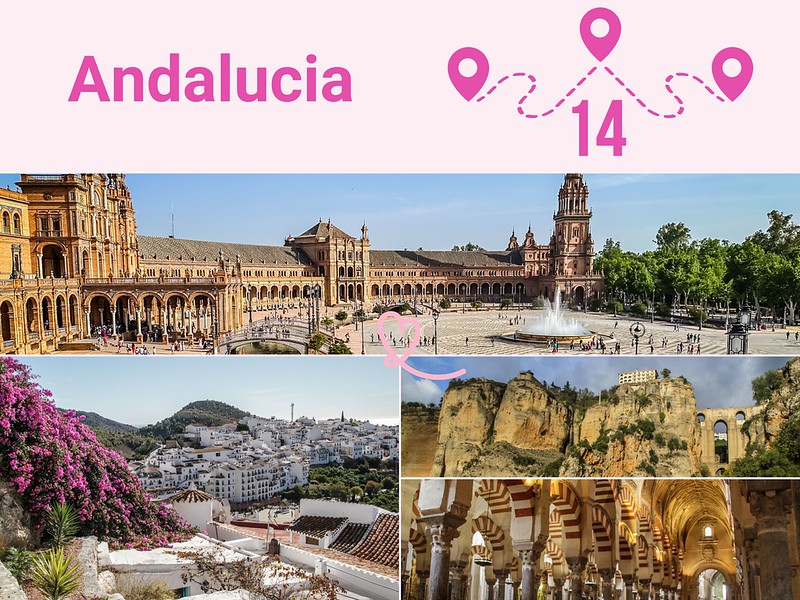
Two weeks are enough to explore a good part ofAndalucia on a road trip, provided you choose your stops wisely. This 14-day tour takes you to Sevilla, Córdoba, Granada, Málaga, Ronda, and Cádiz. Along the way, it passes through the Renaissance towns of the province of Jaén, the white villages of the Sierra de Grazalema, and the beaches of the Costa de la Luz.
We put together this 2-week itinerary for Andalucia based on our previous trips to the region.
This opinion is completely independent, based on our experiences. We made our own choices, visited the area anonymously, and paid our bills in full.
2-Week Road Trip in Andalucia: Summary and Map
The loop begins and ends in Sevilla. Rather than saving the capital of Andalucia for last, we suggest you visit it as soon as you arrive—without a car: the city center is easy to explore on foot, and parking there is expensive. You’ll pick up the car on the third day, then head to Córdoba.
The tour then continues clockwise: Granada, the Mediterranean coast around Málaga, the mountains of Ronda, then the Atlantic coast at Cádiz, before heading back up through Jerez de la Frontera. The itinerary includes a total of six nights’ lodging, including three consecutive nights in Ronda.
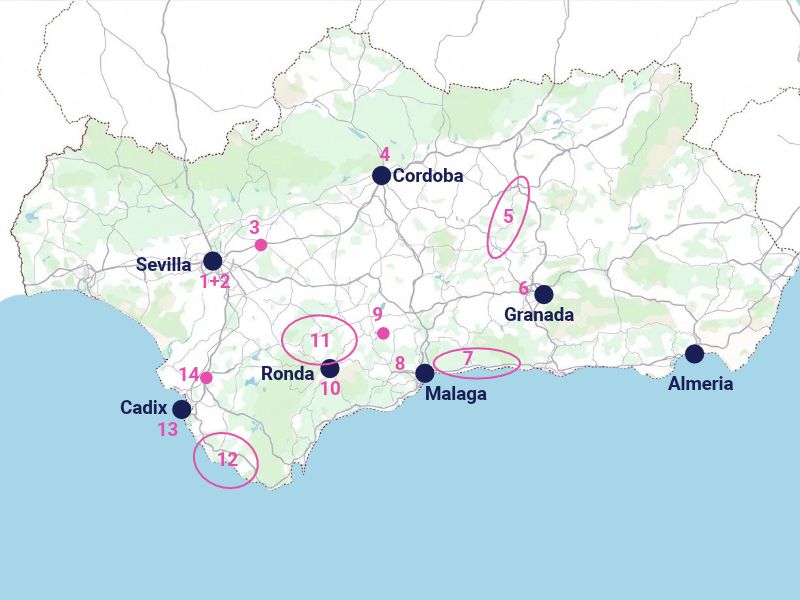
Program Overview:
- Days 1 and 2: Sevilla on Foot
- Day 3: Carmona, then Córdoba
- Day 4: Córdoba
- Day 5: Úbeda and Baeza, then Granada
- Day 6: Granada and the Alhambra
- Day 7: Nerja and Frigiliana, then Málaga
- Day 8: Málaga
- Day 9: Caminito del Rey, then Ronda
- Day 10: Ronda
- Day 11: White Villages Loop
- Day 12: Bolonia Dune and Baelo Claudia, then Cádiz
- Day 13: Cádiz
- Day 14: Jerez de la Frontera and back to Sevilla
If your flight lands in Málaga, join the loop on Day 7 and follow it in the same direction. Sevilla then becomes the final stop on the trip.
Practical Tips for a Road Trip in Andalucia
Which car should I rent?

A car becomes essential starting on Day 3. Book it several weeks in advance between April and October, when rates rise significantly. A compact model is suitable for most roads and makes it easier to park in towns. Be sure to choose a vehicle with enough power to handle the steep slopes of the Sierra de Grazalema mountain passes. If you pick up the vehicle in the city and return it at the airport, check for any one-way fees.
See our tips for renting a car.
Driving in Andalucia

The highways (autovías) connecting major cities are in good condition and, for the most part, toll-free. The challenges are concentrated in historic districts: narrow streets, one-way streets, and resident-only zones—which are monitored by cameras in Granada, in particular. We recommend that you find a public parking lot before arriving at your hotel. We’ve also gotten into the habit of leaving the car at the entrance to the white villages and then continuing on foot.
See all our tips for driving in Andalucia.
Two reservations to make first
Two stops on this tour determine the order of the trip. Alhambra tickets are personalized and assign a specific time slot for the Nasrid Palaces; they sell out several weeks in advance during peak season. Visit the official website or GetYourGuide for tickets and guided tours.

The Caminito del Rey also requires online reservations: Visit the official website or GetYourGuide for guided tours.
RENT A CAR IN Andalucia
- Compare prices on our preferred platform: DiscoverCars – one of the best rated sites.
- Choose a compact car, as some villages have very narrow streets!
- Think ofcomprehensive insurance for the same reason
- Book early for choice.

Day 1: Sevilla, First Steps Without a Car
You won’t need a car on this first day. From the airport, the EA shuttle bus takes about 35 minutes to reach downtown Sevilla, and taxis charge a flat rate. Drop off your luggage, then spend the afternoon in the southern part of the historic center, which is more open and airy than the cathedral district. Here are our suggestions for these two days, or check out our article on the best attractions in Sevilla.
Stop 1: Cathedral and Giralda

Sevilla Cathedral was built beginning in the 15th century on the site of the great Almohad mosque. It is the largest Gothic cathedral in the world. It houses the tomb of Christopher Columbus, the Genoese navigator, supported by four statues of heralds.
The Giralda, its bell tower, was originally the minaret of the mosque, built in the 12th century. You reach it via a series of ramps—designed to be climbed on horseback—leading up to a terrace overlooking the rooftops of the Santa Cruz neighborhood. All our tips for visiting the cathedral.
Stop 2: Plaza de España and María Luisa Park

Plaza de España was built for the 1929 Ibero-American Exposition. Its 200-meter-wide brick semi-circular hall is lined with azulejo benches, each representing a Spanish province. The María Luisa Park, which lies right next to it, offers welcome shaded paths during the hottest parts of the day.
Take some time to stroll around, and we also recommend visiting at dusk to see how the beach transforms under the lights.
See more photos.
Overnight stay in Sevilla. Book a 2-night stay, preferably in the historic district since you don’t have a car yet.
See our selection of the best hotels in Sevilla or go straight to the top-rated accommodations (including rentals).
Day 2: Sevilla’s Monuments
Stop 1: Royal Alcázar

The Palace of Peter I of Castile, built in the 14th century by craftsmen from Granada and Toledo, forms the heart of the Alcázar. It exemplifies Mudejar art, a Christian style that incorporates the techniques and motifs of Muslim Andalucian architecture. The Patio de las Doncellas is the best-known example of this. The upper floors are still used as living quarters for the royal family during their stays.
We recommend that you book an early morning time slot. We spent nearly an hour in the gardens, which feature a mix of ponds, orange trees, and pavilions. Here are all our tips for visiting the Alcázar.
Stop 3: Metropol Parasol

In the afternoon, head north to the Metropol Parasol, nicknamed Las Setas (the mushrooms). This wooden structure, measuring 150 meters by 75 meters and 28 meters high, was designed by German architect Jürgen Mayer and opened in 2011. Its basement contains Roman ruins that were uncovered during construction. We climbed up to the observation deck at the summit at sunset. And so we watched as the city took on shades of ochre, then gradually brightened.
If you still have some time, the Casa de Pilatos—a palace that blends Gothic, Mudejar, and Renaissance styles—is just a 10-minute walk away. Learn more about the Metropol Parasol and Sevilla’s attractions.
An Evening in Triana
At the end of the day, cross the Guadalquivir River via the Isabel II Bridge to reach Triana. The former neighborhood of potters and sailors still has pottery workshops and a covered market, built on the ruins of San Jorge Castle, the former headquarters of the Inquisition. We love to have tapas for dinner there along Calle Betis, across from the historic district. We also attended a flamenco show there in a small venue, which had a more intimate atmosphere than the large tablaos.
Good to know: People in Seville rarely eat dinner before 9 p.m., and many restaurants don’t open until 8:30 p.m. In the early evening, the tapas bars take over.
Second night in Sevilla.
Day 3: Carmona, then Córdoba
Total travel time: about 1 hour and 45 minutes
Pick up your car in the morning at the Santa Justa train station or at the airport. Both are located east of the city, so right on the road to Carmona.
Stop 1: Carmona

Located 30 minutes from Sevilla, Carmona sits on a plateau overlooking the agricultural plain of La Vega. The city was, in turn, Carthaginian, Roman, Muslim, and then Castilian. The Sevilla Gate, a fortification originally built by the Carthaginians and later remodeled by the Romans, marks the entrance to the historic center. Higher up, King Peter I’s alcazar is now home to a Parador.
We enjoyed the tranquility of the narrow streets, which were much less crowded than those in Sevilla. We suggest you end your tour at the Roman necropolis, located below the town, which features hundreds of tombs carved into the rock. See the attractions in Carmona.
Stop 2: Arrival in Córdoba

It takes about 1 hour and 15 minutes to drive to Córdoba. Park in a public parking lot on the edge of the historic district: a large part of the Judería is closed to traffic. A first stroll along the Guadalquivir in the late afternoon is a good way to get your bearings before the day of sightseeing.
Enjoy the views around the Roman bridge, especially as night falls!
Overnight stay in Córdoba. Book a 2-night stay.
See our selection of the best hotels in Córdoba or go directly to the top-rated accommodations (including rentals).
Day 4: Córdoba, the former capital of the Caliphate
In the 10th century, Córdoba was one of the most populous cities in Europe. As the capital of the Umayyad Caliphate of al-Andalus, it rivaled Baghdad and Constantinople at the time. A full day is enough to explore the main sites, all of which are within walking distance.
To plan your own itinerary, see our article on the best attractions in Córdoba.
Stop 1: Mosque-Cathedral

Construction of the Great Mosque began in 785 under Emir Abd al-Rahman I, founder of the Umayyad dynasty in al-Andalus. Having been expanded three times, it still features more than 800 columns connected by double arches with red and white keystones. In the 16th century, a Renaissance cathedral was built in the center of the prayer hall.
We recommend that you go in as soon as it opens. So we walked through the forest of columns almost alone for the first half hour, before the other groups arrived.
Buy your ticket with an audio guide.
See all our tips for visiting the cathedral.
Stop 2: Alcázar of the Christian Monarchs

Just a few minutes away, the Alcázar of the Christian Monarchs is linked to the end of the Reconquista: Isabella of Castile and Ferdinand of Aragon stayed there during the campaign against Granada, and received Christopher Columbus there. Its terraced gardens are cooled by ponds.
We loved exploring it while imagining the court intrigues that took place there. This palace-fortress, built on the ruins of an ancient Moorish fortress, skillfully blends Gothic architecture with Hispano-Moorish influences.
Find out more in our dedicated article.
Stop 3: Palacio de Viana

The Palacio de Viana, nicknamed the “Museum of Patios,” is a treasure in the heart of Córdoba. We were enchanted by its 12 patios, each one unique and beautifully preserved, offering a journey through five centuries of Andalucian architecture.
We were particularly taken with the orange patio, with its murmuring fountains and intoxicating fragrances. As you stroll through the lush gardens, you’ll discover the Cordovan tradition of patios in bloom, a UNESCO world heritage site.
Find out more in our dedicated article.
Second night in Córdoba.
Day 5: Úbeda and Baeza, then Granada
Total driving time: approx. 3h30
This is the longest day of driving on this tour. Between Córdoba and Úbeda, the road winds through the province of Jaén, the world’s leading olive oil-producing region: olive groves cover the hills as far as the eye can see.
Stop 1: Úbeda

Úbeda and the neighboring town of Baeza have been listed together as a UNESCO World Heritage Site since 2003 for their Renaissance architecture. In Úbeda, the main attractions are concentrated around Plaza Vázquez de Molina, which is lined with palaces made of light-colored stone. The Sacra Capilla del Salvador, on which the architect Andrés de Vandelvira worked in the 16th century, is the centerpiece.
We were struck by the unity of this square, which has remained almost intact for five centuries. We had lunch there on the terrace, facing the Vázquez de Molina Palace, which now houses City Hall.
Stop 2: Baeza

Baeza is just 10 minutes away and can be explored in about an hour. The Plaza del Pópulo and its Fountain of the Lions, the cathedral, and the Isabelline Gothic façade of the Jabalquinto Palace form a cohesive ensemble. Antonio Machado, a poet of the Generation of ’98, taught French at the former university from 1912 to 1919.
Learn more about the Baeza.
Head back to Granada in the middle of the afternoon (1 hour and 30 minutes). If you have a little time, a detour to the Fortaleza de la Mota in Alcalá la Real will give you the chance to see a fortress that long marked the border of the Nasrid kingdom.
Overnight stay in Granada. Book a 2-night stay.
See our selection of the best hotels in Granada or go directly to the top-rated accommodations (including rentals).
Day 6: Granada, the Alhambra, and the Albaicín
Stop 1: Alhambra

The Alhambra is the work of the Nasrid dynasty, which ruled the Kingdom of Granada from the 13th to the 15th century. In 1492, the last sultan, Boabdil, surrendered the city to the Catholic Monarchs. This event brought an end to nearly eight centuries of Muslim presence on the Iberian Peninsula.
The site comprises four complexes: the Alcazaba fortress, the Nasrid Palaces, the Palace of Charles V—a 16th-century Renaissance building—and the Generalife Gardens. Please arrive at the exact time indicated on your ticket for the Nasrid Palaces, as late arrivals will not be admitted. We spent the entire morning there. Here are all our tips for visiting the Alhambra.
Stop 2: Albaicín and Sacromonte

In the afternoon, head up to the Albaicín, the old Muslim quarter with its cobblestone streets and houses with enclosed gardens, known as cármenes. The Mirador de San Nicolás overlooks the Alhambra and, on a clear day, the peaks of the Sierra Nevada. Continue on to Sacromonte, where Romani families have been carving out cave dwellings since the 16th century.
At the end of the day, make your way back down to the Royal Chapel, where the Catholic Monarchs are buried. In Granada, many bars still serve a free tapa with every drink ordered. We had dinner like that several evenings in a row, hopping from one bar to another in the Calle Navas neighborhood. There, we discovered simple, hearty cuisine, prepared to order. Learn more about Granada’s attractions.
Second night in Granada.
Day 7: Nerja and Frigiliana, on the way to Málaga
Total travel time: about 2 hours and 15 minutes
Today, we’re heading to the coast to enjoy some beautiful ocean views.
Stop 1: Nerja Caves

The drive from Granada to the Mediterranean takes 1 hour and 15 minutes. The Nerja Caves were discovered in 1959 by five young people from the nearby village of Maro. The network stretches for nearly 5 km, only part of which is open to visitors. The Cataclysm Chamber houses a limestone column about 30 meters high, formed where a stalactite and a stalagmite met.
We enjoyed how cool the galleries stayed even in the middle of summer. We recommend that you reserve your time slot in advance, as lines tend to get longer toward the end of the morning.
Save time and buy your ticket now!
See our article for more tips.
Stop 2: Nerja and the Balcony of Europe

You can walk through downtown Nerja in an hour. The Balcony of Europe, a promontory jutting out into the sea, owes its name to King Alfonso XII, who visited in 1885 to assess the damage caused by an earthquake. Small coves stretch out on both sides, including Calahonda Cove, which is accessible on foot from the lookout point. Learn more about Nerja’s attractions.
Stop 3: Frigiliana

Just 10 minutes away in the hills, Frigiliana still has a Moorish quarter with winding, stair-step streets. Ceramic plaques mounted on the facades tell the story of the 1569 uprising and the Battle of Peñón de Frigiliana. The Moriscos were Muslims who were forcibly converted to Christianity after the fall of Granada. See the attractions in Frigiliana.
We recommend arriving there in the late afternoon, when the day’s tours are leaving. We had a drink on one of the terraces at the top of the village, where the view stretches all the way to the sea. Malaga is then a 50-minute drive away.
Overnight stay in Málaga. Book a 2-night stay.
See our selection of the best hotels in Málaga or go straight to the top-rated accommodations (including rentals).
Day 8: Málaga, with its fortresses, museums, and beaches
Many travelers know nothing about Málaga except for its airport. The city is definitely worth a day’s visit, though: its historic center is pedestrian-friendly and compact, and the beach is a 15-minute walk away.
Here are our favorite places to visit, but you can choose your own from our article on the best attractions in Málaga.
Stop 1: Alcazaba and Gibralfaro Castle

Start your day early at the Alcazaba, an 11th-century fortress built on the slopes of Mount Gibralfaro, just above a Roman theater that was unearthed in 1951. A steep path then leads to Gibralfaro Castle, which was added in the 14th century by the Nasrids. We took a taxi up, then walked back down to enjoy the views of the harbor and the amphitheater. We recommend the combination ticket, which is valid for both sites.
See more photos in our dedicated article.
Stop 2: Cathedral

The magnificent Cathedral of the Incarnation alone is worth the trip to Málaga! We loved our tour of this unique building, famous for its main façade—a Baroque masterpiece—and its unfinished tower, which gives it such a distinctive silhouette!
In addition to the beauty of its architecture, the cathedral’s interior impressed us with its imposing dimensions, rich ornamentation and numerous pieces of sacred art. More details and photos in our dedicated article.
Stop 3: Museums

Malaga also has a wealth of art museums. This is an opportunity to discover another aspect of Spanish culture.
The Picasso Museum is housed in the Buenavista Palace and pays tribute to the painter, who was born in Málaga in 1881. Located in the harbor, the Centre Pompidou Málaga stands out with its colorful glass cube, designed by artist Daniel Buren. And the Carmen Thyssen Museum, dedicated to 19th-century Spanish painting, rounds out this selection.
See our selection of the best museums.
Stop 3: The Seashore and Beaches

To balance out days filled with intense cultural sightseeing, what could be better than an afternoon spent lounging on the beach? The most famous is undoubtedly La Malagueta Beach, located near the town center and port. It’s popular for its lively promenade and numerous restaurants, but there’s something for everyone at Málaga’s other beaches too! Read our article on the best beaches in Malaga.
Second night in Málaga.
Day 9: Caminito del Rey, then Ronda
Total driving time: approx. 2h
Stop 1: Caminito del Rey

Located an hour from Málaga, the Caminito del Rey runs along the cliffs of the Gaitanes Gorge, carved out by the Guadalhorce River. The route is linear and one-way, running from north (Ardales) to south (El Chorro). It is about 7.7 km long, including 2.9 km of footbridges, and takes 3 to 4 hours to walk. Park at the visitor center (€2 per day), then take the shuttle to the north entrance. The shuttle ticket costs €2.50, is payable in cash, and also allows you to return to the parking lot.
Children under 8 years of age are not permitted, and tickets must be personalized online before the visit. We chose an early morning time slot, before it gets too hot. Visit the official website or GetYourGuide for guided tours.
We also enjoyed the first part of the hike, a trail through the woods that prepares you for the suspended walkway. All our tips for hiking the Caminito del Rey.
Stop 2: Drive to Ronda
In the afternoon, head to Ronda—it takes about an hour via a mountain road that passes through Ardales. Take advantage of the end of the day to take your first walk around the bridge, before your tour the next day.
Overnight stay in Ronda. Book a 3-night stay.
See our selection of the best hotels in Ronda or go directly to the top-rated accommodations (including vacation rentals).
Day 10: Ronda, on either side of the Tajo

Ronda is built on a plateau that is cut in two by the Tajo Gorge, which is about 100 meters deep. The Puente Nuevo, completed in 1793 after more than forty years of construction, connects the old city, La Ciudad, to the Mercadillo neighborhood. You can see its silhouette from below: a trail leads down from the Plaza de María Auxiliadora to several viewpoints overlooking the arch.

In La Ciudad, the gardens of the Casa del Rey Moro lead to La Mina, a staircase carved into the rock in the 14th century to draw water from the river during sieges. Further down, the 13th- and 14th-century Arab baths are among the best-preserved in Spain. We walked down the roughly 200 steps of La Mina, which were slippery in places. We therefore recommend that you wear sturdy shoes.
Near Mercadillo, the Plaza de Toros de la Real Maestranza, which opened in 1785, is one of the oldest bullrings in Spain and houses a bullfighting museum. At the end of the day, take a seat on the Alameda del Tajo—a promenade perched high above the valley—just as the tour groups are leaving. Learn more about Ronda’s attractions.
Second night in Ronda.
Day 11: Tour of the white villages around Ronda
Total travel time: approximately 2 hours and 30 minutes for the loop
These villages owe their color to lime, which is regularly applied to the facades to reflect heat and keep the walls clean. The suggested loop connects four of them and passes through the Sierra de Grazalema Natural Park. You’ll return to Ronda to spend the night, without changing hotels. See our selection of the most beautiful villages around Ronda.
Stop 1: Setenil de las Bodegas

Start with Setenil de las Bodegas, 20 minutes north of Ronda. Here, the houses have been built beneath the rocky overhangs carved out by the Trejo River, and the rock itself serves as a roof over several streets. These natural shelters stay cool all summer long. We stopped for coffee on Calle Cuevas de la Sombra, at the foot of the cliff. We recommend that you park at the entrance to the village: the center is narrow and often crowded. See the attractions in Setenil de las Bodegas.
On the road to Setenil, the Roman site of Acinipo— off the beaten path—is worth a 30-minute stop to explore its theater, which overlooks the countryside. Learn more about Acinipo.
Stop 2: Zahara de la Sierra

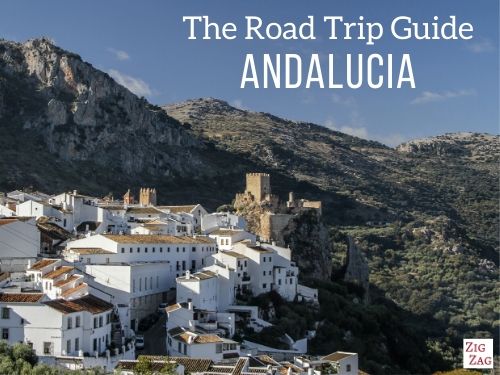
Zahara de la Sierra lies at the foot of a Nasrid watchtower, overlooking the turquoise waters of the Zahara-El Gastor reservoir. The climb up to the tower takes 20 minutes from the main square and offers a view of the entire lake. See the attractions in Zahara.
Stop 3: Grazalema

From Zahara, the road crosses the Palomas Pass, at an elevation of 1,357 meters, before descending to Grazalema. The mountains surrounding the village receive some of the heaviest rainfall in Spain. This moisture supports dense vegetation, including a forest of pinos, a type of fir tree found only in this region.
The village is also known for its wool blankets, which are woven in a traditional workshop that is still in operation. We had lunch in the shade on the main square. We then headed toward Montejaque to make our way back to Ronda. See the attractions in Grazalema.
Stop 4: Montejaque Road

The road connecting Grazalema and Montejaque winds through the limestone hills of the Serranía de Ronda. Less visited than its neighbors, Montejaque’s white houses are arranged in an amphitheater-like formation at the foot of the cliff. Park down below, since the narrow streets aren’t suitable for cars. Ronda is only 20 minutes away.
Third night in Ronda.
Day 12: Bolonia Dune and Baelo Claudia, then Cádiz
Total travel time: about 3 hours and 15 minutes
This day marks the transition from the mountains to the Atlantic. In two hours, the drive from Ronda to the Costa de la Luz takes you through the Alcornocales Natural Park, one of Europe’s largest cork oak forests.
Stop 1: Bolonia Dune

Designated a natural monument, the Bolonia Dune is about 30 meters high. Every year, it moves further inland, driven by the levant, the easterly wind that blows across the Strait of Gibraltar. From its summit, the view takes in the bay and, on a clear day, the coast of Morocco.
We recommend walking there barefoot, but before the sand gets too hot. We then went for a swim at the base of the dune: the Atlantic water there is much cooler than in the Mediterranean.
Stop 2: Baelo Claudia

At the end of the beach lies Baelo Claudia, a Roman city founded in the late 2nd century B.C. Its economy was based on tuna fishing and garum, a fermented fish sauce exported throughout the Empire. Emperor Claudius granted it the status of a municipium in the 1st century, hence its name. The forum, temples, theater, and salting pits can be explored in about an hour.
We were surprised by the condition of the brining tanks, which were lined up facing the sea. We recommend starting at the interpretation center, which displays the artifacts found at the site. See all our tips.
Stop 3: Arrival in Cádiz
Then head to Cádiz—it’s a 1-hour-and-15-minute trip. The road ends at the isthmus, a narrow strip of land between the ocean and the bay, which offers a first glimpse of the city’s location. Check in advance to see if your hotel offers parking, or find a public parking lot at the entrance to the old town.
Overnight stay in Cádiz. Book a 2-night stay.
See all top-rated accommodations directly.
Day 13: Cádiz, a city surrounded by the ocean
Founded by the Phoenicians around 1100 B.C. under the name Gadir, Cádiz claims the title of the oldest continuously inhabited city in Western Europe. It was also here that the Cortes adopted Spain’s first constitution, nicknamed La Pepa, in 1812, while the rest of the country was occupied by Napoleonic troops. To plan your own itinerary for the day, check out our article on the best attractions in Cádiz.
Stop 1: Central Market, Cathedral, and Torre Tavira

Start your morning at the Central Market, one of Spain’s oldest covered markets, which is especially lively before noon. The cathedral, built between 1722 and 1838, combines Baroque and Neoclassical styles, and its golden dome is visible from the waterfront. Climb up to its tower for a view of the rooftops of the old town.
The Torre Tavira, a former 18th-century merchants’ watchtower, houses a darkroom that projects a live image of the city. We found this tool helpful for getting our bearings before exploring the narrow streets. We went there mid-morning, between two very crowded sessions.
Learn more.
Stop 2: Ruins of the Roman Theater of Gadès

The Théâtre Romain de Gadès was an unexpected discovery for us, right in the heart of the city. Built in the 1st century B.C., it could seat up to 10,000 spectators. You’ll be impressed by its architectural features, which blend Greek and Roman influences. It provides insight into the construction techniques of the time.
See more photos.
Stop 3: La Caleta and the Ramparts Promenade

In the afternoon, head to La Caleta Beach, flanked by the castles of San Sebastián and Santa Catalina. Next, follow the promenade that runs along the city walls to Genovés Park, which is planted with species brought back from the Americas by explorers. The Roman theater, located in the Pópulo neighborhood, is also worth a visit during the day.
Stop 4: Stroll through the streets of the old town

The old town of Cadiz is a veritable architectural treasure trove. We enjoyed getting lost in its narrow, mostly pedestrian-only streets, especially since most of them are shaded. Look up and you’ll discover oriels and magnificent balconies with rich decorative details.
All these details attest to the exceptional heritage of this city, considered the oldest in Europe. The maze of streets is also home to numerous cafés and restaurants where you can take a gourmet break.
Second night in Cádiz.
Day 14: Jerez de la Frontera and back to Sevilla

Total travel time:
40 minutes to Jerez, then 1 hour to the Sevilla airport
In Jerez, there is a wide variety of attractions to suit every interest.
Stop 1: A sherry bodega

Jerez gave its name to sherry, which is called “xérès” in French. Together with Sanlúcar de Barrameda and El Puerto de Santa María, the city forms the triangle where this wine is aged using the solera system: the barrels are stacked in rows, and the wine is gradually transferred from the youngest barrels to the oldest.You can visit one of the wineries in the city center.
Stop 2: The cathedral and its tower
Built between 1695 and 1778, the Jerez Cathedral harmoniously blends Gothic, Baroque, and Neoclassical styles. Inside, we were impressed by its tall fluted columns and carved ceilings. You can also admire a rich collection of works of art, including a Virgin Mary by Francisco de Zurbarán. The famous Cristo de la Viga, a 15th-century Gothic crucifix, is truly beautiful.
On the Way to Sevilla
Then return your car to the Sevilla airport, which is a 1-hour drive away. If your flight departs from Jerez, the city’s airport is a 15-minute drive from downtown.
Alternatives for adapting this road trip
In two weeks, we’ll have to make some decisions. Here are the steps we’ve left out of the main program and how to incorporate them based on your interests.
Antequera instead of the Caminito del Rey

If you weren’t able to get a ticket for the Caminito del Rey, or if heights scare you, replace Day 9 with a visit to Antequera, which is 45 minutes from Málaga. El Torcal Natural Park features limestone formations stacked like plates, crisscrossed by marked trails of varying lengths.

The Menga and Viera dolmens, inscribed on the UNESCO World Heritage List in 2016, are among the largest megalithic monuments in Europe. We were surprised by Menga’s size, which was much larger than we had imagined. We suggest you end your tour at the Alcazaba to enjoy the view of the city before heading to Ronda, a 1-hour drive away. Learn more about the dolmens and other attractions in Antequera.
Medina Azahara, near Córdoba

Located 8 km from Córdoba, Medina Azahara is the palace city founded around 940 by Abd al-Rahman III, the first caliph of Córdoba. A shuttle runs between the visitor center and the ruins. You can add it to the end of the afternoon on Day 3 by cutting Carmona short. All our tips for visiting Medina Azahara.
Italica, departing from Sevilla

Founded in 206 B.C., Italica was the first Roman city on the Iberian Peninsula and the birthplace of Emperors Trajan and Hadrian. Its amphitheater could seat about 25,000 spectators. The site is located 20 minutes northwest of Sevilla: plan to visit it on the morning of Day 3, before heading to Carmona.
Learn more about Italica.
Medina Sidonia and Arcos de la Frontera at Plaza de Jerez

If you prefer villages to bodegas, replace Jerez with these two stops on Day 14. Medina Sidonia, perched on a hill 40 minutes from Cádiz, is home to the ruins of a castle and a quiet historic center. Arcos de la Frontera overlooks a bend in the Guadalete River from a cliff, and its lookout points offer a bird’s-eye view of the river. Sevilla is next, at 1 hour and 15 minutes away.
Guadix and the Gorafe Badlands

Located an hour from Granada, Guadix has about 2,000 cave dwellings carved into the clay, many of which are still inhabited. Further north, the Gorafe Badlands form a landscape of ochre-colored ravines dotted with dolmens. This itinerary requires an extra night in Granada: you can spend that night in Málaga instead, which would then be reduced to just one night.

Nature Tour: Almería, Cabo de Gata, and Sierra Nevada
To include the sights of the southeast, allow an additional 3 days between Granada and Nerja. Almería, dominated by its Alcazaba, serves as the gateway to the Cabo de Gata-Níjar Natural Park, which protects a long, unspoiled volcanic coastline. See Almería’s attractions and the beaches of Cabo de Gata.

On the way back to the coast, the Alpujarras Route connects the villages of Pampaneira, Bubión, and Capileira on the southern slope of the Sierra Nevada, a mountain range that includes the highest peaks in mainland Spain.

Frequently asked questions
How far in advance should I book tickets for the Alhambra and the Caminito del Rey?
As soon as your dates are set. During peak season, tickets for the Alhambra sell out several weeks in advance, and the Caminito del Rey releases tickets in batches, with a limited number of spots available each day. Caminito tickets are non-refundable and non-changeable, except in the event of a closure due to weather conditions.
When is the best time to take this road trip?
Spring (April through June) and fall (September and October) offer temperatures that are ideal for hiking and outdoor sightseeing. In July and August, temperatures often exceed 40°C in Sevilla and Córdoba, so plan your visits for early morning and evening. May coincides with the Patios Festival in Córdoba, but accommodations there are more expensive.
Is it possible to do this itinerary without a car?
Only partly. The train connects Sevilla, Córdoba, Granada, and Málaga, and buses serve Ronda and Cádiz. On the other hand, the white villages of Úbeda and Baeza, the Bolonia Dune, and the Caminito del Rey remain difficult to reach by public transportation. The car remains just as interesting starting on Day 3.
Can we extend this program to 3 weeks?
Yes. With one more week, you can visit most of the destinations listed above: Antequera, Medina Azahara, Guadix, Tarifa, and the villages in the province of Cádiz. We’ve provided details about this tour in our 3-week itinerary for Andalucia.
PLAN YOUR TRIP TO Andalusia
Inspiration

Practice

Places not to be missed