Cordoba’s Museum of Fine Arts is housed in the former Hospital de la Caridad, a remarkable historic site dating back to the 15th century. It features works from the Middle Ages to the present day, largely by Cordoban artists, but also by other great names in Spanish painting. Their work reveals the evolution of the Andalucia city through the centuries, as seen through the eyes of painters.
In this article, you’ll find some useful tips to help you prepare for your visit and have a wonderful time!
This opinion is completely independent, based on our experiences. We made our own choices, visited the area anonymously, and paid our bills in full.
Why visit the Cordoba Museum of Fine Arts?
Is the museum worth it? Our opinion:
Yes, Cordoba’s Museum of Fine Arts is well worth a visit!
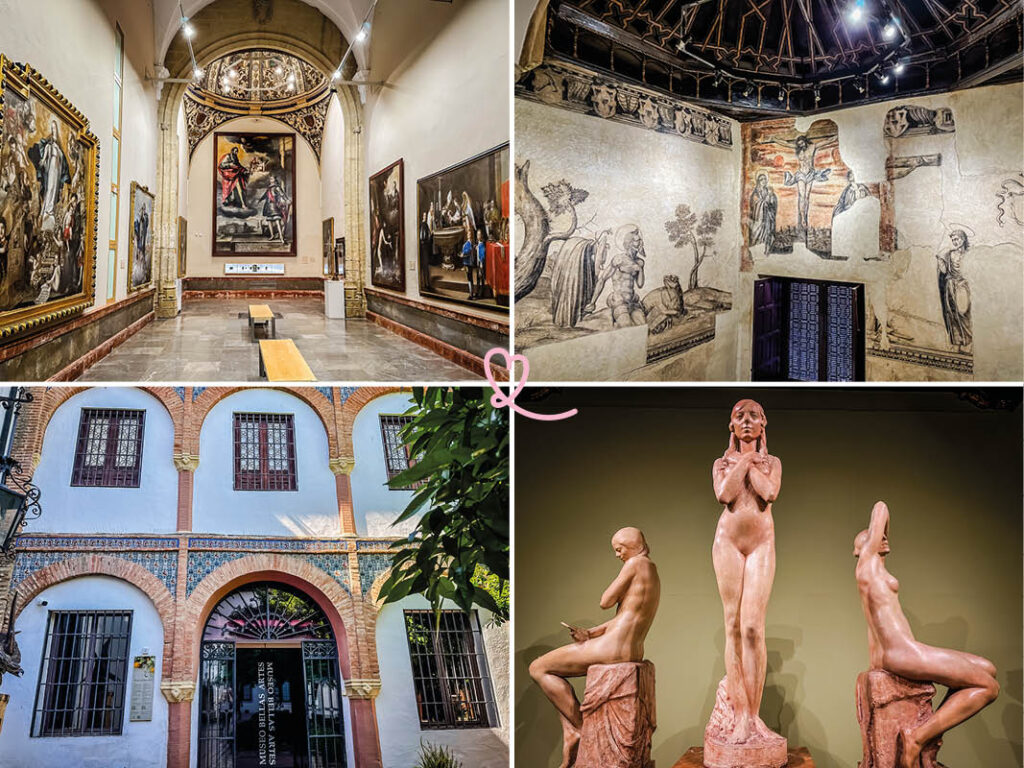
We were particularly taken by thehistory of the building that houses it: a former hospital steeped in history. Its transformation into a museum over the centuries has endowed it with fascinating architectural singularities, such as the magnificent 16th and 17th century frescoes gracing the staircase hall.
Le offers a comprehensive overview of Spanish art history, from the Middle Ages to the modern era. It houses exceptional works by Andalucia artists, illustrating the evolution of the city and its society over the centuries.
It’s one of the city’s best museums.

Our favorite moments
We particularly enjoyed discovering the various works by Cordoban artists. They bear witness to the cultural richness of this city of exceptional heritage, one of the most beautiful in Andalucia.
We were also impressed by thearchitecture of the building: this former hospital turned museum contains many architectural treasures, including the magnificent fresco dating from the 16th and 17th centuries.
History in brief

The museum’s history is full of twists and turns. Here’s what we’ve learned:
- 1835: Royal decrees ordered the confiscation of ecclesiastical property. Fortunately, a local Artistic and Scientific Commission, made up of intellectual and artistic figures, was tasked with collecting and protecting this heritage.
- 1844: Creation of the Cordoba Museum of Fine Arts with an initial collection from confiscations.
- 1862: Move to the former Caridad hospital (today’s building)
- 1962: The museum is declared a monument of cultural interest

Access: Museum of Fine Arts, Cordoba
Where is the museum?
The museum is located in Plaza del Potro:
- In the Juderia district
- 10-minute walk from the Cathedral Mosque and Roman Bridge
- Close to the must-see places in Cordoba
RENT A CAR IN Andalucia
- Compare prices on our preferred platform: DiscoverCars – one of the best rated sites.
- Choose a compact car, as some villages have very narrow streets!
- Think ofcomprehensive insurance for the same reason
- Book early for choice.

How to get there?
There are several options for getting to the Cordoba Museum of Fine Arts:
- The museum is within easy walking distance.
- If you take public transport, the “San Fernando” stop on the city’s transport network is the nearest. To plan your itinerary, please consult the route maps, timetables and fares here.
- You can choose a sightseeing bus tour. Hop-on-hop-off buses are a great way to visit all the sights quickly and easily. Book your Hop-On-Hop-Off pass now.

Parking
There is no on-site parking available. The nearest parking lot is the “La Ribera” parking lot, less than 5 minutes’ walk from the museum.


Useful tips: duration, schedules, eating…
Best time to visit
In our opinion, spring andautumn are the ideal times to discover the city and its monuments at your leisure, and avoid the heat of summer. We therefore recommend that you visit the museum in the morning, as soon as it opens. In this way, you’ll enjoy the peace and quiet and be the first to see the works.
We recommendavoiding the high season (July and August) to visit Cordoba. The city may be subject to overcrowding during this period.

Length of visit and main difficulties
Allow around 1 hour to get the most out of your visit.
The museum hasstairs, but no elevators. Unfortunately, people with reduced mobility will only be able to explore the first floor of the building. If that’s the case, don’t worry: most of the works are on display on the first floor. You can discover Cordovan Baroque art in Room IV, and works by Cordovan artists from the 18th, 19th and 20th centuries in Rooms V and VI.

Advice on how to visit
We recommend you start by heading upstairs to explore Room I, which features works of art on paper , followed by Rooms II and III, which showcase Medieval and Renaissance Cordovan art and a temporary exhibition.
Then descend to the first floor to discover Cordovan Baroque art in Room IV and works by Cordovan artists from the 18th, 19th and 20th centuries in Rooms V and VI.

PLAN YOUR DREAM TRIP TO andalucia
All the information you need for your trip:
- 7 maps that make planning easier
- + 150 pre-selected locations
- Practical advice
- 300+ photos to help you choose
Schedules and rates
Schedules:
- Between June 16 and September 15: Tuesday – Sunday, 9 a.m. to 3 p.m.
- September 16 to June 15: Tuesday – Saturday, 9am to 9pm and Sunday, 9am to 3pm.
- Closed on Monday
Admission: €1.50.
We recommend that you check the latest information on the museum’s official website, here, before your visit.

Catering
There are no catering facilities on site. On the other hand, you’re right in the center of town, close to a number of establishments. Discover our favorite restaurants in Cordoba, to enjoy before or after your visit.

Start of the tour: Medieval and Renaissance treasures of Cordoba
Discover the spectacular mural fresco
As soon as we entered the staircase hall, we were impressed by the majestic 16th-century fresco. We find that it makes the space particularly solemn, and gives a sense of the building’s history.

We wanted to find out a little more about this work and its history, and here’s what we discovered:
- it was created by an anonymous artist
- you can see a Calvary with the Virgin Mary and Saint John on the front wall. As well as Saint Jerome in penance and Saint Francis of Assisi.
- The fresco was unexpectedly discovered in 1923 during construction work.

We particularly appreciated its incomplete aspect, which leaves room for the imagination to fill in the missing parts. Some areas, in black and white only, give the impression of having just been sketched. Our eyes were also drawn to the unusual ceiling, an octagonal lasso frame added in the 14th century.

Observation of works on paper, a delicate art
The collection of drawings and prints in Room I is one of the most important and distinctive sections of the museum, both in terms of the number of works on display and their interest. We were fascinated by the diversity of formats and techniques represented, testifying to the talent of numerous artists.

You can admire works by local artists such as Antonio del Castillo, Antonio Garcia Reinoso, Antonio Palomino and Miguel Verdiguier. We were particularly taken by Francisco Quesadez’s“Saint Louis Bertrand“, pen-and-ink on laid paper, circa 1670. Other notable works include Antonio del Castillo’s“Paysage” and Mateo Inurria’s delicate“Fleur de grenadier”.

Journey to the heart of medieval and Renaissance Cordovan art (14th-16th centuries)
Continuing your tour, you enter Room II. You’ll discover a varied repertoire of works created between the 14th and 16th centuries. Here we discovered notable figures of the “primitive Cordovan school” such as Pedro de Córdoba, Pedro Romana and Alejo Fernández. Here you can admire
- 2 fragments of mid-14th-century wall paintings from Cordoba’s early cathedral,
- “Saint Nicolas de Bari” by Pedro de Córdoba,“Virgin and Child” by Pedro Romana,
- several works by Baltasar del Águila and a sculpture attributed to Bartolomé Ordóñez.

During our visit, we were particularly impressed by the work“Maestro Del Retablo De La Flagelación“, dating from the late 15th – early 16th centuries. The 2 side panels depict Saint John the Evangelist and Saint Anthony of Padua (right), and Saint Anthony Abbot and Saint Francis of Assisi (left). They are presented with their distinctive symbolic attributes. We were astonished to learn that this remarkable work, which entered the museum in 1866, came from the chapel of a 15th-century hospital.

Continuation of the tour: from the Baroque apogee to the Modern Currents
Contemplation of 18th-century Cordouan Baroque art
Continuing our exploration of the museum, we arrived in Room IV, located on the first floor, in the former chapel of the Hospital de la Caridad. It features works from the Baroque and Cordovan movements. You’ll discover paintings by Juan Luis Zambrano, José Ruiz de Saravia and Cristóbal Vela Cobo. The works of Antonio del Castillo Saavedra, a great master of Cordovan Baroque art, occupy a prominent place, both in terms of number and importance.

We were particularly captivated by“Aparición de San Pablo a San Fernando“, one of the most significant paintings in the collection. We discovered that it originally adorned the staircase of the San Pablo Convent in Cordoba, before being transferred to the museum following its confiscation in 1835. This striking painting depicts the apparition of Saint Paul to King Ferdinand III.

Dive into everyday Cordovan life in the 18th and 19th centuries with the Realist movement.
We then moved on to Room V, where we explored works attributed to the Realist movement, dating from the 18th and 19th centuries. Here you can discover the remarkable works of José Cobo de Guzmán, including“L’Ange Gardien” and“La Naissance de San Pedro Nolasco“.

The room also features several works by Antonio Palomino, an artist originally from Cordoba. While looking at the paintings, we were particularly struck by Rafael Romero Barros’“Crepúsculo“, painted in 1890, which depicts a striking twilight over the Guadalquivir River.

Understanding 20th-century Cordovan art: between avant-garde and innovation
Room VI particularly impressed us with its presentation of 20th-century works. This room, where sculptures and paintings coexist, appealed to us for its stylistic diversity, blending Realism and Cubism. Here you’ll find an impressive collection of works by Mateo Inurria Lainosa, a Cordoban sculptor whose artistic career is remarkably well illustrated. You can admire his major works such as “Un náufrago”, “Seneca”, “Lagartijo”, “Eternal Ídolo”, “Forma”, “La parra” and “Les trois âges des femmes”. We enjoyed discovering this artist, whom we didn’t know before visiting the museum. The museography provides a panoramic view of his entire career, allowing us to understand his influences and the evolution of his work over time.

The room also features sculptures by Ruiz Olmos, Enrique Moreno, Juan Serrano, Equipo 57 and Juan Zafra. You’ll certainly notice the bust armed with a bow, a work that particularly impressed us for its expressive power. We were also particularly captivated by Antonio Rodriguez Luna’s“Mujeres vela“. Doesn’t it look a little futuristic?

End of visit: temporary exhibitions and the building’s remarkable architecture
Discover thematic works on temporary display
In Room III, we discovered an interesting exhibition. This space, specially dedicated to temporary exhibitions, enabled us to explore the theme of the male gaze in the visual representation of women between 1850 and 1936.

Did you know that this crucial period marked the evolution of the role of women in Spain? Indeed, their place in society was characterized by total subordination to men and rooted in traditional religious and moral values. We particularly enjoyed Valentín de Zubiaurre Aguirrezabal’s“Culas de Madrid“. Don’t you find the play of light and proportion intriguing?

Exploring the museum’s architecture
Throughout our visit, we were fascinated by the architecture of the building housing the museum: the former Hôpital de la Charité, founded in the 14th century. Did you know that it was used as a military hospital during the Spanish War of Independence in 1810? The fresco on the staircase, mentioned earlier in this article, testifies to the architectural and historical richness of this exceptional site.

The exhibition room, housed in the hospital’s former chapel, offers a singular and magnificent setting that we feel accompanies the works to perfection.
We liked its architecture, which revolves around a large central patio lined with rooms on all 4 sides. The architecture is typical of the city. You’ll notice the many patios as you stroll along its historic streets.

PLAN YOUR TRIP TO Andalusia
Inspiration

Practice

Places not to be missed


SHE MADE THE TRIP Fanny