Not to worry. Here’s our complete guide to driving in Andalucia:
- Safety and driving difficulties
- Rules of conduct
- Road conditions
This opinion is completely independent, based on our experiences. We made our own choices, visited the area anonymously, and paid our bills in full.
Driving in Andalucia: What you need to know
If you don’t want to read the whole article, at least read this short summary of the essential points to know:
- We ride on the right side
- Seat belts are mandatory for all
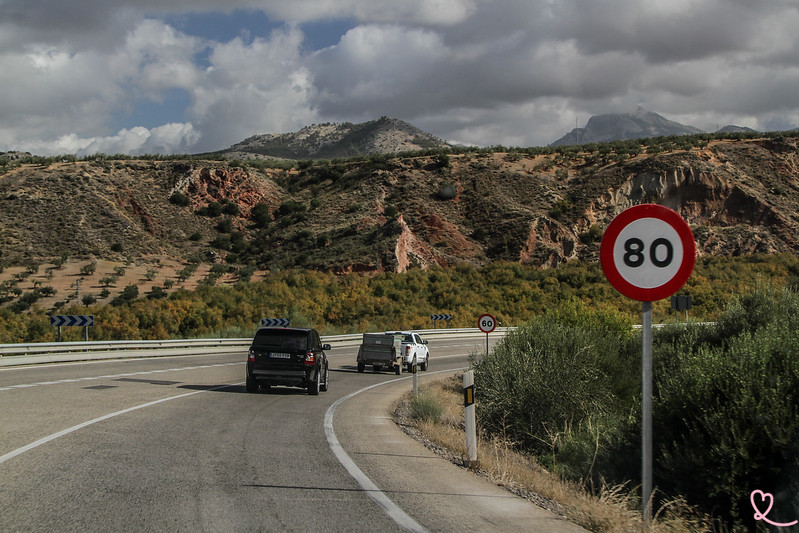
- Speed limits are clearly indicated in red circles
- It is forbidden to wear flip-flops while driving
- Roads are generally in excellent condition, especially freeways.
- Watch out for the more winding mountain roads in the Alpujarras and Sierra Nevada.
- There are tolls on some major freeways
- Spanish national speed limits are: 120 km/h on two-lane roads and freeways, 90 km/h on all other roads and 30 km/h in built-up areas.
- In case of accident – emergency number: 112

Here’s a map of tourist towns in Andalucia and the driving times in the region, to give you an idea of how to get around:

- Sevilla to Cadiz = 1h20
- Sevilla to Cordoba = 2h20
- Sevilla to Granada = 2h45
- Sevilla to Malaga = 2h15
- Sevilla to Ronda = 2h
- Malaga to Granada = 1h40
- Malaga to Ronda = 1h30
- Malaga to Cordoba = 2h
1. Rent the right car in Andalucia
To make driving easier, it’s best to choose a car adapted to the type of road and conditions. We recommend Andalucia:
- A medium-sized car, suitable for both mountain and city roads
- A good engine if you plan to visit the Sierra Nevada or the Alpujarras
- Automatic if possible for mountainous areas
- Air conditioning is strongly recommended in summer
- Find out more in our article: How to rent a car in Andalucia.
- >> See great rental offers on our preferred platform

2. Know the rules of conduct
Permit requirements
To drive in Andalucia or Spain, you need a valid driver’s license from your country.
If you have a valid driver’s license, including:
- a license number,
- a photo,
- a validity date
- written in Latin letters,
So you don’t need an international permit.
Otherwise, you’ll also need an International Driving Permit.
Age
The minimum driving age is 18.
But be aware that many car rental agencies may have other age requirements, often 21 and 1 year’s driving license minimum.
You must also carry your vehicle registration documents and a valid form of identification, such as your passport, with you at all times.
General rules
- In Andalucia, we drive on the right-hand side of the road.
- Seat belts mandatory for all
- No cell phones while driving
- Headphones are forbidden
- Children under 12 are not allowed to sit in the front of the car.
- Don’t wear flip-flops when driving

Alcohol and driving
The legal blood alcohol limit is 0.05%. Driving under the influence is considered a serious offence. We always recommend that you do not drink and drive.
Mandatory in-car equipment
In Spain, the following equipment is compulsory:
- 2 warning triangles
- Reflective vest or jacket
- Spare wheel and tools for changing it
- Set of spare lights
- Booster seats for children under 12 or 1.35m tall
Compulsory insurance
Unlimited third-party liability insurance is compulsory for driving in Spain.
It is automatically included in the price of all car rentals.
If you come with your own car, don’t forget to bring proof of insurance.

FUN in Andalucia: activities
- Cooking course in Sevilla
- Canyoning from the Costa del Sol
- Guided Hike on the Caminito del Rey

3. Preparing for different types of road
Freeways
Andalucia has an excellent network of freeways linking the main cities. The A-7, A-4 and A-92 freeways are the main routes. They are in excellent condition, wide and easy to drive. Some sections are tolled, notably the A-7 between Málaga and Algeciras. The outings are clearly indicated in advance. No particular difficulties.

National and provincial roads
National and provincial roads are generally in good condition. They cross a variety of landscapes, from olive plains to mountain foothills. We particularly enjoyed the road between Granada and the coast, with its spectacular views over the Andalucia countryside. These roads generally have two lanes, one in each direction. Traffic is moderate, except during the high tourist season when some roads can be busier.

Mountain roads
Mountain roads are mainly to be found in the Sierra Nevada, the Alpujarras and the Serranía de Ronda. They are narrower and more winding than the rest of the network. In the Alpujarras, the roads wind their way between perched white villages, offering exceptional panoramas but demanding concentration.
The route to Pico Veleta in the Sierra Nevada is particularly impressive. We advise you to get there early to take advantage of the visibility and avoid the tourist buses.
Some sections can be very narrow, especially in the villages of the Alpujarras, where two vehicles sometimes have difficulty passing each other. Fortunately, there are regular crossing zones.
And what we like best: most roads have safety barriers on the precipice side.

City driving
Major Andalucian cities such as Sevilla, Granada, Córdoba, and Málaga have historic centers with narrow streets that are often closed to cars. We recommend parking on the outskirts or in underground parking lots, and exploring the centers on foot. Traffic can be heavy during rush hour.

In the white villages
The typical white villages of Andalucia have very narrow, often sloping streets. In villages such as Frigiliana, Mijas or Zahara de la Sierra, it’s best to park at the entrance to the village in the parking lots provided. Some streets are so narrow that only one car can fit. The locals know their village inside out and know how to maneuver, but for visitors, it’s best to avoid venturing down these narrow streets.

In nature parks
In parks like Cabo de Gata, you can also find a few unpaved roads. They’re not very long.
Just be aware that the fine print in your car rental contract means you’re not covered on unpaved roads.

WHERE TO STAY IN Andalucia
Our independent picks for the accommodation of your dreams:
Select by city:
- Best hotels in Sevilla
- Best hotels in Malaga
- Best hotels in Granada
- Best hotels in Cordoba
- Best hotels in Ronda
- Best hotels in Almeria
- Best Hotels in Cádiz
Select by hotel type:

4. Understanding signs and tolls
Speed limits
- Speed limits are indicated on circular signs bordered in red.
- Speed limits are expressed in kilometers per hour
- 50km/h in residential areas
- 90km/h on national roads
- 100km/h on expressways
- 120km/h on freeways
- Speed cameras are frequent, be vigilant
Road signs
Road signs comply with European standards. They are clear and in Latin letters. Directions to tourist sites are indicated on brown signs. Freeways are marked in blue, trunk roads in red. In rural areas, beware of signs warning of the presence of wild animals, especially in mountainous areas.

Tolls
Some freeway sections are tolled. The main ones are on the A-7 (Mediterranean coast) and some stretches of the AP-4 towards Sevilla. Tolls can be paid in cash or by credit card. There is also an electronic toll system. Rates vary according to the distance covered. You can choose to use free national roads, but the journey will take longer.

Discover great offers on our preferred car rental platform: DiscoverCars
5. Safety: understanding potential hazards
Is driving in Andalucia dangerous?
No, driving in Andalucia is not dangerous on the whole. The road network is of good quality and well maintained. We travelled through the region for many weeks without encountering any major difficulties. Main roads and freeways are excellent.
The challenges are limited to a few winding mountain roads and rush-hour traffic in the big cities. Spaniards generally respect the highway code, even if they can be a bit brisk in their driving.
Most visitors have no problem at all. All you need to do is pay attention, respect the speed limits and take your time in mountainous areas. Distances between sites are reasonable, so trips are never too long.

Potential hazards
Summer heat
In summer, temperatures can exceed 40°C, particularly inland. Make sure your car has a working air-conditioning system. Make sure you have enough water. If possible, avoid driving during the hottest part of the day.
Local drivers
Andalucia drivers can be impatient and sometimes overtake quickly. Check your mirrors regularly, especially on mountain roads. Don’t let yourself be rushed, keep your pace.
The animals
In rural and mountainous areas, animals can cross the road. We came across goats, sheep and even wild boar. Be particularly vigilant at dawn and dusk.
Cyclists
Andalucia is popular with cyclists, especially in the mountainous areas. Pass them carefully, making sure you have good visibility.
Sudden heavy rainfall
Very heavy rain can sometimes fall quite suddenly while you’re driving. Visibility is greatly reduced. If you can, stop and wait for it to pass!

Specific driving tips
On mountain roads, don’t hesitate to drive slowly if you feel uncomfortable. Locals know the roads and will go faster, so let them pass in the designated areas. In traffic circles, the outside lane is for the first exit. If you take another exit, stay on the inside lane until you reach your exit.
When driving in the mountains, use engine braking on descents to avoid overheating your brakes. Honk before blind bends on narrow roads to signal your presence.
What to do in the event of an accident
If people are injured or there is a conflict, the emergency number is 112.
The best order of action is:
- contact emergency services
- contact the police
- contact your rental provider
6. And the rest: parking, fuel…
Fuels and service stations
Andalucia,
- Unleaded gasoline is called “gasolina sin plomo”.
- Diesel is called “gasoleo” or “diesel”.
- LPG is called “autogas”.
- There are numerous service stations along the main roads.
- Some stations have an attendant, others are self-service.
- Fuel prices are clearly displayed
- In rural areas, stations can be more widely spaced

Parking in town
- Parking in the city center is generally subject to a charge
- Blue zones require a parking ticket
- Underground parking lots are frequent and convenient
- Parking meters generally accept coins and credit cards
- Beware of residents-only parking zones
- Large cities have park-and-ride facilities on their outskirts

Parking at tourist sites
- Major tourist sites generally have parking lots
- In white villages, park at the entrance parking lots
- Arrive early in high season to find a seat easily
- Some natural sites have free parking areas


It’s time to book!
Compare everything: airlines, prices, schedules, and availability.
Andalucia’s most beautiful roads
Don’t miss the chance to drive along some of Andalucia’s most beautiful roads. For example:
- The White Villages Route (Ruta de los Pueblos Blancos) between Arcos de la Frontera and Ronda
- The Sierra de Grazalema road (A-372)
- The Alpujarra route between Lanjarón and Trevélez
- The road to Pico Veleta in the Sierra Nevada (A-395)
- The coastal road between Nerja and Almuñécar (N-340)
- The road from Ronda to the Tajo gorges
- The Caminito del Rey road (access MA-5403)
- …

Frequently asked questions
Do you need a car in Andalucia?
It all depends on your itinerary. If you’re only staying in large cities like Sevilla, Granada or Cordoba, public transport may suffice. However, to explore the white villages, mountainous areas and Andalucia countryside, a car is essential. We highly recommend renting a car to take full advantage of the region’s diversity.
Discover great offers on our preferred car rental platform: DiscoverCars
Can you drive around Andalucia in a week?
Yes, it’s possible to visit the main cities in a week thanks to the good motorway network. Allow around 1h between Málaga and Granada, 2h30 between Sevilla and Málaga, 1h45 between Sevilla and Cordoba. However, to really appreciate the region, explore the white villages and enjoy the scenery, we recommend a minimum stay of 10 to 14 days.
Do I need to hire a 4WD to drive in Andalucia?
No, a standard vehicle is more than enough. The roads are almost all paved and in good condition. A 4WD is only necessary if you are planning specific off-road excursions, which is rare for most visitors.
PLAN YOUR TRIP TO Andalusia
Inspiration

Practice
Places not to be missed