Planning a trip to Cordoba? What a great idea! This Andalucian city is full of fascinating monuments, flower-filled patios, and architectural treasures. We were amazed by its cobbled streets, historic squares and, of course, the majestic Mezquita-Cathedral, which embodies the city’s multicultural history. Between Roman remains, palaces and gardens, there’s no shortage of things to do!
In this article, we’ve put together a selection of the best attractions in Córdoba, illustrated with stunning photos to inspire you!

This opinion is completely independent, based on our experiences. We made our own choices, visited the area anonymously, and paid our bills in full.
Top Attractions in Córdoba: Map
Let’s start with a map to help you find your way around; we’ve included all the places on our main list:
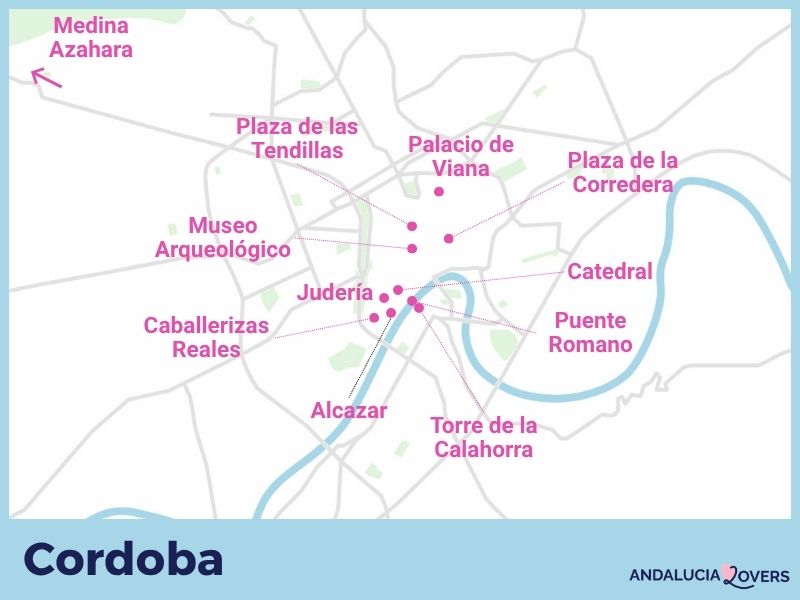
If you’re short on time and only have one day in Córdoba, we recommend:
- Medina Azahara at the opening
- Cathedral
- A stroll through the narrow streets and the square
- Palacio de Viana
For more itinerary ideas: 1 day – 2 days – 3 days
1. Mosque-Cathedral of Córdoba

Why visit?
You’ll be amazed by Cordoba’s Mosque-Cathedral (in Spanish, Mezquita-Catedral de Córdoba). It’s a monument that embodies the fusion of 2 cultures. We were impressed by the Hispano-Moorish architecture, which is subtly integrated into the Christian structure—a lesson in coexistence. The Mezquita-Catedral is one of the most beautiful cathedrals in Andalucia!
Begun in 784 by Emir Abd al-Rahman I, this building reached its current size in the 10th century under Al-Hakam II. After the Reconquista in 1236, Ferdinand III of Castile transformed the site into a Christian cathedral. We were impressed by the way the Moorish architecture, with its 856 columns of marble, jasper, and granite, is subtly integrated into the Christian structure.
Find out more in our dedicated article.

Practical advice
- How to get there: La Mezquita-Catedral is located in the historic district of La Judería. Just a stone’s throw from the banks of the Guadalquivir. The closest parking lot is the Cordoba Mosque Parking Lot, a 1-minute walk away.
If you’re taking public transportation, the “Vallellano (Comisaría)” stop is the closest. Please check the route maps, schedules, and fares here. - Opening hours: the monument is open daily from 10am to 7pm. Please check the timetable before your visit here.
- Price: Admission is €15 for the standard ticket, €20 with an audio guide
- Duration: 1h30 to 2h.
- Book your ticket now!
- Difficulties: you’ll find staircases and cobbled floors on the site.
2. Bell tower overlooking the mosque

Why visit?
The tower of Cordoba’s Mosque-Cathedral, once a minaret and now a bell tower, is an emblematic symbol of the city. We climbed 54m up, following in the footsteps of muezzins and bell-ringers through the centuries. Once you reach the summit, you’ll be rewarded with a breathtaking panoramic view of Córdoba and the surrounding area.
From the summit, you can admire the city’s white and ochre streets. This climb will not only give you a unique perspective on the architecture of the Mosque-Cathedral, but also a deeper understanding of Cordoba’s historical development.

Practical advice
- How to get there: The tower is located inside the Cathedral Mosque, in the historic Judería district. Just a stone’s throw from the banks of the Guadalquivir. The closest parking lot is the Cordoba Mosque Parking Lot, a 1-minute walk away.
- Opening hours: Visits are scheduled every 30 minutes between 9.30am and 6.30pm. Please check the timetable before your visit here.
- Price: Admission is €4.
- Duration: approx. 30min.
- Difficulty: Stairs lead up to the top of the tower.
WHERE TO STAY IN Cordoba
Our favorites: neighborhoods and hotels
Historic district
Hotel Las Casas de la Juderia – See prices, photos and availability
Hotel Madinat – See prices, photos and availability
Santa Marina district
Hotel Hospes Palacio del Bailio – See prices, photos and availability

See our complete selection of the best hotels in Cordoba
3. Crossing the Roman Bridge – Puente Romano

Why visit?
The Roman Bridge of Córdoba, or Puente Romano in Spanish, is much more than just a way to cross the Guadalquivir River. As you walk across its ancient stones, you’ll be transported back to Roman times. We loved its majestic arches, which have spanned the river since the 1st century B.C.
This bridge played a crucial role in the development of Córdoba, connecting the city to the road to Sevilla and facilitating trade. Over the centuries, it has witnessed the city’s evolution, passing from Roman hands to the Visigoths, then to the Moors, and finally to the Christians.
Find out more in our dedicated article.

Practical advice
- Access: The bridge links the old town to the Campo de la Verdad district. It is located near the Mezquita-Cathedral. The nearest parking lot is the Cordoba Mosque Car Park, a 3-minute walk away.
If you’re taking public transportation, the “Avda. Cádiz (Plaza Santa Teresa)” stop is the closest one. - Times and prices: Visits are free and can be made at any time of the day or night.
- Difficulties: there are no particular difficulties. To get on deck, there’s an inclined plane. There are no stairs.
- Read more
4. Palacio de Viana

Why visit?
The Palacio de Viana, nicknamed the “Museum of Patios,” is a treasure in the heart of Córdoba. We were enchanted by its 12 patios, each one unique and beautifully preserved, offering a journey through five centuries of Andalucian architecture.
This 14th-century palace, once the residence of the nobility, houses an impressive collection of arts and crafts. In particular, you’ll be able to see Flemish tapestries, antique weapons, and rare ceramics.
We were particularly taken with the orange patio, with its murmuring fountains and intoxicating fragrances. As you stroll through the lush gardens, you’ll discover the Cordoba tradition of flower-filled patios, which has been designated as part of UNESCO’s Intangible Cultural Heritage.
Find out more in our dedicated article.

Practical advice
- Access: The Palacio de Viana is located in the Santa Marina district, one of Cordoba’s oldest neighborhoods. The nearest parking lot is the Avenida Libertad parking lot, a 15-minute walk away.
If you’re taking public transportation, the “Colón Norte” stop is the closest one. - Book your guided tour of the palace and its patios!
- Duration: 1 to 2 hours.
- Opening hours: Tuesday to Saturday, 10am to 7pm, Sundays until 3pm. July and August, Tuesday to Sunday, 9am to 3pm. Please check the timetable before your visit here.
- Price: between €8.50 and €14, depending on what you choose to visit.
- Difficulties: the patios are equipped with access ramps and there is an elevator inside the palace.
5. Alcázar of the Christian Monarchs

Why visit?
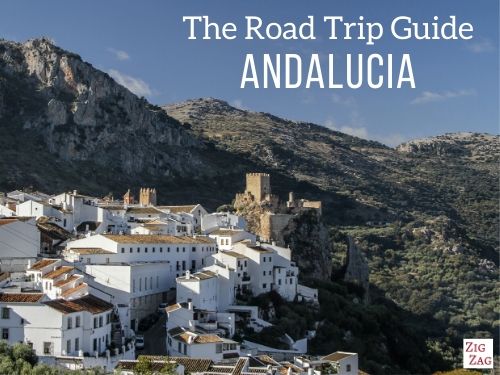
The Alcázar of the Christian Kings, a medieval fortress in the heart of Cordoba, is a fascinating testimony to the city’s eventful history. We loved discovering it, imagining the court intrigues that took place there. You’ll be transported back to the time when the Catholic Monarchs, Isabella and Ferdinand, lived there and planned the reconquest of Granada.
This palace-fortress, built on the ruins of an ancient Moorish fortress, skilfully blends Gothic architecture with Hispano-Moorish influences. We were particularly impressed by the magnificent gardens, adorned with elegant fountains and huge ponds.
Take time to admire the panoramic view of the Guadalquivir from the ramparts. You’ll understand the strategic importance of this site. As you explore the halls of the Alcázar, you’ll discover fascinating exhibits on the history of Córdoba, including Roman mosaics and Visigothic artifacts.
Find out more in our dedicated article.

Practical advice
- How to get there: The Alcázar is located in the old town. Close to Mezquita-Cathedral and the Guadalquivir River. The nearest parking lot is the Cordoba Mosque Car Park, a 5-minute walk away.
If you’re taking public transportation, the “Puerta Sevilla” stop is the closest one. - Opening hours: The site is open from September 16 to June 14, 8.15am to 8pm Tuesday to Friday, 9.30am to 6pm Saturday and 8.15am to 2.45pm Sunday. Please check the timetable before your visit here.
- Reserve your tickets now, including admission + guided tour!
- Price: Admission is €6.50 for full-price tickets and €3.50 for reduced-price tickets.
- Duration: 1 to 2 hours.
- Difficulties: although some areas are accessible, such as the gardens in part, the stairs and uneven cobblestones make it difficult to visit certain parts of the palace. The towers, for example, are not accessible to PRMs, and some historic sections have no ramps or elevators.
RENT A CAR IN Andalucia
- Compare prices on our preferred platform: DiscoverCars – one of the best rated sites.
- Choose a compact car, as some villages have very narrow streets!
- Think ofcomprehensive insurance for the same reason
- Book early for choice.

6. Jewish Quarter – Judería

Why visit?
The Jewish quarter, known as Judería, is a labyrinth of narrow streets where Moorish architecture, developed under the Umayyads as early as the 10th century, blends with Jewish influences. We were captivated by the simple beauty of the white houses adorned with flowers.
As you stroll through this district, you’ll be transported back to a time when cultures crossed and enriched each other, until the expulsion of the Jews in 1492. The heart of the city offers a journey back in time, where every street seems to have preserved the soul of its former inhabitants.
Book a guided tour of the city with a local guide to learn all about its history!

Practical advice
- Access: The Judería district is located in Cordoba’s Old Town (Casco Histórico), in the immediate vicinity of the Mezquita-Cathedral.
- Duration: 1 to 3 hours.
- Difficulties: The lanes are narrow, often irregularly paved. Some streets are slightly sloping, and you’ll come across a number of staircases. However, some parts may be more easily accessible.
- Read more
7. Visit Cordoba’s Archaeological Museum

Why visit?
Cordoba’s Archaeological Museum, housed in a former Renaissance palace, offers a fascinating insight into the city’s history. We explored its impressive collections, which span from prehistory to the Roman and Umayyad periods.
You can admire mosaics, sculptures and objects that bear witness to Cordoba’s wealth through the ages. One of the highlights is the Roman theater discovered beneath the building, an impressive vestige of the time when Cordoba was a thriving Roman city.
Find out more about our visit.

Practical advice
- Access: the museum is located in the Casco Histórico (Old Town) district, close to Plaza de Jerónimo Páez. The nearest parking lot is Parking La Ribiera, a 10-minute walk away.
If you’re taking public transportation, the “Rodríguez Marín” stop is the closest one. - Opening hours: Tuesdays from 2.30pm to 8.30pm, Wednesdays to Saturdays from 9am to 8.30pm and Sundays from 9am to 2.30pm. Please check the timetable before your visit here.
- Price: admission is free for European Union citizens. Otherwise the rate is €1.50.
- Duration: 1 to 2 hours.
- Difficulties: the building is equipped with an elevator.
8. Admire the Torre de la Calahorra

Why visit?
The Torre de la Calahorra, an imposing sentinel at the southern end of the Roman Bridge, is a must-see symbol of Cordoba. We climbed the stairs and, once at the top, admired a spectacular panoramic view of the Guadalquivir River and the old town.
This 12th-century Almohad fortress now houses the Living Museum of al-Andalus. We were captivated by the interactive exhibits illustrating the peaceful coexistence of Christian, Jewish and Hispano-Moorish cultures during Cordoba’s Golden Age. There, you’ll be able to see detailed models of iconic monuments and reenactments of daily life in the Middle Ages.
Read more

Practical advice
- Access: Torre de la Calahorra is located in the Campo de la Verdad district, on the south bank of the Guadalquivir. The nearest parking lot is the Cordoba Mosque Car Park, a 10-minute walk away. If you’re taking public transportation, the “Avda. Cádiz (Plaza Santa Teresa)” stop is the closest one.
- Opening times: the site is open every day, but opening times vary according to the season.
October and March to May: 10am – 7pm. November to February: 10am – 6pm. June to September: 10am – 2pm and 4:30pm – 8:30pm. Please check the timetable before your visit here. - Price: Admission is €4.50 for full-price tickets and €3 for reduced-price tickets.
- Duration: 45min to 1h.
- Difficulties: there is no elevator up the tower.

9. Visit the Medina Azahara

Why visit?
Located just a few kilometers from Cordoba, this fascinating archaeological site, a UNESCO World Heritage Site, bears witness to the grandeur of the ancient Caliphate of Cordoba. Medina Azhara is one of Andalucia’s most beautiful archaeological sites! We explored the ruins of this 10th-century palatine city, marvelling at the scale and sophistication of its architecture. U
A tour will take you back to the heyday of Hispano-Moorish civilization as you explore the ruins of palaces, gardens, and administrative buildings. We were particularly impressed by the Royal House, with its finely chiselled marble decorations. Discover the tumultuous history of Medina Azahara, from its ambitious construction to its rapid destruction, through the museum’s exhibits.
See our dedicated article.

Practical advice
- Directions: The Medina Azahara is located about 8 km west of downtown Córdoba,
- On-site parking is available near the visitor center, about 2km from the archaeological site. Shuttle buses run between the reception center and the Medina.
- Opening hours: Tuesday to Saturday, 9am to 6pm and Sunday, 9am to 3pm. Please check the timetable before your visit here.
- Price: admission is free for European Union citizens. Otherwise the rate is €1.50.
- Book your guided tour of Medina Azahara now!
- Duration: 2-4 hours.
- Catering: a cafeteria is available near the visitor center, offering cold snacks, drinks and sandwiches. For more elaborate meals, you’ll have to go to Cordoba.
- Difficulties: the site is difficult to access for people with reduced mobility. The ground is generally uneven, with many stones and steps.
10. Enjoy the Royal Stables of Córdoba

Why visit?
The Royal Stables, founded in 1570 by Philip II, are the birthplace of the famous Andalusian horse. During your visit, you’ll be impressed by the majestic architecture of this building, with its barrel vaults and stone columns. As you tour the historic stables, you’ll be able to admire the beauty and elegance of the Andalusian horses, known for their grace and intelligence.
If you have the opportunity, we recommend attending a horse show. It’s an impressive performance, where the horses show off all their grace and agility. You can tour the historic stables, learn about dressage techniques, and immerse yourself in Spain’s equestrian heritage.
Read more in our article

Practical advice
- How to get there: The Royal Stables are located in the Santa Marina district, close to the Alcázar of the Christian Kings and the Mezquita-Cathedral. The nearest parking lot is Parking la Mezquita de Córdoba, a 5-minute walk away.
If you’re taking public transportation, the “Puerta Sevilla” stop is the closest one. - Opening hours: Tuesdays from 10am to 1:30pm, then from 4:30pm to 7:30pm; Wednesdays to Saturdays from 10am to 1:30pm, then from 4:30pm to 8pm. Please check the timetable before your visit here.
- Duration: approximately 1 hour.
- Price: Admission to the Royal Stables is free. However, if you are attending a horse show, you will have to pay. Book your tickets now to see in action the horses with the reputation of being the “best horses in the world”.
11. Take a break at the Plaza de las Tendillas

Why visit?
The Plaza de las Tendillas, the vibrant heart of Cordoba, is the ideal place to soak up the city’s lively atmosphere. We enjoyed a coffee on the terrace, watching the comings and goings of locals and visitors to this popular meeting place. You’ll be charmed by the elegant central fountain, topped by the equestrian statue of the Gran Capitán, a 15th-century local hero. C
This square, renovated in the early 20th century, harmoniously blends neoclassical architecture with modern touches. We were intrigued by the square’s unique clock, which strikes the hours with the sound of a flamenco guitar. This square embodies the friendly spirit of Cordoba, combining history and modernity.

Practical advice
- Directions: The Plaza de las Tendillas is located in the center of Córdoba
The nearest parking lot is Parking Parking Calle Sevilla 5 Córdoba, a 5-minute walk away.
If you’re taking public transportation, the “Claudio Marcelo (Tendillas)” stop is the closest one. - Duration: allow 15-30 minutes for the visit.
- Discover Cordoba’s treasures on a guided tour!
12. Enjoy the Place de la Corredera

Why visit?
The Plaza de la Corredera, the only rectangular square in Andalucia, is an architectural gem and the hub of Cordoba life. We were impressed by its imposing 17th-century Baroque architecture, reminiscent of Madrid’s Plaza Mayor. We loved the ochre-colored facades and the wrought-iron balconies that surround the square, creating a picturesque setting.
You’ll be captivated by the lively atmosphere of this square, where locals gather to socialize and enjoy the many cafés and restaurants. Once the site of bullfights and markets, La Corredera has witnessed many historic events. In the evening, the Corredera comes alive even more, embodying the friendly spirit of Córdoba.

Practical advice
- Directions: The Plaza de la Corredera is located in the central district of Córdoba. The nearest parking lot is Parking Parking Calle Sevilla 5 Córdoba, a 10-minute walk away.
If you’re taking public transportation, the “Plaza de la Corredera” stop is the closest one. - Duration: allow 15-30 minutes for the visit.
Things to do in Cordoba: other ideas
Other museums in Cordoba
- Cordoba Museum of Fine Arts: a vast collection of works from the Middle Ages to the 20th century. We admired major works by Andalucia painters such as Antonio del Castillo and Baroque sculptures. This museum is perfect for art lovers wishing to discover the evolution of Spanish art through the centuries. Read more

- Museum of Ethnobotany and its Botanical Garden: the Museum of Ethnobotany, located in Cordoba’s Botanical Garden, is a fascinating place where nature and science meet. The program is ambitious, as demonstrated by the exhibition on the interaction between plants and human societies throughout history. You can also take a stroll through the Botanical Garden, which boasts a large collection of Mediterranean and exotic plants.
- Julio Romero de Torres Museum: dedicated to the famous painter Julio Romero de Torres, a native of Cordou. He is best known for his sensual, melancholy depictions of Andalucia women. The museum displays an impressive collection of his work, including his emblematic portraits that reflect Andalucia’s culture and identity. Read more

- The Fosforito Flamenco Centerlocated in the Posada del Potro, is dedicated to the preservation and promotion of the art of flamenco. You’ll discover exhibitions on the history of flamenco and interactive performances. This center, named after the famous singer Fosforito, will immerse you in the passion of this musical art. Book your tickets to see a flamenco show during your stay!
- The Ramón García Romero House-Museum: this museum is dedicated to the exceptional craftsman Ramón García Romero, a specialist in leatherwork using the guadamecí technique. We discovered a veritable treasure trove of craftsmanship, with unique decorative pieces using ancient gilding techniques. The museum is a tribute to traditional Andalucia craftsmanship.
- See our article on Cordoba’s museums.

Other monuments and historical sites in Cordoba
- Baños Califales (Caliphal Baths): these ancient public baths date from the time of the Umayyad Caliphate of Cordoba. Located near the Alcázar of the Christian Kings, these baths offer a fascinating insight into daily life in 10th-century Moorish Spain.
Learn more.

- The Cordoba Synagogue: built in 1315, this is the only surviving medieval synagogue in Andalucia. Located in the Judería district, it bears witness to the Jewish presence in the city before their expulsion in 1492. We were impressed by its finely sculpted plaster wall decorations. It’s a must for understanding Cordoba’s Judean heritage.
- The Roman Temple: discovered in the 20th century, this is an impressive vestige of Roman times. Located near the town hall, it dates back to the 1st century and reflects Cordoba’s importance in the Roman Empire. Admire its majestic columns and imagine a time when Cordoba was a prosperous provincial capital.

Things to do in Cordoba with children
Cordoba is a family-friendly city. We discovered several activities to delight young and old alike. A visit to the Alcázar of the Christian Monarchs, with its lush gardens, is the perfect place for children to explore the great outdoors. You can also visit the Córdoba Zoo, an educational and entertaining attraction, or enjoy a bike ride along the Guadalquivir River (more info here).
Younger visitors will also enjoy the equestrian shows at the Royal Stables, where majestic Andalucia horses captivate the audience. Córdoba offers a wide range of options for spending quality time with the family while discovering the city.

Things to do in Cordoba when it rains
Even when it’s raining, Cordoba is full of weatherproof activities. We took advantage of museums such as the Archaeological Museum and the Fine Arts Museum, which will take you on a journey through the region’s history. You can also explore the interior of the Mezquita-Cathedral, whose imposing architecture is perfect for sheltering from rain showers while admiring its iconic arches.
What’s more, the Arabic baths offer a relaxing experience: a perfect activity on a rainy day. As you can see, even when the weather’s not cooperating, you’ll find no excuse not to discover Cordoba’s rich cultural and historical heritage.
Book now your moment of relaxation in the city’s most famous hammam. You’ll be immersed in history with hot, warm and cold water baths, as well as traditional massages. Perfect for a rainy day!

Excursions around Cordoba
Cordoba is ideally located in the heart of Andalucia. Most of the region’s major attractions are easily accessible by train. For simplicity’s sake, you can also opt for a day trip:
- Ronda: discover the famous white villages of Andalucia and the magnificent town of Ronda, one of the oldest in Spain, built into the side of a cliff – see prices, availability and bookings.
- Sevilla: Discover the most emblematic monuments of Sevilla, the capital of Andalucia, on a one-day guided tour departing from Cordoba – see prices, availability and booking.
- Granada: take a guided tour of the Alhambra architectural complex, a UNESCO World Heritage site. The monument is fragile, so be careful of your movements and don’t touch the walls – see prices, availability and bookings.

Useful tips for visiting Cordoba
Where is Cordoba?
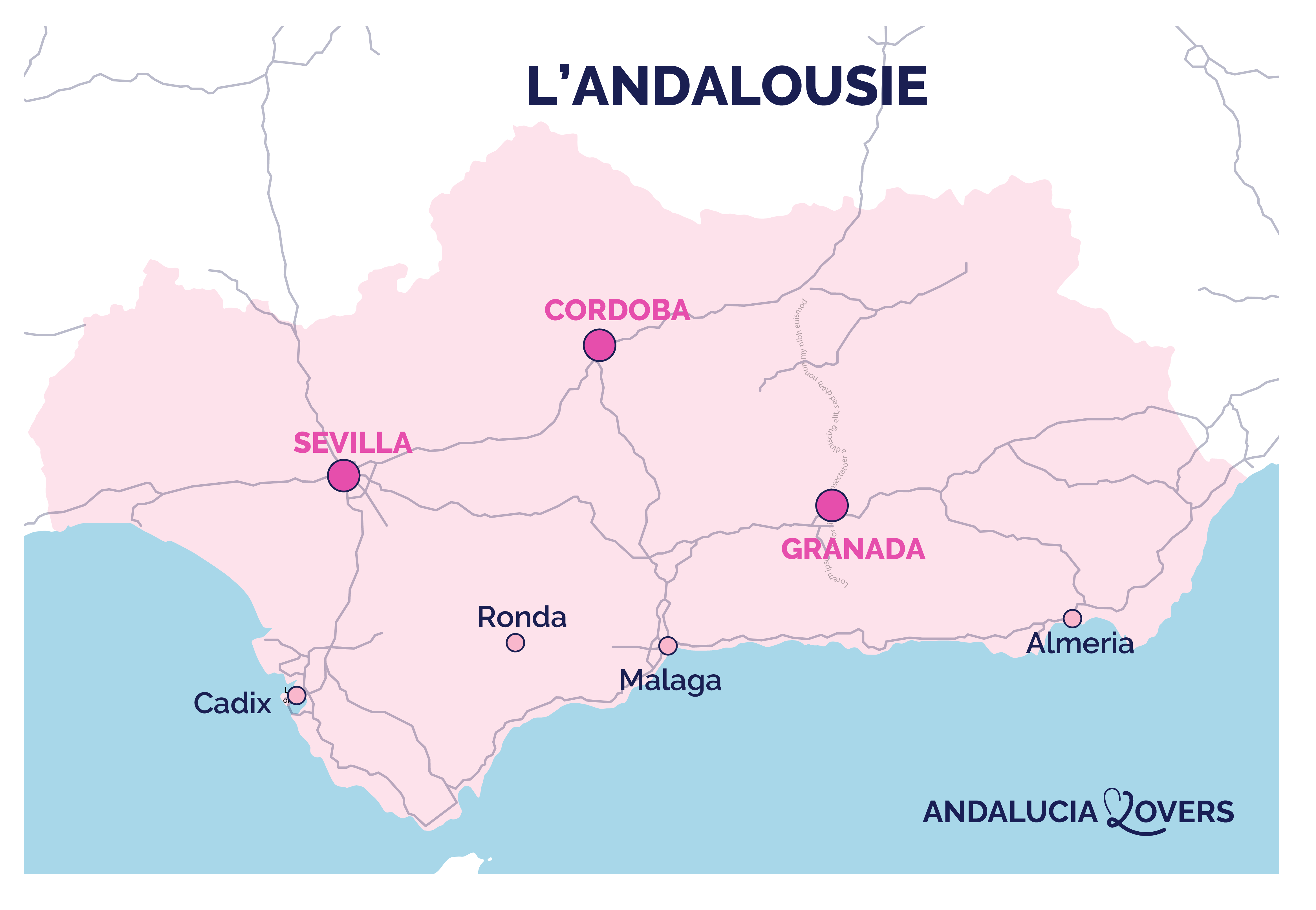
- Cordoba is located in southern Spain.
- Madrid to Cordoba = 4h drive
- Granada to Cordoba = 2h drive
- Sevilla to Cordoba = 2h30 drive
Here is a map to help you find your way:
How to get to Cordoba
You can get to Cordoba by train, which is well connected to Spain’s other major cities, including Madrid (2h) and Barcelona (4h40). You can book your tickets on the Renfe website here. To get to Cordoba station from the city center, we recommend walking or taking the bus.
Sevilla airport is served by major European cities, including Paris, London, Amsterdam and Vienna.
By car, Cordoba is easily accessible, with major highways such as the A-4 and the N432.

Parking in Cordoba
Parking in Cordoba can be a challenge, especially in the historic center, where the streets are narrow and often pedestrianized. We advise you to opt for paid underground parking.

Getting around Cordoba
It’s easy to get around Cordoba on foot throughout the historic center. You can also take public transport. The city bus network serves the city efficiently. It’s particularly convenient for reaching more remote sites such as Medina Azahara. In addition, you can purchase travel passes for unlimited rides at a reduced rate.
Visit the official public transport website here. Finally, the cab network is very efficient and inexpensive, making it a good alternative for long journeys!
Otherwise, you can choose a sightseeing bus tour. Hop-on-hop-off buses are a great way to visit all the sights quickly and easily. Book your Hop-On-Hop-Off pass now.

Where to eat in Cordoba
You’re in for a treat in Cordoba! Here are some of our favorite restaurants, which you can find in our article on the best restaurants in Cordoba (coming soon):
- Restaurant Arbequina: located in the Hospes Palacio del Bailío hotel, offers refined cuisine blending Andalusian traditions with modern creativity. We were seduced by its elegant setting, where historic architecture meets a contemporary ambiance.
- Restaurant La Esquinita de la Judería El Patio: this typical restaurant in the Judería district invites you to sample traditional Andalucia tapas in a warm, picturesque setting. We appreciated the authenticity of the food and the friendly atmosphere.
- Restaurant Taberna de Almodóvar (Bib Gourmand Michelin): this establishment has its roots in a family grocery store in Almodóvar del Río. True to its origins, this classically decorated restaurant perpetuates the authenticity of local flavors. Each dish is a tribute to regional recipes, prepared with respect for the culinary traditions that make Cordoban cuisine so rich.
- More ideas in our article on the best restaurants in Cordoba.
You can also discover the region’s specialties in a dedicated activity:
- Treat yourself to an evening of wine tasting to discover Andalucia’s finest grape varieties! – Find out more and book
- Taste the city’s best tapas on an ultra-gourmet food tour! – Find out more and book

Visiting Cordoba in winter
In winter, Cordoba offers a different and unique atmosphere. With milder temperatures, this is the ideal time to explore the city on foot without suffering from the summer heat. We visited the city during the off-season and enjoyed strolling through the cobblestone streets, making the most of the sunny days while avoiding the tourist crowds.
You can visit emblematic monuments such as the Mezquita-Cathedral or the Alcázar of the Christian Kings in a calm and serene atmosphere. It’s also a great time to admire the magnificent patios, some of which remain green even in winter. In the evening, enjoy the local gastronomy in cosy taverns and sip Andalusian mulled wine. You’ll love the winter charm of this historic town.

PLAN YOUR TRIP TO Andalusia
Inspiration

Practice

Places not to be missed


SHE MADE THE TRIP Fanny