Visiting Cordoba? Don’t miss the Archaeological Museum! This major cultural institution traces the city’s fascinating history, from prehistory to the Middle Ages. We particularly appreciated the richness of the collections, which bear witness to Cordoba’s exceptional heritage through the ages.
In this article, you’ll find some useful tips to help you prepare for your visit and have a wonderful time!
This opinion is completely independent, based on our experiences. We made our own choices, visited the area anonymously, and paid our bills in full.
Why visit Cordoba’s Archaeological Museum?
Is the museum worth it? Our opinion:
Yes, the museum is well worth a visit. In fact, it’s one of the best things to do in Cordoba! We were impressed by the huge collection of antiquities, which gives us a better understanding of the city’s history and historic monuments. The tour takes visitors on a journey through time, from the earliest traces of civilization to Cordoba’s golden age. You’ll be fascinated by the diversity of the exhibits, bearing witness to the different cultures that have shaped the city over the centuries.

Why is the museum famous?
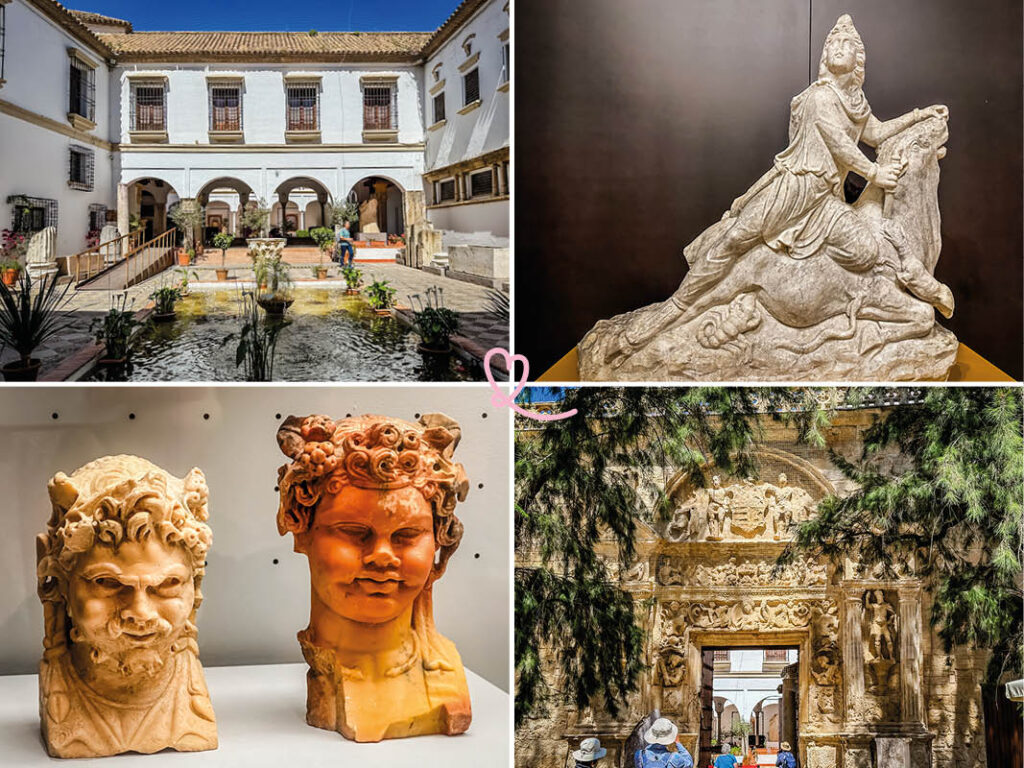
Cordoba’s Archaeological Museum is renowned for its exceptional collection of antiquities, considered one of the most important in Spain. Housed in the magnificent Renaissance Palace of the Páez de Castillejo family, it boasts such remarkable pieces as the Iberian Lion of Nueva Carteya and the impressive Roman sculpture of the god Mithra. The discovery and integration of the remains of a Roman theater during renovation work has further enhanced its reputation. The museum also boasts a rare Paleochristian sarcophagus that testifies to the richness of its collections.

Our favorite moments
You’ll find all the details of our visit later, but we can’t resist sharing our favorites with you:
- These 3 exceptional pieces – the Iberian Lion, the Crouching Aphrodite and the Paleochristian sarcophagus – took us on a journey through Cordoba’s fascinating history.
- The former Palacio de los Páez de Castillejo, which houses the museum, also won us over with its remarkable Renaissance architecture.
- You’re sure to be impressed, as we were, by the discovery of the Roman Theater integrated into the exhibition space.

WHERE TO STAY IN Cordoba
Our favorites: neighborhoods and hotels
Historic district
Hotel Las Casas de la Juderia – See prices, photos and availability
Hotel Madinat – See prices, photos and availability
Santa Marina district
Hotel Hospes Palacio del Bailio – See prices, photos and availability

See our complete selection of the best hotels in Cordoba
History in brief
Cordoba’s archaeological museum, founded in 1867, has been housed in the Renaissance palace of the Páez de Castillejo family since 1960. It houses a rich collection of artifacts tracing the town’s history from prehistory to the Middle Ages. In 2011, a major renovation integrated the remains of a Roman theater discovered during the works, enriching the museum experience. Today, the site plays an important role in understanding the cultural and historical evolution of Cordoba through the ages.

Access: Archaeological Museum, Cordoba
Where is the museum?
The museum is located in the Plaza de Jerónimo Páez:
- In the Juderia district
- 10min walk from the Roman Bridge and the Cathedral Mosque
- Close to the must-see places in Cordoba

RENT A CAR IN Andalucia
- Compare prices on our preferred platform: DiscoverCars – one of the best rated sites.
- Choose a compact car, as some villages have very narrow streets!
- Think ofcomprehensive insurance for the same reason
- Book early for choice.

How to get there?
There are several options for getting to Cordoba’s Archaeological Museum:
- The museum is within easy walking distance.
- If you’re taking public transport, stop at Plaza de las Tendillas or Calle San Fernando. To plan your itinerary, please consult the route maps, timetables and fares here.
- You can choose a sightseeing bus tour. Hop-on-hop-off buses are a great way to visit all the sights quickly and easily. Book your Hop-On-Hop-Off pass now.

Parking
There is no on-site parking available. The nearest covered parking lot is the “La Ribera” parking lot, about a 15-minute walk from the museum.

Useful tips: duration, schedules, eating…
Best time to visit
In our opinion, spring and autumn are the ideal times to discover the city and its monuments at your leisure, and avoid the heat of summer. We therefore recommend that you visit the museum in the morning, as soon as it opens. In this way, you’ll enjoy the peace and quiet and the first view of the exhibits. We recommend avoiding the high season (July and August) to visit Cordoba. The city may be subject to overcrowding during this period. On the other hand, if you visit the Andalucia city in summer, visiting the museum in the afternoon will allow you to take advantage of its coolness!

Length of visit and main difficulties
Allow 1h30 to 2h to fully enjoy your visit. We spent almost 2 hours exploring the different rooms and admiring the collections. The museum is equipped with elevators and ramps to facilitate your visit. You’ll be able to explore the palace’s 3 levels with complete peace of mind.

Advice on how to visit
For the best possible visit, we recommend you follow the itinerary suggested by the museum: start on the 1st floor with the exhibition on the evolution of Cordoba’s territory. Continue to the first floor, where you’ll discover the exhibition on life in Cordoba (religion, privacy and leisure). Then descend to the basement to admire the remains of the Roman theater. Finish your visit by admiring the architecture of the Palacio de los Paez de Castillejo, which houses the museum.

PLAN YOUR DREAM TRIP TO andalucia
All the information you need for your trip:
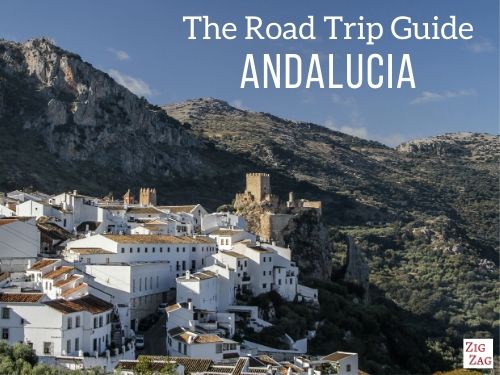
- 7 maps that make planning easier
- + 150 pre-selected locations
- Practical advice
- 300+ photos to help you choose
Schedules and rates
Schedules:
- Between June 16 and September 15: Tuesday – Sunday, 9 a.m. to 3 p.m.
- September 16 to June 15: Tuesday – Saturday, 9am to 9pm and Sunday, 9am to 3pm.
- Closed on Monday
Admission: €1.50.
We recommend you check the latest information on the museum’s official website here.

Catering
There are no catering facilities on site. On the other hand, you’re right in the center of town, close to a number of establishments. Discover our favorite restaurants in Cordoba, to enjoy before or after your visit.

Start of visit: understanding the evolution of the Cordovan territory

To begin your visit, go up to the second floor. Here you’ll discover the first part of the exhibition, dedicated to the evolution of the Cordovan territory from Prehistory to the Middle Ages, through 5 chronological sections. We loved discovering the city from this angle, and understanding how all these eras shaped Cordoba into the incredible city it is today. Here are 3 sections that stood out for us:
Dive into prehistory: Cordoba before Cordoba

The first part of our visit immersed us in the “Before Cordoba” exhibition, which traces the history of the region before the first Roman foundations. We were particularly impressed by Neolithic ceramics such as the Vaso globular with its geometric decorations and reddish stain. The pieces on display are exceptional witnesses to the earliest local civilizations.

You’ll also discover other remarkable objects such as tools and jewelry, as well as the fascinating Ategua Stele, which illustrates early contacts with Eastern Mediterranean civilizations. This section of the museum, which covers a period from the Palaeolithic to the end of the Iberian era, offers a complete panorama of Cordoba’s origins.
The Roman imprint in Cordoba: imperial remains

In the section dedicated to Roman Cordoba, we liked the richness and diversity of the objects on display. This part of the museum is a remarkable illustration of the city’s urban development. You’re sure to be impressed, as we were, by the architectural features, statues and portraits that bear witness to the monumentalization of the city under Augustus, as the Roman Bridge still does today.

The Crouching Aphrodite sculpture was particularly striking. Dating from around 250 BC, it depicts Aphrodite naked in an unusual crouching pose. We’ve learned that historians believe she is probably depicted bathing or contemplating her reflection in the water. You’ll notice that this dynamic posture creates a play of volume and chiaroscuro. We were blown away by the sculptor’s remarkable technical mastery!
Cordoba’s golden age: the reign of the Umayyads

The “Qurtuba” section allows you to discover the splendor of the city during the reign of the Umayyads, as witnessed by the Cathedral Mosque and the former Caliphal Baths. We enjoyed looking at the plans on display, which gave us an idea of the scale of the city at the time, and enabled us to draw parallels with the city of today. You can admire magnificent ataurics, carved tombstones, ceramics and objects in green and manganese bronzes.

During our visit, we were particularly attracted by the bronze doe dating from the Umayyad period between 950 and 1001. We have learned that it is a fountain spout that probably adorned a marble basin in one of the suites in the Madinat al-Zahra palace. As you approach it, you’ll notice its many carved details: little leaves. We found they added a poetic dimension to this beautiful period piece.
Continuation of the tour: experience life in Cordoba through the ages

The tour continues on the first floor. Here you can discover the second part of the exhibition, dedicated to life in Cordoba from prehistory to the Middle Ages, with 3 themes: private life, religion and leisure. We enjoyed discovering the evolution of the daily life of the inhabitants.
Cordovan homes: a glimpse into daily life

The exhibition dedicated to housing interested us with its 3 showcases featuring everyday objects from Iberian, Roman and Andalucia homes. We enjoyed observing the ceramics found in the Iberian village of Cerro de la Cruz in Almedinilla. You’ll also discover a diversity of objects ranging from Roman oil lamps to jewelry from the Caliphate period.

We really enjoyed discovering the particularities of period dwellings, and in particular Roman houses, through various examples. One example is the Roman Villa in El Ruedo, where an impressive lion-shaped marble table leg is on display. We were also pleasantly surprised to hear about the ruins preserved at theHotel Hospes Palacio del Bailio where we stayed!
Crossroads of cultures: religions in Cordoba

The section devoted to religious beliefs is sure to captivate you with its richness and diversity. We fell in love with 2 of the exhibits. The 1st is the Statue of Mithra, a solar god surrounded by numerous symbols such as a snake and a scorpion. At first glance, we didn’t notice all the details of this work. We therefore recommend that you take a close look at it to see all the hidden details.

The 2nd is the Yamur (the highest part of mosque minarets), which was transformed into a Christian cross. We liked this object because we think it perfectly represents Cordoba’s cultural mix. When visiting this collection, don’t miss out on other interesting objects such as the Iberian ex-voto and the Early Christian colonnaded sarcophagus.
Leisure and entertainment under the Umayyads of Cordoba

The section dedicated to leisure and entertainment revealed 2 fascinating aspects of Cordovan social life: did you know that during the Roman Empire, games (races, athletics, Olympiads…) took the form of public spectacles, whereas in Islamic culture they were more of a private affair?

To illustrate this point, we found the Roman theatrical masks of the gods and the musicians’ bottle from the Caliphate period particularly telling. We found this last part of the exhibition a perfect transition to the visit to the archaeological site in the basement of the building.
End of tour: Roman theater remains and museum architecture
Cordoba’s Roman Theatre: an architectural gem unveiled

Descending to the basement, we discovered the impressive remains of the Roman theater, built in the 1st century and abandoned in the 4th. You’ll be able to observe the preserved internal structures and understand the different construction phases thanks to a carefully designed museography. The tour takes place on a footbridge overlooking the remains, designed to respect the ancient structures as much as possible.

We particularly appreciated this system, which allows us to see the big picture while preserving the site. Did you know that, with an impressive diameter of 125m, it was one of the largest theaters in Hispania and could seat up to 15,000 spectators? Excavations, which began in 1994, have uncovered around 30% of its surface, giving us a remarkable insight into this architectural gem from the Roman era!
The Palacio de los Páez: the museum’s historic setting

The palace that houses the museum is an architectural treasure from the 16th century. We were impressed by its main portada, a remarkable work of the Andalucia Renaissance begun in 1540, adorned with Corinthian columns and heraldic motifs. You’ll certainly appreciate the building’s magnificent patios, where archaeological exhibits provide a unique setting for discovering the region’s history. Have you noticed the corner balcony at the intersection of the plaza and the street? It reflects the elegance characteristic of the architecture of the period.

One of the aspects that fascinated us was the palace’s connection with Cordoba’s Roman past, as it houses the remains of the Roman theater, testifying to the importance of this site in antiquity. This juxtaposition of architectural elements from different periods makes the Palacio de los Páez de Castillejo a unique place, linking the Roman past with the Spanish Renaissance.
Frequently asked questions
What are the highlights of the museum?
Not-to-be-missed exhibits at Cordoba’s Archaeological Museum include..:
- The Iberian Lion of Nueva Carteya: A limestone sculpture dating from the 4th century BC, measuring over a metre in length.
- Crouching Aphrodite: A Roman statue from the 2nd century A.D., a copy of a Greek work. J.-C., a copy of a Greek work, measuring over two meters in height.
- Paleochristian sarcophagus: dating from the first third of the 4th century, in white marble, decorated with scenes from the Old and New Testaments.
- The Roman sculpture of the god Mithra: An important piece for its historical and artistic value.
- The Divo Augusto: A marble sculpture of a Roman emperor, with preserved torso and leg.
These objects offer a fascinating insight into the history of Cordoba, from the Iberian period through the Roman era to the Paleochristian era. But when you visit, you’ll notice that in addition to the objects listed above, the museum is packed with treasures.

How can the museum be integrated into Cordoba’s tourist itinerary?
We recommend a visit to the Archaeological Museum after visiting Cordoba’s main historical sites. In fact, the museum offers a complete historical overview that makes perfect sense after exploring the actual sites. A visit to the Mosque-Cathedral, theAlcázar and the Jewish Quarter (Juderia) will give you concrete impressions, which the museum will then contextualize and deepen.

Subscribe to our Newsletter
- Get away from it all with Region Lovers’ beautiful destinations!
- Once a month
- Advertising-free
PLAN YOUR TRIP TO Andalusia
Inspiration

Practice

Places not to be missed


SHE MADE THE TRIP Fanny