Cordoba’s Cathedral Mosque is a unique monument where Hispano-Moorish and Christian architecture blend into a harmony of two-tone columns and arches. We were impressed by this surprising fusion of two seemingly incompatible architectural styles.
Discover in this article our photos and all our tips to make the most of your visit to the Cathedral Mosque of Cordoba!
This opinion is completely independent, based on our experiences. We made our own choices, visited the area anonymously, and paid our bills in full.
Why visit Cordoba’s Mezquita Catedral?
Is the Cathedral Mosque worth it? Our opinion:
Absolutely! If there’s one monument not to be missed in Andalucia, this is it! The Cathedral Mosque is well worth a visit and is one of the most beautiful cathedrals in the region. A major monument to Umayyad art, it bears witness to the Muslim presence in Spain from the 8th to the 15th century. We were captivated by its exceptional architecture, which combines Emiral and Caliphal styles with Gothic, Renaissance and Baroque elements, creating a unique harmony. This historic site, designated a UNESCO World Heritage Site in 1984, is considered one of the world’s most astonishing monuments. This is one of Cordoba’s must-sees!

Why is the Mezquita Catedral famous?
Cordoba’s Cathedral Mosque is famous for its unique architectural evolution, combining Umayyad, Visigoth, Gothic, Renaissance and Baroque styles. Classified as a UNESCO World Heritage Site in 1984, it traces a complex religious history: on the site of today’s monument, a Roman temple first stood. It was then transformed into a Christian basilica, then into a Muslim mosque and finally into the Christian cathedral it is today. This rich history makes it one of the places not to be missed during your stay in Andalucia!

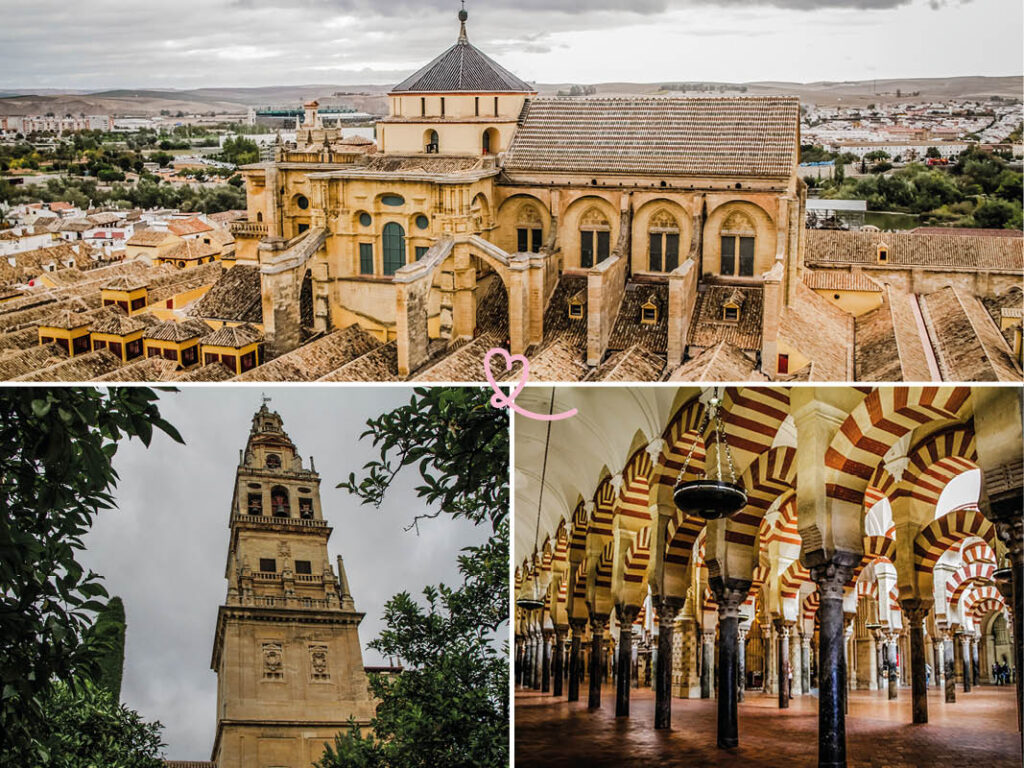
We were fascinated by the way these different influences blended harmoniously. In particular, you’ll be able to observe the antique marble and jasper columns, reused from Roman and Visigothic buildings, that support the remarkable red and white superimposed arches. This unique architectural system, with its double horseshoe arches, raised the ceiling height while lightening the structure.

Our favorite moments
During our visit, we particularly appreciated
- discover the double arch system that creates a unique atmosphere.
- witness the harmonious cohabitation of Umayyad and Christian architecture.
- enjoy a stroll through the orange grove, a haven of peace in the heart of the monument.
- admire the panoramic view of the city from the top of the bell-tower, a memorable souvenir of our visit.

WHERE TO STAY IN Cordoba
Our favorites: neighborhoods and hotels
Historic district
Hotel Las Casas de la Juderia – See prices, photos and availability
Hotel Madinat – See prices, photos and availability
Santa Marina district
Hotel Hospes Palacio del Bailio – See prices, photos and availability

See our complete selection of the best hotels in Cordoba
History in brief
The story of the Cathedral Mosque is full of twists and turns. Here’s what we’ve learned:
- 785-786: Abd al-Rahman I founds the mosque on the site of an ancient Visigothic basilica in San Vicente.
- 833-966: Abd al-Rahman II carries out a number of works, including: the first expansion of the mosque, the construction of the new minaret and the enlargement and embellishment of the mosque, notably with the construction of the mihrab.
- 987-988: Almanzor builds the last extension to the mosque, giving it its current dimensions.
- 1236: During the Christian reconquest of Cordoba, Ferdinand III of Castile consecrated the Great Mosque as a Christian cathedral.
- 1523: Construction of the Christian cathedral begins in the center of the former mosque, at the instigation of Bishop Alonso Manrique.
- Between 1593 and 1597: The structure of the bell tower is outlined and the Patio des Orangers takes on its current configuration.
- 1984: UNESCO declares the Cathedral Mosque a World Heritage Site.

Access: Cathedral Mosque, Cordoba
Where is the Cathedral Mosque?
- La Mezquita-Catedral is located in the historic district of La Judería. Just a stone’s throw from the banks of the Guadalquivir.
- 5min walk from the Roman Bridge andAlcázar of the Christian Monarchs
- Close to must-see places of interest in Cordoba

RENT A CAR IN Andalucia
- Compare prices on our preferred platform: DiscoverCars – one of the best rated sites.
- Choose a compact car, as some villages have very narrow streets!
- Think ofcomprehensive insurance for the same reason
- Book early for choice.

How to get there?
There are several options for getting to the Cathedral Mosque:
- The monument is easily accessible on foot.
- If you take public transport, the Puerta del Puente stop on the city’s transport network is the nearest. To plan your itinerary, please consult the route maps, timetables and fares here.
- You can choose a sightseeing bus tour. Hop-on-hop-off buses are a great way to visit all the sights quickly and easily. Book your Hop-On-Hop-Off pass now.

Parking
The nearest parking lot is the Cordoba Mosque Car Park, a 1-minute walk away.

Useful tips: duration, schedules, eating…
Best time to visit
We recommend avoiding the peak season (July and August) to visit the site, which is often overcrowded during this period. In our opinion, spring and autumn are the ideal times to discover the city and its monuments at your leisure, and avoid the summer heat.

Length of visit and main difficulties
Allow at least 2 hours to tour and admire the mosque.
Note that the interior of the monument is quite dark, so we advise you to visit it when it’s daylight.
The Cathedral Mosque is accessible to people with reduced mobility thanks to ramps. The adapted entrance is via the Puerta de Los Deanes. Accessible toilets with grab bars are available, as are benches for resting along the way.
Only the bell tower is difficult to access for people with reduced mobility, due to its narrow staircases.

Advice on how to visit
There’s no set direction, but here’s an example of a route you can follow:
- Start your exploration in the “forest” of columns and admire the characteristic two-tone arches. We recommend stopping off at the center to appreciate the unique perspective.
- Head for the mihrab: this prayer niche adorned with sumptuous Byzantine mosaics is a masterpiece not to be missed.
- Continue on to the central Christian chapel: discover the striking contrast between Umayyad architecture and the Renaissance addition.
- Explore the various side chapels, each with its own artistic treasures.
- Climb the bell tower (accessible with a separate ticket): the panoramic view over Cordoba is spectacular.
- Finish off with the Patio de los Naranjos: this historic garden, with its orange trees and fountains, is a fitting conclusion to your visit to the monument.
If you prefer to be guided by a guide, book your guided tour ticket now!

PLAN YOUR DREAM TRIP TO andalucia
All the information you need for your trip:
- 7 maps that make planning easier
- + 150 pre-selected locations
- Practical advice
- 300+ photos to help you choose
Schedules and rates
- Opening hours: Cordoba’s Mezquita-Catedral is open daily from 10am to 6pm. Please note that timetables may vary from period to period.
- Prices: Admission is €13 full price and €10 concessions. Children aged 10 to 14 pay €7.
Tip: the visit is free from Monday to Saturday, for 1 hour between 8:30 and 9:30 am.
If you’d like to visit the bell tower, please allow an extra €3 for the ticket. - Check schedules and latest information before your visit on the official website, here.
Book your guided tour ticket now!

Catering
There are no catering facilities on site. On the other hand, you’re right in the center of town, close to a number of establishments. Discover our favorite restaurants in Cordoba, to enjoy before or after your visit.

The Mezquita, a fascinating Hispano-Moorish heritage
A forest of 856 marble and granite columns
As you enter the building, you’ll come straight to the main prayer hall. We were overwhelmed by its 856 columns, spread over an area of almost 15,000 m2. This forest of columns creates a unique space that we found spectacular. These marble and granite columns come in part from the former Visigoth basilica of Saint-Vincent, which once occupied the site, as well as from other Roman buildings in the region.

The system of superimposed arches above them is an architectural feat typical of Umayyad architecture. The lower horseshoe arch supports a second, higher arch, a technical innovation that increases height while lightening the structure. The arches alternate between Claire limestone and red brick, creating the mosque’s distinctive two-tone motif.

The Mihrab and its Byzantine mosaics: the spiritual heart of the mosque
Particularly impressive is the mihrab, a 10th-century masterpiece of Hispano-Muslim art. This 3.5m-deep prayer niche faces south, not exactly towards Mecca. Some historians justify this peculiarity by saying that the architects wanted to copy the orientation of the mosque in Damascus, capital of the Umayyads.

We found the mosaics adorning the mihrab to be exceptional. These are gold and multicolored tesserae, used by Byzantine artists, sent by the Emperor of Constantinople to the Caliph Al-Hakam II. Their intricate patterns of Arabic calligraphy and plant arabesques sparkle in the light.

The architecture of the façade is equally remarkable, with its interlacing poly-lobed arches topped by Quranic inscriptions. The dome that precedes the mihrab, with its criss-crossing ribs, is a technical feat for its time. This entire area, known as the maqsura, was reserved for the caliph.

The Christian cathedral at the heart of the mosque
The majestic Capilla Mayor and its wooden sculptures
The choir is a remarkable example of 18th-century Spanish Baroque art. Its white vaults, adorned with gilded sculptures and Renaissance motifs, rise to an impressive height. On either side, the stretching rows of dark woodwork caught our eye. They form a unique architectural ensemble. At the far end of the choir is an imposing dark wood cathedra (bishop’s seat), a true masterpiece of woodcarving.

Have you noticed the 2 monumental organs overlooking the space? Their golden pipes gleam in the natural light filtering through the high windows. These instruments, built by master organ builder José Martínez Colmenero in the 18th century, are still in use today for major ceremonies.

The black-and-white checkerboard floor and the central aisle leading to the cathedra underline the solemnity of the setting. This Christian section, added in the very heart of the former mosque, illustrates the desire of the Christian authorities to mark their presence while preserving the architectural beauty of the original monument.

The cathedral’s artistic heritage
In addition to its monumental architecture, the cathedral boasts a rich artistic heritage that bears witness to its historical importance. We were particularly impressed by its collection of sacred art and precious liturgical objects, accumulated over the centuries. Magnificent paintings and sculptures adorn the various chapels, illustrating the evolution of artistic styles from the 15th to the 18th century.

During our visit, our eyes were drawn to the large, beautiful stained glass windows in the cathedral section. They illuminate it by letting in natural light through their colored glass. You may notice the contrast in brightness this creates with the darker naves of the old mosque.

The Patio des Orangers and the historic gates
Patio de los Naranjos, one of Europe’s oldest gardens
We loved walking the paths of the Patio des Orangers. This vast garden adjoining the mosque-cathedral takes the form of a 6,500m2 rectangular courtyard, surrounded on 3 sides by covered galleries. The calm of this beautiful wooded area is a welcome escape from the hustle and bustle of the Andalucia city. Alleys lined with orange trees provide welcome shade, especially in summer.

You’ll also notice the many fountains, the oldest of which in the center was used for ritual ablutions. They punctuate the space with elegance and create an illusion of freshness. We also recommend taking the time to explore the galleries lining the patio. They form a harmonious architectural whole with their characteristic arches and offer different views of the Patio de los Naranjos. We learned that this courtyard, once the forecourt (sahn) of the mosque, was used for ablutions before prayer when the building was a mosque.

The historic doors, an invitation to discover the mosque-cathedral
During your visit, you’ll probably notice the many historic doors combining different architectural styles. We learned that they reflect the various periods of construction and modification of the monument.
Among these gates, we particularly noticed the Puerta de San Esteban. Located on the west side of the building, it dates back to the Moorish period and is considered one of the richest and most representative of this period. It once provided access to the prayer hall of the primitive mosque, built at the time of Abd al-Rahman I in the 8th century.
If you look closely, you’ll notice an inscription carved into the stone, thought to be the oldest in the building.

If you’re interested in the architectural evolution of this exceptional monument, listed as a UNESCO World Heritage Site, we recommend you take a look at the doors. Although they are less well known than the cathedral mosque, they are nonetheless important, reflecting the many cultural and architectural developments on the site. Among the most noteworthy are the Puerta de los Deanes, Puerta de San Miguel, Puerta del Espíritu Santo, Postigo del Palacio and Puerta de San Ildefonso. Each offers a unique perspective on the monument, testifying to its complex history and the cultural influences that have shaped it over the centuries. The diversity of their styles bears witness to the building’s gradual transformation.

The bell tower, a symbol of transformation
From minaret to steeple, the story of an architectural metamorphosis
Did you know that the Mosque’s minaret is now hidden beneath an imposing Renaissance tower? We were fascinated by the transformation, which took place by enveloping the old minaret in a new Renaissance-style structure. This metamorphosis took place after the mosque was converted into a cathedral in 1236. This structure embodies the monument’s historical and cultural evolution in the manner of Russian dolls (or Kinder Surprise for the younger among you).

This 54-metre tower is the tallest in the city! Today, it houses a set of bells that still ring during celebrations. We were impressed by the monumental dimensions of this bell tower, which dominates the whole city and embodies the history of the building’s transformation from mosque to cathedral.

Climbing the tower, a unique experience
We highly recommend adding the tower climb to your visit! In fact, it’s one of the must-do activities in Cordoba. We climbed 54m up, following in the footsteps of muezzins and bell-ringers through the centuries.

From the top of the tower, we enjoyed a spectacular panoramic view of the entire mosque-cathedral. From this vantage point, you can observe its unique structure: the roofs of the old mosque, the cathedral at its center, and the Patio de los Naranjos. The view also extends to Cordoba’s historic center, with its characteristic white streets.

This tour will not only give you a unique perspective on the architecture of the Mosque-Cathedral, but also a deeper understanding of Cordoba’s historical development. In fact, during the ascent, you’ll be able to see the structure of the old minaret, hidden within the structure of the current bell tower.
Please note that tours of the tower take place in small groups every 30 minutes. A €3 supplement to the entrance ticket is required for access. Children under 7 years of age are not allowed to climb the mountain.

Subscribe to our Newsletter
- Get away from it all with Region Lovers’ beautiful destinations!
- Once a month
- Advertising-free

Frequently asked questions
Is a visit to the bell tower worth it?
Absolutely! The tower of Cordoba’s Mosque-Cathedral, once a minaret and now a bell tower, stands 54m high and is an emblematic symbol of the city. It offers breathtaking panoramic views of Cordoba, its white and ochre streets and the surrounding area. A visit to the church reveals the old minaret, hidden within the structure of the present bell tower. This climb will not only give you a unique perspective on the architecture of the Mosque-Cathedral, but also a deeper understanding of Cordoba’s historical development. A visit to the bell tower of the Mezquita Catedral is one of the must-do activities of any visit to Cordoba!

Is there a dress code?
We recommend that you dress modestly, avoiding clothes that are too revealing. The ma Mezquita-Catedral website states that visitors are asked to wear “appropriate clothing”. This usually means covering shoulders and knees. Find out more here.

PLAN YOUR TRIP TO Andalusia
Inspiration

Practice

Places not to be missed


SHE MADE THE TRIP Claire