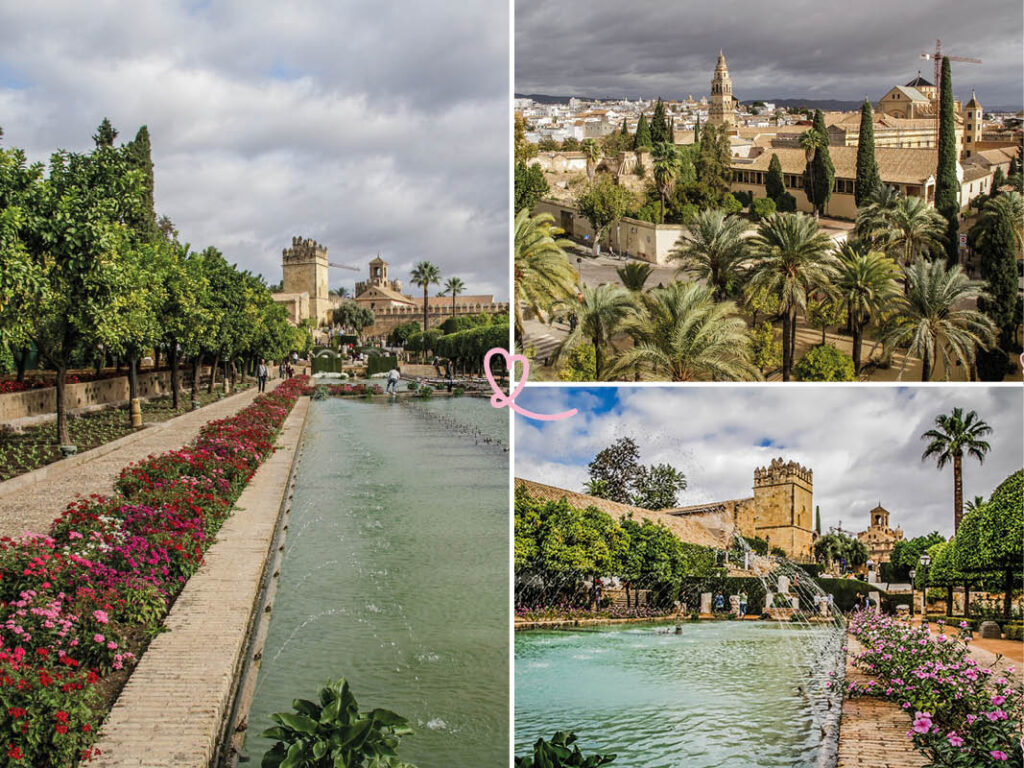
The Alcázar of the Christian Kings is a fortress and historic palace not to be missed in Cordoba. We were impressed by this monument of multiple architectural influences, which combines Roman, Visigoth and Moorish remains around a magnificent flower garden.
In this article, you’ll find some useful tips to help you prepare for your visit and have a wonderful time!
This opinion is completely independent, based on our experiences. We made our own choices, visited the area anonymously, and paid our bills in full.
Why visit the Alcazar of the Christian Kings
Is the Alcazar worth it? Our opinion:
Yes, the Alcazar is well worth a visit for several reasons:
- Unique Mudejar architecture combining Moorish influences and Christian techniques
- Its fascinating history as royal residence, seat of the Inquisition and prison
- Its magnificent gardens with ponds and fountains offer a haven of freshness.
- UNESCO World Heritage listing, attesting to its cultural value
- This is one of the most beautiful palaces in Andalucia!

Why is the Alcazar famous?
The Alcazar is famous for having been the residence of the Catholic Monarchs Isabella and Ferdinand for 8 years. Its unique Mudejar architecture, blending Muslim and Christian influences, earned it UNESCO World Heritage status in 1994. The monument is also known for having served as the seat of the Inquisition and as a civil and military prison over the centuries. Its gardens, adorned with magnificent ponds and fountains, are a great place to stroll, and we’re sure you’ll enjoy discovering them if you visit the Alcazar of Cordoba. Like Seville’s Real Alcázar, it’s one of the best things to see in Andalucia!
Book your guided tour ticket now!

Our favorite moments
- Climb the tower for an overview of the fortress and a glimpse of the Cathedral Mosque
- Stroll through the gardens with their fountains and beautifully shaped trees
- Admire Roman art in the Hall of Mosaics

WHERE TO STAY IN Cordoba
Our favorites: neighborhoods and hotels
Historic district
Hotel Las Casas de la Juderia – See prices, photos and availability
Hotel Madinat – See prices, photos and availability
Santa Marina district
Hotel Hospes Palacio del Bailio – See prices, photos and availability

See our complete selection of the best hotels in Cordoba
History in brief
The history of the Alcazar is full of twists and turns. Here’s what we’ve learned:
- 1236: Fernando III el Santo conquers Cordoba
- 1328: Alfonso XI begins construction of the Alcazar
- 1482: The Catholic Monarchs use the Alcazar as headquarters for the conquest of Granada
- 1486: Historic meeting between Isabella I of Castile and Christopher Columbus

How to get there: Alcazar of the Christian Kings, Cordoba
Where is the Alcazar?
- in the Judería district of Cordoba
- near the banks of the Guadalquivir river
- close to the famous Mezquita-Catedral, the Roman Bridge and the best things to see in Cordoba

RENT A CAR IN Andalucia
- Compare prices on our preferred platform: DiscoverCars – one of the best rated sites.
- Choose a compact car, as some villages have very narrow streets!
- Think ofcomprehensive insurance for the same reason
- Book early for choice.

How to get there?
There are several ways to get to Cordoba’s Alcazar:
- The site is easily accessible on foot.
- If you take public transport, the Puerta Sevilla stop on the city’s transport network is the nearest. To plan your itinerary, please consult the route maps, timetables and fares here.
- You can choose a sightseeing bus tour. Hop-on-hop-off buses are a great way to visit all the sights quickly and easily. Book your Hop-On-Hop-Off pass now.

Parking
We recommend the public parking lot on avenue Docteur Fleming, a 4-minute walk from the monument. For free parking, park on the other side of the Guadalquivir near the San Rafael bridge. From here, a pleasant 10-minute stroll along the Torre de la Calahorra and the Roman bridge will take you to the Alcazar.


Useful tips: duration, schedules, eating…
Best time to visit
We recommend avoiding July and August to avoid the crowds and the heat. Autumn and spring are ideal for enjoying the Alcazar to the full without contributing to overcrowding.

Length of visit and main difficulties
We recommend you allow around 2 hours to explore the entire site. This time will allow you to stroll through the gardens, climb the towers and admire this unique monument.
Note that the monument has staircases in the gardens and to the top of the towers. Disabled access is possible via the exit door leading directly to the gardens, after informing the main reception desk. Some areas are accessible via elevators, but the towers require staircases, and unfortunately there are no alternatives to these. Find out more here.

Advice on how to visit
The monument consists of 2 parts:
- an indoor museum area
- an outdoor area with gardens and fountains
There is no imposed direction of visit. We advise you to let your emotions guide you. It doesn’t matter whether you visit the gardens before or after discovering the towers!

PLAN YOUR DREAM TRIP TO andalucia
All the information you need for your trip:
- 7 maps that make planning easier
- + 150 pre-selected locations
- Practical advice
- 300+ photos to help you choose
Schedules and rates
Alcazar opening days and times vary according to the season:
- Summer (June 15 – September 15)
- Tuesday to Sunday and public holidays: 8.15 a.m. to 2.45 p.m.
- Winter (September 16 – June 14)
- Tuesday to Friday: 8.15 a.m. to 8 p.m.
- Saturday, 9:30 a.m. to 6 p.m.
- Sundays from 8.15 a.m. to 2.45 p.m.
Be sure to check out the latest information on the official website, here, before your visit.
Prices: €16 for adults, €8 for children over 10.
Book your guided tour ticket now!

Guided tours
We highly recommend a guided tour of this major historical monument in Cordoba. An official guide will show you the hidden treasures of the Alcazár and tell you the many stories that took place there.
Guided tours are organized daily. They last 1 hour and cost €16 for adults and €8 for children over 10. Find out more here.
Book your guided tour ticket now!

Catering
There are no catering facilities on site. On the other hand, you’re right in the center of town, close to a number of establishments. Discover our favorite restaurants in Cordoba, to enjoy before or after your visit.

Fortifications and emblematic towers of Cordoba’s Alcazar
The thousand-year-old walls of the Alcazar, witnesses to Andalucia’s history
We learned that the ramparts of the Alcazar of the Christian Kings bear witness to different historical periods. The current building, constructed on the site of an ancient Visigothic and later Moorish fortress, was erected during the reign of Alfonso XI of Castile in the 14th century. Its defensive architecture is characterized by massive walls built of ashlar blocks, forming an almost rectangular structure. It is flanked by 4 corner towers: the Tour des Lions, the Tour de l’Hommage, the Tour de l’Inquisition and the Tour des Colombes.

These thick walls protected the fortress and its occupants. Their strategic position, on the banks of the Guadalquivir, enabled them to control river access to the city. Note the architectural style, combining Gothic and Mudejar elements, reflecting the history of Cordoba after the Reconquista.
Over the centuries, the Alcazar has served a variety of functions: royal residence, seat of the Spanish Inquisition, military prison. We were amazed to learn that its walls have witnessed major historical events, such as the meeting between Christopher Columbus and the Catholic Monarchs around 1486.
Today, the Alcazar offers a fascinating glimpse into its rich multicultural past, where Roman and Visigoth remains stand side by side with Moorish and Christian architectural elements. Its thousand-year-old walls tell the complex story of Cordoba, a crossroads of civilizations that have each left their unique mark on this emblematic monument.

History and treasures of the Inquisition Tower
We enjoyed visiting and learning about the history of the Tower of the Inquisition, one of the 4 main towers of the Alcazar of Cordoba. Built in the 14th century, it is an important witness to the complex history of this monument. Did you know that it takes its name from the Spanish Inquisition of Cordoba, which took place in 1478 and during which it served as a siege?

Today, the Tower of the Inquisition houses some remarkable architectural and artistic features that bear witness to the Alcazar’s different eras. One of the highlights was a Roman sarcophagus, built in white marble and dating from the 3rd century. It features interesting details, such as an open door in the center representing Hades (the abode of the dead in Greek mythology). You can also see Roman mosaics, notably those found under the Plaza de la Corredera.

The 3 other tours: Leones, Homenaje and Colombes
We enjoyed exploring the other tours, each of which offers a unique experience. The Tower of the Lions (Torre de los Leones) is considered the oldest part of the fortified complex. It was our favorite for its exceptional view of Cordoba, the gardens and the archaeological remains of the Court of Women.
The Tower of Homage (Torre del Homenaje), also known as the Keep Tower, can be reached via a narrow passage from the Lions Tower. From here you can enjoy an interesting view of the Mezquita Catedral. Its distinctive silhouette elegantly dominates the horizon. We recommend that you take the time to observe the architectural details of these towers, which bear witness to the skills of medieval builders.

Last but not least, the Tower of the Doves (Torre de las Palomas) has a very special history. Did you know that it’s actually a “false tower”? We learned that it was destroyed in the mid-19th century and rebuilt in the second half of the 20th century, with the aim of restoring the Alcazar to its original appearance.
We enjoyed discovering these towers and their history. They helped us to appreciate the history and evolution of the Alcazar of Cordoba, while also offering some great views.

Moorish gardens of the Alcázar de los Reyes Cristianos
History and functions of Moorish gardens
The gardens you’ll admire during your visit date mainly from the 18th and 19th centuries, but are directly inspired by Moorish tradition. We were charmed by the characteristic layout, with its clipped box hedges, citrus groves and ingenious water features. As you stroll down the aisles, you’ll discover statues commemorating historical figures such as Christopher Columbus and the Catholic Monarchs. Did you know that these gardens hosted Cordoba’s first bullfight in 1492? It was organized in honor of Prince Don Juan. The peaceful atmosphere that prevails today contrasts with the bustle that must have reigned during these royal events.

During your stroll, you’re sure to appreciate the freshness provided by the various fountains and pools, so let’s talk about them in more detail! We were amazed to learn that the complex hydraulic system that has fed the Alcazar since Roman times is still in place today! Water is omnipresent in these gardens, and some of it still comes from an ancient Roman aqueduct. The canals and fountains that dot the gardens perpetuate a thousand-year-old tradition of hydraulic mastery, initiated by the Romans and perfected by Moorish architects, before being adapted to the tastes of subsequent eras.

The Morisco patio, almost unchanged since the 14th century
The Patio Morisco, also known as the Moorish Courtyard, is a remarkable feature of Cordoba’s 14th-century Alcazar. This patio is an excellent example of Moorish architecture in Christian Andalucia, influenced by the Almoravid style.
Observe its characteristic rectangular courtyard and note the 4 paths forming a central cross that leads to a fountain.

We loved its Persian-inspired gardens, home to a variety of fruit trees such as orange, lemon, pomegranate and laurel.
We learned that although the Alcazar has undergone modifications over the centuries, most notably in the 19th century when it was converted into a prison, the Patio Morisco has retained much of its original character. Visiting it will give you an authentic insight into the architecture and landscape design of medieval Andalucia.

Paseo de los Reyes, the Royal Promenade of Cordoba’s Alcazar
The Paseo de los Reyes, or Kings’ Promenade, particularly impressed us, with its majestic avenue lined with cylindrical cypress trees. This royal promenade, divided into two parallel paths separated by elegant, narrow basins that create a striking perspective effect, is one of the most remarkable features of Cordoba’s Alcazar gardens!
What makes this place even more remarkable are the sculptures that line it. You’ll discover statues of the kings who helped build the Alcazar, as well as a particularly significant sculpted group depicting Christopher Columbus alongside Queen Isabella and King Ferdinand. This work commemorates their first historic meeting, which took place in the very precincts of the Alcazar.

Along this walk, you’ll find several statues representing important historical figures linked to the history of the Alcazar. In particular, the effigies of the kings who played a significant role in the construction and history of the Alcazar. We also noticed the statues of Christopher Columbus, Isabella of Castile and Ferdinand of Aragon. Did you know that their “presence” commemorates an important historical event? The meeting between Columbus and the Catholic Monarchs in the Alcazar in 1486! This meeting was crucial to the organization of Columbus’s first voyage to the Americas.

A visit to the Paseo de los Reyes, with its architectural and sculptural features, will give you a true sense of the setting in which the important figures of the time lived. Our visit also made us aware of the historical importance of Cordoba’s Alcazar.

Frequently asked questions
Who built Cordoba’s Alcazar?
Alfonso XI of Castile began construction in 1328, preserving part of the ruins of the ancient Moorish fortress. Alfonso X the Wise initiated its restoration, which continued under the reign of Alfonso XI. Amirs Abd al-Rahman I and his successors also carried out work to adapt the site to Muslim customs.

Who lived in Cordoba’s Alcazar?
Over the centuries, it has been occupied by a succession of different occupants: the Visigoths with their initial fortress, the Umayyads who rebuilt the Caliphal Alcazar, Abd al-Rahman I who used it as a palace after establishing the Emirate of Cordoba, the Moors who enlarged it with baths and gardens, and finally the Catholic Monarchs who made it their principal residence after the Christian conquest in 1236.

What does Alcazar mean?
The word “Alcazar” comes from the Arabic “al-qasr” meaning “palace” or “fortress”. This is a term commonly used in Hispano-Moorish architecture to designate palace-fortresses built during the Al-Andalus period or inspired by it. This etymology reflects the Moorish architectural and cultural heritage of the Iberian Peninsula.

PLAN YOUR TRIP TO Andalusia
Inspiration

Practice

Places not to be missed


SHE MADE THE TRIP Claire