Planning a trip to south-east Spain? The Cabo de Gata-Níjar Nature Park in Andalucia is one of the best preserved jewels on the Mediterranean coast. We were won over by its wild beaches, secluded coves, white villages and volcanic landscapes of raw beauty. Between land and sea, this protected territory offers a rare diversity, far from mass tourism.
Discover our ideas for what to do in Cabo de Gata, illustrated with photos that will make you want to go. Bonus: useful tips and additional activities.
This opinion is completely independent, based on our experiences. We made our own choices, visited the area anonymously, and paid our bills in full.
Cabo de Gata: attractions and map
Here’s a map to help you find your way around and locate the places mentioned in this article:
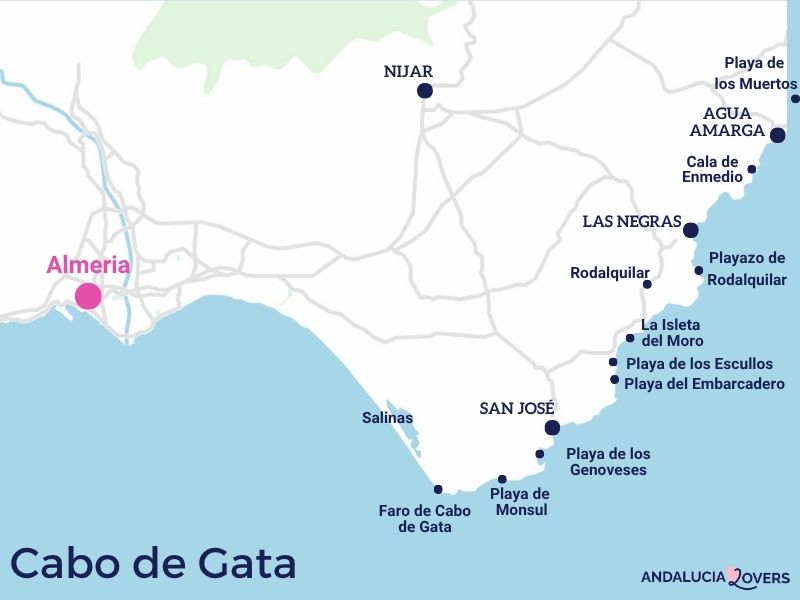
If you only have one day, it’s really hard to choose, but you can take a day trip by 4WD, boat, or kayak. Find all the day trips here. Or you can explore the region at your own pace, starting in the north:
- Playa de los Muertos
- Playazo de Rodalquilar
- La Iselta del Moro
- Playa de los Escullos
- Playa de Monsul
- Detour to the north (no road between playa de Monsul and Faro de Gato)
- Faro de Cabo de Gata
- Salinas – Book a guided tour

But we recommend that you spend at least one night there.
- For example in Agua Amarga – see the best rated accommodations
We enjoyed our night at the Hotel Senderos – Check photos and availability - or Las Negras
- or San José
- See the best rated accommodations in Cabo de Gata
WHERE TO STAY IN Almeria
Our favorites: neighborhoods and hotels
Downtown
Murallas de Jayran Boutique Hotel – See prices, photos and availability
Seaside
El Rincon de Huete Apartment – See prices, photos and availability

See our complete selection of the best hotels in Almería
1. Discover Rodalquilar’s Playa del Playazo

Why visit?
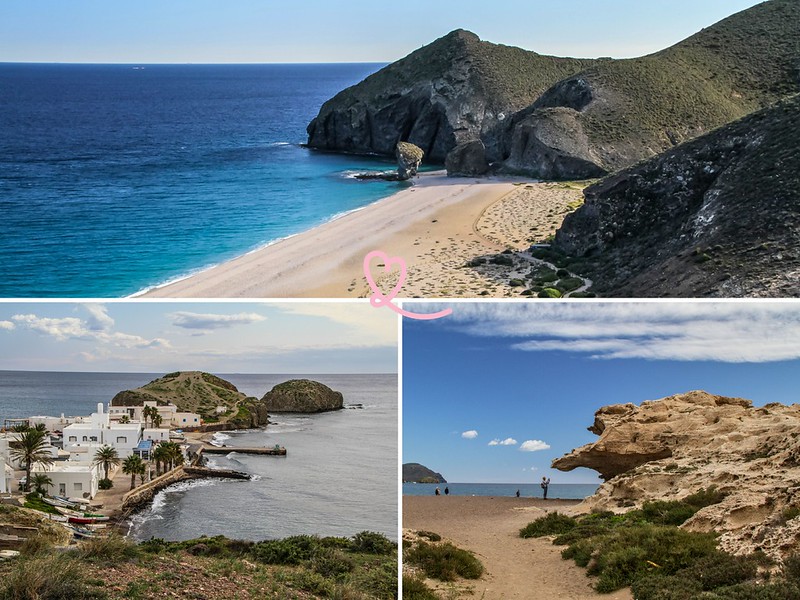
Let’s start with our favorite, rarely mentioned first. Playa del Playazo de Rodalquilar is a vast stretch of fine sand protected by the Castillo de San Ramón, an 18th-century watchtower that still keeps watch over the bay. Its crystal-clear waters and virtually untouched natural setting make this beach a real attraction.
We found the perfect spot for a lazy day away from the hustle and bustle. You can also explore the rocks, views and small coves that line the beach at its extremities. The seabed, rich in posidonia, is ideal for snorkeling.

Practical advice
- Length of visit: 2 hours to half a day
- Opening hours: free access all year round
- Difficulties and PRM access: relatively flat beach, easier access than most of the park’s coves. The parking lot is located right next to the sand.
- Rates: free access

- Access: from Rodalquilar, follow the “Playazo” signs for about 4km of tarmac road, then a track.
- Parking: free underground parking a few dozen meters from the beach.
- Catering: no on-site catering. Plan your supplies. The nearest shops are in Rodalquilar.
RENT A CAR IN Andalucia
- Compare prices on our preferred platform: DiscoverCars – one of the best rated sites.
- Choose a compact car, as some villages have very narrow streets!
- Think ofcomprehensive insurance for the same reason
- Book early for choice.

2. Venture to Playa de los Muertos

Why visit?
Regularly ranked as one of Spain’s most beautiful beaches, Playa de los Muertos impresses with the purity of its turquoise waters and sea-polished white pebbles. Located to the south of Carboneras, it takes its name from the ocean currents that once brought the bodies of shipwrecked sailors to its shores.
We were struck by the wild beauty of this place, surrounded by sheer cliffs of ochre and grey hues. You’ll have to take a steep path to get down there, but the effort is well worth it. The seabed is remarkably clear, making it a popular spot for snorkeling.

Practical advice
- Visit duration: 20min for the view from the top to half a day
- Opening hours: free access all year round
- Difficulties and PRM access: the descent to the beach is steep and takes around 15-20min. Stony path, closed shoes recommended. Not wheelchair accessible. The climb back up in the heat can be very tiring, so make sure you have plenty of water.
- Rates: free access
- Access: from Carboneras, follow the AL-5106 road south for about 2km to the parking lot.
- Parking: free dirt roadside parking, approx. 15-20min walk from the beach.
- Catering: no shops or water points on the beach. Make sure you bring plenty of water and food.
3. Stroll around La Isleta del Moro

Why visit?
La Isleta del Moro is a tiny fishing village nestled on a small peninsula. Its white houses, colorful boats and tranquil atmosphere make it one of the park’s most photogenic hamlets. We loved the authenticity of this place, where time seems to have stood still. You can enjoy fresh fish in one of the village’s small restaurants, with your feet almost in the water.
The small pebble beach also offers a pleasant setting for a quick swim. From the village, a coastal path takes you to Playa del Peñón Blanco in just a few minutes’ walk.

Practical advice
- Tour duration: 30min to 2h
- Opening hours: village open all day
- Difficulties and PRM access: the village is compact and flat. The coastal path to nearby beaches has some stony stretches.
- Rates: free access

- Access: from the AL-4200 road between Rodalquilar and San José, follow the “La Isleta del Moro” sign. Tarmac road to village.
- Parking: small free parking lot at the entrance to the village. Very limited space in high season.
- Eating & Drinking: several fresh fish restaurants in the village, including Restaurant Isleta del Moro.
PLAN YOUR DREAM TRIP TO andalucia
All the information you need for your trip:
- 7 maps that make planning easier
- + 150 pre-selected locations
- Practical advice
- 300+ photos to help you choose
4. Visit the Faro de Cabo de Gata and the Mirador de las Sirenas

Why visit?
The Faro de Cabo de Gata, located at the south-eastern tip of the park, is one of the strongest symbols of this region. This white lighthouse, built in 1863, stands facing the Mediterranean in a windy, mineral setting. A few steps away, the Mirador de las Sirenas offers a bird’s-eye view of the reefs of Arrecife de las Sirenas, volcanic rock formations that emerge from the sea like petrified chimneys.
We found the panorama striking, when the blue of the sea stands out clearly against the dark rock. You can take advantage of this vantage point to observe the coastline and, if you’re attentive, spot the monk seals that gave their name to the place (the “mermaids” actually being these marine mammals).

Practical advice
- Tour duration: 30min to 1h
- Opening hours: free access all year round. The lighthouse is not open to the public.
- Access for wheelchair users: the viewpoint is accessible from the parking lot via a short path. A few steps down to the main viewpoint, not wheelchair-friendly.
- Rates: free access
- Access: from the village of Cabo de Gata (also known as San Miguel de Cabo de Gata), follow the coastal road south for about 5km.
- Parking: free parking near the lighthouse.
- Catering: no on-site catering. The nearest restaurants are in the village of Cabo de Gata or at La Almadraba de Monteleva.
5. Admire Playa de Mónsul

Why visit?
Playa de Mónsul is undoubtedly Cabo de Gata’s most photographed beach. Its immense volcanic rock, planted in the middle of the sand, gives it a spectacular appearance. This unique setting was also used as a film location for Indiana Jones and the Last Crusade.
We were seduced by the striking contrast between light sand, dark rock and the deep blue of the sea. You can climb the sand dune to enjoy an elevated view of the bay. The beach is also surrounded by fossilized dunes that bear witness to the region’s past volcanic activity.

Practical advice
- Visit duration: 45 minutes to half a day
- Opening hours: free access all year round. As with Los Genoveses, access by car may be limited in summer by a shuttle service from San José.
- Difficulties and PRM access: the path from the parking lot is sandy but generally flat. Not suitable for wheelchairs due to soft floor.
- Rates: free access
- Access: from San José, 4km drive. Same route as for Playa de los Genoveses, continuing further south.
- Parking: free underground parking. Very popular in high season, so arrive early.
- Catering: no service on the beach. Refreshments in San José before setting off.
- Read our article on Playa del Monsul for more information
Subscribe to our Newsletter
- Get away from it all with Region Lovers’ beautiful destinations!
- Once a month
- Advertising-free
6. Lounging on Playa de los Genoveses

Why visit?
Playa de los Genoveses is one of the most emblematic beaches in the Cabo de Gata Natural Park. This large cove of golden sand, bordered by arid hills and low vegetation, stretches for around 1km in a totally unspoilt setting. No construction breaks the harmony of the landscape.
We particularly appreciated the peaceful atmosphere here, even in midsummer. The shallow, calm waters are ideal for families. The beach’s name refers to the Genoese sailors who once docked in this wind-protected bay.

Practical advice
- Length of visit: 2 hours to half a day
- Opening hours: free access all year round. In summer (July-August), the access road by car may be closed and regulated; a shuttle service is then provided from San José.
- Access for wheelchair users: the dirt path leading to the beach from the parking lot is passable on foot, but not suitable for wheelchairs. Sandy, uneven terrain on the last few metres.
- Rates: free access
- Access: from San José, follow the carriage road southwards for about 3km. Accessible by car outside the summer season, on foot or by shuttle bus in summer.
- Parking: free dirt parking at the top of the beach (limited spaces). In summer, we recommend arriving early in the morning.
- Restaurants: no shops on the beach. Bring water and a picnic. The nearest restaurants are in San José.
- Read our article on Playa de los Genovenes for more information here
7. Explore the fossilized dune at Playa Los Escullos

Why visit?
Playa Los Escullos is a golden sand beach dominated by a petrified fossil dune, a spectacular vestige of the region’s volcanic activity. We loved this unique geological formation, several meters high, and spent a lot of time exploring it.
You can also see the Castillo de San Felipe, an 18th-century coastal fortification built to protect the coast from pirate raids. Shallow waters and fine sand make this a good choice for families. Nearby, the hamlet of Los Escullos has a few lodgings and a campsite.

Practical advice
- Visit duration: 30min to half a day
- Opening hours: free access all year round
- Difficulties and PRM access: easy beach access from parking lot. Flat terrain, but not wheelchair accessible.
- Rates: free access

- Access: from the AL-4200 road, follow signs to Los Escullos. Tarmac road.
- Parking: free parking near the beach.
- Catering: a bar-restaurant in the hamlet of Los Escullos. You’ll need to bring your own provisions if you’re planning a long stay.
8. Hike to Cala de Enmedio

Why visit?
Cala de Enmedio is a secluded, unspoilt cove nestling between the cliffs south of the village of Agua Amarga. Accessible only on foot, this cove rewards walkers with clear blue waters and white rock formations sculpted by erosion. We loved this secret little beach, which retains its wild, intimate character thanks to its isolation.
You can swim in crystal-clear waters and explore the rocks that line the cove. The path leads through a landscape of arid garrigue and limestone cliffs, offering fine views of the coastline.

Practical advice
- Length of visit: 2h to half a day (including round-trip walk)
- Opening hours: free access all year round
- Difficulty and access for wheelchair users: approx. 45-minute hike from Agua Amarga (approx. 3km one way). Stony path, some uneven sections. Hiking boots recommended. Not wheelchair accessible. There’s no shade on the trail, so bring a hat and sun cream.

- Rates: free access
- Catering: no service on the creek. Take plenty of water with you. Restaurants in Agua Amarga.
9. Enjoy outdoor activities: boating, kayaking, biking…

Why visit?
Cabo de Gata Natural Park is an exceptional playground for water and land sports enthusiasts. The crystal-clear waters and protected seabed offer ideal conditions for kayaking, snorkeling, and scuba diving. We especially enjoyed the kayaking trips along the volcanic cliffs, which provide access to coves that are inaccessible by land.
You can also take a boat tour departing from San José or Las Negras to explore the coastline from the sea. Boat trips usually include swimming stops in secret coves. Scuba diving allows you to explore Posidonia seagrass beds and observe a variety of marine life, including groupers, octopuses, and barracudas. >>> See all the options available online!

10. Flamingo watching at the Salinas de Cabo de Gata

Why visit?
The Salinas de Cabo de Gata are a vast salt lagoon stretching between the village of Cabo de Gata and La Almadraba de Monteleva. This site, exploited since ancient times for salt production, is now home to one of the most important bird sanctuaries in southern Spain. We were amazed to see colonies of pink flamingos feeding peacefully in the shallow pools.
Depending on the season, you can observe avocets, white stilts, grey herons and many migratory birds. Observation posts line the perimeter of the lagoon, facilitating observation without disturbing the wildlife. The contrast between the rosy waters of the saltworks and the surrounding arid landscape creates a remarkable natural tableau.
Sorry for the poor quality of the photos, but they are flamingos.

Practical advice
- Tour duration: 1 to 2 hours
- Opening hours: free access all year round. Flamingos are mainly present from October to March, but some individuals stay all year round. The early hours of the day are ideal for observation.
- Difficulties and PRM access: flat, easily accessible terrain. Observation posts are located along the roadside.
- Rates: free access
- Access: the saltworks border the main road through the village of Cabo de Gata (ALP-202).
- You can also take a guided tour and learn more about the salt flats. Book your tour now.
11. Explore the Playa del Embarcadero

Why visit?
Playa del Embarcadero, located near the hamlet of Los Escullos, takes its name from the old pier once used to load ore from nearby mines. This small stretch of coastline retains an atmosphere steeped in history. We found this beach very pleasant, especially if you go up the little hill for a nice view.

Practical advice
- Visit duration: 45min to 2h
- Opening hours: free access all year round
- Difficulties and PRM access: easy access from the hamlet of Los Escullos. Terrain not suitable for wheelchairs.
- Rates: free access
- Access: from Los Escullos, short walk of a few minutes.
- Parking: use the Los Escullos parking lot.
- Catering: bar-restaurant in the nearby hamlet of Los Escullos.
12. Enjoy the panorama from Mirador de La Amatista

Why visit?
Mirador de La Amatista is located on the coastal road between Rodalquilar and Las Negras. This natural belvedere offers breathtaking views of the volcanic cliffs, the coves below and the immensity of the Mediterranean. The soil contains amethyst quartz inclusions, which give the place its name.
Here you can observe the colorful geological strata of the cliffs, witness to the volcanic activity that shaped the park millions of years ago. It’s an ideal stop for photographers and geology enthusiasts. The site is also the starting point for coastal hiking trails.

Practical advice
- Visit duration: 20min to 1h (longer if you use the hiking trails)
- Opening hours: free access all year round
- Difficulties and access for disabled people: the viewpoint is close to the road and easily accessible. The hiking trails below are more demanding.
- Rates: free access
- Access: on the coastal road between Rodalquilar and Las Negras, well signposted.
- Parking: small dirt parking lot by the road.
- Catering: no service on site.
13. Relaxing in Agua Amarga

Why visit?
Agua Amarga is a peaceful coastal village in the northern part of Cabo de Gata Natural Park. Its white sandy beach, around 500m long, is lined with whitewashed houses and a few seaside restaurants. We enjoyed the relaxed atmosphere of this village, which combines tranquility and convenience without sacrificing its authentic character.
You’ll be able to enjoy calm, transparent waters, perfect for a swim in complete serenity. The village is also the starting point for the hike to Cala de Enmedio. Take a stroll through the narrow streets and you’ll discover the old mining pier, a vestige of the days when iron ore was exported from this coastline.

Practical advice
- Length of visit: 2 hours to half a day
- Opening hours: village open all day
- Handicap access: accessible beach, flat terrain in the village. No particular difficulties.
- Rates: free access
- Access: from Carboneras or the AL-5106 road, follow signs to Agua Amarga.
- Parking: free underground parking lot at the entrance to the village. In high season, places fill up fast.
- Eating out: several restaurants and bars in the village, some of which offer fresh fish and seafood.
14. Visit Rodalquilar and its gold mines

Why visit?
Rodalquilar is a village with a fascinating mining past, nestled in an arid valley in the heart of the park. From the late 19th century to the 1960s, gold was mined here. The former mining installations, now abandoned, offer a singular backdrop, between industrial ruins and desert landscapes. We found the atmosphere of the site very special. The village is also home to the Jardín Botánico El Albardinal, a garden dedicated to the park’s endemic flora.

Practical advice
- Visit duration: 15 min to 3h (village + mines + botanical garden)
- Opening hours: the mining ruins are freely accessible. Jardín Botánico El Albardinal’s opening hours vary according to the season (generally Tuesday to Sunday, check with local authorities).
- Difficulties and access for disabled people: the village is accessible by car. Mine ruins have uneven ground and unsecured structures, so caution is advised. Not suitable for wheelchairs.
- Free admission to the botanical garden.
- Access: from the AL-4200 road, Rodalquilar is well signposted. Tarmac road.
- Parking: free parking in the village.
- Catering: Limited offer, please bring your own provisions if necessary.
15. Count the windmills in Cabo de Gata

Scattered across the park’s arid landscape, Cabo de Gata’s windmills bear witness to a bygone agricultural past. These cylindrical stone constructions, topped with conical roofs, were once used to grind grain thanks to the constant winds that sweep through the region. We spotted several of these mills along the way, notably on the outskirts of the village of Cabo de Gata and on the heights of Fernán Pérez. You’ll easily recognize them by their distinctive silhouette against the horizon. Some have been restored and are in a remarkable state of preservation. They make a great photographic subject, especially when the clear sky highlights their rounded shape against a desert landscape.
Subscribe to our Newsletter
- Get away from it all with Region Lovers’ beautiful destinations!
- Once a month
- Advertising-free
What to do in Cabo de Gata: other ideas
Other villages in Cabo de Gata
Cabo de Gata Natural Park is home to other coastal villages well worth a visit.
Las Negras is a fishing hamlet bordered by a beach of dark volcanic pebbles. From the village, a coastal path leads to the secret cove of Cala de San Pedro, accessible only on foot or by boat. We found the village atmosphere very relaxed, between the restaurant terraces and the boats pulled up on the shore.
San José is the park’s liveliest village and a good base for exploring the south coast. Its sandy beach is pleasant, and here you’ll find the largest concentration of shops, restaurants and services in the park. It’s also the starting point for the beaches of Los Genoveses and Mónsul. We used it as a base camp during our stay.

El Pozo de los Frailes, a few kilometers inland from San José, is a small rural village dominated by a restored windmill. Here you can enjoy the peace and quiet of the park’s hinterland and discover traditional Almerian architecture. It’s a quick but pleasant stop if you take the road between San José and the national highway.
Other buildings and monuments in Cabo de Gata
The park also boasts a number of historic buildings that bear witness to its maritime and defensive past. The Torreón de San Miguel de Cabo de Gata is an 18th-century coastal watchtower in the village of the same name. It was part of a network of fortifications designed to protect the coast from pirate attacks.

TheIglesia de La Almadraba de Monteleva is a small religious building located in the hamlet of La Almadraba, between the saltworks and the lighthouse. This modest place of worship reflects the way of life of the area’s former fishermen. At the northern end of the park, Faro de Punta de la Polacra stands on an isolated promontory. Less well known than the main lighthouse, it offers a wild setting in which to contemplate the coastline. Finally, the Castillo de San Pedro, located on the coast, is a defensive fortress that completes the park’s network of watchtowers.
Excursions around Cabo de Gata
Almería and the Alcazaba
The town of Almería, about 30 minutes’ drive from the park, is worth a visit for its imposing Alcazaba, Spain’s largest Moorish fortress after the Alhambra. We enjoyed the panoramic views of the city and port from the ramparts. You can also stroll through the historic center and visit the one-of-a-kind cathedral-fortress. See the attractions in Almería.

The Tabernas desert
Around 45 minutes north of Almería, the Tabernas desert is the only desert in the strict sense of the word in Europe. This lunar landscape served as the backdrop for numerous Hollywood westerns in the 1960s and 1970s. You can visit the Fort Bravo or Oasys MiniHollywood movie studios, which feature shows and reenactments. We found the contrast between the Cabo de Gata coastline and this arid hinterland striking. You can also explore the desert on horseback or by motorcycle! Find all the activities in the Tabernas Desert here.

Carboneras
Located on the northern edge of the park, Carboneras is a small coastal town with a long sandy beach and a pleasant seafront. We enjoyed a lunch break here, in one of the seaside restaurants serving fresh fish. You can also visit the Castillo de San Andrés, a 16th-century fortress built by the Marquis del Carpio.
Is Cabo de Gata Natural Park worth a visit?
Without hesitation, yes. Cabo de Gata-Níjar Nature Park is one of the few Mediterranean coastal areas to have been spared massive tourism development. Its wild beaches, fishing villages and volcanic landscapes offer an authentic travel experience.

We recommend a minimum of 2-4 days to explore the main sites without rushing. If you’re looking for a natural destination in Andalucia, away from the crowds of the Costa del Sol, Cabo de Gata is a choice you won’t regret.
Useful tips for visiting Cabo de Gata
Where is Cabo de Gata?
- Cabo de Gata-Níjar Nature Park is located in the province of Almería, in south-east Andalucia, Spain.
- From Almería to the village of Cabo de Gata = approx. 30min drive
- FromAlmería to San José = about a 40-minute drive
- Granada to San José = approx. 2h30 drive
- From Almería airport to San José = approx. 45min drive

It’s time to book!
Compare everything: airlines, prices, schedules, and availability.
How do I get to Cabo de Gata?
The nearest airport is Almería (LEI), with flights from Madrid, Barcelona and several European cities. From the airport, a rental car is the most convenient way to get to the park and get around there. Regional buses also link Almería to some of the park’s villages, such as San José, but frequencies are limited, especially out of season. If you’re arriving by train, Almería station is connected to Madrid and other major Spanish cities.
You can also choose to go on day trips, particularly those departing from Almería. For example, 4WD tours in the park are a great way to explore Cabo de Gata.

Parking in Cabo de Gata
Parking in Cabo de Gata Natural Park is generally free. Most beaches and villages have undeveloped dirt parking lots. In high season (July-August), places are very much in demand on the most popular beaches, such as Los Genoveses, Mónsul or Playa de los Muertos. We advise you to arrive early in the morning to ensure a place. In San José, pay parking is available in the village center. For Los Genoveses and Mónsul beaches, the access road may be closed in summer and replaced by a shuttle service from San José.
Getting around Cabo de Gata
The car is the most practical means of transport for exploring the park. Villages and beaches are scattered over a vast area, and public transport remains limited. Bus services link Almería to San José and a few other villages, but frequency is low. Rent a car here!
Where to eat in Cabo de Gata
Cabo de Gata is a paradise for lovers of fresh fish and seafood. In every coastal village, you’ll find restaurants serving the catch of the day. We appreciated the simplicity and freshness of the dishes served at La Isleta del Moro and Agua Amarga. San José offers the most varied choice of restaurants.
Visiting Cabo de Gata in winter
Planning to visit Cabo de Gata out of season? The park is ideal for a winter visit. Temperatures remain mild (around 15°C on average) and visitor numbers are much lower. The park is all the more enjoyable outside summer, when the beaches are almost deserted and the winter light highlights the volcanic relief. This is also the best time to see the pink flamingos in the Salinas. But the water temperature drops to around 15-16°C. Hiking is more comfortable without the summer heat.
PLAN YOUR TRIP TO Andalusia
Inspiration

Practice

Places not to be missed