Visiting Cordoba? Immerse yourself in history with a visit to the magnificent Historic Jewish quarter of La Judería. His synagogue dating from the 14th century, isone of only 3 medieval Hebraic monuments preserved in Spain, making it a unique treasure in Andalucia.
In this article, you’ll find our photos and tips for making the most of your visit to Cordoba’s Synagogue and Judería Quarter.
This opinion is completely independent, based on our experiences. We made our own choices, visited the area anonymously, and paid our bills in full.
Why visit the Synagogue and the Judería?
Are the Synagogue and Jewish Quarter worth it? Our opinion:
Yes, it’s well worth the visit! The Cordoba Synagogue is a 14th-century Mudejar building, listed as a UNESCO World Heritage Site. We were particularly impressed by its exceptional state of preservation and its unique wall decorations, which bear witness to the city’s rich Sephardic history. The area that houses it, the Judería, Cordoba’s ancient Jewish quarter, is also fascinating , with its winding streets and typical Sephardic architecture. It’s one of the best things to do in Cordoba!

Why are they famous?
The Cordoba Synagogue is famous for being the only preserved medieval synagogue in Andalucia. It is also one of only 3 preserved Spanish synagogues dating from before the expulsion of the Sephardic community in 1492. As for the Judería district, it is famous for having been the beating heart of Cordoba’s Jewish community for centuries. Together, they bear witness to the importance of Hebrew culture in the city’s history, particularly during the golden age of Al-Andalus.
Discover Cordoba’s Juderia and Synagogue with an expert guide – find out more and book

Our favorite moments
You’ll find the details of our visit later, but we can’t resist sharing our favorites with you right now:
- The impressive state of conservation of the Synagogue and its mural decorations, which enabled us to make the link with the city’s Sephardic past.
- Discover the Judería district , with its unique atmosphere and white alleyways
- Immerse yourself in the history of Cordoba through that of Spain’s Jewish community.

WHERE TO STAY IN Cordoba
Our favorites: neighborhoods and hotels
Historic district
Hotel Las Casas de la Juderia – See prices, photos and availability
Hotel Madinat – See prices, photos and availability
Santa Marina district
Hotel Hospes Palacio del Bailio – See prices, photos and availability

See our complete selection of the best hotels in Cordoba
History in brief
Here are the milestones in the history of Cordoba’s Jews, which have influenced the history of their neighborhood (Juderia) and its synagogue:
- 8th-12th centuries: Golden age of the Sephardic community under the rule of Al-Andalus
- 1236: Cordoba comes under Christian control
- 1315: Isaq Moheb builds the Synagogue
- 1492: Expulsion of Jews from Spain, the synagogue was converted into a hospital, then a hermitage in 1588, before becoming a public school in the 19th century.
- 1994: Cordoba Synagogue listed as a UNESCO World Heritage Site

Access: Synagogue and Judería district, Cordoba
Where are the Synagogue and the Quartier de la Judería?
The Cordoba Synagogue is located right in the city center:
- It is located at Calle Judíos, 20, in the Judería district.
- Close to the Mosque-Cathedral and the Roman Bridge
- In the historic heart of Cordoba
Cathedral Mosque, Alcazar, Juderia, Roman Bridge… Book a guided tour to discover Cordoba’s landmarks!

RENT A CAR IN Andalucia
- Compare prices on our preferred platform: DiscoverCars – one of the best rated sites.
- Choose a compact car, as some villages have very narrow streets!
- Think ofcomprehensive insurance for the same reason
- Book early for choice.

How to get there?
There are several options for getting to the Juderia district:
- The neighborhood and synagogue are within easy walking distance.
- By public transport:
- if you’d like to start by visiting the Juderia district and then the synagogue: get off at the“El Potro (la Ribera)” stop, then walk up to the synagogue at your own pace.
- if you’d like to start by visiting the synagogue and then the “Quartier de la Juderia”: get off at the“Vallellano (Comisaría)” stop near the synagogue, and after your visit to the building, discover the Jewish quarter that houses it.
To plan your itinerary, please consult the route maps, timetables and fares here.
- You can choose a sightseeing bus tour. Hop-on-hop-off buses are a great way to visit all the sights quickly and easily. Book your Hop-On-Hop-Off pass now.

Parking
The nearest parking lot is the Cordoba Mosque Car Park, about a 1-minute walk away.

Useful tips: duration, schedules, eating…
Best time to visit
We recommend an early morning or late afternoon visit. This avoids the intense afternoon heat, especially in summer.
Spring and autumn are generally the best seasons to visit Cordoba, as the climate is milder, with pleasant temperatures and fewer crowds than in summer. You’ll be surprised to discover that even in winter, a visit to Cordoba is full of surprises!

Length of visit and main difficulties
Allow around 1/2 day to discover the Juderia and its synagogue, depending on your pace, your interest in history and the number of sites visited.
We noted the presence ofstairs in the synagogue to access the upper floor, and there is no elevator. The Jewish Quarter, on the other hand, has irregular cobblestones and narrow streets that can make walking a little tricky, complicating a visit in a wheelchair or stroller.

Advice on how to visit
There is no set direction for your visit, but we suggest that you..:
- Start by visiting the synagogue
- Explore the Jewish Quarter, a UNESCO World Heritage Site since 1994, with its narrow streets and historic buildings.
- Then discover the district’s emblematic monuments, including the Casa de Séfarad and Tiberias Square.
- End with a meal in a typical Sephardic restaurant
Alternatively, you can follow the itinerary suggested by the Spanish Jewish Neighborhoods Network, which can be identified by the dedicated bronze plaques. Find out more here.

PLAN YOUR DREAM TRIP TO andalucia
All the information you need for your trip:
- 7 maps that make planning easier
- + 150 pre-selected locations
- Practical advice
- 300+ photos to help you choose

Visiting with children
In the absence of specific activities for children, the district offers a real journey back in time with its mysterious alleyways. Children can have fun spotting the bronze plaques that guide the tour and discovering the history behind the various monuments.
Schedules and rates
Cordoba Synagogue:
- Opening hours: between June 16 and September 15: Tuesday – Sunday, 9 a.m. to 3 p.m. September 16 to June 15: Tuesday – Saturday, 9am to 9pm and Sunday, 9am to 3pm.
Closed on Monday - Admission: free.
We recommend that you check the latest information on the building’s official website, here, before your visit.
Cordoba’s Juderia district: you can visit the Jewish quarter at any time of the day or night.

Guided tours
To visit the Juderia with a guide, you have 3 options:
- If you want to discover Cordoba’s main monuments: cathedral mosque, alcazar, Juderia, synagogue… Book a guided tour to discover the city’s landmarks!
- To learn more about Cordoba’s Sephardic heritage with an expert guide: opt for a historical tour of the Juderia, its jewels and the synagogue.
- In autonomous mode: explore Cordoba at your own pace with a smartphone audio tour.

Catering
There are no catering facilities on site. On the other hand, you’re right in the center of town, close to a number of establishments. Discover our favorite restaurants in Cordoba, to enjoy before or after your visit.

Discover Cordoba’s historic Judería quarter
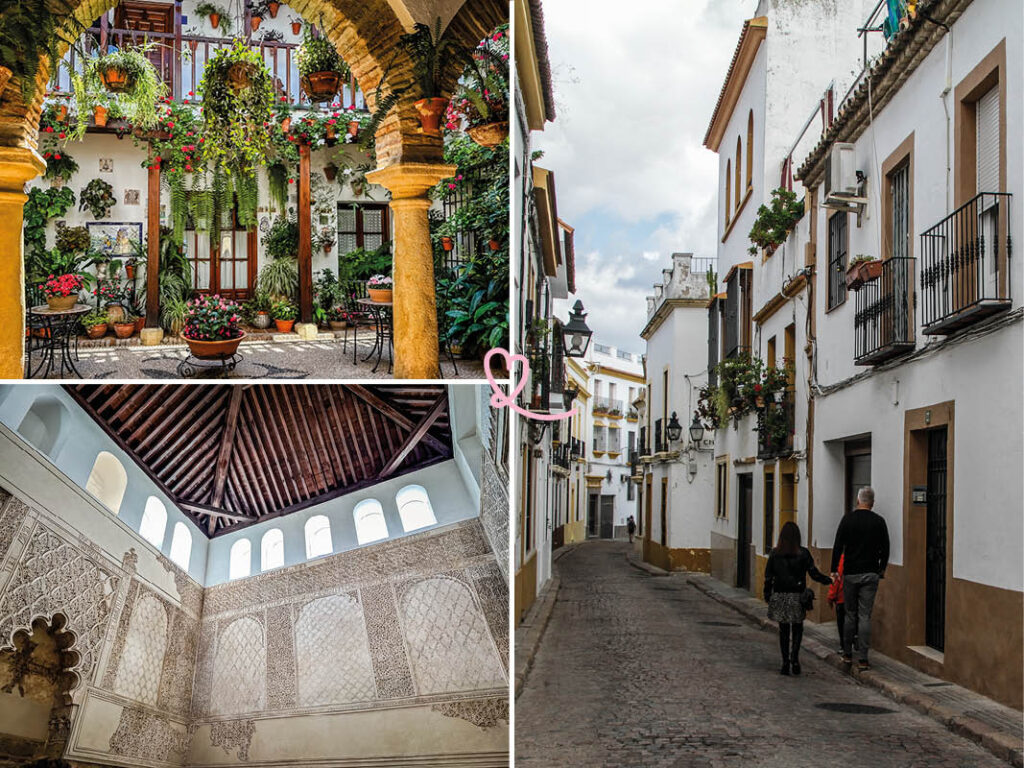
We really enjoyed exploring this area of timeless charm. Wandering through its winding streets, we were seduced by the whitewashed houses, adorned with flower-filled patios that you sometimes have to spy behind their wrought-iron gates. During your visit, you’ll be able to wander between the small squares, where you’ll sometimes find fountains to refresh this picturesque maze. We have fond memories of the colorful patios, the pride of Cordoba’s inhabitants. To lose oneself in the heart of the old Jewish quarter is to travel back in time, to the days when the Judería was a place bustling with the daily life of the Sephardic community, between traditions, trade and cultural richness.

Understand the history and evolution of the Jewish Quarter over the centuries
This neighborhood of Hebraic heritage bears witness to a rich and eventful history. We’ve been fascinated by its evolution, from the golden age of the Sephardic community to the present day. You’ll discover that under Muslim rule, between the 8th and 12th centuries, Judería was a major intellectual center. Personalities such as Maimonides, one of the most illustrious figures in the Sephardic community and in Jewish intellectual history, lived here.

After the Christian Reconquista in the 13th century, the neighborhood underwent profound transformations. Restrictions on the Jewish community gradually intensified, culminating in the Edict of Expulsion of 1492 (more here). Today, as you stroll through these alleys steeped in history, you’ll be struck by how this heritage has survived the centuries. Listed as a UNESCO World Heritage Site since 1984, it bears striking witness to the cultural and historical importance of Cordoba’s Judería.

Visit the Cordoba Synagogue: a jewel of Hebrew culture
The Cordoba Synagogue is particularly impressive for its state of preservation! Not to be missed on your trip to Cordoba, it comprisesa mainhall, which is very busy but well worth a visit. We loved its richly carved stucco walls.

The building is divided into several distinct sections: from the entrance, you first enter a patio, then a hall adorned with a magnificent wooden ceiling. This hall leads to the women’s area via a wooden staircase. We also saw the site of an ancient ablutions basin. The main prayer room (approx. 40 m2), with its high joisted ceiling and Hebrew-inscribed walls, is the highlight of the visit.

History and architecture of the Cordoba Synagogue
Built in 1315, the Cordoba Synagogue boasts a unique architectural style, combining Mudéjar elements with features typical of Hebrew culture. For example, you can see the Mudejar influence in the poly-lobed arches and geometric motifs, typical of Moorish art, that adorn the walls and ceilings. The Sephardic tradition is reflected in the layout of the synagogue, which faces Jerusalem, and in the Hebrew inscriptions decorating certain parts of the building. These combined influences testify to the cultural richness of the period, when different communities coexisted and probably exchanged know-how.

We were particularly impressed by the front door, richly decorated with Mudéjar yeserías. Note the 3 small lobed-arch balconies. Open your eyes and you’ll see that the surroundingalfiz (rectangular frame) is adorned with psalms. We enjoyed discovering the fascinating history of the building: after the expulsion of the Sephardic community in 1492, it was successively transformed. First as a hospital to treat rabies, then as a hermitage in 1588. In the 19th century, it became a public school, before finally being restored in 1884.

Frequently asked questions
What else should you see in Cordoba’s Judería district?
The area is full of interesting places to discover. In particular, we recommend a visit to
- La Calle de los Judios
- The picturesque Calleja de las Flores
- La Casa de Sefarad
- Maimonides Square
- Rafael Boti Foundation
- The Alchemy Museum
- The chapel of San Bartolomé
- Plaza de Tiberíades
- The statue of Maimonides
- A typical Sephardic restaurant

What does the word “judería” mean?
In Spanish, the word“judería” refers to a Jewish neighborhood or urban area where a Sephardic community predominantly resided within a city. The term derives from the Spanish word“judío“, meaning “Jew”.

PLAN YOUR TRIP TO Andalusia
Inspiration

Practice

Places not to be missed


SHE MADE THE TRIP Fanny