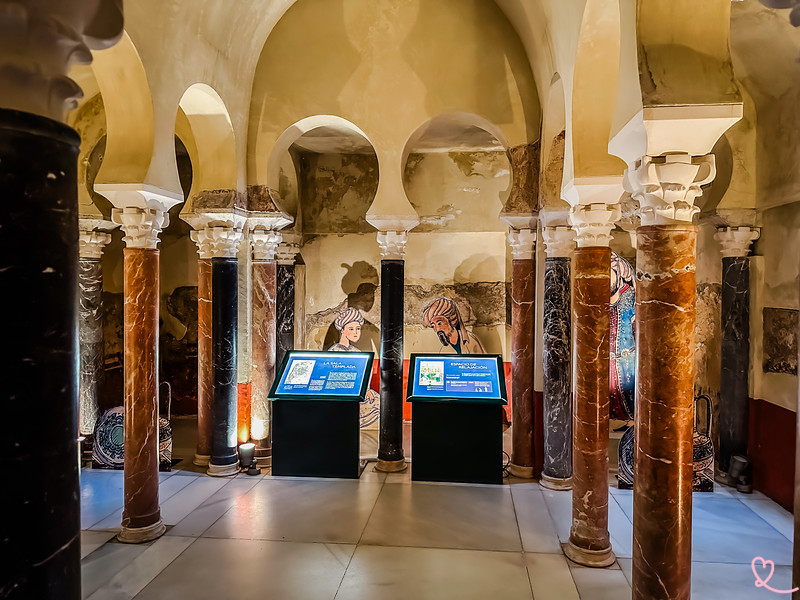
In the heart of Cordoba are the Banos Califales, ancient Arab baths dating back to the 10th century, with a rich history spanning the centuries! We enjoyed discovering the exceptional remains of these thermal baths built under the Caliph Al-Hakam II. With their vaulted rooms and star-shaped dormer windows, these former caliphal baths are the main vestige of the Alcázar Califal.
In this article, you’ll find a selection of useful tips to help you prepare for your visit and have a wonderful time!
This opinion is completely independent, based on our experiences. We made our own choices, visited the area anonymously, and paid our bills in full.
Why visit Cordoba’s Arab Baths?
Are the Baños Califales worth it? Our opinion:
Yes, the Caliphal Baths are well worth a visit for several reasons:
- These are the main remains of Cordoba’s 10th-century Alcázar Califal.
- Their unique architecture features the classic layout of Roman thermal baths
- They were reserved for the caliph, his family and guests.
- A museum on the culture of Andalucia’s Arab baths was opened in 2006.
- These are some of the must-see places in Cordoba

Why are Cordoba’s Arab Baths famous?
The Banos Califales are famous for their historical and cultural importance. Built in the 10th century, they are a unique example of Umayyad thermal architecture. They were probably the most important in the city at the time. The baths played a central role in the political and social life of the time, serving as both a place for religious ablutions and political meetings. We were particularly impressed by the sophistication of the hydraulic system and the elegance of the vaulted rooms.

Our favorite moments
During our visit, we were struck by several elements:
- The observation of ancient piping systems, testimony to the ingenuity of the time
- Exploration of the various thermal rooms: hot, warm and cold
- Observation of the models, which allowed us to project ourselves into the past
- The discovery of the underfloor heating system, present since the 10th century!

WHERE TO STAY IN Cordoba
Our favorites: neighborhoods and hotels
Historic district
Hotel Las Casas de la Juderia – See prices, photos and availability
Hotel Madinat – See prices, photos and availability
Santa Marina district
Hotel Hospes Palacio del Bailio – See prices, photos and availability

See our complete selection of the best hotels in Cordoba
History in brief
The history of Cordoba’s Caliphal Baths is full of twists and turns. Here’s what we’ve learned:
- 10th century: built under the reign of Caliph Al-Hakam II
- 11th-13th centuries: reused under the Almoravids and Almohads, with the addition of a reception room with garden
- 14th century: buried during construction of the Alcázar of the Christian Kings
- 1903: partial discovery of the remains
- 1961-1964: complete uncovering and restoration

Access: Banos Califales, Cordoba
Where can you find Banos Califales?
- Downtown Cordoba
- Near the archaeological site of Madinat al-Zahra
RENT A CAR IN Andalucia
- Compare prices on our preferred platform: DiscoverCars – one of the best rated sites.
- Choose a compact car, as some villages have very narrow streets!
- Think ofcomprehensive insurance for the same reason
- Book early for choice.

How to get there?
The site is within easy walking distance of all the must-see sights in Cordoba. The nearest bus stop is Puerta Sevilla D.C. Consult timetables and route maps here.
Alternatively, you can opt for a sightseeing bus tour. Hop-on-hop-off buses are a great way to visit all the sights quickly and easily. Book your Hop-On-Hop-Off pass now.

Parking
Several parking options are available:
- Parking El Vial on Avenida de la Libertad.
- La Ribera parking lot near the Guadalquivir.
- Street parking is also available, but please note that the area around the site is a blue zone on weekdays.

Useful tips: duration, schedules, eating…
Best time to visit
We advise you to avoid July and August, the hottest and busiest periods. An off-season visit will allow you to enjoy the area in the best possible conditions, and avoid participating in the overcrowding of tourist attractions.

Length of visit and main difficulties
Allow around 30 minutes for your visit. We found the site interesting for archaeology enthusiasts, but the lack of explanation and mediation can make the visit less accessible to the general public. Note that, apart from a few steps, the site’s floors are relatively flat and even. We felt it was possible to take the tour in a wheelchair.

Advice on how to visit
There is no imposed direction of visit. Let yourself be carried away by the atmosphere of the place as you discover the 9 rooms, including cold, warm and hot rooms. Admire the marble columns and capitals, and finish off in the museum, where archaeological remains are on display. Here’s a photo of the site map:

PLAN YOUR DREAM TRIP TO andalucia
All the information you need for your trip:
- 7 maps that make planning easier
- + 150 pre-selected locations
- Practical advice
- 300+ photos to help you choose
Schedules and rates
The site is open all year round at the following times:
- Between September 16 and June 14:
- Tuesday to Friday, 8.15am to 8pm,
- Saturdays from 9:30 am to 6 pm and Sundays from 8:15 am to 2:45 pm.
- The caliphal baths are open to visitors the rest of the year.
- Tuesday to Friday, 8.15 a.m. to 3.15 p.m.
- Sundays between 8.15 a.m. and 2.45 p.m.
Admission is €3.
Check the latest information here before your visit.

Catering
There are no on-site catering facilities. We advise you to plan your visit before or after a meal in Cordoba’s historic center. Nearby, you’ll find some of Cordoba’s best restaurants!
Architecture and history of Cordoba’s Caliphal Baths
The Umayyad origins
The Banos Califales bear witness to the grandeur of the Umayyad period in Cordoba. We found the history of these thermal baths, built during the reign of Caliph Al-Hakam II in the 10th century, interesting. By this time, the Umayyad dynasty had established a powerful caliphate in Cordoba, having founded an emirate in 756. During your visit, you’ll discover a remarkable architectural ensemble with ashlar walls, semi-circular arches and vaults adorned with star-shaped dormers.

The original site had a well thought-out organization: an entrance portico, a checkroom, then the traditional succession of cold, warm and hot rooms, completed by a maintenance and firewood storage area. We particularly enjoyed the warm room, the largest, with its peripheral gallery and column-supported vaults. You’ll be amazed by the plant decoration, unique in Andalusian art, painted on the bases of the arches, as well as by the remains of wall paintings and marble bases.

Evolution of Cordoba’s Arab baths over the centuries
The history of these baths extends far beyond their initial construction. We were impressed by the 3 main phases in the site’s evolution:
- A magnificent reception room with a portico opening onto an Andalusian garden adorned with a fountain was added to the original eastern section during the Taifa era. The walls were decorated with yeserias (polychrome stuccos) and paintings depicting plants, animals and mythological creatures. You’ll be able to see how two small side rooms framed this salon, one leading to the 10th-century baths, the other to wood storage.
- Later, during the Almohad period in the 12th century, a second bath complex was built to the west, cleverly reusing some of the existing spaces. This latest phase of extension shows an evolution in practices, with the addition of a small basin for washing feet, absent from the original caliphal baths.
- History took a turn in the 14th century when the baths were deliberately buried during the construction of the Alcázar of the Christian Monarchs, before being rediscovered in 1903 and restored until 1964.

Preserved architectural elements
As we wandered around the premises, we enjoyed discovering the architectural features that have been preserved. The caliphal bath, located to the east, still boasts some remarkable features of the period. You’ll particularly appreciate the reception room, added in the 11th century, and its garden. To the west, we discovered a second set of rooms built during the Almohad period, testifying to the gradual expansion of the spa complex.

As we toured the premises, we were struck by the richness of the preserved architectural elements. The 3 distinct zones each tell the story of a different period in the spa’s history:
- To the east, the original caliphal bath, which you’ll discover as soon as you enter, features an ingenious elbow-shaped architecture, concealing the interior of the main rooms from outside view.
- In the center, we observed the remains of the reception room with its Andalusian garden, a true testament to the refinement of the Taifa era.
- To the west, the complex built during the Almohad period reveals a different organization: from the vestibule (an old, refurbished side room), you’ll discover the cold room on one side, the warm room on the other, leading to the last space, the hot room. The lukewarm room boasts some remarkable architectural features, which we’ll mention later in this article.
Subscribe to our Newsletter
- Get away from it all with Region Lovers’ beautiful destinations!
- Once a month
- Advertising-free
Spaces and functions of Cordoba’s Arab Baths
Discover traditional thermal baths
The baths faithfully reproduce the classical layout of Roman thermal baths. We were particularly interested in the progression between the different rooms: cold, temperate and hot. The largest room is the warm room, surrounded by a gallery running around its perimeter. It is covered by vaulted ceilings supported by arches, themselves supported by pillars in the form of columns. Once adorned with murals, the room had marble bases. The painted plant decoration at the base of the arches is a unique feature of Andalusian art.

This reflects the importance of baths in Muslim culture. They were essential for religious ablutions and daily personal hygiene. See how the Almoravids and Almohads (Berber dynasties who ruled between the 11th and 13th centuries) preserved and enriched this unique architectural heritage, notably by adding a garden.

The Banos Califales: a place of sociability and politics
Beyond their primary function of religious ablutions and hygiene, we discovered that these baths also played a social and political role. Reserved for the caliph, his family and guests, they were used for political meetings. You’ll be surprised to learn that while this practice may seem unusual to us today, it was common practice at the time to conduct important political business in these thermal baths.
Visit Cordoba’s Arab Baths Museum
The museum is an essential complement to a visit to the baths. We particularly appreciated the relics on display, which gave us a better understanding of the site’s historical importance. The models are particularly useful for projecting back to the time when the baths were in operation. You’ll be able to see how the monument functioned, and gain a better understanding of what remains of this remarkable construction today.

PLAN YOUR TRIP TO Andalusia
Inspiration

Practice

Places not to be missed


SHE MADE THE TRIP Fanny