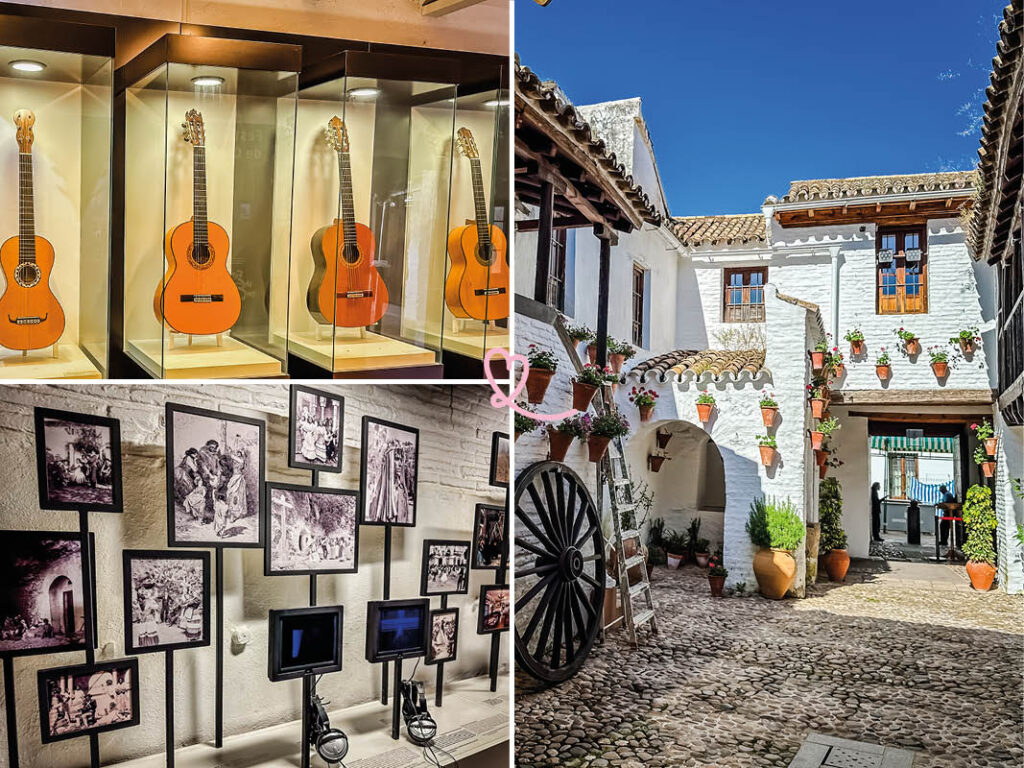
The Fosforito Flamenco Center is a unique place to discover the art of flamenco in Cordoba. Housed in the Posada del Potro, a historic 15th-century inn, this cultural center pays tribute to Flamenco culture and the famous singer Antonio Fernández “Fosforito”. We were captivated by the exhibitions, which trace the history of flamenco through documents, photos, artists’ objects and interactive installations.
In this article, you’ll find our photos and tips for making the most of your visit to Cordoba’s Flamenco Museum.
This opinion is completely independent, based on our experiences. We made our own choices, visited the area anonymously, and paid our bills in full.
Why visit Centre Flamenco Fosforito?
Is the Flamenco Museum worth it? Our opinion:
Absolutely! The Centre Flamenco Fosforito appealed to us for its authentic atmosphere that celebrates the art of flamenco. Housed in a 15th-century inn (the Posada del Potro), this cultural center pays tribute to the famous cantaor Antonio Fernández, known as “Fosforito”.
We enjoyed the exhibition, which retraced the history of flamenco in Cordoba through documents, photos and personal objects belonging to the artists. For example, there’s an area dedicated to the ” Cinco Llaves de Oro del Cante “, flamenco’s highest distinction, of which Fosforito was the only holder.
Last but not least, this old inn, referred to by Cervantes in Don Quixote as “a den of brigands”, offers the perfect historical setting for exploring this ancestral art. This is one of the best museums in Cordoba.

Our favorite moments
– We were delighted to discover the Posada del Potro, a 15th-century inn.
– We enjoyed discovering the part of the exhibition dedicated to Fosforito.
– The interactive multimedia area, where we could discover the different styles of flamenco, gave us the opportunity to learn more about this emblematic Spanish art form.

History in brief
The history of the Museo del Flamenco also includes that of the Posada del Potro, an emblematic Andalucia-style inn and home to the Fosforito center. Built in the 15th century, this typical house served as both an inn and a trading center, reflecting the bustle of the times. In 1972, the inn closed its doors and embarked on a new phase of its existence with a complete renovation that preserved its historic charm while giving it a new vocation. Today, the Posada del Potro is home to Cordoba’s Fosforito Flamenco Center, a space dedicated to the preservation and celebration of this traditional Spanish art form, symbolizing a bridge between past and present.

Access: Flamenco Museum, Cordoba
Where is the Fosforito Flamenco Center?
The museum is located on Plaza del Potro in the Juderia district.
- The Julio Romero de Torres Museum and the Cordoba Museum of Fine Arts are located in the same square.
- Just a 10-minute walk from the famous Cathedral Mosque and all the must-see places in Cordoba.

RENT A CAR IN Andalucia
- Compare prices on our preferred platform: DiscoverCars – one of the best rated sites.
- Choose a compact car, as some villages have very narrow streets!
- Think ofcomprehensive insurance for the same reason
- Book early for choice.

How to get there?
There are several options for getting to the Cordoba Museum of Fine Arts:
- The museum is within easy walking distance.
- If you take public transport, the “San Fernando” stop on the city’s transport network is the nearest. To plan your itinerary, please consult the route maps, timetables and fares here.
- You can choose a sightseeing bus tour. Hop-on-hop-off buses are a great way to visit all the sights quickly and easily. Book your Hop-On-Hop-Off pass now.

Parking
There is no on-site parking available. The nearest parking lot is the “La Ribera” parking lot, less than 5 minutes’ walk from the museum.


Useful tips: duration, schedules, eating…
Best time to visit
In our opinion, spring and autumn are the ideal times to discover the city and its monuments at your leisure, and avoid the heat of summer. We therefore recommend that you visit the museum in the morning, as soon as it opens. In this way, you’ll enjoy the peace and quiet and be the first to see the works. We recommend avoiding the high season (July and August) to visit Cordoba. The city may be subject to overcrowding during this period.
If you can, we recommend visiting the museum on a Sunday, as there are shows every Sunday at noon! Alternatively, book your ticket for a Flamenco show in Cordoba!

Length of visit and main difficulties
Recommended duration of visit is between 30min and 1h.
The building has retained its interior almost intact after 6 centuries, which means you’ll find irregular cobblestones on the floor. Staircases are present, but the center haselevators to facilitate movement between floors.

Advice on how to visit
There’s no set direction, but you can visit the site as follows:
- start by exploring the former inn’s inner courtyard and stables, which have retained their authenticity since the 14th century.
- Continue on to the Sala del Maestro, dedicated to Fosforito’s legacy, with its precious objects and historic photographs.
- Continue your visit by discovering the interactive exhibits presenting essential flamenco techniques, such as compás and palos.
- If you’re lucky enough to visit the center on a Sunday lunchtime, finish off with a live flamenco performance.

PLAN YOUR DREAM TRIP TO andalucia
All the information you need for your trip:
- 7 maps that make planning easier
- + 150 pre-selected locations
- Practical advice
- 300+ photos to help you choose
Visiting with children
The museum does not offer activities aimed directly at children.
However, interactive experiences are available for children, including touch screens and multimedia devices that allow them to discover flamenco in a fun way!

Schedules and rates
Opening hours: Monday to Saturday 11am to 8pm and Sunday 11am to 3pm.
Price: admission is generally free, but some special presentations may cost €2.

Catering
There are no catering facilities on site. On the other hand, you’re right in the center of town, close to a number of establishments. Discover our favorite restaurants in Cordoba, to enjoy before or after your visit.

Center Flamenco Fosforito: An immersion in flamenco art
Interactive flamenco discovery

The museum offers a unique experience of immersion in the world of flamenco. We particularly enjoyed the interactive rooms, which explore the history and origins of this emblematic art form. Here you’ll discover sculptures depicting portraits of legendary artists such as Antonio Chacón and Carmen Amaya.

We really enjoyed listening to the audio on headphones and other interactive installations! They will help you discover the world of flamenco and all the subtleties of this art form. You’re likely to be captivated by the exhibits detailing the essential components of flamenco: song, music and dance.
A space dedicated to the memory of Fosforito

The Salle du Maestro is the vibrant heart of the museum. Here, we discovered objects tracing the exceptional career of Antonio Fernández Díaz, known as “Fosforito”, one of the greatest flamenco singers of the 20th century. Here you can admire his awards, including the prestigious Clé d’Or du Cante received in 2005, as well as historic recordings and photographs.

This unique collection has enabled us to better understand the career of one of the most awarded singers in the history of flamenco, a true legend of Cordoba. If after your visit to the museum you’d like to learn more about Flamenco culture, discovering the world of Fosforito is a good place to start.
La Posada del Potro: an architectural treasure of Cordoba
A 15th-century inn

The Posada del Potro is a building that bears witness to Cordoba’s rich history. We really enjoyed discovering this place steeped in history, which once served as an inn and trading post. Did you know that Cervantes immortalized it in his Don Quixote as a “den of brigands”? As you explore the premises, try to project yourself back to the days when travelers and merchants stopped here, exchanging stories and goods in 15th-century Andalucia. During your visit, we advise you not to miss the room where a collection of models is on display. They will give you an insight into the evolution of the Posada del Potro inn over its almost 6 centuries of existence.

We noticed that this house is located near the Guadalquivir. We then deduced that it played an essential role in the commercial exchanges of the time, welcoming vendors and other visitors to Cordoba. Note its traditional Andalucia architecture, with open patios and galleries surrounding the common areas. This layout was typical of inns of the time, designed to accommodate travelers, their animals and their goods. This reflects their essential role in commercial and social exchanges.
An example of traditional Andalucia architecture

The architecture of Posada del Potro perfectly embodies traditional Andalusian style. We were seduced by its typical central courtyard, around which the various rooms are organized. As you walk through the building, you’ll notice characteristic features such as whitewashed facades and elegant wooden balconies.

We also really enjoyed discovering the famous little terracotta pots hanging on the walls, containing pretty flowers. They contribute to making the whole a typical Andalucia setting. As you tread its cobblestones, consider that this building represents one of the last remaining examples of traditional 14th and 15th century architecture. It’s a precious witness to the Cordovan style, with its typical corrala design.
Subscribe to our Newsletter
- Get away from it all with Region Lovers’ beautiful destinations!
- Once a month
- Advertising-free
Frequently asked questions
Are there any shows at Cordoba’s Flamenco Museum?
Yes, the Fosforito Flamenco Center offers live flamenco performances, including free shows on Sundays at 12:00 pm. See the center’s calendar here for the full program.

What else can you see at Centre de Flamenco Fosforito?
The center boasts a library of over 500 volumes on flamenco, accessible to students, researchers and enthusiasts. Here you’ll find Fosforito’s personal archives, as well as specialist works on the contribution of women and Cordoba to flamenco art. The library is also equipped with audiovisual facilities and serves as a space for discussion, rehearsals and workshops.

PLAN YOUR TRIP TO Andalusia
Inspiration

Practice

Places not to be missed


SHE MADE THE TRIP Fanny