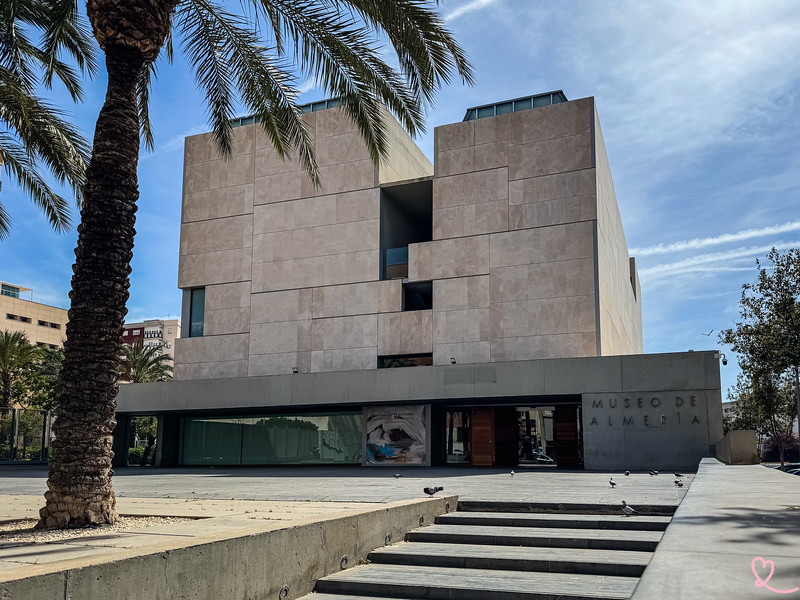
Are you visiting Almería and looking for an original tour? Discover the Archaeological Museum of Almería. Its modern, cube-shaped façade is an eye-catcher, setting the tone for what promises to be a captivating experience.
Inside, bright, educational exhibition rooms invite you to take a journey through the ages, from prehistory to Roman times.
Here are our useful tips for planning your visit to the Archaeological Museum inAlmería and exploring the hidden treasures of Andalucia.
This opinion is completely independent, based on our experiences. We made our own choices, visited the area anonymously, and paid our bills in full.
Is a visit to the Museo Arqueológico de Almería worthwhile?
Certainly, and we particularly liked its immersive, playful approach.
As soon as we entered, we were struck by thelight-filled architecture designed by Ángela García Paredes and Ignacio García Pedrosa. We also appreciated the quality of the collections and their staging. The museography is enhanced by video projections and carefully-crafted models, making the archaeological discoveries more tangible. Last but not least, what makes this visit truly unique is the dialogue between archaeology and contemporary art , with several works of art enlivening the tour!

What you can see
Sublime collections
We were pleasantly surprised by the diversity of the museum’s collection of objects, testifying to the incredible richness of the region’s heritage, from prehistoric to medieval times. Exceptional pieces are on display, such as the famous Indalo, the emblem of Almeria dating from the 3rd millennium BC. For our part, we particularly appreciated the marble stele representing the inscriptions commemorating the founding of the town of al-Marija (954-955) on the orders of Caliph Abd al-Rahman III (photo below). Find out more about the must-see works on the site here.

An original scenography
What impressed us most about this museum was its determination to bring the collections to life. Enjoy a dialogue between objects and artefacts from the excavations and contemporary installations and projections. This is perfectly illustrated in the Circle of Life room, which features a piece of wirework, objects in display cases related to different themes (ceramic production, medicinal practices, diet) and a video reconstructing life at the time.

RENT A CAR IN Andalucia
- Compare prices on our preferred platform: DiscoverCars – one of the best rated sites.
- Choose a compact car, as some villages have very narrow streets!
- Think ofcomprehensive insurance for the same reason
- Book early for choice.


The room of the first agro-pastoral societies
The second floor begins with a room devoted to the first agro-pastoral communities and their daily lives. Note the animal mats on the floor, the display case with period objects (shells carved for funerary rites, bowls, jewelry, stones cut into weapons) and the reconstruction film that brings the exhibits to life.

The rooms dedicated to Los Millares society
On the second floor, you’ll also see a sequence devoted to Los Millares society (3200-2250 BC). We particularly liked the symbolic and funerary world room. Plunged into darkness, you’ll be able to see the remains of remains accompanied by a video reconstruction of a funeral rite.
Other edifying features of the room include a frieze showing the stages in the construction of a burial site, and a display case with objects related to mourning.

The room around the community of El Agar
The second floor is dedicated to the community of El Agar (1st millennium BC) through a ramped and zigzagged pathway that reflects the society’s strong social stratification. We found the videos on cereal growing techniques particularly interesting.

The Roman society room
On the third floor, you’ll find a room devoted to Roman society and trade in south-eastern Spain (206 BC-409). The Bacchus de Chirivel sculpture sits proudly on part of a mosaic from El Villar de Chirivel. Other remains (slave tombstones, coins, amphorae) illustrate the Roman presence in the region.

The room dedicated to the Al-Andalucia period
The final part of the exhibition focuses on the city of Almería in the Islamic period (711-1489). We particularly liked the installation “The Cube of Islam”, housing various showcases with archaeological assemblages from the maritime republic of Madinat Al-Mariyya (Almeria’s former Arabic name). Here you’ll find jars, ceramics and pieces of wood carved from Almería’s ancient mosque.

The stratigraphic column
Another special feature of the museum is the reproduction of a full-scale stratigraphic section, 13m high, showing sixteen strata from the bedrock to the present day. It presents the entire historical sequence of sites in the province of Almería. You’ll have to climb to the top floor to get a bird’s-eye view!

Numerous educational models
On all floors, you’ll find didactic models summarizing the various research projects. We particularly enjoyed Ramón López’s model on the second floor, entitled The opened territory. The historical interpretation of the Los Millares territory is shown through the language of the contemporary artist. He created a composition using the same materials that a Millares-era inhabitant would have used. Or how to combine science and art!

The cloud on the first floor
Finally, don’t forget to look up to admire the aerial work called “Nube de Siret” (Cloud of Siret) on the first floor. These are photographs of archaeological finds taken by Luis Siret, the famous Spanish-Belgian archaeologist (1860-1934). Placed sculpturally in this way, they invite visitors to open their eyes!

WHERE TO STAY IN Ronda
Option 1: In the historic or modern city center
We recommend exploring the attractions on foot:
- Hotel Casa Palacio Villa Zambra – See prices, photos and availability
- Hotel Palacio de Hemingway – See prices, photos and availability

Option 2: In the surrounding countryside
If you prefer nature and peace and quiet, we recommend it:
- Hotel Cortijo La Organic – See photos and availability.

See our complete selection of the best hotels in Ronda
Almería Archaeological Museum: how to get there
Where to find the archaeology museum
- In the city of Almería
- 2h15 from Malaga or 1h50 from Granada
- Downtown
Access by car and parking
The museum is accessible by car, and parking spaces are available on the street.
There is also bicycle parking in front of the museum.

Public transport access
The museum is accessible:
- by bus: stop C/ Federico García Lorca, lines 2, 6, 7, 12, 18
- by cab: the nearest cab rank is C/ Rafael Alberti y Estación Intermodal
- on foot: 10min from the station
Visiting difficulties
No problem at all! All floors are accessible to wheelchair users, the spaces are large and airy, and there are benches on every floor if you need a little break between two discoveries. Rucksack lockers and toilets are also available on the first floor.
Subscribe to our Newsletter
- Get away from it all with Region Lovers’ beautiful destinations!
- Once a month
- Advertising-free
Useful tips for visiting the Almería Archaeological Museum
Schedules and prices
The museum is open Tuesday to Saturday, 9am to 9pm, and Sunday, 9am to 3pm.
Admission is free for European citizens.
See the latest news on the official website here.
How long
We recommend that you allow between 1 and 2 hours for your visit, to ensure that you have enough time to appreciate the museum’s various contents. You can also take a look at the temporary exhibitions and browse through the library’s collection of scientific books.

Best moment
You can come at any time of day to this museum, where the wide-open spaces make for a pleasant visit.
Direction of visit
The tour follows the chronology of the site. Here you can discover..:
- On the second floor: exhibitions on the first agropastoral societies (5000-3200 BC) and the Los Millares society (3200-2250 BC).
- On the second floor: a study of the El Agar society (2250-1150 BC).
- On the third floor: exhibitions on Roman society in south-eastern Spain (206 BC) and a temporary exhibition on the Al-Mariyya society (711-1489), part of the Iberian Muslim world.
If you have a little time left over, you can also take a look at the temporary exhibition room devoted to contemporary art, on the first floor.

Visiting with children
Although the in-store labels are in English and Spanish, you can ask at reception for a French-language presentation booklet, as well as a fun booklet for children.
Although the scenography is designed at children’s height and the rooms are immersive, we felt that the tour might be a little too dense for young audiences.
We recommend that you opt for one floor and do it all the way through, rather than all 3 at once.
Eating out
It’s right in the center of town, with a host of restaurants that you’ll soon be able to discover in our dedicated article.
Hotels
Likewise, the museum is close to a number of hotels, some of which we’ve tested and revealed in our dedicated article.
PLAN YOUR TRIP TO Andalusia
Inspiration

Practice
- Where to stay in Andalucia
- Best luxury hotels in Andalusia (coming soon)
- Best restaurants
- Rent a car in Andalucia
- Driving in Andalucia
- Itineraries: 3 days – 4 or 5 days – 1 week – 10 days – 2 weeks (coming soon)