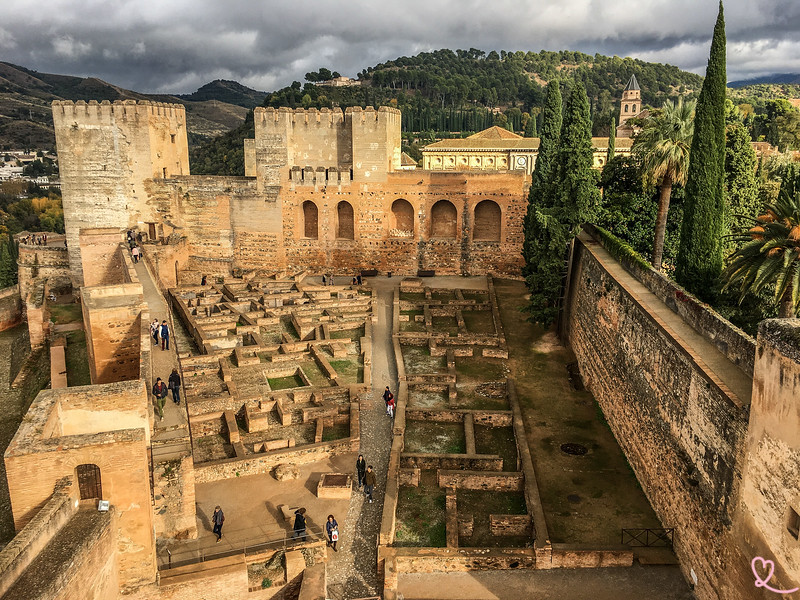
Visiting Granada? It’s impossible not to visit the Alhambra, the jewel of Andalucia and a UNESCO World Heritage Site. Beyond its sumptuous palaces, don’t miss theAlcazaba, the oldest structure in the complex. Built in the 9th century, this imposing fortress is both a testimony to medieval military architecture and a formidable vantage point from which to admire exceptional panoramic views of Granada.
In this article, we’ll take you on a tour ofGranada’s Alcazaba, from its walls to its towers and peaceful gardens. And we’d like to take a look at some of its incredible architecture and historical details!
This opinion is completely independent, based on our experiences. We made our own choices, visited the area anonymously, and paid our bills in full.
Why visit Granada’s Alcazaba?
Is the Alcazaba worth it? Our opinion:
The Alcazaba is well worth a visit for both its historical importance and its impressive architecture. Its squares and towers, relics of military engineering, will plunge you into the heart of its defensive past. Perched high above Granada, it also offers spectacular panoramic views of the city and the Sierra Nevada.

Why is the Alcazaba so famous?
The Alcazaba is famous above all for being the oldest part of the Alhambra. This imposing fortress, perched on a promontory overlooking Granada, is the defensive heart of the palace, marking the site’s military origins before its transformation into a royal residence under the Nasrids. It is also emblematic for its imposing towers, notably the Torre de la Vela, from which the Catholic Monarchs hoisted their standard in 1492 to mark the Reconquest of Granada.

Our favorite moments
While we were impressed by the defensive architecture of the Alcazaba, with its massive walls and watchtowers, we especially enjoyed the magnificent panoramic views of the surrounding area. Special mention must go to the Torre de la Vela, which offers a 360° view of the city and mountains.

History in brief
Here are the key dates in the history of the Alcazaba:
- 9th century: Construction of the Alcazaba by Sawwar ben Hamdun during the struggle between the Arabs and the Muladies
- 13th century: Muhammad I fortifies the existing castle and adds three new towers: the Split Tower, the Keep, and the Watch Tower.
- 1492: Ferdinand and Isabella raise the banner of the Catholic Monarchs’ victory from the Torre de Vela.
- 16th century: Addition of a curtain wall linking the towers and structures such as the Tour Cubo to resist modern weapons
- 19th century: Restoration and exploration work begins after a long period of neglect

Access: Alcazaba, Granada
Where is the Alcazaba inside Granada’s Alhambra?
The Alcazaba is located at the western end of the Alhambra complex, on a rocky spur overlooking the city. Its name comes from the Arabic “al-qasbah” meaning citadel, and it is the oldest building in the complex.
Read our article on the Alhambra to find out how to visit this iconic monumental complex and enjoy each of its attractions.
Simplified map of the Alhambra
To give you a better understanding of the complex, we’ve created a simplified map showing the places to see inside the fortress. Most maps are not easy to read when you’re just trying to understand the place.

On site, you’ll find more detailed maps, with toilets, lockers etc.
RENT A CAR IN Andalucia
- Compare prices on our preferred platform: DiscoverCars – one of the best rated sites.
- Choose a compact car, as some villages have very narrow streets!
- Think ofcomprehensive insurance for the same reason
- Book early for choice.


How to get there?
We recommend taking the shuttle bus to the Alhambra. The walk up the hill can be tiring, especially in summer. The Alhambra is easily accessible by bus (C30, C32, C35). To plan your route, visit the Granada transport network website here.
Parking
If you’re coming by car, there are several guarded pay parking lots on the premises.
DISCOVER Granada
- Things to do in Granada
- Best hotels
- Best restaurants
- Museums
- Itineraries: 1 day – 2 days – 3 days

Useful tips: duration, schedules, eating…
Best time to visit
Granada’s Alhambra is one of the most visited monuments in the world!
By 2024, it was welcoming over 7,000 visitors a day. So there’s really no better time to come and visit in peace and quiet, but perhaps the best time would be in spring when the gardens are in bloom and temperatures are mild.
Please note, however, that we advise against visiting in July and August, when the heat is overwhelming and a visit to the Alcazaba, which is entirely exposed to the sun, can be painful.

Length of visit and main difficulties
Allow 30-45 minutes for the tour. We’d like to warn you that there’s little shade, so it’s best to avoid the hottest hours. The terrain is rugged, with many steps, so we recommend you wear good shoes.

Advice on how to visit
There is no set direction for the tour, and unfortunately the route through the Alcazaba is not very clear. While we were carried away by the maze of squares and passageways that the site has to offer, we still advise you to use the audioguide to find your way around.
PLAN YOUR DREAM TRIP TO andalucia
All the information you need for your trip:
- 7 maps that make planning easier
- + 150 pre-selected locations
- Practical advice
- 300+ photos to help you choose
Visiting with children
We didn’t find any special facilities for children, but the youngest visitors should enjoy the maze of the Alcazaba, and especially climbing the towers to admire the panoramic views!

Schedules and rates
The Alcazaba is open daily from 8:30 am to 6 pm (October 15 to March 31) and from 8:30 am to 8 pm (April 1 to October 14). For the latest updates, visit the official website here.
Entry is included with the Alhambra ticket. The full price for a visit to the entire site is €19. See our complete price list here.

Guided tours
The site does not offer guided tours, but audioguides are available.
Find out more on the official website here. Price: from €6.
If you prefer a guided tour, there are several options, with or without the Nasrid palaces, accelerated or premium… – see tours and availability.

Catering
On site, you’ll find the Cafétéria du Pavillon d’Accès and the Café du Palais de Charles Quint, serving sandwiches and salads. If you’re looking for a quiet break, we recommend the Hotel Parador, nestled in the heart of the Alhambra, which offers meals in exceptional surroundings at affordable prices, far from the hustle and bustle.
Subscribe to our Newsletter
- Get away from it all with Region Lovers’ beautiful destinations!
- Once a month
- Advertising-free

The Alcazaba: A military fortress in the heart of the Alhambra
A complex defensive architecture
Granada’s Alcazaba is a fortified military complex whose architecture bears witness to centuries of evolution. We were fascinated by the different influences that have shaped this place over time. Its earliest structures probably date back to a Roman fortification, before being transformed by the Arabs during the Caliphate period. In the 11th century, the Ziríes reinforced the walls’ defenses, making Granada the capital of a Taifa kingdom. You’ll discover that most of the present-day construction dates back to the Nasrid era (13th-15th centuries), when the Alcazaba became a veritable defensive bastion. After the Christian Reconquest, parts of the fortress were modified, notably with the addition of the round Cube tower, built to reinforce the site’s defense.
The Alcazaba is surrounded by a double ring of imposing walls, punctuated by strategically positioned towers. You’ll start at the Plaza de los Aljibes, where you’ll walk along the east wall, where the Homenaje, Quebrada and Adarguero towers stand (only the base remains). The Torre del Homenaje, in the northeast corner, is the tallest in the complex (26 metres), and is said to have housed Alhamar, founder of the Alhambra. Further on, the Torre del Cube, built after the Reconquest, offers a breathtaking view of the Albaicín and the Darro valley.

The Place d’Armes and the remains of the military quarter
The Plaza de Armas was the original entrance to the Alcazaba. The Puerta de las Armas was the only entrance to the Alhambra directly connected to the city.
We were impressed by this ensemble of buildings, which bears witness to daily life in the fortress.

Take a look at the large cistern with its two naves: originally used as a rainwater reservoir, it began to receive water from the Alhambra canal in the 17th century. Near the cistern, we discovered the remains of a hammam, located to the left of the Alcazaba gate. In the center of the square and along the wall, you can see the foundations of several Arab houses, where the civilian population lived, looking after the needs of the resident dignitaries and military.

The best views of Granada from the Alcazaba
Panorama from Torre de la Vela
The Torre de la Vela, the Alhambra’s tallest tower, is undoubtedly the most symbolic of the complex. In Nasrid times, you would have heard its bell ringing to alert the population in the event of a disaster. During the Reconquest, it became a symbol of the triumph of the Catholic Monarchs, who hoisted their standard here on January 2, 1492. A tradition that continues to this day: unmarried girls who ring the bell on this day have a chance of getting married before the end of the year.

The square-shaped Torre de la Vela measures 16 metres square and 26.80 metres high.
We were impressed by its massive base and four-storey structure supported by arches and pillars. The first floor includes a silo and a dungeon. Originally crenellated, it lost its battlements in the 1522 earthquake.
The present bell, which you can admire on the west façade, dates from 1840, although it was damaged by lightning in 1882 and subsequently rebuilt. From its summit, we were dazzled by the spectacular panoramic view: you can take in the city of Granada, the snow-capped peaks of the Sierra Nevada, the fertile plain of La Vega and the surrounding villages all in one glance.

Breathtaking view from the Adarves Gardens
We particularly appreciated the peaceful atmosphere offered by the Jardins des Adarves! Located along the parapet walk, they offer a bucolic break in this military setting.

At the western end, we recommend a stop at the mirador, the starting point of the wall that stretches to the Torres Bermejas. This is where you can read the famous lines by the poet Francisco A. de Icaza: “Give him alms, O woman, for there is no greater sorrow than to be blind in Granada.”

Frequently asked questions
What is the Alhambra?
The Alhambra is a fortified palatial city that served as both the residence of the rulers and the seat of government of the Nasrid kingdom of Granada. Its name comes from the Arabic “Al-Hamra” meaning “the red”, in reference to the color of its walls.
Its unique architecture harmoniously combines Nasrid and Christian styles with post-15th-century Renaissance additions. The ensemble is distinguished by remarkable hydraulic innovations and sophisticated arabesque and calligraphic decorations. What’s more, you can admire the work done with natural light through its courtyards and finely crafted windows, creating a play of light and shadow.
The complex includes :
- Royal palaces
- A military fortress (Alcazaba)
- A medina (city)
- Gardens
- A summer residence (Generalife)
Read our article on the Alhambra to find out how to visit this iconic monumental complex and enjoy each of its attractions.

PLAN YOUR TRIP TO Andalusia
Inspiration

Practice
- Where to stay in Andalucia
- Best luxury hotels in Andalusia (coming soon)
- Best restaurants
- Rent a car in Andalucia
- Driving in Andalucia
- Itineraries: 3 days – 4 or 5 days – 1 week – 10 days – 2 weeks (coming soon)