The Palacio de Viana in Cordoba is an exceptional historical building that has developed over 5 centuries. This stately home houses 12 magnificent patios illustrating the evolution of the Cordovan patio since the 15th century. You can also discover the palace: an authentic house in which inherited objects are displayed in their environment and context. We were impressed by Cordoba’s most important and best-preserved stately home, a unique place that harmoniously combines architecture and nature.
In this article, you’ll find a selection of useful tips to help you prepare for your visit and have a wonderful time!
This opinion is completely independent, based on our experiences. We made our own choices, visited the area anonymously, and paid our bills in full.
Why visit Viana Palace?
Is the palace worth it? Our opinion:
Yes, the Palais de Viana is definitely worth a visit! This former stately home offers a unique historical and sensory journey through 5 centuries of history, from its original medieval quarter to its Moorish-inspired orchard garden. We were particularly captivated by its 12 patios, which bear witness to the evolution of architectural styles, from the sober Renaissance to the baroque Cordouan. This is one of the most beautiful palaces in Andalucia!
We also appreciated the authenticity of this home, inhabited until the end of the 20th century, where collections and objects are presented in their original context. Did you know that this is one of the most important and best-preserved stately homes in Cordoba, and certainly one of the most important in Spain?

Why is Viana Palace famous?
The palace is famous for its unique architecture, which combines different historical influences. It houses remarkable Renaissance art collections, including paintings, mosaics, tapestries and guadamecíes (worked leathers). We learned that its library contains over 6,000 volumes, and its historical archives contain over 400,000 documents dating back to the 12th century!
Declared an asset of cultural interest in 1981, the palace is an exceptional testimony to the evolution of civil architecture in Cordoba. In fact, it’s one of Cordoba’s best attractions!

Our favorite moments
We really enjoyed discovering and exploring the 12 patios, each with its own identity and telling part of the palace’s history. The discovery of this stately home, one of the best preserved in Spain, was particularly impressive. We also enjoyed exploring the first floor and its various rooms. Historical elements such as furniture and horse-drawn carriages helped us imagine what life was like in this incredible home, when it was still inhabited.

WHERE TO STAY IN Cordoba
Our favorites: neighborhoods and hotels
Historic district
Hotel Las Casas de la Juderia – See prices, photos and availability
Hotel Madinat – See prices, photos and availability
Santa Marina district
Hotel Hospes Palacio del Bailio – See prices, photos and availability
- Hotel 1 – See prices, photos and availability
- Hotel 2 – See prices, photos and availability

See our complete selection of the best hotels in Cordoba
History in brief
The history of the Palais de Viana is marked by a number of milestones. Here’s what we’ve learned:
- 14th to 17th centuries: various owners buy land and plots, and the future Palais de Viana takes shape
- 1606: Luis Gómez de Figueroa y Córdoba, II Lord of Villaseca carries out the first major transformation of the manor house, building the current Patio de Recibo and the main entrance.
- 1873: the 9th Marquise de Villaseca, widow and sole heiress to the Marquisate, married Teobaldo Saavedra, son of the Duke of Rivas, who in 1875 was granted the title of Marquis de Viana by King Alfonso XII.
- 1980: the third Marquise de Viana, widowed and without descendants, sells the palace to the Caja Provincial de Ahorros de Córdoba (Provincial Savings Bank of Córdoba).
- 1981: Opening to the public and declaration as an asset of cultural interest
Access: Palacio de Viana, Cordoba
Where is Viana Palace?
- In the center of Cordoba, in the Santa Marina district, on Plaza Don Gome,
- A 10-minute walk from the Roman Temple, and about a 20-minute walk from the Juderia district, where you’ll find the Roman Bridge, the Alcazar and the Cathedral Mosque.

How to get there?
There are several options for getting to Viana Palace:
- The monument is easily accessible on foot.
- If you take public transport, the nearest stop is the “Palacio de Viana” stop on the city’s transport network. To plan your itinerary, please consult the route maps, timetables and fares here.
- You can choose a sightseeing bus tour. Hop-on-hop-off buses are a great way to visit all the sights quickly and easily. Book your Hop-On-Hop-Off pass now.

RENT A CAR IN Andalucia
- Compare prices on our preferred platform: DiscoverCars – one of the best rated sites.
- Choose a compact car, as some villages have very narrow streets!
- Think ofcomprehensive insurance for the same reason
- Book early for choice.


Parking
There is no on-site parking available. The nearest parking lot is“Parking Calle Sevilla 5 Córdoba“, a 15-minute walk from Viana Palace.

Useful tips: duration, schedules, eating…
Length of visit and main difficulties
Allow around 1h30 to visit the 12 patios, the garden and the exhibition rooms.
Inside the site, the ground is sometimes paved and there are regularly steps. However, we did notice some accessibility features: ramps to facilitate access to the patios for people with reduced mobility or strollers. The interior of the palace is equipped with an elevator. Find out more here.

Schedules and rates
Opening hours are generally as follows:
- Tuesday to Saturday: 10 a.m. to 7 p.m.
- Sunday: 10 a.m. to 3 p.m.
- Closed on Monday
- Opening times often vary according to the time of year, so be sure to check the official website before you visit.
Rates:
- Tour of the 12 patios and the first floor of the palace: €8
- Guided tour of the Palace interior (40min): €8
- Combined visit of the 12 courtyards + guided tour of the Palace interior: €12
- Reserve your tickets now!
Visit the official website for more info here.

Catering
There are no catering facilities on site. On the other hand, you’re right in the center of town, close to a number of establishments. Discover our favorite restaurants in Cordoba, to enjoy before or after your visit.

PLAN YOUR DREAM TRIP TO andalucia
All the information you need for your trip:
- 7 maps that make planning easier
- + 150 pre-selected locations
- Practical advice
- 300+ photos to help you choose
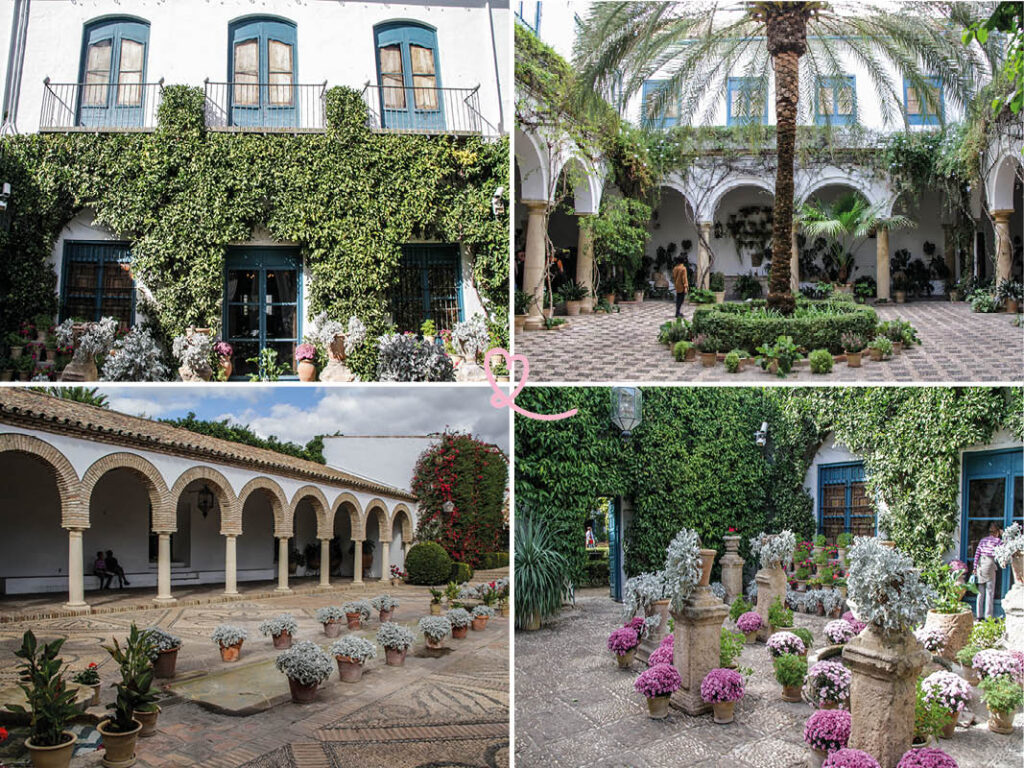
Discover the 12 historic patios of the Palacio de Viana, Cordoba
Patio de Recibo and Patio de los Naranjos
The Patio de Recibo is the main entrance to Viana Palace, and the first one you’ll encounter on your visit. Are you charmed by its beauty and elegance? It’s normal! We learned that it was designed to dazzle the visitor and show the nobility of the place and its inhabitants. It’s a magnificent wooded area where you can admire bougainvilleas and a sumptuous palm tree. It is also surrounded by 16 Tuscan columns, but you may notice that one seems to be missing from the entrance. This is indeed the case! The visit helped us understand that this allowed cars to access the stables.

The Patio de los Naranjos, meanwhile, is part of the palace’s original 15th-century core. If you visit during the orange blossom season, you’ll be intoxicated by the sweet scent of orange blossom. We enjoyed the 2 fountains planted with trees and flowers that occupy this beautiful space. You’ll see lilies and water lilies. Hundred-year-old orange trees and wisteria add to the enchantment of this patio.

Subscribe to our Newsletter
- Get away from it all with Region Lovers’ beautiful destinations!
- Once a month
- Advertising-free

Patio de los Jardineros and Patio de las Columnas
The Patio de los Jardineros, incorporated into the Palacio de Viana in the 19th century, was once used as accommodation for the staff of the country estates of the Counts of Torres Cabrera, who were visiting Cordoba. We learned that after the houses were integrated into the palace, the patio became a work space for gardeners, who stored their tools there.
We loved its wall covered with celestine, also known as blue jasmine, forming a veritable vertical garden that’s magnificent in summer. You can also see archaeological objects and earthenware tiles, introduced in the 20th century to give the space a more seigneurial feel.

Did you know that the Patio de las Columnas was added to the palace in the 1980s? We were amazed to learn that it was built to host public events such as theater, concerts and literary presentations. Its rectangular shape is punctuated by 2 central basins that divide the space symmetrically. We found it less picturesque than the other patios. We loved the floor, cleverly adorned with unbaked brick and traditional Cordoba tiles. We learned that this type of paving, made with two-tone pebbles, is a Moorish heritage.

DISCOVER Cordoba
- Things to do in Cordoba
- Best hotels in Cordoba
- Best restaurants
- Best museums and palaces
- Visit the cathedral
- Visit Medina Azahara (coming soon)
- Itineraries: 1 day – 2 days – 3 days

Explore the garden and interior of the Palacio de Viana
The Baroque garden
The garden was integrated into the palace in the 19th century, on the initiative of Diego Rafael Cabrera Fernández de Mesa, the palace’s 12th owner. We noticed the French-inspired layout, typical of the 19th century, with its labyrinth of passageways and its sixteen bicentennial boxwood parterres, which retain their greenery all year round.

There’s also a stone fountain, a circular grotto-style kiosk and a remarkable collection of espalier citrus trees, including lemons, limes, mandarins, oranges and grapefruits – some of the oldest in the palace! Don’t leave the garden without seeing its most imposing feature: the century-old holm oak, which rises more than 25 meters above the palace roofs. With its 4 centuries of existence, it is the oldest inhabitant of the Palais de Viana!

The Palace and its historical objects
The Palacio de Viana, linked between the 15th and 19th centuries to the seigniory and then the marquisate of Villaseca, offers a unique insight into the private life of the Cordovan elite. We discovered the tastes and customs of the various owners through the palace’s architecture and exceptional artistic collections: elaborate leathers, azulejos, tapestries and period furniture bear witness to the refinement of its successive occupants.

We also enjoyed discovering the chapel of the Palais de Viana, in the heart of the patio that bears its name. Here you can admire a 19th-century altarpiece featuring a painting of La Douleur and a sculpture of Christ de l’Humilité. In the adjacent Galerie Saavedra, you can admire 6 remarkable family portraits, all painted in the style of the Habsburg royal portraits. They are surrounded by period decorative elements, but something caught our eye: did you notice the sabres and swords hanging next to each of the portraits? These are the ones they brandished when they were alive. Together with the swords and rapiers in this room, they make up a curious collection.

PLAN YOUR TRIP TO Andalusia
Inspiration

Practice
- Where to stay in Andalucia
- Best luxury hotels in Andalusia (coming soon)
- Best restaurants
- Rent a car in Andalucia
- Driving in Andalucia
- Itineraries: 3 days – 4 or 5 days – 1 week – 10 days – 2 weeks (coming soon)


SHE MADE THE TRIP Claire