Are you visiting Ronda and want to learn about its history? Don’t miss a tour of the Arab Baths. Built in the late 13th century, this Muslim-era thermal complex is the best-preserved of its kind on the Iberian Peninsula and offers a fascinating journey back in time.
Here are some helpful tips for planning your visit to the Arab Baths in Ronda.

This opinion is completely independent, based on our experiences. We made our own choices, visited the area anonymously, and paid our bills in full.
Is a visit to the Arab Baths worth it?
Yes, this remarkably well-preserved historic spa complex is worth a visit. Exploring these ruins is a way to spark your imagination and gain an appreciation for Ronda’s rich history. The baths served a dual purpose: as a site for religious rituals, on the one hand, and as a hub of social life, on the other.
In addition, they often served as the first stop for travelers arriving in the city, acting as a true gateway to Ronda.
In our opinion, it’s one of Ronda’s must-see attractions.
What you can see
The preserved architecture of the thermal baths
Built in the late 13th century, this Muslim-era thermal complex is the best-preserved of its kind on the Iberian Peninsula! The Arab hammam is an adaptation of the Roman baths, based on steam baths—unlike the Romans, who bathed in water. We were particularly impressed by the beauty of the main hall.

The room is divided into three distinct spaces, separated by graceful horseshoe arches.
These arches—four pairs in all—rest on elegant columns made of a harmonious blend of brick and stone. The structure supports barrel vaults (hemispherical) dotted with skylights.
An educational film
We recommend that you start by watching the documentary video to immerse yourself in the history of the thermal baths. This will then help you understand the purpose of each room as you walk through the exhibition. In fact, the video helps viewers understand the water collection and distribution system.

For example, we realized that, since these are steam baths, it is mainly the air that is heated, not the water. Heat circulated beneath the floor (through the hypocaust system) to the warm and temperate rooms. To create steam, water was then poured onto the hot floor of these rooms.
RENT A CAR IN Andalucia
- Compare prices on our preferred platform: DiscoverCars – one of the best rated sites.
- Choose a compact car, as some villages have very narrow streets!
- Think ofcomprehensive insurance for the same reason
- Book early for choice.

The starry vaults
This was one of our favorite parts of the tour! We loved the play of light created by the star-shaped skylights in the vaulted ceilings. We learned that they were once used as ventilation grilles. Did you know that geometric patterns are very common in the architecture of Muslim Andalucia (8th–15th centuries)?
They bring a sense of structured harmony to buildings while symbolizing the infinite nature of creation, thereby celebrating the divine in an abstract way.
Want to learn more about the city’s Muslim history? Check out our suggested one-day itinerary to explore Ronda’s Moorish heritage.

The reception room
This open-air room precedes the entrance to the baths proper. The reception hall, which served as the starting point of the bathing process, consisted of latrines (toilets) and changing rooms arranged around a fountain. This room is believed to have been covered by a large dome supported by cruciform pillars and low arches; therefore, the current view of the arcades is distorted.

The different rooms
The most impressive thing is to walk through the different rooms and imagine the atmosphere—both serene and lively—that must have prevailed in the hammam back then. We discovered: the cold room, the temperate and warm rooms, the hypocaust (a Roman heating system), and the rear of the building, which houses the hearth where water was heated.

The well
To facilitate access to water, a waterwheel was built at the point closest to the confluence of Las Culebras Creek and the Guadalevín River. Located at the top of a tower, the wheel was powered by a tethered donkey, which, as it walked, set a mechanism in motion. This structure carried water from the river to the aqueduct channel, which in turn supplied the thermal baths. Today, only the deep well is visible!

Mediation panels
Take the time to read the interpretive signs along the trail. Carved from wood, they blend seamlessly into the space while helping visitors understand how the thermal baths work. For example, we learned about the existence of craft workshops, including a pottery studio and a tannery. The excavations did indeed uncover clay settling ponds.

The view of Puente Viejo
From this spot, you’ll have a beautiful low-angle view of the Puente Viejo. Although it is far less famous than the Puente Nuevo, the symbol of the city of Ronda, it has its own historical significance. Presumably built during the Roman era, it was rebuilt during the Muslim period.

A chapel
We also liked to take a look at the bucolic-looking San Miguel Chapel, which was probably built on the site of a former mosque.

WHERE TO STAY IN Ronda
Option 1: In the historic or modern city center
We recommend exploring the attractions on foot:
- Hotel Casa Palacio Villa Zambra – See prices, photos and availability
- Hotel Palacio de Hemingway – See prices, photos and availability

Option 2: In the surrounding countryside
If you prefer nature and peace and quiet, we recommend it:
- Cortijo La Organic Hotel – Check photos and availability.

See our complete selection of the best hotels in Ronda
Les Bains Arabes in Ronda: how to get there
Where the old thermal baths are located
- In the city of Ronda
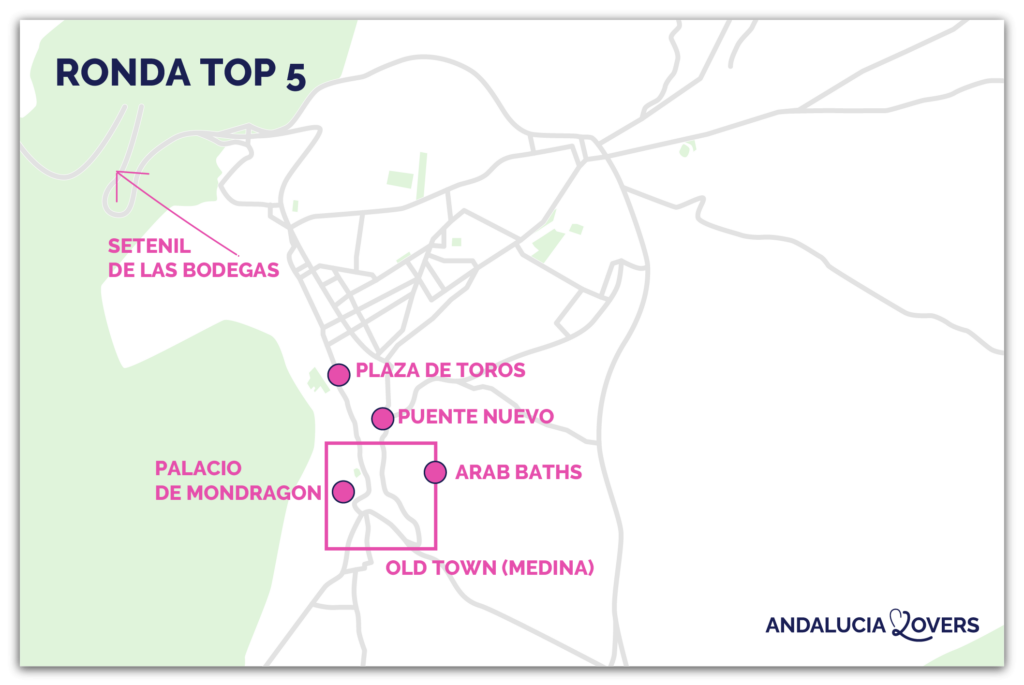
- In the San Miguel neighborhood, located below the Old City and the New City.
- Here’s a map to help you find them in the city:
Access by car and parking
You can reach the site by car, but we do not recommend this option because the roads are very narrow and public parking spaces are scarce.
The closest parking lot is Parking Ronda, located at the southernmost part of the city, an 8-minute walk from the thermal baths.
Public transport access
There is no public transportation access to the site of the Arab baths in Ronda. If possible, we recommend walking there. From the Plaza de Toros, it’s a 10- to 15-minute walk downhill. A very pleasant stroll through this well-preserved historic neighborhood.
Visiting difficulties
There are several steps to go down to reach the site, and the ground is uneven.
We did not notice any specific accommodations for people with disabilities.
Please also note that the website’s introductory video is available only in English and Spanish.

Tips for visiting the Arab Baths
Schedules and prices
The site is open Tuesday through Friday from 9:30 a.m. to 8:00 p.m. without a break; on Mondays and Saturdays from 10:00 a.m. to 2:00 p.m. and then from 3:00 p.m. to 6:00 p.m.; and on Sundays from 10:00 a.m. to 3:00 p.m. Last admission 30 minutes before closing.
The admission price is 4.5 euros.
Free admission for children under 14 and people with disabilities. See the latest news on the official website here.

How long
Allow between 30min and 1h to tour the remains.
Best moment
You can come at any time of day, as the site is fairly uncrowded, but we recommend you come on a fine day to enjoy the beautiful light over the ruins.
Direction of visit
Let yourself be swept away by the maze of rooms! There is no set route for the tour, but you can explore the site as it was in the past by referring to the original map (photo below).

Eating out
There are no dining options on site, and since the location is quite remote, we recommend that you bring water with you for your visit. You can reach the restaurants in the Old Town in a 10-minute walk. Check out our selection of the best restaurants in Ronda!
Hotels
The site is located an equal walking distance from both the old town and the modern district.
Check out our article on the best hotels in Ronda.

SHE MADE THE TRIP Claire