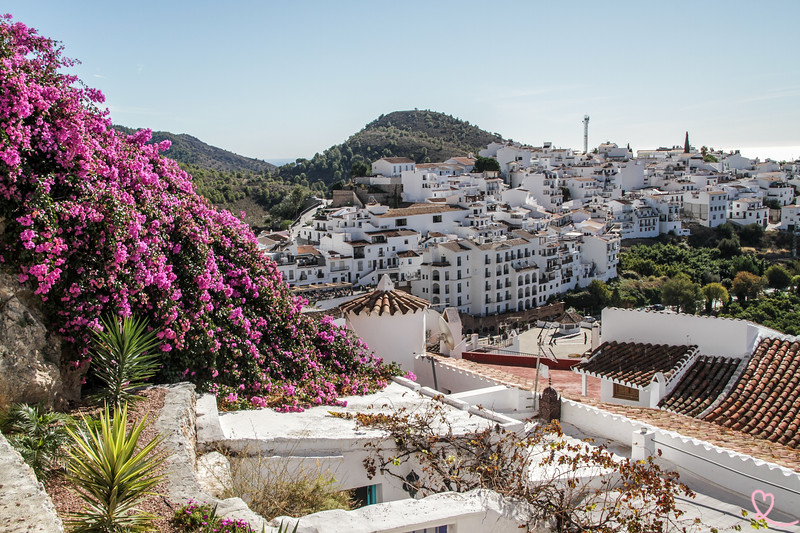
Let yourself be seduced by Frigiliana, one of Andalucia’s most beautiful white villages, perched 300m above sea level on the Costa del Sol. We were won over by its picturesque lanes, immaculate houses and breathtaking views of the Mediterranean Sea.
Discover our selection of the best attractions in Frigiliana, illustrated with photos that will make you want to go there. Bonus: useful tips and extra activities!
This opinion is completely independent, based on our experiences. We made our own choices, visited the area anonymously, and paid our bills in full.
Is the village of Frigiliana worth a visit?
Yes, the village of Frigiliana is well worth a visit. The village perfectly combines the authentic charm of traditional white houses with spectacular views of the sea and surrounding mountains. It’s one of the most beautiful white villages on the Costa del Sol, large enough to allow beautiful walks while retaining an intimate, peaceful atmosphere.
If you don’t have a car, you can discover Frigiliana on an organized excursion from Malaga, Marbella or Granada – see options
1. Explore the historic district

The historic heart of Frigiliana is a maze of narrow, winding streets lined with bright white traditional houses. We particularly enjoyed getting lost in these cobbled alleys. The locals take great care of their village, and the alleyways are adorned with pots of green plants and colorful flowers. We recommend taking the time to explore the side streets, which are often quieter and more authentic.
What you need to know: Why are the houses white in Firigiliana?
White facades aren’t just aesthetically pleasing: they keep houses cool in summer and naturally repel insects thanks to the lime. Since 1971, a local law has required that the white uniformity that gives the village its charm be maintained. But it also serves to repel insects.
RENT A CAR IN Andalucia
- Compare prices on our preferred platform: DiscoverCars – one of the best rated sites.
- Choose a compact car, as some villages have very narrow streets!
- Think ofcomprehensive insurance for the same reason
- Book early for choice.


2. Admire the views

Frigiliana’s elevated position offers spectacular panoramic views over the region. The Mirador de Santo Cristo offers one of the finest 180° views of the hills, white houses and Mediterranean Sea.
We were seduced by this view, especially with the splashes of color from the local flowers below! We also recommend climbing the village steps to discover unexpected views of the white roofs and surrounding mountains. The El Fuerte hill, which rises to 976m, offers breathtaking views for the most courageous.
3. Admire the pavements

The floors of Frigiliana’s cobbled streets also deserve your attention. You’ll discover geometric patterns and creative designs. Although their appearance suggests historical authenticity, these pavements are actually relatively recent (60 to 50 years ago). But it also adds interest to the perspectives of the alleyways: rosettes, stars…
PLAN YOUR DREAM TRIP TO andalucia
All the information you need for your trip:
- 7 maps that make planning easier
- + 150 pre-selected locations
- Practical advice
- 300+ photos to help you choose

4. Note the Palacio de los Condes

At the heart of the village stands the imposing Palacio de los Condes, also known as El Ingenio. You can’t miss it!
This 16th-century Renaissance building extends over 2000m². Built for the Manrique de Lara family from the stones of the old castle, it was later converted into a sugar refinery. We particularly appreciate its architecture, which bears witness to the region’s rich industrial history. Today, its massive silhouette still dominates the village square, a reminder of the prosperous days when mills in the surrounding hills crushed grain and sugar cane.
5. Discovering history through ceramic plates

Throughout the village, 12 ceramic plaques tell the fascinating story of Frigiliana. We enjoyed this original way of discovering the village’s rich past, from the Phoenicians to the present day. Although recently installed, these plaques illustrate key moments in local history, including the Moorish period and the battle of 1569. We recommend you start with the plaque showing the 16th-century map, which helps you understand the historical context.
This plate hunt provides an interesting thread for exploring the village, especially if you have children.
6. Spend the night in the village

Extending the experience by staying overnight in Frigiliana allows you to fully appreciate the village’s unique atmosphere. Enjoy the peaceful atmosphere of the alleyways in the mornings and evenings, away from the crowds!
Although the hotel offer is limited, the village offers charming Bed and Breakfasts and character apartments. What’s more, the 300m altitude offers more pleasant temperatures in summer.
See our accommodation in Frigiliana.
Hotel Villa Frigilana, for example, is in the heart of the village.
7. Visit the church of San Antonio de Padua

The church of San Antonio de Padua (Parroquia de San Antonio de Padua) is a fine example of local religious architecture. We were particularly interested in its eventful history, including its transformation from a former mosque to a Christian church. Its bell tower, a former minaret, bears witness to this fascinating past.
We recommend you take a close look at the Mudejar-style ceiling with its characteristic wooden trusses. Although the interior dates mainly from the 1940s, following the destruction of the Civil War, the cross-shaped nave and its three aisles are well worth a visit.
8. Explore Lizar Castle

At the top of the hill overlooking Frigiliana stand the remains of Lizar Castle. The climb is steep but well worth the effort for the exceptional panoramic view over Frigiliana and Nerja. The ruins themselves are modest, but the historic atmosphere of the place is undeniable. Bring good shoes and water for the climb.
9. Discover local crafts

Frigiliana is home to many craftsmen and artists who perpetuate local traditions. Here you’ll discover, among other things, the quality handmade ceramics on offer in the village stores. From traditional pottery to contemporary creations, we recommend you take the time to discover these unique pieces. Stalls are particularly concentrated in the alleyways around the Palacio de los Condes, where you can watch craftsmen at work.
10. The old silo (granary)

The remains of “Los Reales Pósitos”, the former 18th-century communal granary, bear witness to an era of village solidarity. This building played a crucial social role: it stored the surplus from good harvests to support the population in difficult years.
This tradition may even date back to 1640, when the first warehouse was built on the site. Today, only a few arches remain, harmoniously integrated with the houses that have since moved in.
11. Penon de La Sabina

In the heart of the old village stands a surprising natural feature: the historic rock of “La Sabina”. A rock formation that seems to defy gravity.
In 1936, heavy rains caused it to move, spreading panic among the inhabitants. Note the steel cables that now anchor it firmly to the rocky base, an ingenious solution put in place to secure this natural monument that is an integral part of Frigiliana’s heritage.
Other monuments and attractions
The fountains
As you explore the village, you’ll find fountains from different eras, such as…
- the Fuente Vieja built by the Moors and restored in 1640
- the ancient Roman fountain (very old but not particularly beautiful) whose source is in the mountains.
- the Fountain of 3 Cultures (see later in this article).

El Torreón
100m from the church, opposite the town hall, stands one of the oldest buildings in the village: El Torréon. The Moors used it as a military barracks, and it later became a granary.
El Teatro Mecanico
In front of the Palacio de los Condes, discover the small circular “theater”.
Several windows show different scenes. The one in the photo below is “The Moor and his parrot”.

Museo Arqueológico – Casa del Apero
Near the tourist office, you’ll find the small Casa del Apero archaeological museum.
It features exhibitions on Frigiliana, from Neolithic times to the present day.
It closes between 2 and 4 pm – see the latest information on the official website.
Hiking
The area around Frigiliana offers superb hiking opportunities, especially along the Rio Chillar. The hikes are accessible at different levels and allow you to discover the local flora. But be careful, because it can get very hot during the day!

Other attractions in and around Frigiliana
The Nerja cave
Just a few kilometers away, the Grotte de Nerja impresses with its spectacular rock formations, including the famous 32m-high Column of Hercules. The guided tour takes in rooms with remarkable stalactites and stalagmites.

Nerja Aqueduct
This magnificent 19th-century structure features 37 arches over 4 storeys. Originally built to supply a sugar refinery, it is now used for local irrigation.
The town of Nerja
This charming coastal town is famous for its Balcony of Europe and picturesque beaches. Its well-preserved historic center is well worth a visit.
History of the village of 3 cultures

Frigiliana is also known as the village of 3 cultures, because for hundreds of years Muslims, Christians and Jews have lived here in tolerance and harmony. This fountain at the bottom of the town represents just that.
The caves around the village were occupied in prehistoric times. The village was first built around 900 BC by the Phoenicians, then colonized by the Romans. It was later occupied by the Moors and then the Catholic kings. On June 11, 1569, the bloody “Battle of Frigiliana” took place.
And unfortunately, in 1930, during the Civil War, many churches were burned down.
The name Frigiliana means nothing in particular in Spanish.
How to get to Frigiliana + parking + map
Where to find Frigiliana
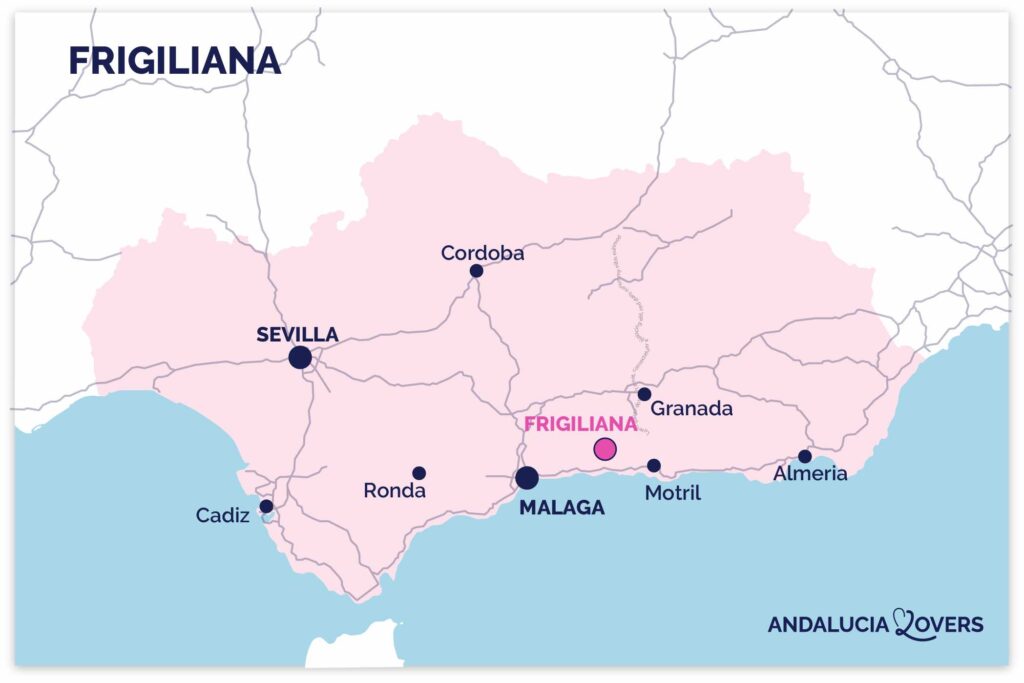
- In Andalucia, on the Costa del Sol
- From Nerja = 15min drive
- From Malaga = 50min drive
- From Granada = 1h15 drive
- From Sevilla = 2h45 drive
- Here’s a map to help you find your way:
How to get there
The car is the most convenient way to reach Frigiliana. The road is wide and well-maintained. Alternatively, you can take a cab from Nerja or use the local buses (not very frequent).
Organized excursions are also available from Malaga, Marbella or Granada – see options

Parking in Frigiliana
Underground parking is available at the entrance to the old village. Alternatively, you’ll find parking spaces along the main road beneath the old village. We recommend arriving early in the morning to find a seat easily.

Useful tips for visiting Frigiliana
Getting around Frigiliana
The best way to discover the village is on foot. Explore the alleyways and discover all the decorative details. But the streets are steep and have stairs. Good footwear is recommended.

If climbing the stairs seems difficult, there are two pleasant alternatives for exploring Frigiliana.
- the little tourist train, which makes a 30-minute loop around the southern part of the village, with commentary in English and Spanish.
- tuk-tuks: although they can’t use the staircases, these vehicles take you to the panoramic viewpoints in the upper parts of the village via alternative routes.

How long and when?
Allow half a day to visit Frigiliana and have lunch. To avoid the crowds, visit early in the morning (before 10am) or late in the afternoon (after 4pm). The village enjoys 320 days of sunshine a year. In summer, avoid the hottest hours of the day.
Tour directions, map and difficulty
The village is divided into two parts: the old town to the left of the Palacio (with historic buildings and the 12 plaques) and the new part to the right (overlooking the gorge). The streets are steep, with staircases.
Visiting with children
Children will love the little tourist train that takes 30 minutes to circumnavigate the village. The many staircases can be tiring for the little ones, but as it creates a little maze, they may enjoy it. And you can have them look for the ceramic plates.

Restaurants
There are several restaurants in the village. The Garden Restaurant particularly caught our eye for its fine cuisine and exceptional views. Book your table in advance to get the best seats on the terrace.
PLAN YOUR TRIP TO Andalusia
Inspiration

Practice