Malaga Cathedral is a must-see: it’s the tallest cathedral in Andalucia!
Overlooking Malaga’s urban skyline with its atypical silhouette, its unfinished tower, far from being an imperfection, adds to the mystery of this imposing building. Behind its main façade, a masterpiece of Baroque art, lie many treasures.
Cathédrale de l’Incarnation stands out for its collection of works of art, the splendor of its choir and the refinement of its architecture.
In this article, you’ll find some useful tips to help you prepare for your visit and have a wonderful time!
This opinion is completely independent, based on our experiences. We made our own choices, visited the area anonymously, and paid our bills in full.
Why visit Malaga Cathedral?
Is Incarnation Cathedral worth it? Our opinion:
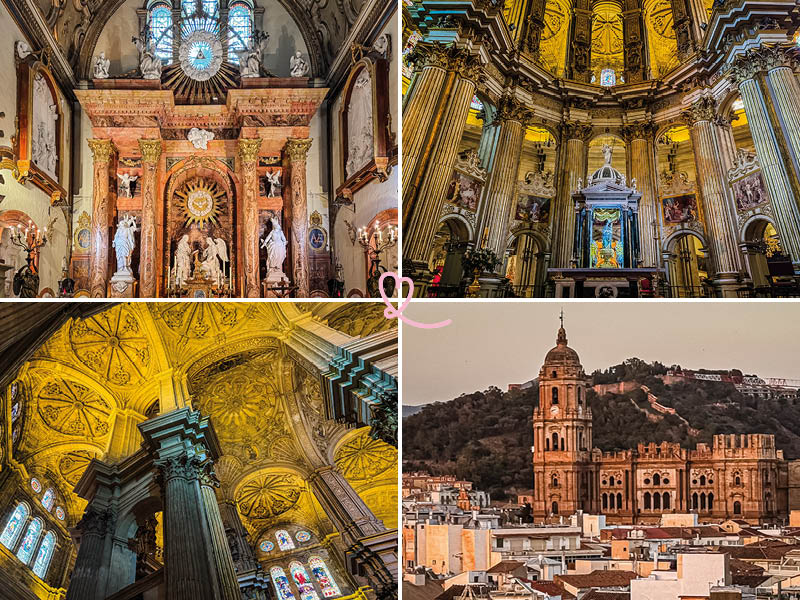
Yes, the cathedral is well worth a visit – in fact, it’s one of the city’s must-see activities! We loved our visit to this atypical cathedral, which is worth a detour for its main façade, a Baroque masterpiece with medallions and twisted columns.
In addition to the beauty of its architecture, the cathedral’s interior impresses with its imposing dimensions and rich ornamentation. Last but not least, you’re sure to be charmed by the many pieces of sacred art on display.
Book your ticket now.

Why is La Manquita famous?
The cathedral is most easily recognized by its unfinished south tower, which gives it a unique silhouette that has earned it the affectionate nickname “La Manquita” (the one-armed one) from the locals.
Yet its imposing allure looms over the whole city, and we loved finding it even in the distance as we wandered the streets of Malaga. It’s also known for its blend of architectural styles (Renaissance, Gothic, Baroque) and richly decorated interiors, packed with stunning works of art.
This is one of Malaga’s must-see attractions.

Our favorite moments
You’ll find out more about our tour in a moment, but here are the things we think you shouldn’t miss on your visit:
- The superb vaults, full of curves and bewitching mouldings,
- The choir and its finely carved wooden pulpits,
- An exceptional group of 11 chapels, each richly decorated and housing stunning works of art.
- Want to discover all the cathedral’s secrets? Book a guided tour!

WHERE TO STAY IN Málaga
Our favorites: neighborhoods and hotels
In the historical center
Hotel Palacio Solecio – see photos and availability
Near the sea, Playa de la Magualeta
Gran Hotel Miramar – see photos and availability
In the Soho district
Hotel Only You Malaga – view photos and availability

History in brief
The history of Malaga Cathedral is linked to that of the Al-Jama mosque where it was built. After the reconquest of Malaga by the Catholic Monarchs in 1487, the main mosque was converted into a Cathedral dedicated to Our Lady of the Incarnation.
Construction of the current building began in 1528, following plans by Diego de Siloé, the great 16th-century architect who also built Granada Cathedral, with the help of Andrés de Vandelvira.
Work spread over several centuries, mixing different architectural styles (mainly Renaissance with Gothic and Baroque influences) until it was interrupted in 1782, leaving the cathedral unfinished.
Despite its asymmetrical appearance, which has earned it the nickname La Manquita (the one-armed one), the cathedral remains a major monument of Andalucia.

How to get there: Incarnation Cathedral, Malaga
Where is Malaga Cathedral?
- In Malaga city center
- 9 Calle Molina Lario
- 5min walk from Paseo del Parque
RENT A CAR IN Andalucia
- Compare prices on our preferred platform: DiscoverCars – one of the best rated sites.
- Choose a compact car, as some villages have very narrow streets!
- Think ofcomprehensive insurance for the same reason
- Book early for choice.

How to get there?
The cathedral is in the heart of Malaga. It’s easy to get to, as the historic center is within walking distance. The Atarazana metro stop (line 1) and the Paseo del Parque street car stop (line 3) are just a few minutes’ walk from the cathedral.

Parking
Traffic is heavy on Malaga’s streets and parking spaces are scarce, so we recommend you leave your car in your hotel parking lot if you’re staying in Malaga, or plan to park in one of the parking lots in the city center (Parking Camas, Parking Carriola, a 5-minute walk from the cathedral).
Useful tips: duration, schedules, eating…
Best time to visit
In season, there can be long queues in front of the monument. We advise you to visit the cathedral in the afternoon, to enjoy the peace and quiet. They are less popular with groups visiting the building in the morning, between 10am and 12pm.
To make sure your visit goes smoothly, we recommend that you visit at the end of the day, just before closing time.
Last but not least, we recommend that you come back to admire the building at nightfall, when it’s lit up and takes on a lovely golden sheen.

Length of visit and main difficulties
We advise you to allow at least 1 hour to admire all the cathedral’s secrets. And if you take the audioguide, it takes around 40 minutes to listen to all the stations.
After your visit, you can take a look at the museum above the store. Here you’ll find religious paintings, 15th and 16th century sculptures, goldsmiths’ and silversmiths’ wares and other religious objects.
There are no major difficulties in visiting the site, especially as it is fully accessible to PRMs (only access to the terrace is via a staircase). Toilets and drinking water are also available on site.

Advice on how to visit
If you opt for the audioguide (included free of charge in the ticket price), you can follow the signposted route. If you don’t have the time, we advise you to follow the route and do so:
- Start your visit by observing the exterior architecture,
- Enter the cathedral and walk through the ambulatory to discover the 11 chapels,
- Finish with the Choir and the Chapelle Majeure, which we consider to be the highlight of the show!

PLAN YOUR DREAM TRIP TO andalucia
All the information you need for your trip:
- 7 maps that make planning easier
- + 150 pre-selected locations
- Practical advice
- 300+ photos to help you choose

Visiting with children
Audioguides with fun routes are available to accompany your children during their visit.
Schedules and rates
The cathedral is open:
- Monday through Friday, at least from 10:30 a.m. to 6:30 p.m.
- Saturday, 10 a.m. to 6 p.m. and Sunday, 2 p.m. to 6 p.m.
- Please note that final access is 45 minutes before closing time.

Prices are as follows:
- Full price: €10
- Reduced rates: 6 or 7€
- To consult the latest timetables and fares, as well as the list of discounted and free ticket holders, visit the official website here.

Guided tours
The tour is self-guided, and audioguides in several languages are included in the price. The tour retraces the history of the cathedral and details the various works scattered throughout the chapels. You’ll also be able to find your way around thanks to the many signs indicating the various points of interest (see photo below).
Alternatively, a guided tour of the cathedral roofs is available. Please note that the ascent is via a narrow spiral staircase of around 200 steps. Unfortunately, we weren’t able to test this option when we visited, as the roof was being renovated. Maybe you’ll have better luck than we did! For further information, click here.

Catering
As the cathedral is located in the city center, you’ll have no trouble finding good places to eat after your visit. Just a stone’s throw from the cathedral, we enjoyed our break at Illari Vinos y Tapas, where we had a salad on the charming, shaded terrace.
But if you want to go even faster, you can opt for a bocadillo (sandwich) to be enjoyed on one of the benches in the pretty park adjoining the cathedral, called the Patio of the Orange Trees.

FUN in Andalucia: activities
- Cooking course in Sevilla
- Canyoning from the Costa del Sol
- Guided Hike on the Caminito del Rey

Unfinished, captivating architecture
Before discovering the treasures of Malaga Cathedral, we advise you to allow 15 minutes for a tour of its exteriors and various facades, to understand the complexity of the place, where different styles blend harmoniously.
The various majestic facades
We began our visual examination of the exterior with the Baroque-style Main Façade . Richly decorated, it has two floors, divided into three by tall Corinthian columns. We loved the warm harmony between the different shades of marble used.
On the second floor, we noticed the finely chiselled medallions under the arcades. On the second floor, you’ll notice the three long windows, topped by another window flanked by two oculi. By observing them from the outside, you’ll be able to understand where the captivating play of light inside comes from!

If you go around the main façade to the right, you can then admire the southern façade, known as the Sun Gate. This features two storeys of Corinthian columns and numerous windows. You can then head for the Chain Gate, the entrance to the building. We found the slender façade particularly beautiful and elegant!

Last but not least, the only Gothic facade in the entire cathedral, on the north side, belongs to the Sagrario church. It was commissioned by Bishop Ramírez de Villaescusa in the early 16th century. We were able to admire the richness of its iconography when we came back to see it illuminated at dusk!

The unique silhouette of two mismatched towers
The North Tower, also known as the Clock Tower, houses a clock, of course, but also 14 bells that still ring out during mass! Measuring 87m high, it is the tallest cathedral in Andalucia. Composed of four floors, we found the last section very elegant, with its octagonal shape and dome topped by a cupola.

Last but not least, the cathedral’s silhouette wouldn’t be so memorable without its other tower, which is still unfinished! You can see from a distance, from Molina Lario Street for example, that its columns don’t overlook anything! This architectural flaw earned it the nickname of Manquita (The Manchurian), but also made it famous. Yet even today, people are still debating whether or not to complete the construction. To be continued!

The enchanting orange courtyard and imposing apse
From the gardens, you can admire the cathedral’s fortress-like apse. The gargoyles, sculpted in the shape of cannons, bear witness to this. It’s even said that, at the time, its walls surpassed those surrounding the city. On either side are two symmetrical portals by José de Bada. We loved resting for a while on this charming patio, full of greenery and crossed by the water of its pools.

A monumental, opulent interior
There’s no doubt that once you’ve explored the various facades, you’ll be eager to discover the cathedral’s hidden treasures, including its impressive nave, its major chapel and its breathtakingly beautiful choir.
As soon as we arrived, we were instantly struck by the monumentality of the cathedral, composed of 3 imposing vessels flanked by 11 side chapels.
To support the high nave, the architect used an original method: stacking the supports!
On pillars of columns with Corinthian capitals, you’ll see entablatures supporting a second level of square pillars on which the vaulting arches rest. It all adds up to a stunning visual effect!

We also spent a long time staring up at the ceiling, contemplating the magnificent pendentive domes covering the bays! Richly decorated, you’ll notice that some vaults are circular while others are elliptical.
And don’t forget that this was once the site of the Al-Jama mosque, with its 113 columns. The cathedral’s architect subtly paid tribute to this past by designing five naves, creating a tangible link between the eras.

The choir and its finely carved sculptures
One of the cathedral’s most iconic pieces! Take a moment to admire this set of 44 chairs and their carvings, which are among the most remarkable examples of 17th-century Spanish Baroque art.
We invite you to take a closer look at the colossal work of artists Louis Ortiz de Maris, José Michael Alfaro and Pedro de Mena, who brought this sculptural ensemble to life. All the more so as you’ll have the chance to enter and admire up close this space usually reserved for officiants.

We didn’t know where to turn, the sculptures were so full of detail! Carved from cedar and mahogany, the beautifully illuminated steles can be admired on all three levels.
From the first level’s enchanting allegorical motifs (plants, animals), through the highly expressive figures of the apostles on the second, to the female heads in medallions on the third, each element fascinated us for its realism and precision.
The amazing major chapel
Last but not least, how can we fail to fall under the spell of the major chapel, adorned with golden reflections? Our eyes were immediately drawn to the majestic pillars forming a hexagonal structure, supporting a richly decorated 2-level entablature.
Take time to observe the busts of the Church Fathers on the first level and the allegorical figures on the second.

But what fascinated us most were the paintings by Italian painter Cesare Arbasia that adorn the wooden panels surrounding the altar. They depict various scenes from the Passion of Christ (the Last Supper, Flagellation, etc.), a rarity we’ve never seen in a choir before. Finally, the red marble pulpits by Fray Juan Batausita, created in the 17th century, close this space with refinement.


It’s time to book!
Compare everything: airlines, prices, schedules, and availability.
An art sanctuary
Don’t limit your visit to the choir or the cathedral’s main chapel! Many other remarkable pieces are hidden in each of the chapels. And let’s not forget the majestic organs and colorful stained glass windows that adorn the building.
Chapels full of treasures
The cathedral’s chapels are a surprise in their own right, rivalling each other in beauty! Nevertheless, we had to make a choice for this article and we invite you to take a closer look at the following chapels:
The Chapel of the Immaculate Conception features a beautiful 17th-century work by Claudio Coello. We appreciated the contrast between the subject and its delicate movements in this wooden setting. And don’t forget the dove in the golden hoop above!

In a much less peaceful style, we spent a long time observing the painting by Enrique Simon in the Virgen de Los Reyes chapel. Depicting the beheading of Saint Paul, we found this painting magnificent despite its horrific charge. In fact, we liked the contrast between the abhorrent, bloody act in the foreground and the white figures in the crowd behind it, weeping and praying.
Not forgetting the head of Saint Paul, gently haloed at the front of the painting, capturing our full attention. Not for nothing did this work win first prize at the Madrid Fine Arts Exhibition in 1887!

Last but not least, the Santa Barbara Chapel, with its Gothic altarpiece dating from 1524. Note the figure of Sainte-Barbe (sculpted in 1765) in the center of the work, shown next to a tower. This young girl, who converted to Christianity despite her father’s prohibition, was imprisoned in a tower and beheaded by her own father for her faith.
This saint, now patron saint of fire-related trades, is surrounded by other figures such as Christ crucified and the evangelists. In the same chapel, you can also observe the contrast between the two paintings of the Ascension and the Asumption, which face each other on the walls.

The two imposing organs
And don’t miss the two 18th-century Baroque organs on either side of the choir! These masterpieces by Julian de la Orden rise three storeys to a height of 22 metres. Adorned with elegant Corinthian columns, delicate plant motifs and covered in a surprising pistachio green, both instruments have a unique presence.
At the top, we discovered finely sculpted angels, complementing the refined gold accents throughout the room! The idea that these instruments contain more than 4,500 tubes let us imagine the sublime concerts that are still to come!

The stained glass windows
There was so much to look at in this cathedral that we almost forgot to admire the stained glass windows! Yet they lend the building a very special brightness.
Once you’ve explored the cathedral’s treasures in detail, we invite you to take another look at the touches of color in the polychrome windows, even in the naves, where you’ll find triptych stained glass.

PLAN YOUR DREAM TRIP TO andalucia
All the information you need for your trip:
- 7 maps that make planning easier
- + 150 pre-selected locations
- Practical advice
- 300+ photos to help you choose
Frequently asked questions
Where’s the best view of Malaga Cathedral?
From the Castle of Gibralfaro, you’ll have a bird’s-eye view of the Cathedral, while from the Port of Malaga, you’ll see its recognizable, centuries-old profile towering over Malaga’s urban skyline. But for a breathtaking view, the best thing to do is treat yourself to a drink on one of the city’s many rooftops, and why not admire it at sunset?

Why is L’Incarnation Cathedral called here?
The cathedral got its name from the fact that it was consecrated in 1487 under the patronage of Saint Mary of the Incarnation. In Christian theology, the Incarnation is the moment when God becomes flesh—that is, when He takes on human form in the person of Jesus.
The motif of the Mystery of the Incarnation (representing the angel Gabriel and the Virgin Mary) can be found in some of the cathedral’s paintings, and even on the main façade, on the central medallion of the decorative portals.

PLAN YOUR TRIP TO Andalusia
Inspiration

Practice

Places not to be missed