Sevilla Cathedral is a must-see: it’s the 3rd largest cathedral in the world! Its charm is quite singular, as it was created over a 12th-century mosque, when Sevilla was ruled by the Almohad dynasty. We really liked his eclectic style. We were stunned by its main altarpiece: the highest in the world! You won’t be disappointed when you visit this record-breaking cathedral.
In this article, you’ll find some useful tips to help you prepare for your visit and have a wonderful time!
This opinion is completely independent, based on our experiences. We made our own choices, visited the area anonymously, and paid our bills in full.
Why visit the cathedral?
Is the cathedral worth it? Our opinion:
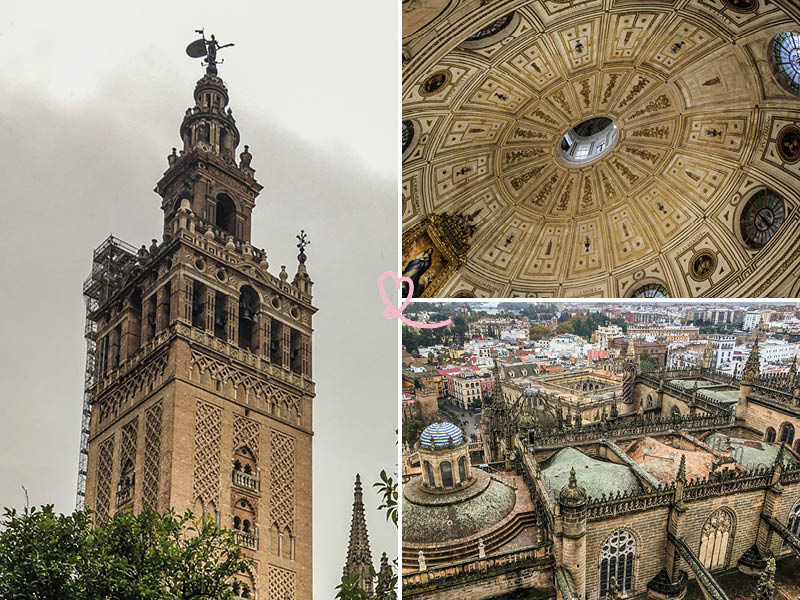
Yes, the cathedral is well worth a visit. We were impressed by its massive size. It is the 3rd largest cathedral in the world, and the widest of the Gothic cathedrals. This is because it was built on top of a 12th-century mosque, when the city was under Muslim rule. In fact, it was during this period that the Giralda, a 104m tower, was built. Get ready to enjoy superb panoramic views of Sevilla from its summit!
This is one of Sevilla’s most beautiful monuments.

Why is she famous?
The cathedral is not only famous for its enormous size and Giralda, but also for the treasures it contains. First and foremost is the main altarpiece in the center of the building. We were captivated by its 220m2 of gilded wooden figurines, and with good reason! This altarpiece is the largest in the world. Finally, the building houses the mausoleum of Christopher Columbus. His remains were repatriated from Havana at the end of the 19th century.

Our favorite moments
You’ll find out more about our visit, but we can’t resist sharing our favorites with you right now:
- The choir: we found this central part of the cathedral superb, with its altarpiece, sculpted vaults and magnificent stalls.
- The Sala Capitular: we were pleasantly surprised by this ovoid room with its spectacular dome.
- Panoramic views from the Giralda: climbing to the top of the tower affords great views of the rest of the cathedral and the city.
>> Book your ticket for the entrance.

WHERE TO STAY IN Seville
Option 1: In the historic center
Convenient for visiting everything on foot, we recommend:

Option 2: El Arenal
Between quiet streets and riverside ambience, we recommend it:

See our complete selection of the best hotels and neighborhoods in Sevilla
History in brief
The cathedral’s history dates back to the 12th century, when the Almohad dynasty conquered Sevilla. Caliph Abú Yakub ordered the construction of a large mosque. That’s why you’ll see magnificent ornaments typical of Islamic art, especially on the beautiful Puerta del Perdón. It wasn’t until the 15th century that the decision was made to build a Gothic cathedral to symbolize the city’s power after the Reconquista. Elements of the mosque have been reused, and the minaret (Girlada) transformed into a campanile. The cathedral was consecrated in 1507 and listed as a UNESCO World Heritage Site in 1987.

How to get there: Cathedral of Saint Mary of the See, Sevilla
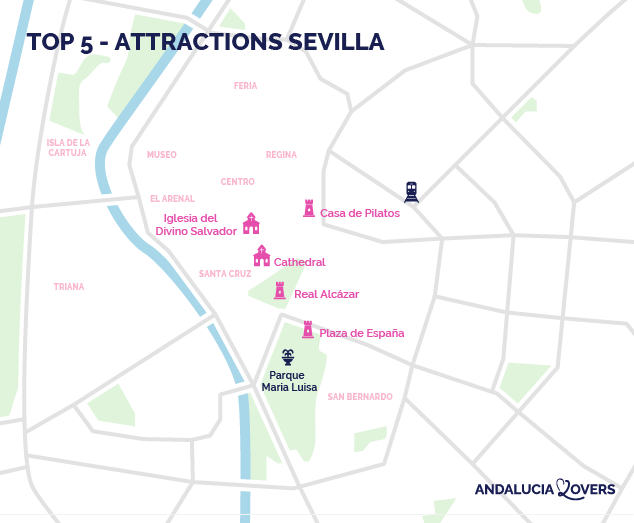
Where is the cathedral?
- Downtown Sevilla (Santa Cruz district)
- Avenida de la Constitución, s/n, 41001 Sevilla
- close to the Alcázar and Plaza Nueva.
RENT A CAR IN Andalucia
- Compare prices on our preferred platform: DiscoverCars – one of the best rated sites.
- Choose a compact car, as some villages have very narrow streets!
- Think ofcomprehensive insurance for the same reason
- Book early for choice.

How to get there?
The cathedral is in the heart of Sevilla. It’s easy to get to, as the historic center is within walking distance. The “Puerta de Jerez” metro stop and the “Archivo de Indias” streetcar stop are a ten-minute walk from the cathedral. To plan your route, visit the official public transport website here.

Parking
Parking in Sevilla is difficult. We advise you to opt for a paid underground parking lot. The Avenida Roma and Paseo de Christina parking lots are a 10-minute walk from the cathedral.
PLAN YOUR DREAM TRIP TO andalucia
All the information you need for your trip:
- 7 maps that make planning easier
- + 150 pre-selected locations
- Practical advice
- 300+ photos to help you choose
Useful tips: duration, schedules, eating…
Best time to visit
As the cathedral is very busy, we advise you tobook your ticket several months in advance. In season, there can be long queues in front of the monument. We advise you to choose afternoon hours (2pm-3pm). They are less popular with tourists, who fear the heat and prefer to visit the building in the morning. To be sure of a peaceful visit, we recommend that you visit Sevilla in winter!

Length of visit and main difficulties
Allow 2 hours for the visit (1 hour if you don’t climb to the top of the Giralda). The monument is accessible to people with reduced mobility. Visitor booklets are available in Braille, and tours in sign language are also organized. Find out more on the official website here.
The main difficulty, in our opinion, is the climb to the Giralda. It’s quite tiring, although there are stairs only at the end of the ascent. We do not recommend it for people suffering from claustrophobia or vertigo. Particularly in high season, the crowds are very high, both at the top and on the way up, which can lead to a feeling of confinement.

Advice on how to visit
If you buy your ticket online, you’ll enter the cathedral via the Puerta del Lagarto. If you buy your tickets on site, you’ll have to pass through Puerta del Príncipe (also known as Puerta de San Cristobal) to get to the ticket offices. Then, if you wish, we suggest you climb to the top of the Giralda. You can then visit the rest of the building with greater peace of mind. Then take a look at Christopher Columbus’ mausoleum, before discovering the antechamber and sala capitular. Then take your time to admire the choir, and finish your tour on the patio de los naranjos before exiting via the Puerta del Perdón.

Visiting with children
Documents are available on the official website here to accompany your children during their visit. However, they are only available in Spanish. Changing tables are available in the permanent exhibition area and in the patio de los naranjos.

Schedules and rates
The cathedral is open Monday to Saturday, 11am to 7pm (last entrance at 6pm) and Sunday, 2.30pm to 7pm (last entrance at 6pm).
Here are the prices:
- Full price: €13 online / €14 at the cash desk
- Reduced price (students under 25, over-65s…): €7 online / €8 at ticket offices.
- Free admission: by reservation from 2 to 3 p.m. Monday to Friday, for Sevilla residents, children under 13…
- To consult the latest timetables and fares, as well as the list of discounted and free ticket holders, visit the official website here.
- Ticket for cathedral + Giralda tower here.

Guided tours
Guided tours lasting 1.5 hours are organized daily at fixed times, and cost €20 (online). You can opt for a tour that includes the Giralda or not. Access is via Puerta San Miguel on Avenida de la Constitución. Visit the official website here for more information.
You can also book a 1-hour guided tour of the cathedral’s chapels and works of art, with priority access. Book your guided tour now.

Catering
As the cathedral is located in the city center, you’ll have no trouble finding good places to eat after your visit. Just a stone’s throw from the cathedral, you can enjoy elaborate dishes at Vuela Tapas & Cocktails. To find your way around, check out our article on the best restaurants in Sevilla!

A former mosque
La Puerta del Perdón
As mentioned above, Sevilla Cathedral was built on the site of a 12th-century mosque. When the cathedral was built in the 15th century, elements of the mosque were preserved and adapted to the new monument. The Puerta del Perdón, at the end of the tour route, is a good example. In Almohad times, it was the main entrance to the mosque. Its horseshoe arch, typical of Islamic art, has been preserved. We really appreciated its plateresque ornamentation (inspired by the Italian Renaissance). The sculptures of Saints Pedro and Pablo on the sides were added in 1520. The same is true of the New Testament scene depicted above the door: the Expulsion of the Merchants from the Temple.

El patio de los naranjos
The Puerta del Perdón provides access to the patio de los naranjos. We enjoyed this quiet, leafy location. As the name suggests, you’ll see orange trees lined up in perfect rows. This patio was originally the sahn, the mosque’s religious courtyard. Imagine pillars with arches all over the patio! They formed three galleries. The site of today’s large fountain corresponds to the old sabil, a fountain used by Muslims to perform ablutions before entering the mosque.

La Giralda
The Giralda is undoubtedly the most famous part of the cathedral. It’s even sometimes considered the emblem of the city! In any case, it’s the most visible element of the former mosque. We tried to imagine this ancient minaret in the time of the Almohads. Its square structure houses 35 levels of ramps, which used to be used to lift horses! Take time to admire its ornamentation, with horseshoe arches and lozenges. The upper part, too deteriorated, had to be remodeled in the 16th century. It was on this occasion that a four-metre-high bronze statue of a woman was installed. In Renaissance style, it represents “victorious faith”. It is called Giraldillo, which explains the name given to the tower!

Be brave for the climb, the tower is 104m high! On our way up, we saw a number of objects, including the Giralda’s 1st clock, inaugurated by the king in 1400. But it was the summit that really stood out. We admired the bells of the Giralda, converted into a campanile in the 15th century. Finally, we took in the superb views of the rest of the monument and Sevilla.

A Gothic cathedral
Massive doors
In the 15th century, the cathedral was built in Gothic style. The cathedral’s doors were built at this time, or almost. The puerta de la Asunción below was not completed until 1827. As its name suggests, and as the scene depicted on its tympanum shows, it is dedicated to the ascension of the Virgin. We found it more solemn than the other doors. This may be because it’s on the west side of the building, considered the main part.

The second gate that caught our eye the most was the Puerta de la Concepción. It is located on the north face of the transept and gives access to the Patio de los naranjos. Like its predecessor, it was not completed until 1887. We were surprised to find out, as we found the door to be quite harmonious. The architect, Adolfo Fernández Casanova, deliberately imitated the Gothic style to ensure continuity with the buildings of previous centuries, such as the 16th-century lateral pilasters (columns set into a wall). Take time to admire the scene above the facade: beneath a crown, you can see Jesus as a priest, surrounded by his apostles.

Magnificent vaulted ceilings
During your visit to the cathedral, don’t forget to look up at the ceiling, to admire the vaults. The majority are simple cross vaults, typical of the Gothic style. Completed in 1506, they stand on the former site of the mosque’s prayer hall. At the choir level, in the center of the cathedral, we were overwhelmed by the decorative richness of the vaults. Did you know that they expand under the effects of temperature changes? In the morning, they rise due to the heat and, at the end of the day, they fall back down. This phenomenon was observed during the restoration of the building in 2006. Rest assured, there’s no danger – on the contrary! This “flexible” architecture makes it more resilient in the event of a problem.

The choir: its altarpiece and decorative elements
Speaking of the choir, we need to go into more detail. We loved this part of the cathedral, with its extraordinary wealth of decoration! You won’t want to miss the capilla mayor, or altar master. It contains the world’s largest altarpiece! No fewer than 1,500 sculpted and gilded figurines can be admired over an area of almost 220m2! Created by Flemish sculptors in a flowery Gothic style, it depicts 45 scenes from the life of Christ. Can you spot the Nativity?

The interior of the choir also impressed us with its impressive carved wooden stalls. There are no fewer than 117 seats! Completed in the 16th century, they were built in the Mudejar Gothic style (influenced by Islamic art) and feature sculptures of saints and reliefs with scenes from the Old and New Testaments. Finally, don’t forget to admire the two organ cases, separated on either side of the choir. They are controlled from a single central console, making them a single instrument. They date from the 18th century, in superb Cuban mahogany.

A Renaissance cathedral
The impressive antechamber
Additions and changes were made to the cathedral during the Renaissance. The Royal Chapel, for example, replaced a Gothic apse. However, we’re going to tell you more about the antecabildo (antechamber), which caught our eye. Built in the 16th century, this room features a Renaissance-style coffered vault. Take a look at the high-relief sculptures on the sides. Among other things, they depict scenes from the Apocalypse. They are all accompanied by a Latin commentary. This room leads to a spectacular egg-shaped hall: the Sala Capitular.

The Sala Capitular and its masterpieces
We were amazed by this room, topped by a magnificent Renaissance dome. Built in the 16th century, it was the first elliptical-plan room of the Spanish Renaissance. This provided perfect visibility and acoustics for the ecclesiastical members who gathered here. The sides feature high-relief scenes. They represent the virtues constituting a moral code that clerics had to respect at their assemblies. Don’t miss the series of medallion paintings created by the famous painter Bartolomé Esteban Murillo in 1667. We fell in love with the centrally-located Inmaculada, which seemed to exude great delicacy.

In the center of the room, you’ll see a superb secretary and an archiepiscopal chair made in 1592. The beautiful marble floor also deserves your attention. The dome gave us the impression of being in Italy! It’s no coincidence that this paving was inspired by a project designed by Michelangelo for Rome’s capitol.

The sacristy and its treasure
We found the decor of this sacristy particularly grandiose. Renaissance in style, and more specifically Plateresque (Spanish Renaissance), it features grotesques and garlands, as well as richly sculpted pilasters (embedded columns). They are framed by vaulted ceilings decorated with scallops. Look up to admire the dome. You’ll see a representation of the Last Judgement, the Heavenly Court and the damned. The vaults are decorated with representations of apostles and bishops.

The room features rich reliquaries, as well as a significant collection of paintings and sculptures. But it was the goldsmiths’ collection that caught our eye the most. It forms the cathedral’s treasury. The most important piece is Juan de Arfe’s silver monstrance in the Renaisssance style, weighing over 300kg!

Subscribe to our Newsletter
- Get away from it all with Region Lovers’ beautiful destinations!
- Once a month
- Advertising-free
Frequently asked questions
What’s so special about Sevilla Cathedral?
Sevilla Cathedral is the largest in Spain and one of the largest in the world, with a surface area of almost 500,000 m3.
What to wear to visit the cathedral
To enter the cathedral, you must wear decent clothing and uncover your head. We strongly recommend wearing knee-length pants or skirts and covering your shoulders.
Who is buried in Sevilla Cathedral?
In addition to the tomb of Christopher Columbus, the cathedral houses other tombs, located in the capilla Real, which is closed to the public. Inside are the tombs of Ferdinand III the Saint, patron saint of Sevilla, Alfonso X the Wise, King of Castile and León, as well as those of Beatrice of Swabia, Queen of Castile, and Sevilla’s patroness Our Lady of the Kings.

PLAN YOUR TRIP TO Andalusia
Inspiration

Practice

Places not to be missed


SHE MADE THE TRIP Claire