If you’re visiting Malaga, don’t miss the magnificent Carmen Thyssen Museum. Nestled in the city’s historic district, this museum takes you on an exceptional journey to the heart of Spanish painting, with a collection of over 200 works.
With the Palacio de Villalón as its backdrop, it highlights Spanish art, tracing its evolution from Romanticism to the dawn of modernity, while celebrating the creative abundance of Andalucia.
In this article you’ll find some useful tips to help you prepare for your visit to the Carmen Thyssen Museum in Malaga and have a wonderful time!
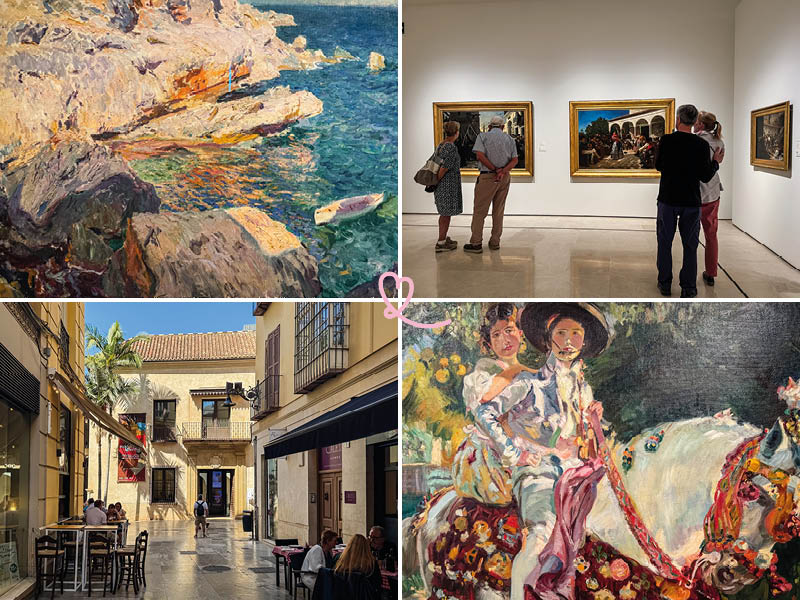
This opinion is completely independent, based on our experiences. We made our own choices, visited the area anonymously, and paid our bills in full.
Why visit the Carmen Thyssen Museum
Is the Carmen Thyssen Museum worth it? Our opinion:
Yes, absolutely! We even put the Carmen Thyssen Museum at the top of our list of the best museums in Malaga! We loved this colorful immersion in Spanish painting from the 13th to the 19th centuries, and especially the focus on Andalucia painting, so typical!
Don’t wait—book your skip-the-line admission ticket today!

Why is the Carmen Thyssen Museum famous?
This must-see museum in Malaga is first and foremost known for its founder, Carmen Thyssen, one of the world’s greatest collectors, who exhibits here a remarkably coherent collection of Spanish painting.
The exhibition offers a captivating journey through the centuries and features a stunning selection of paintings from Andalucia!
In addition to its exceptional permanent collection, the museum is distinguished by its daring temporary exhibitions. When we came, we particularly appreciated the exhibition of Man Ray’s photographs, grouped together as if in a cabinet of curiosities.

Our favorite moments
We really fell in love with this museum, both for its..:
- Its soothing atmosphere: the scenography is uncluttered, and the visitor’s path through the exhibition is fluid and intuitive, encouraging contemplation.
- Its uniquecollection of Andalusian art: we really enjoyed discovering the scenes of authentic daily life and the historic landscapes of Málaga!
- A colorful immersion in the sublime canvases of such great names in Spanish painting as Sorolla, Zuloaga, Romero de Torres, Regoyos and Fortuny.
- Fancy a guided tour of the museum’s magnificent collection? More info and availability here.

WHERE TO STAY IN Málaga
Our favorites: neighborhoods and hotels
In the historical center
Hotel Palacio Solecio – see photos and availability
Near the sea, Playa de la Magualeta
Gran Hotel Miramar – see photos and availability
In the Soho district
Hotel Only You Malaga – view photos and availability

History in brief
History in brief
The Carmen Thyssen Museum in Malaga opened its doors in 2011, as part of a drive to showcase Andalusian and Spanish art in a historic setting. Located in the 16th-century Palacio de Villalón, the museum houses an impressive collection of over 200 works, mainly from the 19th century, assembled by Baroness Carmen Thyssen-Bornemisza. The collection highlights emblematic artists such as Julio Romero de Torres and Joaquín Sorolla, while reflecting the evolution of Spanish painting.

How to get there: Carmen Thyssen Museum, Malaga
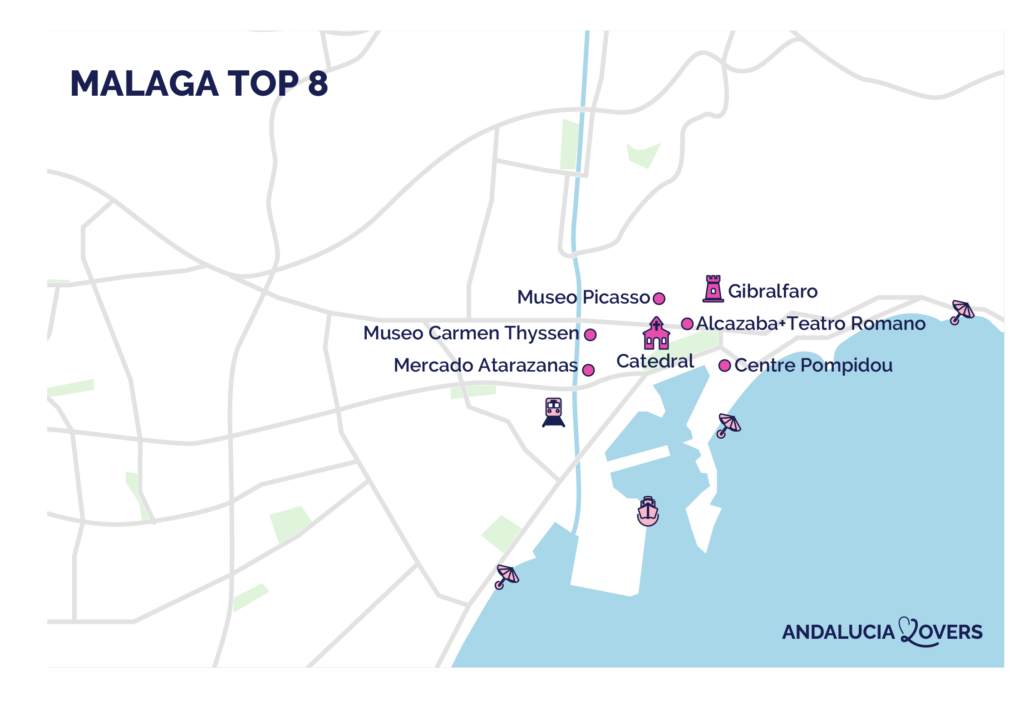
Where is the Carmen Thyssen Museum?
- In Malaga, on Plaza Carmen Thyssen, Calle Compañía
- In the historic center, next to Plaza de la Constitucion
- 5min walk from Cathédrale de l’Incarnation
- Here’s a map to help you find your way:
RENT A CAR IN Andalucia
- Compare prices on our preferred platform: DiscoverCars – one of the best rated sites.
- Choose a compact car, as some villages have very narrow streets!
- Think ofcomprehensive insurance for the same reason
- Book early for choice.

How to get there?
Please note that the museum is located in a secluded street, so it won’t be possible to drive in or be dropped off by cab just outside.
If you’re already in the city center, it’s best to come on foot, as the historic part of town is not very extensive. The Cathedral of the Incarnation, for example, is just a 5-minute walk away.
The museum is easily reached from María Zambrano station in just 12 minutes by tramway line 1 (Atarazanas stop).

Parking
Please note that the museum has no parking facilities for cars or bicycles.
The nearest parking lot is Calle Granados, a 6-minute walk away.
Useful tips: duration, schedules, eating…
Best time to visit
Malaga’s Carmen Thyssen Museum seems to stand out for its peaceful atmosphere, far removed from the hustle and bustle of the tourist crowds. All the more so as the exhibition spaces are vast, making for a pleasant visit even when it’s busy.
For the best experience, we advise you to avoid weekends and visit late in the day, as the museum is open until 8pm.
And don’t forget to take time out for a visit to the museum store outside, which is well worth a visit! We found this store particularly well-stocked, with books and posters by the artists in the collection, as well as a selection of design objects, home decor and singular jewelry.
More info on the boutique website here.

Length of visit and main difficulties
We advise you to allow at least 2 hours for your visit, if you wish to discover the entire collection, and 3 hours if you wish to visit the temporary exhibitions.
There are no difficulties for this visit. All exhibits arewheelchair accessible. Note, however, that the museum is very air-conditioned in summer, so bring a cardigan or scarf in anticipation of the temperature difference.
We’ll be happy to help you:
- lockers on the first floor, where you can leave your small belongings (you’ll need a 1 euro coin) so you can enjoy your visit hands-free.
- a relaxation area on level 2 where you can sit back and take a break between discoveries.

Advice on how to visit
To get the most out of your visit, we recommend you follow the museum’s chronological itinerary:
- First floor: romantic landscapes and costumbrists
- Level 1: Old masterpieces, naturalistic landscapes and precious styles
- Level 2: fin de siècle works
- Level 3: temporary exhibitions
All you need to do is follow the clearly indicated numbering. Throughout the halls, you’ll discover a wealth of mediation panels, available in English and Spanish, offering enriching explanations for each section.

PLAN YOUR DREAM TRIP TO andalucia
All the information you need for your trip:
- 7 maps that make planning easier
- + 150 pre-selected locations
- Practical advice
- 300+ photos to help you choose
Visiting with children
There are no special facilities for children, but an educational group room is available for groups, by reservation. Find out more about all the activities on offer for young audiences on the official website here.
Schedules and rates
The Carmen Thyssen Museum is open Tuesday to Sunday, 10 am to 8 pm.
Prices are as follows: €12–15 (full price), €8–10 (reduced price), free (under 18)
More information on the official website here.
Guided tours
The Carmen Thyssen Museum offers guided tours in several languages for €11.
Visits to temporary exhibitions and thematic tours of the collection are available on request. Find out more in the relevant section of the website here.
Alternatively, you can download notices of works via a QR code available in the auditorium, which you can also listen to.
Finally, on Level 2, you’ll find a touch-sensitive tablet that allows you to view the works of art in high resolution, zoom in on certain details and, above all, get educational details.

Catering
We recommend taking a break at the on-site cafeteria! The menu offers a short breakfast menu, coffees, cold drinks and, above all, tempting pastries! All served on a lovely patio shaded by brick walls.
Otherwise, as the museum is located in Malaga city center, you can find our selection of good addresses in Malaga in our dedicated article (coming soon).

Discover the history of the museum
The origins: the collection of an art lover
Carmen Thyssen is one of the world’s greatest art collectors! She grew up surrounded by works of art and began collecting at the age of 17.
In 1985, she married Baron Thyssen-Bornemisza, himself an art lover with a collection of over 600 Old Master paintings.
Convinced, like her husband, that art is a universal language, she has been exhibiting her and the Baron’s collection at Madrid’s Museo Thyssen-Bornemisza since 1992.
The Museo Carmen Thyssen Málaga, inaugurated in March 2011, was created with the support of the Mayor of Málaga, Francisco de la Torre. The museum contains over 240 works which, like the Madrid museum, are on loan free of charge.

A 16th-century palace as a showcase
The Museo Carmen Thyssen Málaga is housed in the Palacio de Villalón, a 16th-century municipal palace typical of Renaissance architecture in Malaga. Built on the remains of the Roman city, in Malaga’s old Moorish quarter, it has been restored so that visitors can enjoy the original spaces.
A restored Renaissance gateway leads into the palace, which extends over two floors around a central courtyard surrounded by arcaded galleries. We loved the light coming through the glass roof on the top floor, allowing a glimpse of the Santos Martires church tower.
And don’t miss the remarkable carved wooden ceilings in the main rooms!

Contemporary buildings to complement
Adjacent to the palace, several new buildings designed in a contemporary style have been erected to house temporary exhibitions as well as the store and auditorium.
These new buildings coexist harmoniously with the old ones, making it easy to stroll through the spaces.

Explore the rich collection
An artistic journey from the 13th to the early 20th century
Malaga’s Carmen Thyssen Museum offers a complete panorama of Spanish painting, from the 13th century to the modern era. We were literally swept away by the chronological tour, following the transformation of styles, techniques and themes through the ages.
The visit begins on the first floor, with a section devoted to “costumbriste” painting. This 19th-century movement focused on depicting local customs and traditions through scenes of everyday life.
You’ll be dazzled by this colorful introduction, where the canvases exude a festive atmosphere, with scenes of férias, flamenco demonstrations and bucolic Andalucia patios.

While the first floor features romantic landscapes where the focus is on the picturesque details of nature, the second floor is radically different!
You’ll notice that in the first series, the paintings feature a more subdued color palette, moving away from the fantastical in favor of a more realistic approach.
This section celebrates the advent of the naturalistic landscape, where artists, driven by a quest for truth, strive to capture the authentic essence of nature. This stylistic evolution testifies not only to an aesthetic change, but also to a new way of perceiving the world, marking a crucial stage in the history of Spanish art.

On the same floor, you’ll also find paintings known as preciosista or precious style, a movement that emerged in Spain in the second half of the 19th century. This style is characterized by remarkably fine execution and particular attention to lighting effects. The artists favored gallant scenes, aristocratic portraits and mythological subjects, reflecting the sophisticated tastes of 18th-century Spanish court and high society. We really appreciated the striking contrast between these small, precious canvases and the wilder landscape paintings.
Finally, this floor also houses an intimate room dedicated to antique masterpieces.

The second floor is reserved for works from the late 19th century. Spanish artists took an interest in international painting and allowed themselves to be influenced, modernizing their subjects and opening up to other practices. In this room, we particularly liked the works by Sorolla and Francisco Itturino, which brilliantly illustrate this period of transition to modernity.

Andalusian art in the spotlight
In addition to this express lesson in art history, the museum stands out for its remarkable collection of Andalusian art, one of the most complete in Spain. It offers a fascinating immersion in 19th-century Andalucia, which has become the embodiment of the idealized, romantic image of Spain. The works on display capture the essence of the region through emblematic themes such as Moorish architecture, flamenco, bullfights, religious processions and depictions of gypsy communities.
These subjects, which had a profound impact on the imagination of artists of the time, helped forge a stereotypical image of Andalucia. This romantic representation in turn influenced Spanish painters in their quest for a national artistic identity, creating a fascinating dialogue between historical reality and idealized vision.

Among the many colorful paintings, we particularly liked the work of Sevillian artist Ricardo López Cabrera, who devoted most of his work to painting scenes of morality. His painting Jeunes Mariés (Young Married Men) is a perfect example of his determination to transcribe reality. Aside from the realistic, ultra-detailed composition of the vegetation, right down to the crumpled paper of the colored lanterns, what we liked best was the precision with which the painter focuses on his subjects.

If you look closely, you’ll see the particularity of each character, from the singer who stands up to toast the couple’s happiness, to the priest and his sidelong glance at the bride, to the apparent tiredness of the old lady sitting behind the couple. Sometimes, costumbrism includes a satire of morals, and here, a real plot is woven into this initially decorative tableau.

A vibrant plunge into the palette of the great masters
Finally, the Carmen Thyssen Museum is a veritable godsend for discovering Spain’s most renowned artists. Among the most prominent are Pérez Villaamil, Lucas Velázquez, Romero de Torres, Casas and Zuloaga.
Beyond the precious style mentioned above, the second floor also illustrates the radical transformation of artistic taste in Spain in the second half of the 19th century.
Mariano Fortuny i Marsal embodied this transformation, introducing an innovative style characterized by colorful, spontaneous, small-format compositions. Such was his success on the art market that many contemporary artists adopted his style.
We spent a long time observing his Corridas de toros painting and the sensitivity with which he captures the brutality of combat. In the foreground, Fortuny captures the essence of the joust, skilfully blending the massive silhouettes of the bulls with the colorful capes of the bullfighters. This vibrant scene almost makes us forget the background, whose tiers are sketched with only a few nervous strokes, surprisingly evoking abstract art, which would not emerge until several decades later, in the 20th century.

Last but not least, we fell in love with Joaquín Sorolla y Bastida‘s magnificent painting Rocks in Jávea and the White Ship. Looking at this painting, we were instantly captivated by the brilliant light and the play of reflections in the water.
Part of a series of 16 works on the same theme (sea and rocks), this work was created during the summer of 1905 in Javea, a town on the Costa Blanca to which the painter was deeply attached. Looking at the canvas, we had the impression that Sorolla had succeeded in capturing the feeling of serenity that this landscape gave him.
Could it be his way of capturing the sun on the rocks, or the vibrations brought out by the intermingling of orange, violet and blue? In any case, we advise you not to miss out on this jewel in the collection!

Subscribe to our Newsletter
- Get away from it all with Region Lovers’ beautiful destinations!
- Once a month
- Advertising-free

Frequently asked questions
What activities does the Carmen Thyssen Museum offer?
In addition to guided tours, the museum offers numerous activities throughout the year, including lecture cycles, creative workshops (musical initiation, storytelling for children) and living arts cycles (dance, meditation, concerts). To be found on the website here.
Is Carmen Thyssen’s collection on show elsewhere?
The Carmen Thyssen Collection is considered one of the most important private collections in the world. Apart from the Malaga museum, the Thyssen-Bornemisza couple’s collection has been on display at Madrid’s National Museum since 2004. It presents a chronological tour from 17th-century Dutch painting to 20th-century art. Find out more on the official website here.
There may even be a new Carmen Thyssen museum in Barcelona.
To be continued…
PLAN YOUR TRIP TO Andalusia
Inspiration

Practice

Places not to be missed