Malaga’s Roman Theatre is one of the city’s must-see historic sites. Its remarkable remains, dating from the 1st century AD, plunge visitors into the history of the Roman era. In this article, you’ll find some useful tips to help you prepare for your visit to Malaga’s Roman Theatre.
This opinion is completely independent, based on our experiences. We made our own choices, visited the area anonymously, and paid our bills in full.
Why visit Malaga’s Roman Theatre?
Is the Roman Theatre worth it? Our opinion:
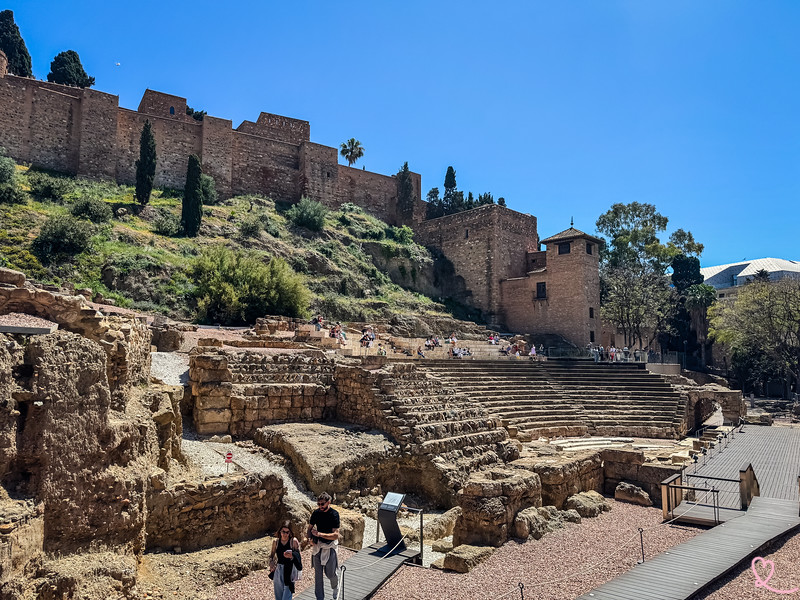
The theater is worth a visit for a great photo of the Roman remains against the backdrop of the Alcazaba. We particularly enjoyed the dialogue between these two emblematic Malaga monuments.
The contents of the interpretation center are fairly limited, however, so we recommend you book a guided tour if you want to learn more about Malaga’s history.

Why is the Roman Theatre famous?
The site, dating from the 1st century AD, bears witness to Malaga’s Roman past. It is famous for the remarkable preservation of a large part of the cavea, its terraces, most of which follow the slope of the hill.

Our favorite moment
We stayed for a long time, observing the changing colors of the bleachers and trying to get the best shot we could!
And don’t forget to come back at nightfall to admire the site’s illuminations.
The theater also comes back to life during cultural events, hosting flamenco, dance and concert performances that perpetuate its original vocation.

History in brief
The history of Roman theater is full of twists and turns. Here are a few key dates:
- 1st century AD: Construction of the theater under the reign of Augustus
- 3rd century: Theatre gradually abandoned
- 5th-6th centuries: The site is transformed into a necropolis

For centuries, the theater remained buried beneath streets built on the slope of the Alcazaba, and it was only a stroke of luck that revealed the remains!
During gardening work in 1951 for the Casa Cultura, the first remains of the theater came to light. The following decades were marked by excavations, culminating in the demolition of the Casa de la Cultura in 1995 to allow complete excavation of the archaeological site. The Centre d’Interpération, designed by architect A. Tejedor, was inaugurated in 2010.
Access: Roman Theatre, Malaga
Where is the Roman Theatre?
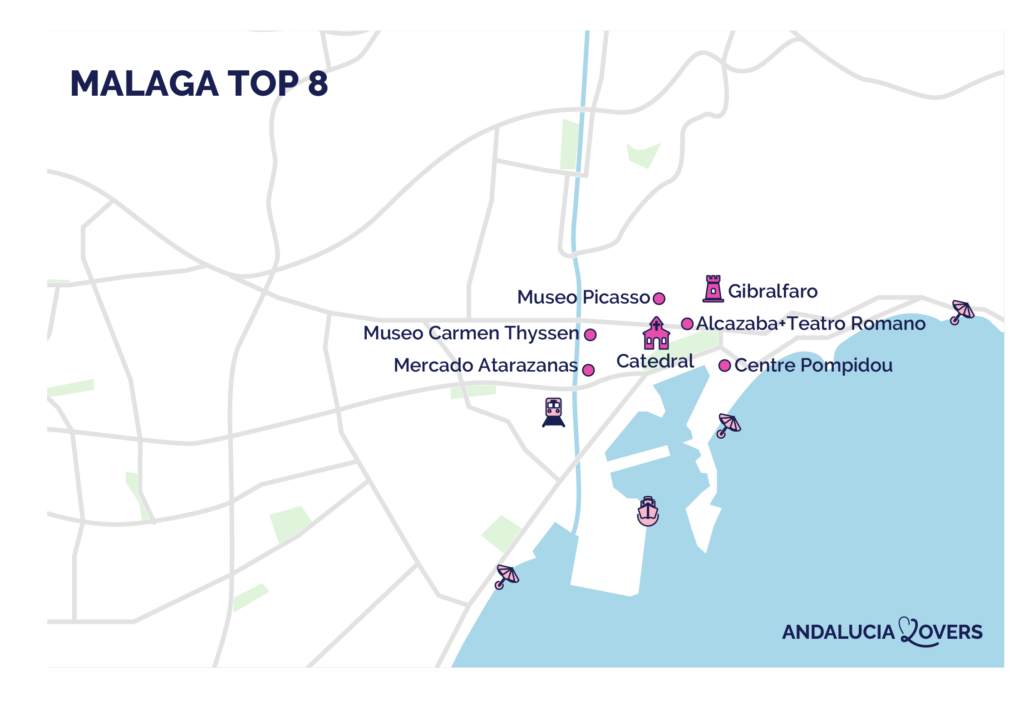
The theater is located in Malaga city center, at 8 Calle Alcazabilla. It is located at the foot of the Alcazaba. Here’s a map to help you find your way:
RENT A CAR IN Andalucia
- Compare prices on our preferred platform: DiscoverCars – one of the best rated sites.
- Choose a compact car, as some villages have very narrow streets!
- Think ofcomprehensive insurance for the same reason
- Book early for choice.


How to get there?
The easiest way is on foot! Malaga’s city center is easy to navigate, and access to the Roman Theater of Malaga is from the Plaza de la Aduana.
If you’re coming by public transport, the nearest bus routes stop at Paseo del Parque. From there, it’s a 12-minute walk. Although there is no metro station directly on site, La Malagueta station is about a 15-minute walk away.
If you come by car, please note that it will be impossible to drive through the entrance to the Roman Theater, as the street is pedestrianized.
Access by car from Malaga airport takes around 20 minutes.
Parking
The Alcazaba parking lot, on calle Guillén Sotelo 1, is the closest to the Roman Theatre.
Useful tips: duration, schedules, eating…
Best time to visit
We advise you to choose the morning or the end of the day to admire the sun’s rays on the bleachers. For a more leisurely visit, opt for a weekday tour.

Length of visit and main difficulties
Allow 15-30 minutes for the visit.
Bring a hat if you come in the middle of the day, as the site is in a bowl and the heat can be intense.
Please note that PRM access is only guaranteed in the museum. To reach the remains, take a staircase.

Advice on how to visit
Although there is no set direction for your visit, we recommend that you:
- Start at the Interpretation Centre to discover the history of the site,
- Explore the remains from below,
- To finally reach the Mirador de la Alcazabafor a high view of the ruins.
PLAN YOUR DREAM TRIP TO andalucia
All the information you need for your trip:
- 7 maps that make planning easier
- + 150 pre-selected locations
- Practical advice
- 300+ photos to help you choose
Visiting with children
There are no special facilities for children on the site, but they should enjoy discovering the remains and improvising as ancient actors!
Schedules and rates
The theater is open: Tuesday to Saturday: 10am to 6pm and Sunday: 10am to 4pm.
Admission is free.

Guided tours
Unfortunately, information panels are limited, so we advise you to book a guided tour. They are available by appointment by contacting the following address: teatroromanomalaga.ccul@juntadeandalucia.es
Catering
There are no catering facilities on site. However, you’ll find plenty of restaurants and cafés in the adjacent streets of the historic center.
Discover our best addresses in our article on where to eat in Malaga!
Discover Malaga’s Roman heritage
You’ll start your visit at the Interpretation Centre, for an introduction to the history of the site. Outside, take time to observe the inscriptions on the building, which correspond to fragments of the Lex Flavia Malacitana. This Roman municipal law governed the political, legal and administrative organization of the colony of Malaca, testifying to its integration into the Roman Empire.
Note that the theater was built between the 1st and IIᵉ centuries AD, part of a period when many public buildings were erected, reflecting the political and economic vitality of the city.
As you enter the building, you’ll see a number of archaeological remains and a few interpretive panels. For example, we loved the expressiveness of Melpomène‘s mask, the muse of tragedy. For the Romans, the mask had a profound meaning, symbolizing the person himself. In addition to reducing the number of actors required, it offered the audience an immediate means of identifying the characters portrayed on stage.

Did you know? The theater, used for almost two centuries, saw its use decline from the end of the IIᵉ century AD, before being definitively abandoned in the IIIᵉ century. After its abandonment, the site was looted and then reallocated to the salting industry. The town was then studded with pudrideroswhere fish and its entrails were transformed into garum, a condiment highly prized in ancient cuisine. A number of ponds were built in the theater area for this production, some of which can still be seen today.
Explore the remains of Malaga’s Roman theater
Once you’ve completed your tour of the museum, you can finally go and admire the remains. The 16-metre-high cavea or bleachers are particularly well-preserved. In those days, the stands were divided into three sectors(Ima, Media, Summa), access to which depended on social and legal status.
Observe also the theater’s mixed architecture, combining terraces set against the hill, as in Greek theaters, with others resting on artificial foundations.
Look out for a few mediation panels that give you an idea of what the theater was like in those days!

For our part, we particularly enjoyed the orchestra, a semi-circular space 15 metres in diameter, richly decorated with marble slabs. Its perimeter housed seats reserved for aristocrats and senators. You can even see one still preserved! The stage, meanwhile, has been recreated with a wooden floor faithful to the original. In fact, this is the very stage you’ll be strolling around on, giving you the chance to improvise as a playwright!

Before you leave, be sure to take a look at the vaulted porch, known as the aditus maximus, which provided access to the orchestra. This passageway, covered by a barrel vault on which the grandstands were located, is still in excellent condition today.

Enjoy the unique setting between past and present
The theater’s location offers a captivating dialogue between ancient history and contemporary life. We were amazed to see how the modern urban fabric has been added to the ancient remains. The site has become a popular meeting place for locals, particularly enchanting at the end of the day, when the sun’s rays turn the remains a lovely ochre color.

Did you know? Used as a cemetery in the 5th and 6th centuries, the stone from the Roman theater was later used to build the Alcazaba. This practice of reusing ancient materials was common at the time, saving resources and time when building new structures. Think about it when you look at the Column Gate! Find out more in our article on the Alcazaba.

Subscribe to our Newsletter
- Get away from it all with Region Lovers’ beautiful destinations!
- Once a month
- Advertising-free

PLAN YOUR TRIP TO Andalusia
Inspiration

Practice