Getting away from it all in Almería? Don’t miss its atypical cathedral! With its thick walls and flat roof designed to accommodate cannons, the Cathédrale de l’Incarnation was conceived as a veritable fortress to protect the city from Mediterranean pirates in the 16th century.
Behind this austere exterior lie some real gems: a finely sculpted Renaissance choir, a richly ornate chapel and a monumental cloister. In this article, you’ll find some useful tips to help you prepare for your visit to Almería Cathedral and have a wonderful time!
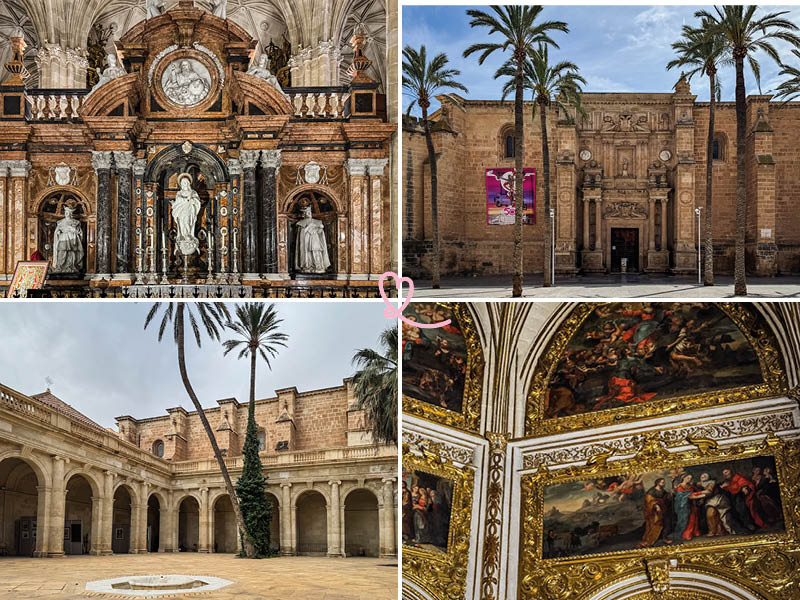
This opinion is completely independent, based on our experiences. We made our own choices, visited the area anonymously, and paid our bills in full.
Why visit Almería Cathedral?
Is Incarnation Cathedral worth it? Our opinion:
Yes, the cathedral is well worth a visit for its impressive military architecture, richly decorated interiors and beautiful pieces of sacred art.
The visit is made all the more interesting by the included audioguide, which helps visitors understand the site’s historical heritage and value. In fact, it’s one of the best things to do in Almería!

Why is she famous?
Almería Cathedral is famous for both:
- Fascinating military architecture,
- Its exceptional architectural mix, combining Gothic, Renaissance and Neoclassical styles,
- And last but not least, its remarkable artistic heritage.

Our favorite moments
While Almeria Cathedral is truly impressive, our favorite part of our visit was the little details scattered throughout its nooks and crannies. We took a long look at the anthropomorphic sculptures on the church pillars, the stone scrolls in the vaults and the hidden symbols.
Take a look, for example, at the finely-worked doors leading to the cloister. They are covered with fleur-de-lis, a reference to the purity of the Virgin Mary, symbol of the cathedral, under the patronage of Notre Dame de l’Incarnation.

History in brief
Although the first Christian community was founded by Saint Indalecio in the 8th century, Almeria came under alternating Christian and Muslim control between the 12th and 15th centuries. It wasn’t until the Reconquest by the Catholic kings in 1489 that the bishopric was re-established and the history of the cathedral began:
- 1496: Construction of a cathedral-temple under the orders of the Cardinal Archbishop of Toledo, Pedro González de Mendoza, on the former mosque
- 1522: Total destruction of the cathedral by an earthquake
- 1524: Construction of today’s cathedral by Juan de Orea, commissioned by Fray Diego Fernández de Villalán, Bishop of Almeria.
- 18th century: Construction of the neoclassical cloister
- 1936-1939: Extensive damage during the Civil War
- After 1939: Reconstruction and enrichment of collections

How to get there: Incarnation Cathedral, Almería
Where is Almería Cathedral?
The cathedral is located in the heart of Almeria, Plaza de la Catedral, 8.
RENT A CAR IN Andalucia
- Compare prices on our preferred platform: DiscoverCars – one of the best rated sites.
- Choose a compact car, as some villages have very narrow streets!
- Think ofcomprehensive insurance for the same reason
- Book early for choice.

How to get there?
It’s easy to get to, as the historic center is within walking distance. From the station, you can take the bus (line M 370, Fuente De Los Peces stop), which will take you there in 11 minutes.
Parking
There is no dedicated parking for the cathedral. We recommend parking in one of the public parking lots in the city center, such as the one on Las Ramblas, a 10-minute walk away.

Useful tips: duration, schedules, eating…
Best time to visit
We advise you to visit the cathedral in the afternoon, to enjoy the peace and quiet. They are less popular with groups visiting the building in the morning, between 10am and 12pm. To make sure your visit goes smoothly, we recommend that you visit at the end of the day, just before closing time.

Length of visit and main difficulties
There are no major difficulties in visiting the site, especially as it is fully accessible to PRMs (only access to the Torre de Campanario terrace is via a staircase with a hundred or so steps). There are also toilets and a small store on site.
We advise you to allow around 1 hour for your visit, especially if you decide to follow the audioguide, which will considerably enrich your discovery.

Advice on how to visit
If you opt for the audioguide (included free of charge in the ticket price), you can follow the signposted route. If you don’t have the time, we advise you to follow the route and do so:
- Start by exploring the cathedral’s exterior, noting the elegant Renaissance portals and defensive features,
- Then step inside to admire the splendor of the cathedral and the various treasures it houses,
- Finally, head out into the courtyard to visit the Renaissance cloister and, if you have time, the small adjoining museum.
PLAN YOUR DREAM TRIP TO andalucia
All the information you need for your trip:
- 7 maps that make planning easier
- + 150 pre-selected locations
- Practical advice
- 300+ photos to help you choose

Visiting with children
Almeria Cathedral doesn’t offer anything suitable for children, but they should enjoy exploring.
Schedules and rates
The Cathedral is open to visitors every day:
- Monday to Thursday, 10 a.m. to 2:30 p.m. and 4 p.m. to 7 p.m.
- Saturday from 10am to 7pm and Sunday from 3pm to 6pm without interruption
The price scale is as follows:
- Normal price: €7
- Reduced rate: €5 (students)
- Children: €3

Guided tours
An audioguide is included in the price of the visit, enabling you to learn more about the cathedral’s must-see rooms.
Guided tours are also available on Friday and Saturday at 11am and 4pm for €11.
For a unique experience, you can opt for the guided tours of the Torre de Campanario, on Fridays and Saturdays at 1pm and 5.30pm for €5, which offer an exceptional view of the city.
Find out more about guided tours on the official website here.

Catering
There’s no on-site restaurant, but as the cathedral is in the center of town, there are plenty of alternatives in the surrounding streets.
Just 2 steps from the Cathedral, we tried Café Hierbabuena, where we drank a delicious fresh orange juice.
Fortress architecture: guided tour of the exterior of Almería Cathedral
Before starting your visit, we recommend you take the time to admire the cathedral’s exterior and all the symbols hidden within its walls.
A fortified cathedral
To understand the particularity of the Cathedral of the Incarnation, we need to place ourselves in the historical context of the 16th century. The city of Almería was an easy target for Mediterranean pirates. This constant threat led to the design of a cathedral, conceived as a veritable fortified temple.
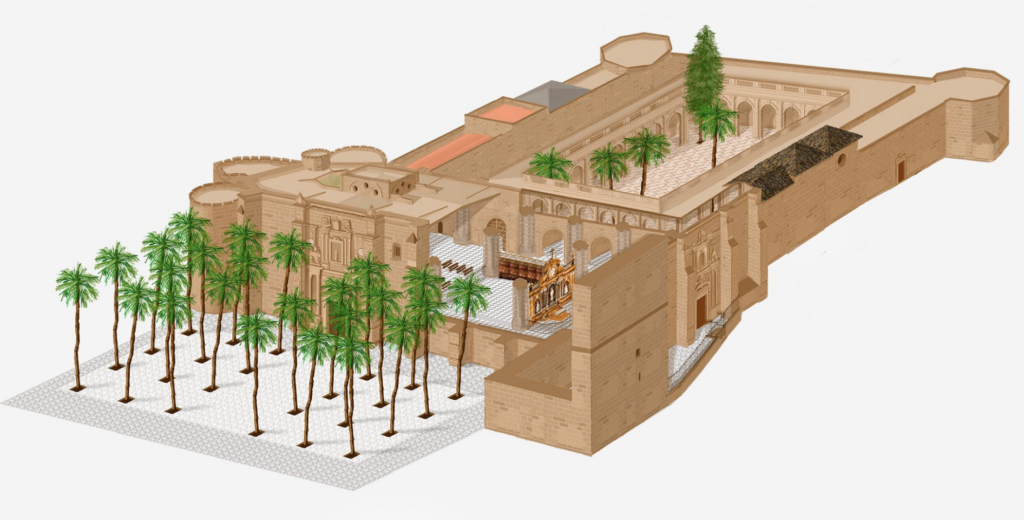
The particularly thick reinforced walls and uniform flat roof, designed to accommodate defensive systems, bear witness to this protective function. You’ll be impressed by the perimeter surrounded by wide walls and sturdy buttresses.

The defensive aspect is also reflected in the four circular towers at the corners, which once housed cannons to defend the town. If you look closely at the facades, you’ll notice the presence of crenellations and embrasures, real loopholes ensuring the protection of the holy site. We were intrigued by these unusual military features for a place of worship.

This defensive vocation is also reflected in the interior architecture. We noted the absence of the traditional stained glass windows, replaced by more modest openings. Even more surprising is the fact that all three naves are the same height, unlike traditional Gothic cathedrals where the central nave is higher. There were purely pragmatic reasons for this: the flat roof provided better defense in the event of an attack.

The different facades: a way of embellishing the fortress
Once you’ve detailed the cathedral’s defensive elements, you can turn your attention to the decorative details. On the main portal, a major work by Juan de Orea in the mid-16th century, numerous motifs are interwoven. Christian, Marian and even pagan symbols coexist harmoniously to embellish the façade, which was once the cathedral’s front door.

You can then admire La Porte du Pardon, also by Juan de Orea, completed in 1569. Typical Renaissance elements are combined with antique architectural features: columns, pilasters, shell-shaped niches and various moldings.

More sober but just as imposing, the two-section square bell tower completes the monumental ensemble. Here you can see the eight historic bells, including the oldest, the belfry bell, which was cast by José Corona in 1781.

The monumental neoclassical cloister
After visiting the interior of the cathedral, you’ll be delighted to discover the cloister, with its 30 semi-circular arches resting on powerful Ionic columns. This masterly 17th-century work was created by Juan Antonio Munar.
It’s hard to imagine that the cloister was originally conceived as a place of arms to reinforce the fortified character of the enclosure.
It was the only link to the outside world from the cathedral.

Opulent interiors: discover the Cathedral’s 3 must-see treasures
Once you’ve admired the contrast between the sobriety of the fortress and the ornamentation of its facades, you can discover the flamboyant decor of its interiors.
The choir: the Renaissance masterpiece of Almería Cathedral
When you enter the cathedral, you’ll come straight into the cathedral choir, as the former entrance is now closed.
This is where the canons used to gather for the reading of the Office.
You’re sure to marvel at the finely carved walnut wood sculpture, a true Renaissance masterpiece by Juan de Orea.
Take time to admire the two rows of seats on two levels: the upper stalls feature a gallery of saints, prophets and martyrs, while the lower stalls feature medallions with anthropomorphic effigies evoking Greco-Latin art. The seats are separated by Ionic columns.

The trascoro (rear choir), designed by Ventura Rodríguez, is a fine example of 18th-century neoclassical art. We were captivated by the harmony that emanates from this ensemble, where a magnificent Immaculate Conception in pure marble occupies the central niche, escorted by statues of Santo Domingo de Guzmán and San Juan Nepomuceno.
On the atic just above, you’ll find a medallion of God surmounted by two praying angels and a cross.
Don’t you think the arrangement of the columns and the mix of colors in the materials (marble, jasper, alabaster) add a touch of elegance to the whole?
On the forged railing, you’ll notice an inscription from the Song of Songs (“Thou art beautiful my friend, there is no flaw in thee”) in reference to the Virgin Mary.

The major chapel abounds
Just behind the choir, you’ll find the main chapel, linked to the ambulatory by 5 semicircular arches. This feature of Eastern cathedrals allows the Blessed Sacrament to be adored from any angle.
Look up: above the marble altar is a series of paintings and relief sculptures depicting the life of Christ.
The first level represents adoration, while the second represents Calvary.
The central panel features a remarkable relief of the Incarnation of Christ in Mary, considered to be the work of Granada master Pablo de Rojas. The calvary above it depicts Christ crucified by Jerónimo Quijano, a pioneer of Renaissance sculpture in Spain.

Once you’ve detailed the chapel’s ceiling, linger over the impressive alabaster, jasper and marble tabernacle, designed by Ventura Rodríguez.
In the form of a baldaquin, this neoclassical work was created in 1775.
Observe its monumental structure, framed by twin Corinthian columns and crowned by a richly decorated dome.
You won’t know where to turn with all the allegorical and hagiographic figures that adorn the whole: saints, evangelists, doctors and prophets rub shoulders. Finally, beneath the altar, you’ll find a silver urn containing the relics of the bishop who founded this “second cathedral”, Fray Diego Fernández de Villalán.

The sacristy
Finally, the main sacristy is one of the cathedral’s most prestigious spaces, a true jewel of Renaissance art in southern Spain.
Designed in the 16th century by Juan de Orea as a place for the preparation of ministers of religion, its architecture perfectly combines function and beauty.
You’ll be seduced by the Renaissance classicism that uniformly covers the entire perimeter, from the base to the barrel vault divided into three sections.

Observe the arches, anthropomorphic busts and other decorative motifs (angels, flowers, dragons) that adorn the space. A remarkable collection of paintings depicting the Adoration of the Shepherds (17th-century oil on copper) complements the traditional furnishings of chests of drawers, mirrors and a central table in jaspered marble.

Subscribe to our Newsletter
- Get away from it all with Region Lovers’ beautiful destinations!
- Once a month
- Advertising-free

Frequently asked questions
What works of art can be seen in Almería Cathedral?
In addition to the must-see items mentioned in this article, the chapels also feature numerous pieces of sacred art.
We also recommend you take a look at the painting of the Immaculate Conception by Joseph Antulinies (1670) in the nave to the left of the trascoro. We also particularly appreciated the trompe l’oeil of the organ (dating from 1775). Next to the chapter house, you’ll also find a small museum well worth a visit.

Is the Cathedral still a place of worship?
Yes, Almería Cathedral is still an active Catholic place of worship. Find the schedule of services and celebrations on the official website here.
What is Almeria’s emblem?
At the cathedral chevet, don’t miss the Portocarrero Sun. This bas-relief with an anthropomorphic face edged with ribbons adorns the surrounding wall of the Chapel of the Holy Christ. Although it predates the time of Bishop Portocarrero, popular tradition has given it this name, which still survives today. Today, it is the symbol of the city!

PLAN YOUR TRIP TO Andalusia
Inspiration

Practice

Places not to be missed