A true jewel of Almería, the Alcazaba stands majestically on the city’s heights, a testament to the military ingenuity of Muslim Spain. You won’t be able to remain indifferent in front of this impressive fortress made up of three distinct enclosures, a complex system of towers and ingenious cisterns.
In this article, you’ll discover Almería’s Alcazaba, from its spectacular zigzag entrance to its peaceful gardens and the remains of its Arab-Andalusian palace. And we’d like to take a look at some of its incredible architecture and historical details!
This opinion is completely independent, based on our experiences. We made our own choices, visited the area anonymously, and paid our bills in full.
Why visit Almería’s Alcazaba?
Is the Alcazaba worth it? Our opinion:
You can’t come to Almería without visiting its incredible fortress. It’s the city’s most beautiful monument! Like us, you’ll be seduced by its vast and remarkable architecture, itswell-preserved remains and its incredible panoramic views, especially of the Jayrán Wall.

Why is Almería’s Alcazaba famous?
Almería’s Alcazaba is one of the most impressive medieval defensive monumental ensembles inal-Andalus. It is famous for its outstanding, well-preserved architectural heritage, but also for its historical legacy.
In addition to its fortifications and remains of 10th-century Muslim Spain, the site boasts the remains of a Christian castle, whose keep offers the finest views of the city. Last but not least, the Alcazaba is famous for having been used as a film locationfor many movies, including Cleopatra (1963), Wonder Woman (2020) and the Game of Thrones series (2016).

Our favorite moments
While we were impressed by the defensive architecture of the Alcazaba, with its massive walls and watchtowers, it was above all the serenity of the place that won us over.
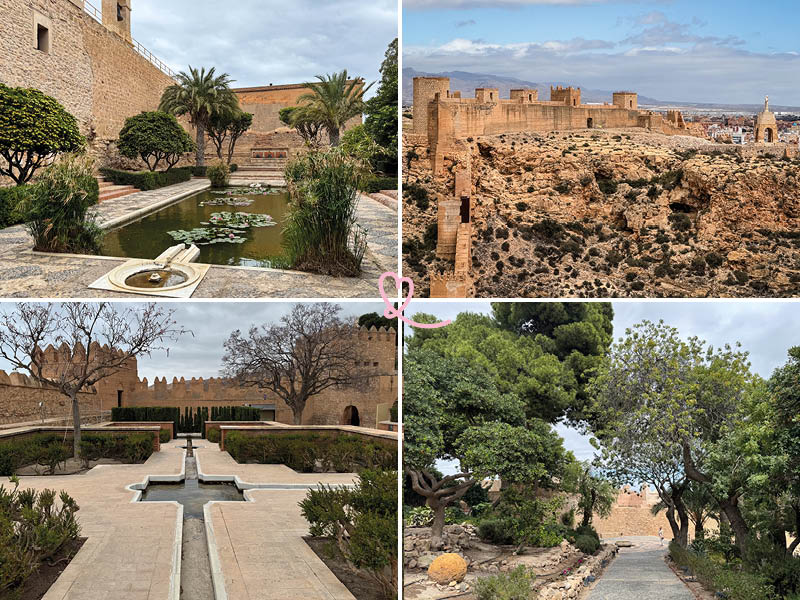
As the tour progresses, Pietro Moreno’s verdant gardens, laid out in the 1940s, create harmonious transitions between the various enclosures.
You’ll gradually forget the military character of the fortress and let yourself be carried away by the peaceful beauty of the surroundings. Exceptional views of the city and sea from the towers add to the feeling of being in a haven of peace, far from the hustle and bustle of the city. In short, we were charmed by our visit to the Almería fortress, and even preferred it to theAlcazaba in Málaga!

History in brief
Although the hill has been occupied since Roman times, it seems clear that construction of the Alcazaba began with the official founding of the city of Almeria by Abd a-Rahman III:
- 955: Construction begins on the Alcazaba, the seat of power for Abd al-Rahman III. The town became a major commercial port.
- 11th century: Golden age of the Alcazaba during the period of the Taifa kingdoms.
- 1147-1157: First Christian conquest by Alfonso VII. Period of decline
- 13th-15th centuries: Nasrid period with major architectural changes
- 1489: Final Reconquest by the Catholic Monarchs and construction of the Christian castle
- 1940: Start of refurbishment work for the tour

How to get there: Alcazaba d’Almería
Where is the Alcazaba?
The Alcazaba is located in the heart of Almeria, on Calle Almanzor. It’s just a few minutes’ walk from downtown. It’s a 5-minute walk from the city’s other attraction, the Cathedral of the Incarnation.

RENT A CAR IN Andalucia
- Compare prices on our preferred platform: DiscoverCars – one of the best rated sites.
- Choose a compact car, as some villages have very narrow streets!
- Think ofcomprehensive insurance for the same reason
- Book early for choice.

How to get there?
Easy to reach on foot from the town center, it’s just a few minutes’ walk to the fortress entrance.
From Almerìa station, you can reach the site by bus in 20 minutes (line M
Fuente De Los Peces stop then 10min walk).

Parking
There is no dedicated parking and very few spaces around the citadel. The nearest parking lot is the Parking Plaza del Ayuntamiento Almería telpark, a 10-minute walk away.
If you’re staying in Almerìa, we recommend you leave your car at the hotel.

Useful tips: duration, schedules, eating…
Best time to visit
The spring season is particularly mild and pleasant, with plenty of sunshine and flowering vegetation.
Choose an early-morning visit or one at the end of the day for sunset.
However, we don’t recommend coming between 2pm and 4pm, especially in summer when the heat can be intense.

Length of visit and main difficulties
We recommend you allow 2 hours to explore the entire site and observe the magnificent panoramas.
As most of the tour takes place outdoors, you’ll need protection from the sun in summer and the wind in winter.

Note that the site is very extensive (1430m perimeter), with several staircases leading up to the castle entrance or to the towers. The slopes are steep and the ground sometimes unstable, so we advise you to wear good shoes for your visit.
Finally, we have not noticed any PRMaccess to the site.

Advice on how to visit
You are free to visit the Alcazaba. Nevertheless, we recommend you start with the two lower enclosures to understand the topography of the site during the period of Muslim domination, before moving on to the last enclosure where the Christian castle is located. On the way out, we followed route a (in green on the map), which takes us along the impressive north wall, and on the way back, we followed route c (in white on the map) to enjoy the gardens.
We’ve let ourselves be carried away by the maze of the site, but we’d still advise you to use a guide to find your way around.

Visiting with children
We didn’t find any routes suitable for children, but the youngest visitors should enjoy the maze of Alcazaba and its different panoramas.
Note, however, that the staircase up to the Torre del Homenaje can be dangerous for the youngest visitors. On the other hand, they’ll be delighted to meet the little residents of the Alcazaba: a family of cats has taken up residence on the site and is very fond of being petted.

Schedules and rates
The site is open from Tuesday to Saturday in high season (March-October), 9am to 9pm non-stop. Sundays only, 9 a.m. to 3 p.m.
Admission is free for EU citizens.
Guided tours
Although the site has a few educational panels (in English and Spanish only), we strongly advise you to book a guided tour to understand the full complexity of the site and its history.
The Alcazaba offers free guided tours every Saturday at 9am.
Find out more on the official website here.

Catering
The Alcazaba does not offer a catering service, but there is a vending machine on the premises. Outside, we recommend the Restaurant Almedina Baraka, just across the street, where you can enjoy a mint tea before or after your visit. Just note that the service is slow.

History and architecture of a fortress
Before starting your visit, take time to admire the majestic Alcazaba structure from Calle Almanzor. See how the walls hug the rocky promontory. The steepness of the hill and its great visibility were decisive factors in the choice of the Alcazaba’s location.
Unlike the other alcazars(fortified palaces) built throughout the Iberian Peninsula, the Alcazaba d’Almerìa built in 955 was purely military. On this mainly defensive basis, the town grew, rapidly becoming Spain’s most important port.

A succession of enclosures: from Umayyad origins to the Reconquista
Once you’ve admired the sobriety of the façade, you’ll need to use your imagination as you make your way through the 3 successive enclosures that make up the Alcazaba.
These spaces have undergone many transformations over the centuries.
The first perimeter, now home to charming gardens, was once a veritable urban district. Archaeological excavations have revealed a complex network of alleyways, dwellings and public baths that bear witness to an active community life.

The second enclosure was reserved for palatial life, and once housed the sumptuous residence of the Taifa ruler Almotacín. Although only a few remains of this sumptuous 11th-century palace have survived the passage of time, it’s still a fascinating place to explore, and you can even learn about the daily life of the period in the Casa de Alcaide, which has been converted into a museum.
Here you can also see the Chapel of San Juan, once a mosque.

Finally, you’ll come to the third enclosure, which once housed a castle built in the 15th century after Granada was taken by the Catholic Monarchs in 1492. This new construction served a dual purpose: to strengthen the defenses against artillery advances, and to create a strong symbol of the new power. The castle’s semi-circular towers, vast inner courtyard and majestic keep, also known as the Torre del Homenaje, remain.

An elaborate defensive system
Now that you’ve understood the structure of the Alcazaba, you can turn your attention to its defensive configuration. The Arab fortress is impressive with its massive walls and various watchtowers.
We were particularly fascinated by the North Wall, which retains its original shape, having undergone no modern restorations. Constructed from masonry and adobe, which insulates it from the dampness of the ground and gives it greater stability, its imposing dimensions – over 3 metres wide and 5 metres high – make it a real eye-catcher.
Look at the merlons and battlements, which are a whiter shade because they’ve been rebuilt.

During the Christian reconquest, the fortress was equipped with new defensive systems, the remains of which can still be seen today. The Torre de Polvora bears witness to the evolution of military techniques with its cannon emplacements. Look up at the top of the walls and you’ll discover the machicolations, used to repel attackers by pouring oil or boiling water on them.
The Christianization of the building can also be seen in its symbols: the loopholes take the form of crosses, while the Gothic portal of the keep proudly bears the coat of arms of the Catholic Monarchs.

Arab-Andalusian heritage: archaeological discoveries
Beyond its rich heritage, Almeria’s Alcazaba is a key archaeological site for understanding life in Muslim Spain.
The remains of the palace complex
Once inside the second enclosure, you can head for the archaeological area. Here you’ll find the ruins of the palatial complex as well as the remains of the Arab baths. You can still make out the various spaces in the lower part of the hammam (oven, boiler, pyre). Baths are of great importance in Arab culture, serving both ritual ablutions and daily hygiene.
You’ll notice that one area is not accessible to the public: the excavations are still in progress!

Next to the ruins, take a tour of the Casa del Alcaide. This is a reconstruction of a typical Arab house, retaining its structure around a patio and fragments of the original red-tinted walls. Inside, several objects from the excavations are on display.
You’ll be interested to discover fragments of columns from the period, crockery and even children’s toys! Very touching.

The Alcazaba hydraulic system: a model of innovation
One of the highlights of our visit is the caliphal cistern. Cisterns are a remarkable innovation in water management, particularly suited to semi-arid regions like Almería, where rainfall is scarce but often torrential.
The Alcazaba is monumental with its 5 naves!
The water is tapped from a well inside the cistern, then distributed via a network of ceramic pipes. The system is also enriched by runoff from surrounding surfaces, channeled through channels that naturally follow the slope of the land. Before being stored in the cistern, the water passes through settling basins, where it is filtered. This enabled the city to survive in the event of siege or attack.

A haven of peace overlooking Almeria
Historic gardens redeveloped
As soon as we entered the first enclosure, we were charmed by the layout of the various green spaces. A majestic central avenue, lined with pine and palm trees, gives structure to the whole. On either side, the gardens unfold in elegant zigzags, punctuated by exotic plants, fountains and refreshing pools.
The omnipresence of water bears witness to the heritage of Arab-Andalusian gardens, where its use, both aesthetic and practical, enabled the cultivation of various plantations.

The second enclosure particularly appealed to us with its soothing garden, complete with a water lily pond. As you stroll through these verdant spaces, you’ll understand that water also has a spiritual function in Muslim-inspired gardens. Hence the presence of ablution basins to purify oneself before prayer!

Exceptional panoramas
In addition to its harmony with nature, we were particularly taken by the Alcazaba’s commanding position. The panoramic views over Almeria and the bay accentuate this feeling of serenity, giving the sensation of being on a balcony overlooking the city.
Once you’re inside the first enclosure, we recommend you go to the end of the site, to the projecting bastion, to see the Cerro de San Cristóbal wall.
Better known as the Jayrán wall, it is the remains of the ancient wall that surrounded the entire city of Almería. Its name derives from the fact that it was built by Jayrán, the first king of the Taïfa of Almería, to protect the old Musalla district, between 1012 and 1028. Standing 5m high, it has seven towers, three of which are square, of Arab origin, and four circular, of Christian origin.

The Torre de Homenaje offers without doubt the most spectacular view of the Alcazaba. From here, you can see the ramparts of the Alcazaba and the superb Mirador de l’Odalisque blend harmoniously into the valley. On the other, you’ll see the urban skyline, revealing the contrast between the city’s expansion towards the sea and the tranquility of the mountains.

Finally, the Torre Norte offers a breathtaking view of the Jayran walls and the monument dedicated to Jesus, as well as a unique perspective on the different levels of the fortress. It’ll be all the more enjoyable now that you understand its evolution!


Frequently asked questions
Does the Alcazaba offer events?
Yes, the Alcazaba offers summer events such as night tours, opera performances and Christmas celebrations.
Find out more about the program on the official Alcazaba website here.

PLAN YOUR TRIP TO Andalusia
Inspiration

Practice

Places not to be missed