Picasso’s birthplace is a must-see for anyone wishing to immerse themselves in the world of the Spanish genius. This venue, steeped in history, boasts an immersive and colorful scenography, featuring previously unseen works and personal objects, offering an intimate and captivating look at the artist’s early life and relationship with Andalucia.
In this article, you’ll find some useful tips to help you prepare for your visit to the Museo Casa Natal de Picasso in Malaga.
This opinion is completely independent, based on our experiences. We made our own choices, visited the area anonymously, and paid our bills in full.
Why visit the Museo Casa Natal de Picasso?
Is Picasso’s birthplace worth it? Our opinion:
Yes, the visit is well worth the detour, as the museum offers a unique perspective on Picasso’s early years. Although nothing remains of the original house apart from the stained glass windows, the museum invites visitors to immerse themselves in Picasso’s intimacy, through previously unseen pieces and some of his personal belongings. Finally, the colorful scenography punctuates the space and makes the visit particularly pleasant.
Although we appreciated the richness of the exhibition, we regret the lack of perspective on Picasso’s personal life. The problematic aspects of his personality that have now come to light are not addressed, leaving a shadow over the artist. We therefore invite you to learn more about this facet of the artist before your visit, to better grasp the complexity of his legacy.

Why is Picasso’s birthplace so famous?
Classified as a Monument Historique et Artistique d’Intérêt National in 1983, this museum is famous for occupying the house where Pablo Picasso was born and spent the first ten years of his life. Although the stained glass windows are the only period features still visible, the house now houses a rich collection of engravings, ceramics and illustrated books. The Fondation Picasso enriches this offer with a regular program of temporary exhibitions, presented in an adjoining building.

Our favorite
While we enjoyed this intimate museum as a whole, we fell in love with the few ceramics on display, testifying to Picasso’s inventiveness.
Indeed, it was at the age of 66 that Picasso discovered ceramics in Vallauris and devoted himself intensely to the craft, creating over 4,000 pieces in two years. His highly expressive pieces revive the Andalusian imagination and illustrate his bold reinvention of the decorative arts.

History in brief
It’s hard to sum up Picasso’s 91-year life and 50,000-work career in just a few lines, but here are a few key dates:
- Birth and childhood (1881-1891): Born in Malaga on October 25, 1881, Picasso grew up in a family of artists. His father, an art teacher, introduced him to art at an early age.
- Artistic training and beginnings (1895-1904): After studying in Barcelona and Madrid, Picasso moved to Paris in 1904. These early years saw the emergence of his blue and pink periods, influenced by melancholy and poetic themes.
- Artistic revolution with Cubism (1907-1917): In collaboration with Georges Braque, Picasso co-founded Cubism, transforming artistic codes with major works such as Les Demoiselles d’Avignon and his experiments with deconstruction of form.
- Political commitments and major works (1930-1945): Picasso used his art to express his political positions, notably with Guernica (1937).
- Artistic diversification (1945-1973): Settling in the south of France, Picasso continued to be prolific, renewing himself and returning to Mediterranean themes.

How to get there: Picasso’s birthplace, Malaga
Where is Picasso’s birthplace?
- In Malaga city center
- Plaza de la Merced, 15
- Just a 4-minute walk from the Picasso Museum
RENT A CAR IN Andalucia
- Compare prices on our preferred platform: DiscoverCars – one of the best rated sites.
- Choose a compact car, as some villages have very narrow streets!
- Think ofcomprehensive insurance for the same reason
- Book early for choice.


How to get there?
The easiest way is on foot! Malaga’s city center is easy to navigate, and the Picasso Museum is within easy reach of other emblematic sites such as the Cathedral of the Incarnation and theAlcazaba, each just a 3-minute walk away.
If you’re coming by public transport, the nearest bus routes stop at Paseo del Parque. From there, it’s less than a 10-minute walk. Although there is no metro station directly to the Picasso Museum, the Atarazanas station is about an 11-minute walk away.
If you come by car, please note that it will be impossible to drive past the entrance to the Picasso Museum, as Calle San Agustín has been pedestrianized.
From Malaga airport, access by car takes around 20 minutes.

Parking
There’s no on-site parking, but if you’re coming by car, you can leave your car in the paid public parking lot at Paseo del Parque, an 8-minute walk away.
More information on the city’s official parking website here.
Useful tips: duration, schedules, eating…
Best time to visit
Although the Museo Casa Natal de Picasso is still a confidential site, you should still plan your visit during the week, to enjoy the peace and quiet of this small space.

Length of visit and main difficulties
Allow 1 hour to take full advantage of the tour and the many commentaries on the audioguide.
Note also that the temporary exhibition rooms and the birthplace are suitable for people with reduced mobility.
Advice on how to visit
You’ll find 9 rooms spread over two floors. The first floor shows Picasso’s relationship with art from childhood, while the rooms upstairs illustrate the recurring motifs in his work and the influence of his Andalucia roots on his art.
You can follow the museum’s well-marked itinerary, or pick and choose as you see fit. Then take a tour of the store, and don’t miss the temporary exhibitions in another area, on the corner of San Juan de Letran street.

PLAN YOUR DREAM TRIP TO andalucia
All the information you need for your trip:
- 7 maps that make planning easier
- + 150 pre-selected locations
- Practical advice
- 300+ photos to help you choose
Visiting with children
We didn’t find any facilities for children, but creative activities are offered on Saturdays. Find out more here.
Schedules and rates
The museum is open daily from 9:30 am to 8:00 pm.
Admission for adults is €3 (admission only) and €4 if you wish to include access to the temporary exhibitions.
More information on the official website here.
Guided tours
An audioguide is included in the tour price, and we recommend it to enhance your visit with anecdotes. Themed tours are also offered, highlighting the family, social and cultural links between Pablo Picasso and Malaga.

Catering
The museum does not offer on-site catering, but is located in the heart of the city, with many restaurants and cafés close by.
Plunge into the intimacy of Picasso
Discover Picasso’s beginnings through personal documents and objects, revealing the construction of an extraordinary artistic personality.
Picasso’s childhood and artistic awakening
Although only the stained-glass windows remain from Picasso’s original home, we were thrilled to discover the few personal objects belonging to the Picasso family. Shawls, combs and jewelry bear witness to the daily life of the period, while Picasso’s toy soldiers and early sketchbooks touch the heart.
We also discovered that Picasso painted his first canvas entitled El picador amarillowhen he was just 9 years old. It depicts a bullfighter in a bullring, inspired by the bullfights he had seen with his father.

The influence of Picasso’s father on his work
Don José Ruiz Blasco, Pablo’s father, played a decisive role in his son’s career. A drawing assistant at the Málaga School of Fine Arts and curator of the Municipal Museum, he immersed the young Pablo in the city’s artistic atmosphere.
He inherited his father’s passion for doves as a pictorial theme. José Ruiz Blasco used to paint these birds, a motif that his son took up again and again, going so far as to install a large dovecote in his Vallauris home to observe them. The dove motif even became a universal motif of peace when his famous lithograph The Dove of Peace was chosen in 1949 as the official poster for the First World Congress of Peace Supporters.

Explore Picasso’s work from another angle
Through a colorful scenography, the museum reveals a Picasso deeply rooted in his Andalucia roots, and offers visitors the chance to discover little-known creations from his oeuvre. Special mention should be made of the many quotations on the walls that give Picasso a voice!
The influence of Andalucia’s roots on Picasso’s work
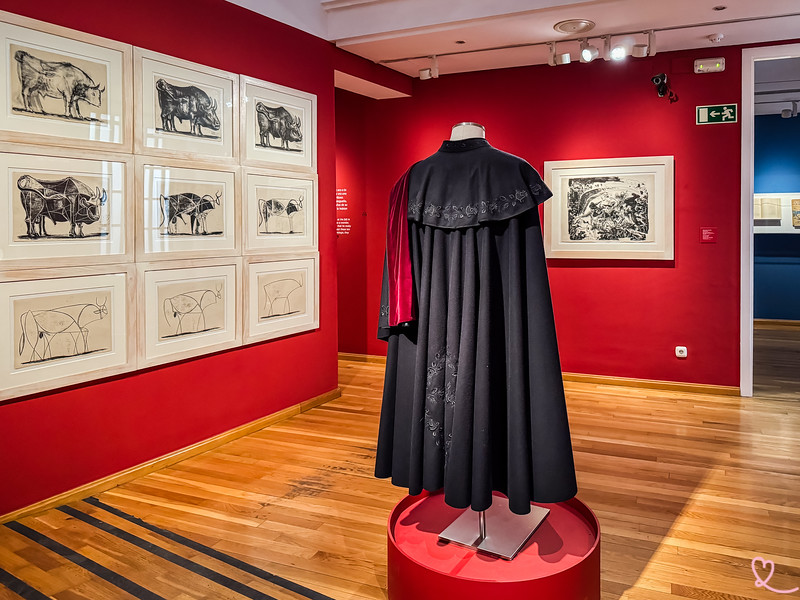
Although he left Málaga at the age of 10, you’ll discover how the artist has never stopped returning to and being inspired by his hometown. We were particularly interested in the way the museum highlights the influence of the Mediterranean on Picasso’s work. We stayed captivated for a long time in Room 9, devoted to bullfighting, which features engravings, highly expressive ceramics and even a bullfighter’s cape belonging to Picasso, which he would have dressed in after his death.
You’ll discover, for example, how bullfighting in the south of France became Picasso’s only link with Spain after the Civil War, when he refused to return to his native country while Franco was in power. We particularly liked the collection of plates decorated on this theme.

The discovery of never-before-seen works
And while the museum doesn’t feature any of Picasso’s major “masterpieces”, it does house valuable archives that shed light on his creative process. You’ll discover linocuts and drypoint works, testifying to the artist’s technical diversity. Among the treasures on display is a notebook of preparatory sketches for Les Demoiselles d’Avignon. This painting, depicting fragmented female figures, revolutionized art and marked the advent of Cubism.
We invite you to explore these sketches, which offer a fascinating insight into the variations and experiments that led to the creation of this masterpiece.

Subscribe to our Newsletter
- Get away from it all with Region Lovers’ beautiful destinations!
- Once a month
- Advertising-free
Frequently asked questions
Does the Musée-Maison natale de Picasso organize temporary exhibitions?
The Fondation Picasso was created in 1988 by the city of Málaga with the aim of promoting and disseminating Picasso’s work. It manages Picasso’s birthplace, which has been transformed into a museum, and offers another exhibition space on the corner of San Juan de Letran street.
Here you’ll find temporary exhibitions related to the world of Picasso, as well as works by contemporary artists. When we visited, the space was exhibiting “Les images de Picasso”, an analysis of Picasso’s public representation.

What other places should you visit to follow in Picasso’s footsteps in Malaga?
To follow in Pablo Picasso’s footsteps in Málaga, start at the Plaza de la Merced, where he played as a child and where a statue of him now stands.
Continue along Calle Granada to the Santiago parish church, where he was baptized. And don’t miss the Museo Picasso de Málaga in Calle San Agustín, where you can discover the creative abundance of his work!
And if you’re interested in his origins, you can take a look at the Plaza de la Constitución, where his father taught at the San Telmo School of Fine Arts, or the Plaza de Toros de La Malagueta, where Pablo attended several bullfights with his father.

PLAN YOUR TRIP TO Andalusia
Inspiration

Practice