Malaga is famous for being the birthplace of one of the most famous painters of the 20th century: Pablo Picasso! To immerse yourself in his work, visit his eponymous museum, housed in the Andalusian palace of Buenavista. Here you’ll find an eclectic collection of over 200 works, including paintings, sculptures, drawings and ceramics, testifying to Picasso’s virtuosity.
In this article, you’ll find some useful tips to help you prepare for your visit to the Picasso Museum in Malaga.
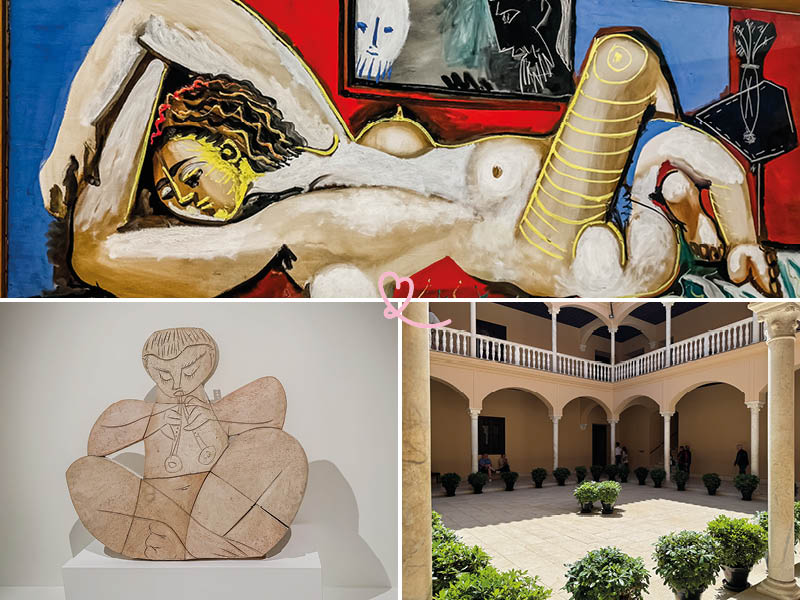
This opinion is completely independent, based on our experiences. We made our own choices, visited the area anonymously, and paid our bills in full.
Why visit the Picasso Museum in Malaga?
Is the Picasso Museum worth it? Our opinion:
Yes, the Picasso Museum is one of Malaga’s must-sees!
In addition to the magnificent setting offered by the Palais Buenavista, we appreciated the curators’ original choice of adopting a thematic rather than chronological approach to presenting the collection. This tour enables visitors to understand and compare the diversity of styles and forms (drawings, paintings, sculptures) explored by Picasso.
While we appreciate the richness of the exhibition, we regret the lack of perspective on Picasso’s personal life. The problematic aspects of his personality, which have now been demonstrated, are not addressed, leaving a shadow over the artist. We therefore invite you to learn more about this facet of the artist before your visit, to better grasp the complexity of his legacy.

Why is the Picasso Museum famous?
The museum is famous for honoring one of the 20th century’s most influential artists, Pablo Picasso, in his native Malaga, in accordance with the artist’s wish to have his works exhibited there. The exhibition features over 200 pieces from the private collections of Christine and Bernard Ruiz-Picasso. It celebrates the artist’s boldness and ability to constantly push back the boundaries of art, exploring a variety of media and revisiting styles from classicism to abstract. Finally, the exceptional setting of the Palacio Buenavista, a 16th-century Renaissance building, adds to the prestige of the place.

Our favorite moments
Our choices are subjective, based on our artistic sensibilities, but we’d still like to share with you our 3 favorite moments from our visit to the museum:
- The remarkable collection of ceramics (photo below),
- Room 10, conceived as a final bouquet of colorful works by the artist,
- The original set design makes it easy to compare the paintings!

History in brief
It’s hard to sum up Picasso’s 91-year life and 50,000-work career in just a few lines, but here are a few key dates:
Birth and childhood (1881-1891): Born in Malaga on October 25, 1881, Picasso grew up in a family of artists. His father, an art teacher, introduced him to art at an early age.
Artistic training and beginnings (1895-1904): After studying in Barcelona and Madrid, Picasso moved to Paris in 1904. These early years saw the emergence of his blue and pink periods, influenced by melancholy and poetic themes.
Artistic revolution with Cubism (1907-1917): In collaboration with Georges Braque, Picasso co-founded Cubism, transforming artistic codes with major works such as Les Demoiselles d’Avignon and his experiments with deconstruction of form.
Political commitments and major works (1930-1945): Picasso used his art to express his political positions, notably with Guernica (1937).
Artistic diversification (1945-1973): Settling in the south of France, Picasso continued to be prolific, renewing himself and returning to Mediterranean themes.

Access: Picasso Museum, Malaga
Where is the museum?
The Picasso Museum is located in the heart of Malaga’s city center:
- In the Palacio de Buenavista, Calle San Agustín 8
- 3min walk from Plaza de la Merced, Picasso’s birthplace
- In the immediate vicinity of all of Malaga’s must-see sites
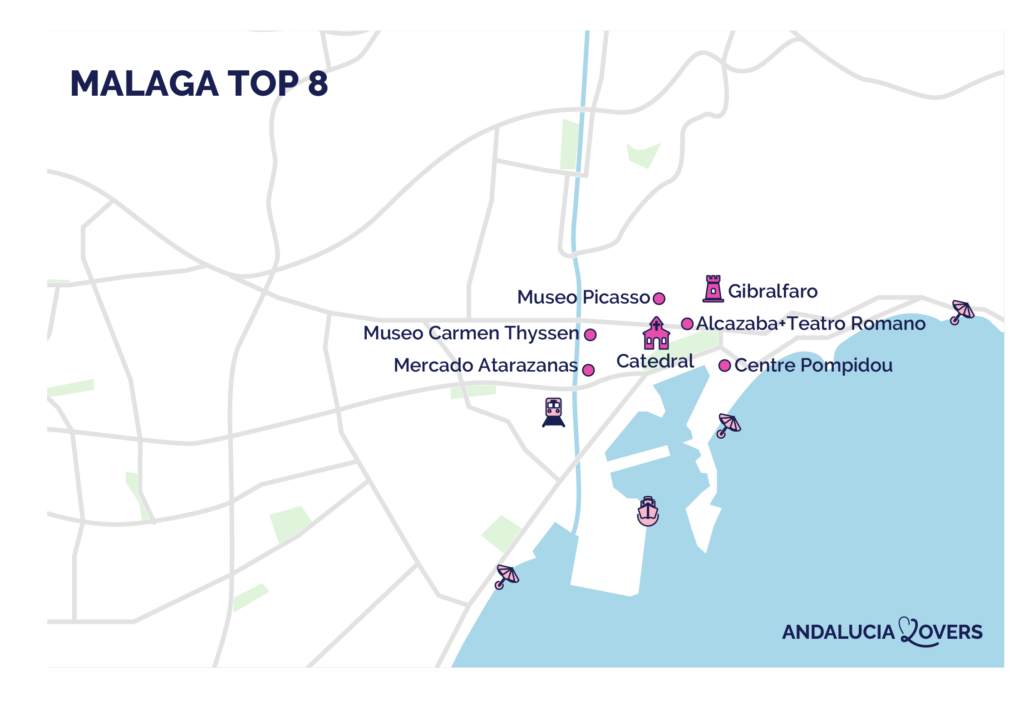
Here’s a map to help you find your way around Malaga’s must-sees:
RENT A CAR IN Andalucia
- Compare prices on our preferred platform: DiscoverCars – one of the best rated sites.
- Choose a compact car, as some villages have very narrow streets!
- Think ofcomprehensive insurance for the same reason
- Book early for choice.

How to get there?
The easiest way is on foot! Malaga’s city center is easy to navigate, and the Picasso Museum is close to other emblematic sites such as the Cathedral of the Incarnation and theAlcazaba, each just a 3-minute walk away.
If you’re coming by public transport, the nearest bus routes stop at Paseo del Parque. From there, it’s less than a 10-minute walk. Although there is no metro station directly to the Picasso Museum, the Atarazanas station is about an 11-minute walk away.
If you come by car, please note that it will be impossible to drive past the entrance to the Picasso Museum, as Calle San Agustín has been pedestrianized.
Access by car from Malaga airport takes around 20 minutes.

Parking
There’s no on-site parking, but if you’re coming by car, you can leave your car at the paid public parking lot, Paseo del Parque, an 8-minute walk away.
More information on the city’s official parking website here.
Useful tips: duration, schedules, eating…
Best time to visit
We advise you to come in the early morning or late afternoon to avoid the crowds. We advise against visiting at weekends, when the city is at its busiest. Note, however, that the museum remains very busy even on weekdays!
Length of visit and main difficulties
Allow 1h30 to visit the museum and enjoy the various commentaries on the audioguide.
To avoid a long wait, we strongly recommend that you book your tickets in advance. Please note, however, that a reserved time slot does not guarantee immediate access: you should expect to wait around 30 minutes for access to the site.
What’s more, queue management can sometimes be confusing. Be sure to identify the queue that corresponds to your situation (with or without a ticket) to avoid an unnecessary wait.
Please note that the entire tour is accessible to wheelchair users. We also appreciated the large benches in the patio for taking a break, to make up for the lack of seating in the exhibition spaces.

Advice on how to visit
All you have to do is let yourself be guided by the clear, well-thought-out tour itinerary.
Please note that an audioguide is included in the price of the visit and follows the museum itinerary.
At the end of your visit, don’t miss the museum store, stocked with Picasso products (posters, postcards, magnets) such as his iconic marinière, as well as excellent catalogs and multiples of his works of art.

WHERE TO STAY IN Málaga
Our favorites: neighborhoods and hotels
In the historical center
Hotel Palacio Solecio – see photos and availability
Near the sea, Playa de la Magualeta
Gran Hotel Miramar – see photos and availability
In the Soho district
Hotel Only You Malaga – view photos and availability

Visiting with children
Although there are no special features on the permanent itinerary, the museum offers a wide range of activities for children, including art workshops, special guided tours and interactive exhibitions. You can find the program on the official website here.
Schedules and rates
The museum is open Tuesday to Saturday from 10am to 6pm and Sunday from 10am to 3pm.
Prices are as follows: €9.50 (adults), €7.50 (seniors, students), free (children).
Guided tours
The audioguide is included in the tour price. We found the commentaries brief but pertinent to understanding the context of the works.
You can also opt for a 50-minute guided tour with a museum mediator, or a 30-minute express tour. Prices range from €25 to €85. Find out more here.

Catering
The museum has a café with a peaceful garden, ideal for a sweet break after a visit. We also recommend the La Teteria tea room, located right next door, with its charming terrace facing the San Augustin church. Remember to book in advance.
Otherwise, check out the best restaurants in Malaga in our Where to eat article.

Explore the rich Picasso collection
A Picasso Museum like no other
Perhaps you’ve heard of the Picasso Museum in Paris, Barcelona orAntibes?
You’ll love the one in Malaga, which presents its collection in a whole new way.
In fact, the scenography moves away from a classic chronological route, bringing together works from different periods in unexpected ways.
In the very first room, you’ll discover a portrait of Picasso’s sister, painted in 1896 when he was 15, a bronze sculpture Enfant dating from 1960, and a canvas entitled Maternité, painted in 1970 and featuring a gigantic, distorted version of a Christian motif. Comparing these three very different works gave us a better grasp of his virtuosity. Recurring themes such as family and childhood are explored through a variety of media, illustrating how Picasso has renewed art.

Along the way, you can explore different styles, revealing both innovation and continuity in Picasso’s work. Indeed, the artist often moved back and forth between different stylistic approaches. The work below, inspired by a photograph of his son Paul, is a case in point: although the subject is treated with vivid colors, the technique remains relatively classical. This contrasts with the bold forms he had previously experimented with, notably when, alongside French painter Georges Braque, he became a leading figure in Cubism from 1907. Perhaps this choice of a more classic style is intended to present the image of an idealized family?

French art historian Sophie Chauveau has also noted this to-and-fro between his different styles, observing that he systematically returned to Cubism after leaving a woman, as a way of destroying her. Perhaps this is the case with the disturbing painting below, Femme au fauteuil rouge, in which the woman’s face has been completely erased, while the rest of the body appears peaceful.

A dive into the heart of Picasso’s inspiration
The tour also allowed us to explore the wealth of Picasso’s influences.
From 1907, the artist drew inspiration from the primitive African art he collected to create a new stylistic language: cubism. This cubist period, which he explored until 1914, was characterized by a deconstruction of form. Below, three works illustrate this period, from left to right:
- A nude from 1908, evoking the forms of an African statuette,
- A female nude from 1910, representing the apogee of “analytical cubism”,
- Man with guitar, 1913, an example of “synthetic cubism”.
Picasso reinterprets the classic nude motif through simplified and exaggerated signs.
What struck us? It does not seek to reproduce the visible world, but offers an artistic alternative.

The war had a profound effect on Picasso’s work. His famous painting Guernica, commissioned by his partner and photographer Dora Maar, depicts the Spanish Civil War (1936-1939). We discovered that Picasso also depicted the Second World War, choosing to remain in Paris during the German occupation. He depicts less explicit violence than deprivation and static figures, enclosed in interiors. Years later, he continued to depict the suffering associated with war, as in El gallo atado (1962), where a tied-up rooster, isolated under a spotlight, evokes a scene of unsettling intensity.

The last room reveals another inexhaustible source of inspiration for Picasso: bullfighting. We were amazed at the mastery with which he captures the violence of the arena in just a few strokes. Observe the evolution of his work on the wall: initially focused on the confrontations, his drawings gradually open up to suggest the whole arena, even incorporating the bleachers on the edges of the plates, as in the work below.

Unique masterpieces to admire
Perhaps that’s what we particularly enjoyed about this museum: discovering works by Picasso that we weren’t used to seeing!
In particular, we were captivated by a lesser-known facet of his work: the use of ceramics. His passion for this material has its roots in his childhood in Malaga, influenced by ancient Greek ceramics and Muslim heritage.
Picasso, the iconoclast, takes ceramics away from its utilitarian function and turns it into a medium of pure expression. Take time to observe the extent to which he reinvents forms: anthropomorphic vases, feminine curves. This creativity shines through in the figure of the flautist, one of his greatest ceramics, where we loved to find the delicate lines of a drawing encapsulated in a sculpture.

We also fell in love with this small-format work on a cigar box lid, an original medium that reveals Picasso’s audacity.
This work is part of Picasso’s classical period (1918-1925), marked by a return to references to Antiquity and the work of Ingres, the famous 18th-century French painter.
Where academic painters used to draw their subjects nude before dressing them in paint to erase any trace of preparation, Picasso reverses this tradition: he contrasts the brute force of abstract line with the smooth softness of the red background.
We loved the fact that he made a work of the unfinished!
And yet, while this work exudes a delicate sensuality, it’s hard to ignore a more critical reading given Picasso’s controversial figure. Indeed, the contrast between the man, depicted in all his presence, and the female figure, relegated to a lascivious, almost ghostly position, raises questions about Picasso’s representation of women.

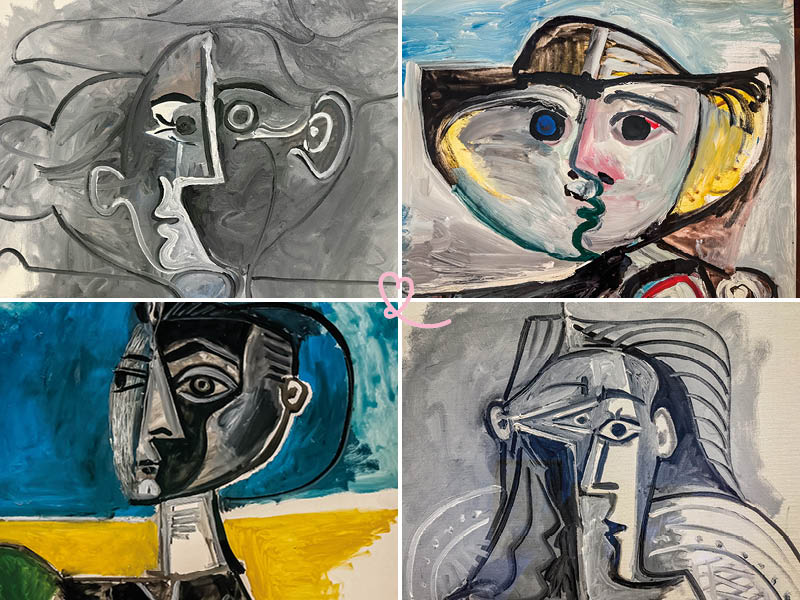
Finally, as the scenography encourages comparison, we spent some time observing the variations in faces from one painting to the next. We noticed that, in some works, two faces seem to be embracing, sometimes a male face seems to merge with a female face, evoking a hold, while other compositions play with deformation, transforming the faces into sculptures.
We recommend this fun and confusing game during your visit!
Discover the unusual setting of the Musée Picasso
A typical Andalusian palace
The Buenavista Palace, which houses the museum, is a magnificent example of 16th-century Andalucia Renaissance civil architecture. We admired its traditional patio, designed to encourage natural light and ventilation, the columns and capitals inspired by the Italian Renaissance, not forgetting the Mudejar-style ceiling with its intricate decorative friezes.
Did you know? As the Buenavista Palace was too small for a modern museum, fifteen houses to the rear of the building were gradually purchased to add a new wing. They now house other areas (bookshop, offices, etc.), leaving the original palace to house the permanent collection.

Archaeological remains underground
Don’t miss a tour of the museum’s basement, which offers a fascinating journey back in time. You can stroll along footbridges through the various remains dating from different eras.
You’ll find a Phoenician tower from the 6th century B.C. or a Greco-Italian amphora from the 5th century directly inlaid in the wall, or even the remains of a salting factory, active from the 3rd to 5th centuries A.D., exporting to Rome and bearing witness to Malaga’s trading past.

And more surprises…
Once you’ve immersed yourself in Picasso’s unique world, you can also take a tour of his studio. A photocall area awaits you to immortalize your visit to the museum! We also allowed ourselves a moment of relaxation in the museum’s delightful garden, a veritable haven of peace…

There’s also a small room dedicated to printing, featuring a vintage machine with explanatory panels. Here, you’ll learn about engraving techniques and the importance of this practice at the end of Picasso’s career. Inspired by the great masters, he used engraving to reinterpret images inspired by Antiquity, the Golden Age or Parisian circus scenes.

Subscribe to our Newsletter
- Get away from it all with Region Lovers’ beautiful destinations!
- Once a month
- Advertising-free

Frequently asked questions
Why is Picasso such a controversial figure today?
Pablo Picasso, one of the most influential artists of the 20th century, is today at the heart of a controversy that calls into question his artistic legacy. This reappraisal is part of a broader context of questioning historical figures through the prism of contemporary issues ranging from sexism following the Me-Too movement to politics and cultural appropriation.
Picasso may have been an undeniable genius, but a number of sources indict his relationship with women, which was marked by psychological and physical abuse. Picasso’s work thus reflects his toxic relationships with women. This is evidenced by certain paintings in which he depicts himself with the figure of the Minotaur, his alter ego embodying his sexual urges. Fortunately, the Picasso Museum in Malaga spares us these most explicit paintings, but if you want to delve deeper into the subject, we recommend you read this article in Beaux-Arts Magazine or visit the Musée Picasso website in Paris. In 2023, the institution organized a seminar devoted to the delicate question of the contemporary reception of Picasso’s work.
Is it better to visit the Picasso Museum or the Casa Natal de Picasso in Malaga?
The two venues offer complementary experiences. Picasso’s Casa Natal offers an immersion into his childhood, enriched by quotations and colorful staging. The Musée Picasso, on the other hand, offers a more complete vision of his work and artistic evolution, with a richer and more varied collection.
Ideally, start at Casa Natal to discover Picasso’s roots, then explore the Musée Picasso to appreciate the full extent of his artistic genius. If you don’t have a lot of time and want to discover his works first and foremost, the Musée Picasso is the best option, as it offers a broader overview of his artistic production.

Are there any organized activities at the Picasso Museum in Malaga?
Yes, the museum offers a rich program of cultural and educational activities. Consult the agenda on the official website here.
Subscribe to our Newsletter
- Get away from it all with Region Lovers’ beautiful destinations!
- Once a month
- Advertising-free
PLAN YOUR TRIP TO Andalusia
Inspiration

Practice

Places not to be missed