The Museo de Málaga is a must-see for lovers of Spanish art andarchaeology! You’ll be as enchanted by theformer customspalace that serves as its setting as you will by the scope of its rich, double collection, with over 15,000 pieces to discover!
The museum is distinguished by its vast spaces, where colorful scenography creates a welcoming, immersive atmosphere.
Here are some useful tips for planning your visit to the Malaga Museum in Malaga.
This opinion is completely independent, based on our experiences. We made our own choices, visited the area anonymously, and paid our bills in full.
Is a visit to the Malaga Museum worthwhile?
The Museo de Málaga is the largest state museum in Andalucia and well worth a visit! The collection is divided into two parts: on the one hand, the archaeological pieces, retracing the fascinating history of the region, and on the other, the art collections, featuring Spanish and Andalucia works. For us, it’s one of the city’s most beautiful museums!
In this article, we reveal what you can see in the Malaga Museum, but first, we can’t resist listing our 3 favorites:
- The Venus Mosaic dating from the 3rd century, from the archaeological collections
- An enigmatic work by Vicente Palmaroli González
- The colorful, vibrant work of Antonio Muñoz Degrain (photo below)

What you can see
The historic building
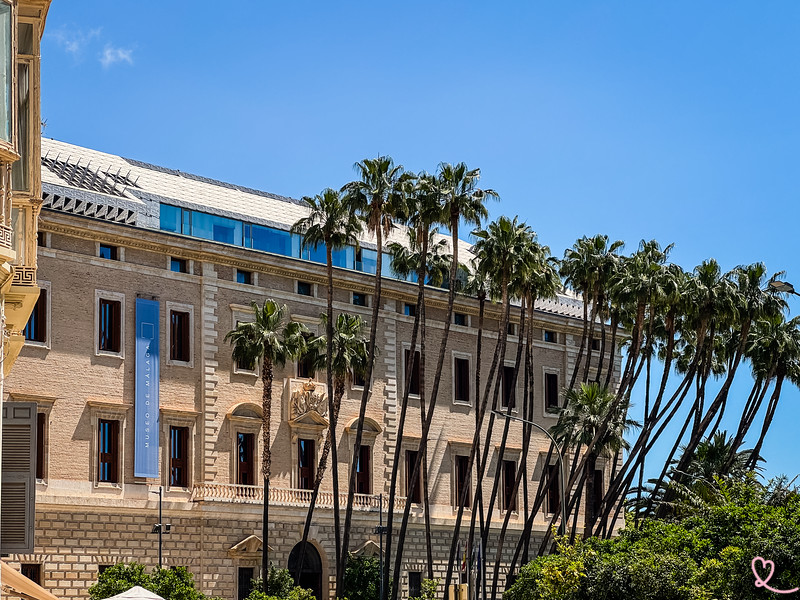
The Museo de Málaga is housed in the old customs house, one of the most remarkable buildings of Málaga’s neoclassical period. Built in 1787 by architect Manuel Martín Rodríguez, this building was commissioned by King Charles III in response to the growing volume of maritime traffic following the introduction of free trade with the Americas.
Completed in 1829, it first served as a tobacco factory, then as a customs house from 1835, and then alternated with administrative use. The building has undergone several modifications over the years, but its architecture is still impressive! With a surface area of over 18,400 m2, the museum offers an impressive setting for its collections, and unveils a charming patio where we loved to take a break.

Open-access reserves
The tour begins on the ground floor, where you’ll have access to the museum’s storage areas. Many artifacts—including ancient sculptures, mosaics, archaeological finds, and religious icons—come together in a joyful interplay, bearing witness to the city’s rich past. We loved this first glimpse—it was like Ali Baba’s cave!

RENT A CAR IN Andalucia
- Compare prices on our preferred platform: DiscoverCars – one of the best rated sites.
- Choose a compact car, as some villages have very narrow streets!
- Think ofcomprehensive insurance for the same reason
- Book early for choice.

A plunge into Spanish art on the second floor
The visit then continues on the second floor with the painting collections, offering a veritable journey through the pictorial history of Spain. We appreciated the pedagogical effort made to understand the evolution of the different artistic movements.
The 19th century is particularly well represented, with a room dedicated to landscape art, followed by the emergence of the Málaga school of painting, which enjoyed national success.
In particular, we discovered the work of emblematic artists such as Muñoz Degrain and Moreno Carbonero. The transition to the 20th century is illustrated by the works of José Nogales Sevilla and Enrique Simonet y Lombardo, while the avant-garde is symbolized by Pablo Picasso and the poet José Moreno Villa. This panorama is completed by a section dedicated to contemporary art.

Right: Enrique Simone y Lombardo on the right El Juico de Paris, 1904
Our discovery: The vibrant work of Antonio Muñoz Degrain
A native of Valencia, Antonio Muñoz Degrain (1840–1924) moved to Málaga in 1870 to work with his friend Bernardo Ferrándiz on the decoration of the ceiling at the Cervantes Theater in Málaga. With this commission, he became one of Málaga’s most important painters and received numerous commissions from the city’s bourgeoisie.
We loved discovering the various works by this virtuoso artist, who—despite a career focused on commissioned works—managed to subvert genre conventions through his bold use of color. This is evident in the painting *Noche Clara en La Caleta*, which was presented at the 1915 National Exhibition and immediately caught our attention. Indeed, the contrast between the scene’s nocturnal atmosphere and the splashes of color from the clothing, lanterns, and campfire creates a festive and vibrant effect.

FUN in Andalucia: activities
- Cooking course in Sevilla
- Canyoning from the Costa del Sol
- Guided Hike on the Caminito del Rey

The vast archaeological collections on the second floor
The second floor is dedicated to archaeology and features a fascinating collection of artifacts, sculptures, and remains that bear witness to the various civilizations that have inhabited the region. First of all, we appreciated the effort made to make the exhibition accessible, with numerous explanatory panels that helped us navigate the different time periods. The objects are beautifully lit, whether in display cases or on pedestals, and are complemented by educational models.
We particularly enjoyed the section tracing Malaga’s Muslim history, showing the construction of the city walls and the Alcazaba, as well as the way of life in the old medina. It’s a great way to complement your city sightseeing!

The magnificent Venus Mosaic
Take your time to detail this incredible piece dating from the 3rd century.
Discovered in 1956 in Cártama, the “Birth of Venus” mosaic is a Roman masterpiece in excellent condition—and we fell in love with it at first sight!
Composed of different-colored tesserae, it depicts Venus emerging from the sea on a large shell, surrounded by birds and geometric motifs. This rare representation in Spain may have adorned a spa area or a room dedicated to celebrations in an ancient Roman domus. The mystery surrounding its origins makes it all the more appealing!

WHERE TO STAY IN Málaga
Our favorites: neighborhoods and hotels
In the historical center
Hotel Palacio Solecio – see photos and availability
Near the sea, Playa de la Magualeta
Gran Hotel Miramar – see photos and availability
In the Soho district
Hotel Only You Malaga – view photos and availability

Immersive, colorful scenography
Finally, we would like to highlight the exhibition design as a remarkable feature of the museum in its own right. Indeed, the careful use of colors and materials creates a unique and stimulating visitor experience.
The different colors of the rooms help organize the exhibition by historical period, while the semi-open picture rails and others made of striated wood add a contemporary touch. Together, these elements create a vibrant atmosphere that perfectly showcases the works on display.

Several rooms also feature benches for long contemplation of the works, and each floor has rest areas with armchairs.
An attention to detail that will not leave travellers indifferent, after a day strolling through the city and its museums!

Amélia’s model (our favorite!)
Despite the many monumental paintings on display at the museum, we set our sights on this work by Vicente Palmaroli González (1834–1896). Trained at the Academy of Fine Arts in Madrid, this painter won over the general public with his portraits before becoming director of the Prado Museum. We immediately loved the contrast between the meticulous detail and refinement of the subject and its simple medium—which is none other than the painter’s palette!
While this practice was common among 19th-century artists, the originality of the work lies in the model’s captivating pose, whose gaze draws the viewer in. Her hand, resting on her face with a studied nonchalance, reinforces the way she draws the viewer in with her direct gaze.
This portrait could therefore be an allegory of feminine beauty, as suggested by the laurel wreath or the model’s seemingly casual gesture, which conveys a sense of self-awareness—almost narcissistic.

PLAN YOUR DREAM TRIP TO andalucia
All the information you need for your trip:
- 7 maps that make planning easier
- + 150 pre-selected locations
- Practical advice
- 300+ photos to help you choose

Malaga Museum: access
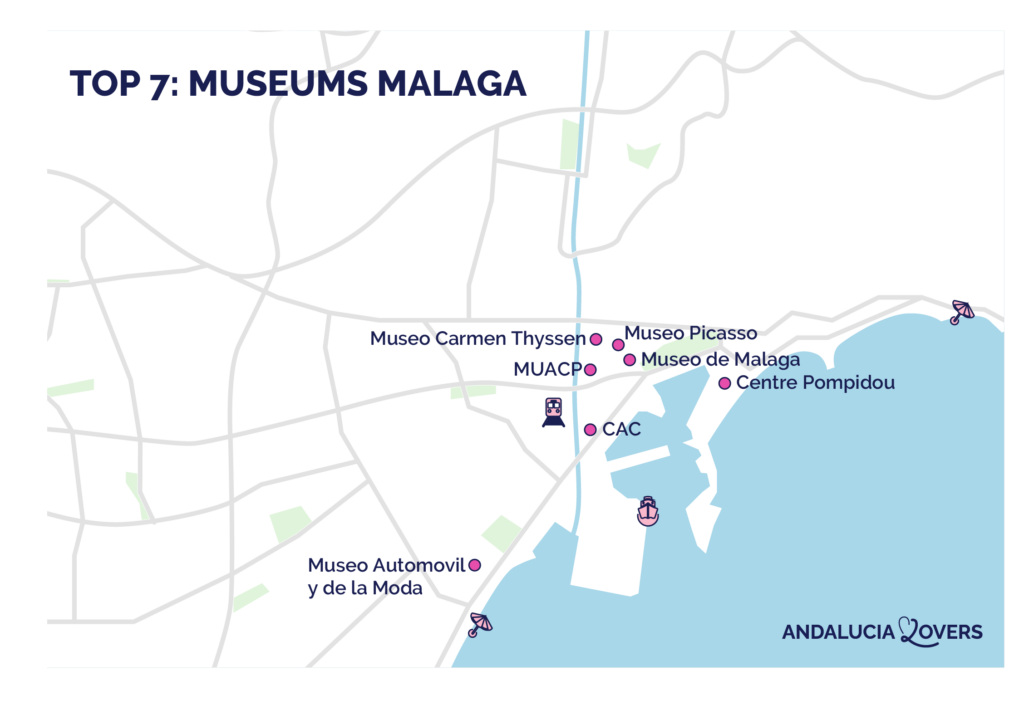
Where to find the Malaga Museum
- In the city of Malaga
- Plaza de la Aduana, Central District
- Opposite the Paseo del Parque and a 4-minute walk from the Cathedral
Access by car and parking
The museum is accessible by car but does not have its own parking lot. The closest one is located on Plaza de la Marina y Alcazaba. However, there is a parking area for motorcycles and bicycles right in front of the museum entrance on Avenida de Cervantes.
Public transport access
If you’re in the city center, we recommend walking to the museum.
Several bus lines serve the Paseo del Parquestop, a 3-minute walk from the museum.
For those who come by cab, the nearest stations are as follows:
Cortina del Muelle, Plaza de la Merced or Plaza de la Marina.
Visiting difficulties
There’s no difficulty in visiting this museum, which is perfectly accessible for PRMs, with elevators, adapted toilets, large rooms for easy circulation and the possibility of renting wheelchairs on site.

Useful tips for visiting the Museo de Málaga
Schedules and prices
The museum is open Tuesday to Friday, 9am to 9pm, and Saturday, 9am to 3pm.
Closing day is Monday.
Admission is free for European citizens (see the official website here for the latest information) and 1.50 euros for everyone else.
How long
We advise you to allow at least 2 hours for your visit, if you wish to discover the archaeological and artistic collections, given the number of works and the detail of the explanations. In hindsight, we feel that we should almost split the visit in two, and set aside an afternoon for each collection, given their scale.

Free guided tours are offered every Saturday at noon.
To register, simply arrive 30 minutes before the start time at the reception desk.
More info on the news tab of the official website here.
Best moment
The Malaga Museum seems to stand out for its peaceful atmosphere, far from the hustle and bustle of the tourist crowds. For the best experience, we recommend avoiding weekends and visiting in the evening, as the museum is open until 9 p.m.
Direction of visit
To make the most of your visit, we recommend you follow the chronological itinerary proposed by the museum. All you need to do is follow the clearly indicated numbering. Throughout the halls, you’ll discover numerous mediation panels, available in English, offering enriching explanations for each section.

In addition, each floor has a detailed map, making it easier for you to find the items that might interest you the most. To round out your visit, be sure to stop by the museum shop or library.
Visiting with children
We noticed several features designed to make family visits easier, such as educational displays tailored for children and designated areas with small tables. However, we do not consider the museum to be ideal for a family visit. The tour can be long, and the content—especially in the archaeology section—may be too much for very young children to take in, and they might quickly get bored.

Eating out
The museum has a restaurant, but it was not accessible at the time of our visit.
Find out more on the museum’s official website here.
Alternatively, you can check out our article featuring our list of the best restaurants in Málaga!
PLAN YOUR TRIP TO Andalusia
Inspiration

Practice

Places not to be missed