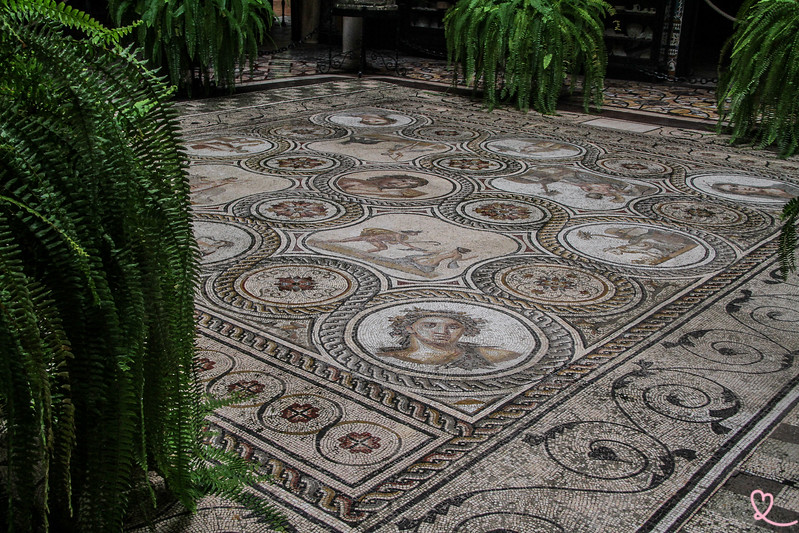
Located in the heart of Sevilla, the Palacio de Lebrija stands out for its eclectic style, which blends Mudejar and Renaissance influences. This early 20th-century palace is famous for its vast Roman mosaics from Itálica, which we found absolutely stunning, as well as for its art collections, which include works by Van Dyck and Bruegel the Elder.
In this article, discover our helpful tips—illustrated with photos —to help you best prepare for your visit and fully enjoy this unique historic residence right in the heart of downtown.
This opinion is completely independent, based on our experiences. We made our own choices, visited the area anonymously, and paid our bills in full.
Why Visit the Palace of the Countess of Lebrija
Is the Palace of the Countess of Lebrija worth a visit? Our opinion:
Yes, the Palace of the Countess of Lebrija is worth a visit for several reasons:
- Its exceptional collection of Roman mosaics from the ancient site of Itálica,
- Its eclectic architecture, which blends Mudejar influences with Renaissance elements,
- The wealth of works of art that adorn its rooms is a testament to the Countess’s refined taste.
In our opinion, this is a rewarding journey into the history and art of Sevilla— a must-see if you enjoy places that blend ancient heritage with refined architecture.

WHERE TO STAY IN Seville
Option 1: In the historic center
Convenient for visiting everything on foot, we recommend:

Option 2: El Arenal
Between quiet streets and riverside ambience, we recommend it:

See our complete selection of the best hotels and neighborhoods in Sevilla
Why is the Palace of the Countess of Lebrija famous?
The Palace of the Countess of Lebrija is renowned for its vast Roman mosaics, which cover almost the entire ground floor. These mosaics come mainly from the archaeological siteof Itálica, which is just a few kilometers from Sevilla and well worth a visit! They bear witness to the cultural richness of Roman antiquity in Andalucia.
The palace also houses a valuable collectionof works of art, including paintings from the Murillo school, as well as Empire-style furniture and porcelain. This collection reflects the Countess of Lebrija’s passion for art and archaeology; she restored the palace in the early 20th century to showcase her discoveries.

Our favorite moments
We particularly liked it:
- The main patio, which embodies Andalusian craftsmanship.
- The Roman mosaic floor, which evokes the city’s ancient history.
- The azulejos and the refined atmosphere of the interiors, particularly the dining room.
History in brief
The Palace of the Countess of Lebrija stands in the historic center of Sevilla on the ruins of a 15th-century house. Its main structure dates back to the 16th century, when it took on the form of an aristocratic palace typical of the city.
In 1901, Countess Regla Manjón Mergelina, a passionate archaeologist, purchased the palace and undertook an ambitious restoration project. She converted the ground floor to display her archaeological finds, including ancient mosaics, thereby transforming the space into a veritable private museum.

Location: Palace of the Countess of Lebrija, Sevilla
Where is the Palace of the Countess of Lebrija located?
- Neighborhood: in the Casco Antiguo, in the historic center, just a few steps from the Monument Las Setas
- Address: Calle Cuna, 8, 41004 Sevilla, Spain
RENT A CAR IN Andalucia
- Compare prices on our preferred platform: DiscoverCars – one of the best rated sites.
- Choose a compact car, as some villages have very narrow streets!
- Think ofcomprehensive insurance for the same reason
- Book early for choice.


How to get there?
- The Palace of the Countess of Lebrija is within easy walking distance of Sevilla’s historic center, making it a convenient option for visitors who want to combine several sightseeing stops.
- By public transportation, several bus lines stop at the Laraña stop on Plaza Encarnación, near the palace. Lines 10, 11, 12, 13, 14, 15, 20, 21, 23, 24, 25, 26, 27, 30, 31, 33, 34, 35, 40, 41, and 42 provide easy access to this central location.
- If you prefer biking or walking, the neighborhood offers a pleasant and safe environment for these modes of transportation.
Parking
The Palace of the Countess of Lebrija is located in an area where public parking is limited. We recommend using the nearby paid parking lots, particularly those around Plaza Encarnación, which are just a few minutes’ walk away. We recommend that you usepublic transportation or walk to avoid traffic and parking problems in Sevilla’s historic center .

PLAN YOUR DREAM TRIP TO andalucia
All the information you need for your trip:
- 7 maps that make planning easier
- + 150 pre-selected locations
- Practical advice
- 300+ photos to help you choose

Useful tips: duration, schedules, eating…
Best time to visit
The Palace of the Countess of Lebrija is generally less crowded in the early morning, allowing you to enjoy a more peaceful visit before the tour groups arrive. The peak tourist season in Sevilla runsfrom April through June and from September through October. During these times, the palace is more crowded, especially around midday. In July and August, the intense heat reduces the number of visitors. For a more enjoyable visit, plan to go in the morning to avoid the high temperatures.

Length of visit and main difficulties
Plan on spending 1½ to 2 hours for a full tour, which will allow you to appreciate the palace’s mosaics and decorations.
The ground floor is accessible, but the lack of an elevator makes it difficult to reach the upper floor, as there are a few flights of stairs to climb. Accessibility for people with reduced mobility is therefore limited. The ground floor is accessible (accessible restrooms, accessible reception desk). There is no elevator to the upper floor, and some rooms have stairs at the entrance.
Advice on how to visit
For a smooth tour, start on the ground floor, where the Roman mosaics immediately captivated us. Continue on to the main patio before exploring the rooms on the upper floor, which are accessible via the central staircase.

Visiting with children
The palace does not offer any special tours for children. In our opinion, the tour is quite contemplative.
Schedules and rates
The palace is open from September through June, every day from 10:00 a.m. to 6:00 p.m., with last admission 45 minutes before closing. In July and August, hours are reduced to 10:00 a.m. to 3:00 p.m. every day.
Prices: €15 for adults, €6 for children ages 6 to 12, and free for children under 6. Admission is free on Fridays at 10:00 a.m. for the ground floor only, subject to availability.
More info on the official website here.

Subscribe to our Newsletter
- Get away from it all with Region Lovers’ beautiful destinations!
- Once a month
- Advertising-free

Guided tours
The palace itself does not offer guided tours, but you can opt for an organized group tour that includes a guided tour of the palace.
Catering
There are no dining options inside the palace, but since it’s in the city center, it’s surrounded by restaurants. Check out our article on the best restaurants in Sevilla for more ideas.

Eclectic Architecture and Decor
Architectural style of the palace
In our view, the Palace of the Countess of Lebrija is distinguished by its eclectic architectural style, the result of the many renovations it has undergone since the 16th century. It skillfully blends Mudejar elements—characteristic of Andalucian architecture—with Renaissance influences , which are evident in certain decorative details and the building’s overall structure. Among the Mudejar elements, you’ll particularly notice the arabesque arches that adorn several areas of the palace. They stand in contrast to the more understated and symmetrical lines typical of a more European style.

Interior Design
We found the ground floor of the Palace of the Countess of Lebrija remarkable for its Roman mosaics, which completely cover the floors. These mosaics, from the ancient site ofItálica, are worth the trip on their own.
Also note the walls, which are decorated withazulejos—the colorful ceramic tiles typical of Andalucia. Their presence highlights the Mudejar influence in the interior design, reinforcing the palace’s eclectic character. These azulejos are also characteristic of traditional Sevillian homes.
Another highlight of the palace is its coffered ceilings. We were particularly taken with the ones in the summer dining room. This ceiling is decorated with painted depictions of several Spanish cities. This decoration clearly illustrates Countess Regla Manjón Mergelina’s desire to combine historical heritage and aesthetics in the restoration of the palace.

A unique collection
Roman Mosaics
The Roman mosaics in the Palace of the Countess of Lebrija come mainly from the site of Itálica, located just 12 km from Sevilla—the first Roman colony in Spain and the birthplace of Emperors Trajan and Hadrian. Set directly into the floors of the ground-floor rooms, they date from the 2nd and 3rd centuries A.D. and cover nearly 580 m². The centerpiece is the large mosaic in the central courtyard: its central medallion depicts the god Pan, surrounded by eight medallions illustrating the love affairs of Zeus, while the four corners feature allegories of the seasons. We have rediscovered the major themes of Roman mosaics: mythology, natural cycles, and divine figures.
The countess had these floor tiles transported from the archaeological sites at Italica and other locations to save them from deterioration and use them as the decorative framework of her palace. She was the first woman to be elected a full member of the Santa Isabel de Hungría Academy of Fine Arts, and later became a corresponding member of the Royal Academy of Fine Arts of San Fernando in Madrid. In our opinion, this is as much a preservation effort as it is an aesthetic one, and it has earned the palace the title of “the best-paved palace in Europe”!

Works of Art
The Palace of the Countess of Lebrija houses a beautiful collection of paintings by Spanish masters. We particularly enjoyed the works of Bartolomé Esteban Murillo and Francisco de Zurbarán. These paintings, on display mainly on the upper floor, illustrate the artistic richness of Baroque Sevilla.
In addition to the paintings, the palace features a carefully curated selection of ceramics and porcelain, including a remarkable collection of English blue porcelain that we had the opportunity to admire. These decorative pieces, displayed in various rooms, reflect the eclectic taste of Countess Regla Manjón Mergelina, who collected them in the early 20th century to enhance the historic atmosphere of the site.

Historical Artifacts
The Palace of the Countess of Lebrija also houses a remarkable collection of glyptics, consisting notably of ancient gemstones that were also excavated from the archaeological site of Itálica. You’ll be able to see these items, which are on display in a dedicated showcase. They exemplify the meticulous art of stone engraving, a practice that was widespread in Roman antiquity. Beyond glyptics, we have finally discovered a variety of historical objects, such as busts, vases, amphorae, and basins, as well as ancient columns and sculptures.

PLAN YOUR TRIP TO Andalusia
Inspiration

Practice


SHE MADE THE TRIP Claire