Visiting Granada? Don’t miss the Generalife, the former summer palace and country estate of the Nasrid rulers, nestled on the slopes of Cerro del Sol. We were struck by the serenity of this place, quite different from the more monumental atmosphere of the Alhambra palaces. Here, water, vegetation and light filter through the arcades to create an experience in its own right.
In this article, you’ll find our photos and tips for making the most of your visit to Generalife.
This opinion is completely independent, based on our experiences. We made our own choices, visited the area anonymously, and paid our bills in full.
Why visit the Generalife
Is the Generalife worth it? Our opinion:
Yes, the Generalife is definitely worth a visit. Built between the late 13th and early 14th centuries, this former summer palace of the Nasrid kings offers a quieter, greener atmosphere than the Alhambra palaces. We particularly appreciated the omnipresence of water, ponds and canals, which provide a welcome coolness, as well as the exceptional views over the entire Alhambra, impossible to obtain from the main palaces themselves.
This is one of Granada’s best activities.
>> Book your ticket (also valid for the Alhambra)

Why is the Generalife famous?
The Generalife was the summer residence of the Nasrid kings of Granada, who used it both as a private retreat and as a farm, with its orchards and irrigated crops. Its name derives from the Arabic Jannat al-‘Arif, often translated as “Garden of the Architect” or “Garden of the Artist”. Listed as a UNESCO World Heritage Site along with the Alhambra and Albaicín since 1984, it is recognized as one of the best-preserved Islamic garden ensembles in Spain!
It’s famous for two things:
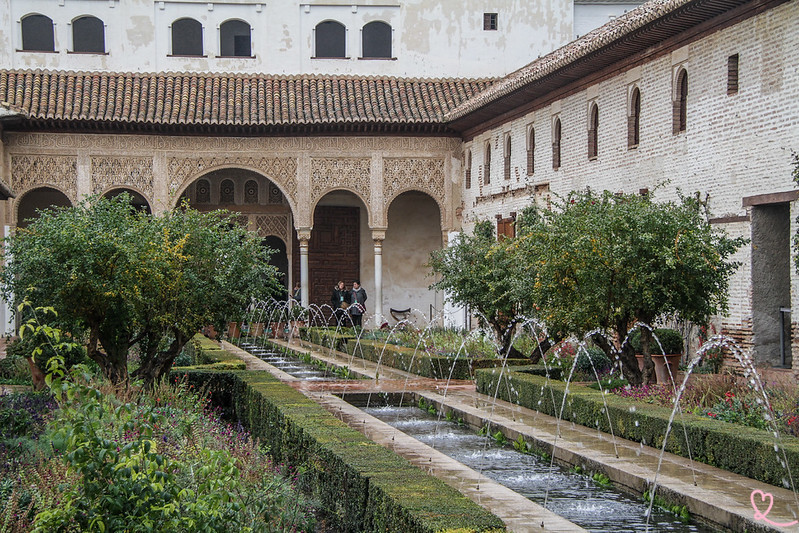
- the Patio de la Acequia, whose large central canal lined with fountains has become one of the most emblematic images of Andalucia.
- l’Escalera del Agua, typical of medieval hydraulic architecture, with its canal ramps that allow water to flow down the steps, a unique achievement.

Our favorite moments
We loved it:
- Stroll through the Patio de la Acequia and beneath the palace’s elaborate decorations when visitors are still few and far between.
- Climb theEscalera del Agua in the shade of the canopy and discover how it works.
- Enjoy views of the towers and ramparts of the Alhambra.

WHERE TO STAY IN Granada
Our favorites: hotels and neighborhoods
Downtown
Hotel Luna Granada Centro – See prices, photos and availability
Hotel Corrala del Realejo – See prices, photos and availability
At the Alhambra
Alhambra Palace – See prices, photos and availability

See our complete selection of the best hotels in Granada
History in brief
The Generalife is one of the best-preserved examples of Nasrid civilization. We were surprised by his story:
- Late 13th century: origins of the Generalife under the reign of Muhammad II (1273-1302), founder of the estate on the slopes of the Cerro del Sol.
- Early 14th century: major extensions under Muhammad III (1302-1309), giving the site its main configuration.
- 1492: after the Christian conquest of Granada, the Catholic Monarchs take over the estate and modify certain parts, notably the north pavilion of the Patio de la Acequia.
- 19th and 20th centuries: the gardens undergo gradual remodeling; the Jardines Nuevos are laid out in the 1930s in a style inspired by, but distinct from, the original Nasrid gardens.
- 1984: UNESCO World Heritage listing, along with the Alhambra and the Albaicín district.

Access: Generalife, Granada
Where is the Generalife?
- On the Cerro del Sol hill, east of the Alhambra complex, about 2-3km from the center of Granada.
- Accessible from the Real de la Alhambra area, within the same monumental perimeter
- In the immediate vicinity of the Nasrid palaces and the Alcazaba
RENT A CAR IN Andalucia
- Compare prices on our preferred platform: DiscoverCars – one of the best rated sites.
- Choose a compact car, as some villages have very narrow streets!
- Think ofcomprehensive insurance for the same reason
- Book early for choice.

How to get there?
From the center of Granada, there are several options for getting to the Generalife. By city bus, there are routes from Plaza Isabel la Católica directly to the main entrance of the Alhambra. By cab, the journey from the center is short. You can also opt to walk up the Cuesta de Gomérez, a 20-30min walk through the woods along the ramparts. By car, take the A-44 (N-323) ring road, exit at Ronda Sur (A-395), then head for the official Alhambra parking lots.

Parking
There is no specific parking at Generalife: visitors use the official Alhambra parking lots, located near the main entrance to the complex. These parking lots are fee-paying, supervised and suitable for visits lasting several hours, with hourly rates and daily ceilings. We advise you to arrive early in the morning to find a place easily, especially in high season.
PLAN YOUR DREAM TRIP TO andalucia
All the information you need for your trip:
- 7 maps that make planning easier
- + 150 pre-selected locations
- Practical advice
- 300+ photos to help you choose

Useful tips: duration, schedules, eating…
Best time to visit
Spring (April-May) and early autumn (September-October) are the most favorable periods: temperatures are mild and gardens are particularly green and flowery. In summer, the heat in Granada can be intense during the day, so we recommend early morning or late afternoon. In addition, special night-time tours of the gardens and Generalife are offered in season: they offer a very different atmosphere, with careful lighting and much more pleasant temperatures.
Length of visit and main difficulties
Allow 1h30 to 2h to discover the Generalife at your leisure: its gardens, palace and Escalera del Agua.
The route includes numerous steps and sometimes steep slopes. We suggest you wear comfortable shoes with non-slip soles. Walkways around ponds can be slippery in wet weather or after watering. And don’t forget water and sun protection, especially in the warmer months.

Advice on how to visit
You can include a visit to the Generalife in your overall visit to the Alhambra, or decide to do just this part. In any case, to get the most out of the Generalife, we recommend entering through the Jardines Nuevos and gradually working your way up to the palace. This progression keeps the Patio de la Acequia as the highlight of the visit. Then climb up to the Jardín Alto andEscalera del Agua, which offer the highest views of the Alhambra and the Granada plain before descending.

DISCOVER Granada

Visiting with children
The Generalife is ideal for a family visit. The Patio de la Acequia’s gardens, pools and fountains can be fun for children, and the Escalera del Agua, with its water running down the steps, is sure to fascinate them. However, we advise you to opt for a baby carrier if you have one or more infants, as the route includes stairs and areas that are impractical for strollers. Remember to bring water, a cap and sun cream: the shade of the cypress trees helps, but doesn’t mean you don’t need appropriate protection.

Schedules and rates
Rates:
- Full price Generalife + Alhambra and Nasrid Palaces: €22.27
- Generalife + Alcazaba rate: €12.73
- Price for a night visit to the gardens and Generalife:€8.48
Daytime opening hours:
- April 1 to October 14, daily: 8:30 a.m. to 8 p.m. (ticket office opens at 8 a.m.)
- October 15 to March 31, daily: 8:30 a.m. to 6 p.m. (ticket office opens at 8 a.m.)
Visit the official website for more info here.
Guided tours
Many guided tours combine the Alcazaba, the Alhambra gardens and the Generalife, in small groups with an official guide or audioguide. They often provide access to popular time slots and detailed explanations of Nasrid hydraulics, the symbolism of Islamic gardens and the history of the site. We recommend this option if you want to go beyond contemplation and really understand what you’re looking at. You’ll come away with a much richer understanding of the place!

Lodging
Most visitors choose to spend the night in the center of Granada, around the cathedral, Plaza Nueva or Albaicín district, and then spend the day at the Alhambra and Generalife. Some hotels and apartments explicitly mention their proximity to the bus stop for the Alhambra, which makes logistics easier, especially if you have an early morning slot.
See our selection of hotels here to make the best choice!

Catering
There are no full catering facilities inside the Generalife itself. Drinks and snacks are available in the Alhambra area, but we recommend eating before or after your visit. The Realejo district and the area around Plaza Nueva, in the center of Granada, offer a much more varied and pleasant selection. See our article on the best restaurants in Granada.

Generalife Palace
The Generalife palace lacks the monumentality of the great halls of the Alhambra. And that’s precisely what makes it so interesting: here, everything is designed for rest, freshness and contemplation, in a sober architecture that leaves plenty of room for gardens and light.
Indoor rooms
The palace’s interior spaces are organized around the Patio de la Acequia, in keeping with the logic of a summer residence rather than an official palace. The main hall, known as the Sala Regia, was intended as a resting place for the Nasrid rulers. We were struck by the sobriety of these spaces, very different from the opulence of the neighboring Nasrid palaces. Volumes are contained, ornamentation is measured, and windows opening onto the gardens play an active role in natural ventilation. You’ll immediately perceive this ingenious climatic logic, where architecture itself becomes a tool for freshness.

Galleries and watchtowers
Along the Patio de la Acequia runs a porticoed gallery whose arcades open directly onto the canal and gardens. From the north gallery, framed views of the Alhambra ramparts and the city below are revealed, particularly beautiful in the late afternoon when the low-angled light warms the stones. We loved these shady spaces, designed as much for covered circulation between rooms as for contemplation. The viewpoints also offer vistas over the Darro valley and the Albaicín hills: stop for a moment to savour them to the full.

Nasrid decorative elements
Although the Generalife palace is more sober than the Alhambra’s Halls of the Lions or Ambassadors, it still boasts some fine decorative details typical of Nasrid art. We noted the finely carved stucco arches, slender marble columns and coffered wooden ceilings in the Mudejar tradition. Decorative epigraphic friezes run along some walls, and glazed ceramics are used with restraint. Look closely at these elements: their very discretion reveals their refinement.

Patio de la Acequia
It’s the heart of the Generalife, its most famous space and, without doubt, one of the most accomplished Islamic gardens we’ve visited.
The central canal and water jets
A long rectangular pool runs right through the courtyard, fed by theAcequia Real, the royal canal that carries water from the Sierra Nevada to the hilltop. On either side of the basin, water jets cross in graceful arcs over the canal, creating a curtain of droplets. We were amazed by the ingenuity of this medieval hydraulic system, which combines a practical function – cooling – with a genuine aesthetic intent.

The north and south pavilions
At either end of the canal face two pavilions with porticoes adorned with Nasrid arches. The north pavilion is the main entrance to the palace rooms, modified after the Christian conquest of 1492 by the Catholic Monarchs. The south pavilion acts as a belvedere overlooking the terraced gardens. We appreciated the symmetry of this ensemble, which frames the pool like a painting. These spaces, designed for rest and contemplation, retain their ability to invite you to take a break.
Plant life and architecture
Flower hedges line both sides of the canal, structuring the perspective and delimiting flower beds whose composition varies with the seasons. This symmetrical composition, typical of Islamic gardens, establishes a constant balance between mineral, water and plant elements. From certain angles, you’ll enjoy framed views of the terraced gardens, like plant “windows” opening onto the Granada landscape – a striking contrast between the highly controlled rigor of the patio and the more open panoramas of the city.

The Generalife gardens
Beyond the main patio, the Generalife gardens unfold in successive terraces, linking the palace to the heights of the Cerro del Sol via a series of staircases, ponds and plantings. It’s a progressive journey, with each level revealing new perspectives.
L’Escalera del Agua
The Escalera del Agua is one of the highlights of the Generalife, and one of the most often cited by specialists in medieval hydraulic architecture. This staircase connects the upper terraces via several landings whose hollowed-out ramps serve as canals. Water flows continuously along the railings, creating a permanent visual and audible accompaniment to the climb. Small circular fountains mark each landing, and cypress trees provide shade and coolness along the way. We found the climb particularly gentle, carried along by the sound of the water with each step. Immerse yourself in the unique atmosphere that epitomizes Nasrid hydraulic engineering.

Jardín Bajo and Jardín Alto
The Jardín Bajo, located in the immediate vicinity of the main palace, and the Jardín Alto, set on the upper terraces, form the backbone of the Generalife’s historic gardens. Organized in successive levels, they feature geometric flowerbeds with varied plantings, punctuated by ponds and small canals. These spaces, more open than the Patio de la Acequia, provide a transition between the palace and the heights of the estate. From the Jardín Alto, panoramic views gradually widen over the Alhambra, its towers and the rooftops of Granada – you’ll be impressed by the vastness of the landscape unfolding before you, all the way to the plains and Sierra Nevada.

Jardines Nuevos
Jardines Nuevos is the most recent part of the estate, built in the 1930s. Their wide, symmetrical paths, lined with cypress trees that form plant walls, give them a formal allure that contrasts with the more intimate character of the historic gardens. Decorative rectangular basins punctuate the course, and today the whole area serves as the main circulation zone for visitors entering the site. Even if their inspiration is Nasrid, we could see the stylistic difference with the period spaces. What really caught our eye here were the numerous vantage points overlooking the entire Alhambra: the walkways act as veritable contemporary belvederes, framing perspectives of the palaces and fortress – particularly popular framings for photographs.

Subscribe to our Newsletter
- Get away from it all with Region Lovers’ beautiful destinations!
- Once a month
- Advertising-free

Frequently asked questions
Do I need to book in advance to visit the Generalife?
Yes, it’s highly recommended to book tickets for the Alhambra (including the Generalife) several days or even weeks in advance, especially in spring and summer. Daily quotas are strict, and same-day tickets are often sold out in high season. Don’t leave booking to the last minute: that’s our main advice to anyone planning a visit to Granada.
>> Book your ticket (also valid for the Alhambra)

Is the Generalife included in the Alhambra ticket?
The Generalife is included in the “General Alhambra” ticket, which includes the Nasrid palaces, the Alcazaba and the gardens. There is also a special “Gardens, Generalife and Alcazaba” ticket, which allows you to visit Generalife without entering the Nasrid palaces, at a reduced rate. If your time is limited, or if you want to concentrate on the gardens, this second option makes perfect sense.
>> Book your ticket (also valid for the Alhambra)
What’s the best time of year to visit Generalife?
Spring (April-May) and early autumn (September-October) are generally considered the best periods: temperatures are milder, and gardens are particularly green and flowery. In summer, the heat in Granada can be intense during the day, but early-morning or evening visits are still very pleasant thanks to the shade of the cypress trees and the ever-present water in the gardens.

PLAN YOUR TRIP TO Andalusia
Inspiration

Practice

Places not to be missed


SHE MADE THE TRIP Claire