Are you an architecture enthusiast or a history buff? The Monastery of San Jerónimo awaits you in Granada. This monastic complex, founded by the Catholic Monarchs, is one of the best-preserved Renaissance ensembles in Andalucia. We visited it and came away conquered by the richness of its decor and the serenity of its cloister.
In this article, you’ll find our photos and tips for making the most of your visit to the San Jerónimo Monastery.
This opinion is completely independent, based on our experiences. We made our own choices, visited the area anonymously, and paid our bills in full.
Why visit the Monastery of San Jerónimo
Is the San Jerónimo Monastery worth it? Our opinion:
Yes, without hesitation. The San Jerónimo Monastery is one of Granada’s most unjustly overlooked monuments. Overshadowed by the Alhambra, it attracts few crowds, but in our opinion offers an interesting visit thanks to its superb Renaissance architecture.
This is one of Granada’s best activities.
>> Get a head start and book your ticket

Why is the Monastery of San Jerónimo famous?
The San Jerónimo Monastery owes its renown to several exceptional features. Firstly, its altarpiece in the main chapel, mainly by the sculptor Pablo de Rojas, is considered the starting point for great Andalucia sculpture – the stylistic matrix from which the entire Seville Baroque school emerged. We were struck by the iconographic density of this altarpiece, where sacred figures and military trophies coexist in a single decorative flourish.
The monastery is also the mausoleum of the Gran Capitán, Gonzalo Fernández de Córdoba (1453-1515), the general who unified the Spanish armies in Italy under the Catholic Monarchs. We admired it in the chapel.
It was also the world’s first temple dedicated to Mary’s Immaculate Conception, a title that gives it singular importance in the history of the Catholic Church. Last but not least, it has close ties with Charles V, whose wife Isabella of Portugal stayed here on her honeymoon in 1526.

Our favorite moments
Among the elements that impressed us the most were..:
- The exterior portal is absolutely magnificent and unique, typical of the Spanish Renaissance.
- The beautiful altarpiece rises to a vault decorated with carved coffers, and the Gran Capitan’s tomb with its aristocratic details.
- Stroll through the first cloister and its seven arcosolia (funerary niches) Renaissance style, framed by gardens that offer a meditative atmosphere.

WHERE TO STAY IN Granada
Our favorites: hotels and neighborhoods
Downtown
Hotel Luna Granada Centro – See prices, photos and availability
Hotel Corrala del Realejo – See prices, photos and availability
At the Alhambra
Alhambra Palace – See prices, photos and availability

See our complete selection of the best hotels in Granada
History in brief
We were struck by the monastery’s rich history. Here are the milestones in its history:
- Before 1492: The Catholic Monarchs decided to found the monastery even before the capture of Granada. The convent was first established at Santa Fe, the Castilian military camp in front of the city.
- 1504: Construction begins on the current complex in Granada. Tuscan artist Jacopo Florentino directed the first works on the church from 1513.
- 1522: Completion of the major chapel. The bodies of the Gran Capitán (Gonzalo Fernández de Córdoba, a Spanish general famous for being one of the greatest military strategists of his time) and his wife are transferred here from the Convento de San Francisco.
- 16th century: after Jacopo Florentino’s death, Diego de Siloé took charge of the building site and unified the whole in a coherent Renaissance style. Pablo de Rojas creates the Mannerist altarpiece in the main chapel.
- 19th century: The Napoleonic invasion (1808-1812) destroyed the church tower, the stones of which were used to build the Puente Verde on the Río Genil. When the Jeronymite Order was driven out in 1835, the monument fell into partial abandonment.
- 1877 and 1931: Successive classifications – the church was declared a historic monument in 1877, the entire monastery in 1931 as a Site of Cultural Interest.
- 1916-1920: Restoration by architect Fernando Wilhelmi. The tower was rebuilt in 1963.
- Today: The monastery is still inhabited by a community of Jeronymite nuns. Only part of it is open to the public.
How to get there: Monastery of San Jerónimo, Granada
Where is the Monastery of San Jerónimo?
- In the Centro-Sagrario district, in the heart of Granada’s historic center
- Calle Rector López Argueta, 9, 18071 Granada
- Next to the Gran Vía de Colón and the Capilla Real, the Royal Chapel

How to get there?
Several bus routes serve the nearby stops Gran Vía 28 – Sagrado Corazón or Catedral (routes 3, 5 and 8 depending on itinerary). By cab or VTC, ask for “Monasterio de San Jerónimo, calle Rector López Argueta”. From the Alhambra, walk down the Paseo de los Tristes for 25-30 minutes, or take a 10-minute cab ride. By car, traffic in the historic center is very restricted: it’s best to opt for a park-and-ride on the outskirts and walk to the monastery.
RENT A CAR IN Andalucia
- Compare prices on our preferred platform: DiscoverCars – one of the best rated sites.
- Choose a compact car, as some villages have very narrow streets!
- Think ofcomprehensive insurance for the same reason
- Book early for choice.

Parking
There is no public parking lot dedicated to the monastery, as the area is a restricted zone for non-resident vehicles. The nearest parking lot we saw was Parking San Augustin, about a 10-minute walk away. On-street parking is available in the streets adjacent to Calle Rector López Argueta, but is rare and subject to a charge.

A unique Renaissance façade
The Renaissance façade
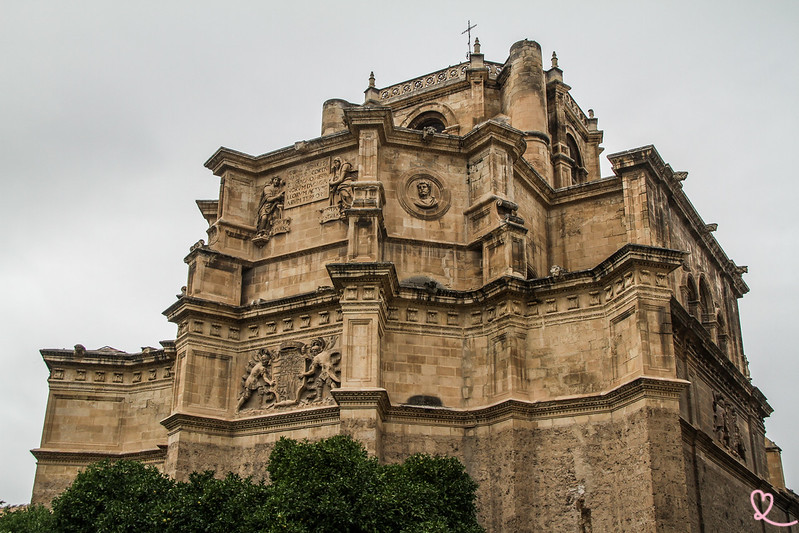
The main façade of the Monastery of San Jerónimo opens onto Calle Rector López Argueta through a monumental portal – the compás – which marks the boundary between the street and the monastery itself. Pay close attention to the typical early Spanish Renaissance style. The surfaces are densely covered with carved motifs, interlacing, medallions and shell niches, which contrast powerfully with the sobriety of the region’s blond stone walls. We were struck by the sheer density of decoration as soon as we stepped inside.
The church portal is attributed to Jacopo Florentino (Jacopo Torni, known as l’Indaco), a Tuscan artist whose work from 1513 onwards laid the structural foundations for the whole complex. Stop in front of the statue of the Virgin of Anguish surmounting the main portal – it’s not the original sculpture, which has disappeared over the centuries, but it’s still very beautiful. The tower, destroyed by French troops during the Napoleonic invasion, was rebuilt in 1963 in its original slender form. We found the monument’s ability to reconstitute itself after each historical ordeal remarkable.

The two cloisters
The Monastery of San Jerónimo has two adjoining garden cloisters, typical of 16th-century Spanish Jeronymite monasteries. During your visit, you can enter the first cloister. Most of the Renaissance decoration is concentrated here. We discovered the seven arcosolia – semicircular arches used for funerary purposes – adorned with pilasters, sculpted friezes and medallions. Designed to house the tombs of the Fernández de Córdoba family, these spaces give the cloister a memorial and sumptuous dimension. We enjoyed taking the time to wander around, away from the hustle and bustle.
In 1522, the bodies of the Gran Capitán, Gonzalo Fernández de Córdoba, and his wife, María de Manrique, were transferred to this first cloister. The second cloister is now the clausura of the community of Jeronymite nuns who still live here – it is closed to the public. Yet it was here that Empress Isabel of Portugal stayed on her honeymoon in 1526, after her marriage to Charles V. Soak up the historic atmosphere as you stroll through the accessible cloister – you’ll be able to imagine what aristocratic and religious life was like within these walls over the centuries.

DISCOVER Granada

The monastery’s rich interiors
The church and its monumental altarpiece
As soon as we entered, we noticed that the church of the Monastery of San Jerónimo follows a Latin cross plan. The choir is elevated at the foot of the nave, and the main altar is accessible via a wide escalinata – a monumental staircase that underlines the theatrical dimension of the space. The altarpiece in the main chapel is, in our opinion, the most outstanding feature of the interior. Mannerist in style, it is considered the starting point for Andalucia sculpture. We spent a long time admiring this exceptional ensemble.
Pay close attention to the altarpiece’s iconography, designed to celebrate the Gran Capitán’s military virtues. You’ll see warriors, trophies and battle scenes mingling with sacred figures, making this altarpiece as much a civil monument as a religious one.

The main nave is in the Renaissance style. The side chapels open out between the inner buttresses in a pattern typical of Spanish Jeronymite architecture – some were reserved for noble families from Granada, decorated at their own expense. We were impressed by the quality of the sculptural detail in each chapel, rivaling that of the main chapel in richness. Don’t hesitate to look up and admire the finely sculpted vaults and the play of light filtering through the high windows.
Then head for the tomb of the Gran Capitán and his wife, located in the crucero, the transept, at the intersection of the nave and the arm of the cross. Gonzalo Fernández de Córdoba was a Spanish general famous for being one of the greatest military strategists of his time. You’ll particularly appreciate the solemnity of this location, at the crossroads of all the church’s perspectives.

Carved decorations
We were fascinated by the interior decor of the San Jerónimo Monastery: caissons, shells and groups in the round cover the vaults and arches of the main chapel with delicacy and opulence. The rich Renaissance decoration combines references to classical antiquity – Corinthian pilasters, entablatures, friezes with plant garlands – with a Christian and military symbolic vocabulary specific to the context of the Spanish Reconquista. Pay close attention to how these two registers, the sacred and the warlike, interact throughout the space.

Useful tips: duration, schedules, eating…
Best time to visit
On weekdays, mornings are the ideal time: crowds are low and natural light streams through the church’s high windows. Avoid Sundays, when the monastic community holds services and some parts may be temporarily inaccessible. The ideal season is spring (March-May) or autumn (September-October): temperatures are pleasant enough to reach the monastery on foot, and tourist numbers are much lower than in summer. In July and August, the heat in Granada can exceed 38-40°C – the coolness of the church makes it a welcome refuge, but the streets to get there are tough.

Length of visit and main difficulties
In our opinion, it takes between 30min and 45min for a leisurely visit including the church, altarpiece, transept and first cloister. In terms of accessibility, the floor is largely composed of old cobblestones, irregular in the cloister, and liable to be slippery in wet weather. Most of the church is partially wheelchair-accessible, but some areas of the cloister may present difficulties.

Advice on how to visit
Start byentering via the compás, the large courtyard between the street and the church, to appreciate the Renaissance portal in its entirety before entering the building. Then enter the church, stopping in the middle of the nave for a bird’s-eye view of the main chapel. We suggest you then move on to the altarpiece, taking time to climb theescalinata. See the tomb of the Gran Capitán in the transept, then explore the side chapels. Exit through the sacristy if access is open, then join the first cloister for the gardens and arcosolia section. It’s time to slow down and linger over the sculpted details. Finish with the street-side exterior gate, particularly beautiful against the late-morning light.

Visiting with children
A visit to the Monastery of San Jerónimo is above all a contemplative experience. No specific activities are planned for children. Nevertheless, for the more inquisitive, the site offers an introduction to Renaissance art and architecture.
Schedules and rates
Admission is €10 per adult and €8 for concessions. Please note: timetables may be subject to change during religious services and on Catholic holidays such as Holy Week. You can buy your ticket in advance to avoid waiting at the ticket office.
San Jerónimo Monastery is open mornings from 10am to 1:30pm (winter and summer), and afternoons from 3pm to 6:30pm in winter and from 3:30pm to 7pm in summer. Visit the official website for more info here.

Guided tours
The monastery does not provide an official on-site guide. The visit is free.
But private guided tours of Granada often include the San Jerónimo Monastery in a tour of the historic center, in combination with the Cathedral and the Capilla Real. We recommend this type of tour to fully contextualize the richness of the site. Find a selection of guided tours here.
Catering
There are no cafés or restaurants inside the monastery. Less than a 5-minute walk away, the Plaza de la Universidad and its surrounding streets offer a good selection of tapas bars and cafés. Find our selection of the best restaurants in Granada in our dedicated article here.


Frequently asked questions
Is the San Jerónimo Monastery still inhabited?
Yes. A community of Jeronymite nuns has lived here for several centuries. The second cloister is their living and prayer space: it is closed to the public and cannot be visited. The cohabitation of monastic life and tourism is managed with discretion. We advise you to adopt a respectful attitude, keep your voice low and dress appropriately.
Can I visit the Monastery of San Jerónimo without booking in advance?
Yes, the monastery does not require advance booking, and tickets can be purchased directly on site. Unlike the Alhambra, where tickets are snapped up weeks in advance, the San Jerónimo Monastery welcomes a limited number of visitors and queues are rare, even in high season. However, you can buy your ticket in advance here.

PLAN YOUR TRIP TO Andalusia
Inspiration

Practice

Places not to be missed