Cadiz’s Roman Theatre is a real surprise in the middle of the city. Its remains, excavated as recently as 1980, are hidden away in the heart of the Pópulo district. In this article you’ll find useful tips to help you prepare for your visit to the Roman Theatre of Cadiz.
Why visit Cadiz’s Roman Theatre?
Is the Roman Theatre worth it? Our opinion:
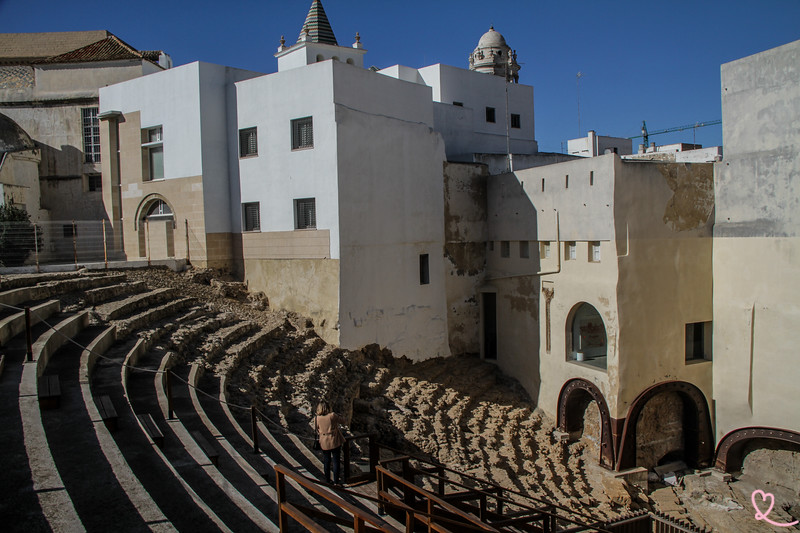
This is one ofthe most surprising places to discover in Cadiz. The surprise effect is total: you enter through a normal street, between residential buildings, only to suddenly discover these monumental ruins. What a shock!
Although the stage and other parts remain under the city, the museum, however small, is interesting and the panels are packed with information crucial to understanding the site.

Why is the Roman Theatre famous?
Built in the 1st century BC, it was the largest Roman theater in Hispania and one of the largest in the Empire. It could accommodate up to 10,000 spectators. Its maximum diameter approaches 120 meters, testifying to the historical importance of the city of Gades.

History in brief
The history of the Roman theater is marked by its immense size and late rediscovery:
- 1st century BC: Construction of the theater (the oldest and largest).
- Middle Ages: The site is covered by the city and the Pópulo district.
- 1980: Discovery of the remains during an archaeological dig.

WHERE TO STAY IN Cádiz
In the historic district:
- Aparthotel Luz de Gade – Check photos and availability
- Parador de Cádiz – Check photos and availability
Near the beaches:
- Monte Puertatierra Hotel – Check photos and availability

See our complete selection of the best hotels in Cadiz (coming soon)
How to get there: Roman Theatre, Cadiz
Where is the Roman Theatre?
The theater is located at the southeastern end of Cadiz’s present-day Pópulo district.
- From Sevilla: 1h15 drive
- From Cordoba: 2h30 drive
How to get there?
There are several options for getting to Cadiz:
- By car: the cheapest, most comfortable and fastest solution. You’ll have more freedom to explore the city and visit the surrounding area.
- By plane: Cadiz has no airport; the nearest is Jerez, 45km away.
- By train: Cádiz station is located in the city center, and tourist attractions are close enough to be reached on foot or by bus, with easy access from the historic center. The entrance looks like a classic house door and is easy to miss, so keep your eyes peeled!
The Roman Theatre is located on Calle Mesón. If you’re facing Cadiz Cathedral, go around the square to the left and into the small alley.
RENT A CAR IN Andalucia
- Compare prices on our preferred platform: DiscoverCars – one of the best rated sites.
- Choose a compact car, as some villages have very narrow streets!
- Think ofcomprehensive insurance for the same reason
- Book early for choice.

Parking
As the area is pedestrianized and made up of narrow streets, it’s impossible to park directly in front of the entrance. The nearest parking lot is the Canalejas underground parking lot or the station car park, just a few minutes’ walk from the Pópulo district.
Useful tips: duration, schedules, eating…
Best time to visit
As the site is partly covered (museum) and partly uncovered (bleachers), a visit in the morning avoids the crowds and the heat.
Length of visit and main difficulties
Allow 35 to 40 minutes for the complete visit (museum + remains).
Access is via the interpretation center. Beware: some of the ruins require you to walk on footbridges or ancient floors.

Advice on how to visit
The route is fairly linear:
- Start with the small museum (Interpretation Center) to understand the plans,
- Then descend into the underground (ring) gallery,
- Finish with a view of the open-air bleachers.

Visiting with children
The tour is short and visual, making it suitable for children, although there is no specific route for them. They’re sure to appreciate the pedagogical models.

Schedules and rates
The theater is open Monday to Saturday, 11am to 5pm, and Sunday, 10am to 2pm.
Admission is free, but it is advisable to book a ticket online in advance.
Visit the official website here.
Catering
You’re right in the heart of the Pópulo district and a stone’s throw from the central market. You’ll find plenty of tapas bars and restaurants just outside the theater.
VISIT Cadiz
- What to do in Cadiz
- Excursions from Cadiz
- Visit the cathedral
- Roman Theatre
- Itineraries: 1 day – 2 days – 3 days
Discover the history of the Roman Theatre of Cadiz
We recommend you start your visit at the Interpretation Center, which serves as the entrance to the site. Although modest in size, this museum is a goldmine of information. It provides an insight into the context of ancient Gades and the shock of discovering the theater beneath the urban fabric, excavated as recently as 1980.

The showcases also highlight discoveries made in the nearby Roman necropolis. These artifacts testify to the wealth of the city at the time.
Take the time to read the explanatory panels (translated into English) detailing construction techniques. You’ll learn how builders used local stone and Roman concrete to create the vaults you’ll walk through. It’s the essential introduction before heading out into the open air to explore the bleachers.

Explore the remains of Cadiz’s Roman theater
Once in the archaeological zone, you can admire the sheer size of the site. At present, we can see a large part of the bleachers, with a diameter approaching 120 m. The building is set on a natural cliff, using local “ostionera” stone for the seats.

The architectural highlight is the ring gallery, 3 m wide and 4.70 m high, which extends beneath the stands. It was built using a mixed technique: the outer wall and vault in concrete(opus caementicium) and the inner wall in ashlar(opus quadratum).
Take a close look at the vault: it was cast on a system of wooden hangers, and the imprints of the planks used during construction are still clearly visible!

Before you leave, realize that what you see is only the tip of the iceberg. The stage and other sections of the theater have still not been excavated, and are still lying dormant under the neighboring buildings. Unlike other fully-cleared sites, here the medieval and modern urban fabric “hugs” the remains, reminding us that the city has continued to live on top of its history for millennia.

PLAN YOUR TRIP TO Andalusia
Inspiration

Practice

Places not to be missed