Exploring the Costa de la Luz? Head to Baelo Claudia, one of Spain’s best-preserved Roman cities. Overlooking the Strait of Gibraltar, this ancient port city charmed us with its well-preserved historical sites and its exceptional natural setting, nestled between the sea and the mountains. There you’ll find a forum, a theater, and several temples that bear witness to the former prosperity of this city, which thrived on the garum trade.
In this article, check out our photos and all our tips for making the most of your visit to Baelo Claudia.
This opinion is completely independent, based on our experiences. We made our own choices, visited the area anonymously, and paid our bills in full.
Why Visit Baelo Claudia
Is Baelo Claudia worth the trip? Our opinion:
Yes, Baelo Claudia is definitely worth a visit. We were impressed by the state of preservation of this Roman city, considered one of the most complete ancient urban complexes on the Iberian Peninsula. It is one of the most beautiful archaeological sites in Andalucia.

Why is Baelo Claudia famous?
Baelo Claudia owes its fame to its status as the best-preserved Roman city on the Iberian Peninsula. Founded in the late 2nd century BCE, it prospered thanks to tuna fishing and the production of garum, a fermented fish sauce that was highly prized throughout the Roman Empire.

Our favorite moments
Here are our 3 favorite moments from our visit:
- The location and scenery: a mix of ruins, the beach, and the hills
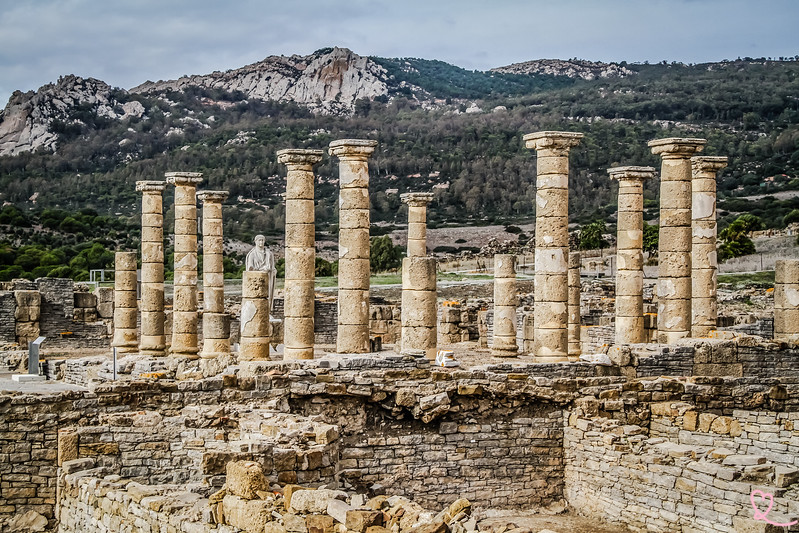
- A view of the Forum and the Basilica, where the statue of Emperor Trajan still stands, with the Bolonia Dune in the background.
- The walk to the Temple of Isis, a rare remnant that bears witness to the cultural exchanges between Rome and ancient Egypt.

WHERE TO STAY IN Cádiz
In the historic district:
- Aparthotel Luz de Gade – Check photos and availability
- Parador de Cádiz – Check photos and availability
Near the beaches:
- Monte Puertatierra Hotel – Check photos and availability

See our complete selection of the best hotels in Cadiz (coming soon)
Directions and Map: Baelo Claudia, Bolonia (Tarifa)
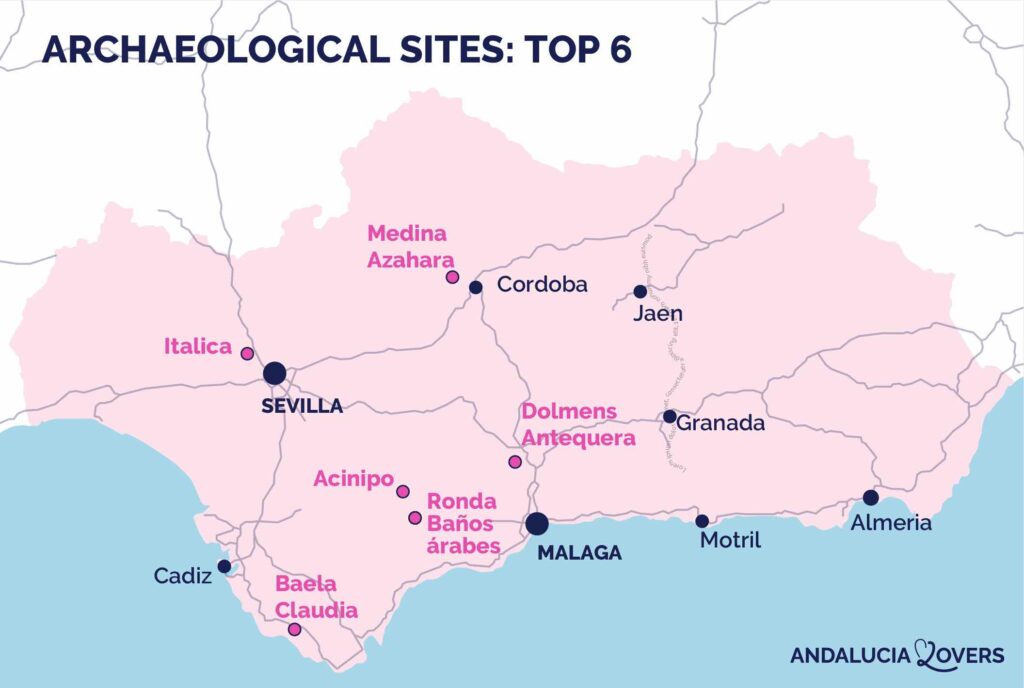
Where is Baelo Claudia located?
- In the village of Bolonia, in southwestern Andalucia
- Travel time from Tarifa: 26 min (23 km)
- Travel time from Cádiz: 1 hour and 15 minutes (96 km)
- Here is a map to help you find your way around, showing Baelo Claudia on the coast:
How to get there?
The easiest way to get to Baelo Claudia is still by car. From National Highway N-340 (Cádiz–Málaga), take Provincial Highway CA-P-8202 toward Bolonia, then continue for a few more kilometers until you reach the site.

Parking
The visitor center has a parking lot that can accommodate about 70 cars and 7 buses, with spaces reserved for people with limited mobility. Its hours of operation are the same as those of the site.

RENT A CAR IN Andalucia
- Compare prices on our preferred platform: DiscoverCars – one of the best rated sites.
- Choose a compact car, as some villages have very narrow streets!
- Think ofcomprehensive insurance for the same reason
- Book early for choice.

Useful tips: duration, schedules, eating…
Best Time to Visit and Length of Visit
Come in the morning, right when it opens, to enjoy the site before it gets hot and crowded. Be sure to bring comfortable shoes and a light jacket, as the area is particularly windy even in the summer.
Allow between 1 hour and 30 minutes and 2 hours to tour the site and the visitor center. If you’re a history buff, you can easily extend your visit to 2 hours and 30 minutes by spending some time in the themed library.
Main Challenges
The site is generally accessible to people with limited mobility: a dedicated route leads from the parking lot to the visitor center, and then to the Roman city via an elevator as an alternative to the stairs. However, you will need to cross a metal bridge with a slight slope. Please also note that pets are not allowed on the grounds or in the museum, with the exception of guide dogs.

Advice on how to visit
We suggest you start with the visitor center and its museum, which will give you a better understanding of the site’s historical and geographical context before exploring the Roman city itself. Then continue on to the forum, the theater, the temples, and the salting house, following the marked trails that wind through the archaeological site.
PLAN YOUR DREAM TRIP TO andalucia
All the information you need for your trip:
- 7 maps that make planning easier
- + 150 pre-selected locations
- Practical advice
- 300+ photos to help you choose
Schedules and rates
Baelo Claudia’s hours vary depending on the time of year:
- March 21–June 20: Tuesday through Saturday, 9 a.m. to 9 p.m. Sundays, holidays, and Mondays preceding a holiday, from 9 a.m. to 3 p.m. Closed on Mondays (except the day before a holiday).
- June 21 through September 20: Tuesday through Saturday, 9 a.m. to 3 p.m. Sundays, holidays, and Mondays preceding a holiday, from 9 a.m. to 3 p.m. Closed on Mondays (except the day before a holiday).
- September 21 through March 20: Tuesday through Saturday, 9 a.m. to 6 p.m. Sundays, holidays, and Mondays preceding a holiday, from 9 a.m. to 3 p.m. Closed on Mondays (except the day before a holiday).
- As for admission fees, entry is free for accredited citizens of the European Union.
- For other nationalities, the fee is €1.50.
- Latest news on the official website here.

Catering
There are no restaurants within the archaeological site, but there are several places to eat just a few minutes’ walk away, along Bolonia Beach.
FUN in Andalucia: activities
- Cooking course in Sevilla
- Canyoning from the Costa del Sol
- Guided Hike on the Caminito del Rey

The Visitor Center and the Museum
Before visiting the ruins of the Roman city, we invite you to stop by the visitor center, which opened in 2007 and was designed by the Andalusian architect Guillermo Vázquez Consuegra. This modern building, which has sparked some debate due to its impact on the landscape, houses a museum space consisting of two permanent exhibition halls and one hall dedicated to temporary exhibitions.

There, you’ll find a model of Baelo Claudia that helps you get a good sense of the city’s layout before exploring it. The center also includes a library specializing in the Roman world, a conference room, and a facility for restoring and conserving artifacts uncovered during excavations conducted at the site for over a century.

From the upper floor, you also have a beautiful view of the ruins and the famous Bolonia Dune. You can’t see the entire site, but you can see the temple’s columns.
The Punta Paloma Aqueduct
Baelo Claudia obtained its fresh water supply through a network of three aqueducts, both for domestic use and for the needs of the salt-curing industry. We were surprised by the distance covered by the first of these: 5.2 km long, it came from the east via Punta Paloma, and its remains can still be seen at the intersection with the Arroyo de la Chorrera.

The other two aqueducts entered the city from the west, from the Sierra de la Plata. Once there, you’ll see several well-preserved stone arches, which you can now walk alongside without damaging them, thanks to wooden footbridges and a metal footbridge. The water was then piped to public fountains, where people came to get water.

One detail that caught our attention: wastewater and sewage, known as “aqua caduca,” were also drained away through a complex system of pipes, ensuring the city’s sanitation.
The Forum and the Basilica
As the beating heart of the ancient city, the Forum was the center of all public and administrative life in Baelo Claudia. We enjoyed lingering there, at the intersection of the city’s two main thoroughfares, where the Curia, the courthouses, and the Basilica are located.

The latter, considered the site’s most recognizable feature, still preserves several columns as well as a statue of Emperor Trajan, which stands out against the Bolonia sand dune in the background. You will no doubt be struck, as we were, by the contrast between the stone ruins and the immense white dune that dominates the horizon. The lower part of the city was home to the main public monuments, while the upper part, on the hillside, housed the more modest dwellings.

The Roman Theater
The theater is the largest building in Baelo Claudia and could seat up to 2,000 spectators at its peak. According to researchers, the building was not intended for athletic competitions but served as a stage for performers, with a space reserved for the orchestra and musicians.

The building underwent two phases of construction, though it is unclear whether this was a planned expansion or a reconstruction following a major collapse. You’re sure to enjoy the unobstructed view of the sea from the bleachers. The theater setting was truly ideal!

The temples, including the Temple of Isis
Baelo Claudia preserves the ruins of four temples, which attest to the religious diversity of its inhabitants. Three of them formed the Capitoline Triad, dedicated to Jupiter, Juno, and Minerva, respectively, while the fourth was dedicated to the Egyptian goddess Isis, whose cult was widespread at that time in several provinces of the Roman Empire.

It is also likely that the central temple of the forum was dedicated to the Punic god Melkart, who was identified with Hercules according to the Roman interpretatio and associated with the imperial cult. We were struck by the presence of this temple of Isis, a rare example of its kind preserved on the Iberian Peninsula, which serves as a reminder of the cultural exchanges between Rome, Egypt, and the Punic world.

Take a moment to look at the column bases and foundations, which still reveal the layout of each of these religious buildings.
The Salted Meat Processing Plant and Garum
Baelo Claudia’s prosperity depended largely on tuna fishing and the production of garum, a fermented fish sauce made from the innards of tuna and other small fish. We have learned that this particularly expensive condiment was consumed mainly by the wealthy classes and exported throughout the Roman Empire thanks to the city’s strategic location on the trade routes connecting Europe to North Africa.

The site preserves the remains of several salting vats, as well as the remains of one of the three aqueducts that supplied the city with water. It’s really fascinating to watch. It’s quite different from other archaeological sites!

View of Bolonia Beach and its dune
One of Baelo Claudia’s greatest assets is its location on the beachfront in the Bolonia cove, sheltered by Cape Camarinal to the west and Cape Paloma to the east. The site is located within the Détroit Natural Park, which ensures that the environment surrounding the ruins remains unspoiled.
We especially enjoyed the view of the large sand dune at Bolonia, which rises just behind the ruins and which you can climb (once you leave the archaeological site) to take in a panoramic view of the entire bay.

History in brief
Baelo Claudia has weathered several centuries of turbulent history. Here are the key dates to remember:
- Late 2nd century B.C.: The city was founded, initially as a fishing port.
- 1st century A.D.: Emperor Claudius granted the city the status of a municipium, under the name Baelo Claudia.
- 2nd century A.D.: An earthquake damaged much of the city, which then began to decline.
- 7th century: The site was permanently abandoned before the Arab invasion of 711.
- 18th century: Rediscovery of the ruins by scholars and travelers.
- 1917: The start of systematic archaeological excavations, led by French archaeologists.
- 1925: The site was designated a National Historic Landmark.
- 1989: Officially designated as a “Conjunto Arqueológico” by the Regional Council of Andalucia.
- 2007: Opening of the new visitor center and museum, designed by architect Guillermo Vázquez Consuegra.
VISIT Cadiz
- What to do in Cadiz
- Excursions from Cadiz
- Visit the cathedral
- Roman Theatre
- Itineraries: 1 day – 2 days – 3 days
Frequently asked questions
Where does the name Baelo Claudia come from?
The city was founded under the name Baelo at the end of the 2nd century BCE. It was later named Baelo Claudia when the Roman emperor Claudius, who reigned in the 1st century CE, granted it the status of a municipality.
What is garum?
Garum is a fermented fish sauce made from tuna innards and small fish. Highly prized in Roman cuisine, it was produced in Baelo Claudia and exported throughout the Empire thanks to the city’s strategic location on the trade routes of the Strait of Gibraltar.
Can we go swimming at Bolonia Beach after the tour?
Yes, Bolonia Beach is right next to the archaeological site. So once you’ve finished your tour of Baelo Claudia, you can easily round out your day with a swim or a stroll along the beach.
PLAN YOUR TRIP TO Andalusia
Inspiration

Practice

Places not to be missed