A getaway to Antequera? Don’t miss a visit to the Dolmens of Antequera! These impressive megalithic structures are one of the most important examples of megalithism in Europe. The site features three exceptional funerary monuments. We were fascinated by their state of preservation and the technical prowess they represent.
In this article, you’ll find some useful tips to help you prepare for your visit and have a wonderful time!
This opinion is completely independent, based on our experiences. We made our own choices, visited the area anonymously, and paid our bills in full.
Why visit the Dolmens d’Antequera
Are the Dolmens of Antequera worth it? Our opinion:
Yes, the Dolmens of Antequera are definitely worth a visit. This exceptional site is one of the most important examples of megalithism in Europe, which is why it was designated a UNESCO World Heritage Site in 2016. We were impressed by the state of conservation of these three very different structures. The size of the Menga dolmen, the largest in Europe, is sure to leave you speechless.
This is one of Antequera’s best activities.

Our favorite moments
You’ll find out more about our tour, but we think these are the highlights of your exploration of the Dolmens d’Antequera:
- Theimpressive Menga dolmen, with its giant chamber and colossal dimensions, making it the largest dolmen in Europe.
- The perfectly preserved corridor of the Viera dolmen, with its two successive doors delimiting the entrance and burial chamber.
- The unique structure of the El Romeral tholos, with its round, beehive-shaped chambers and false vault, considered to be the first of its kind in history.
We recommend that you visit all three monuments, which are very different from one another and all deserve your attention.

PLAN YOUR DREAM TRIP TO andalucia
All the information you need for your trip:
- 7 maps that make planning easier
- + 150 pre-selected locations
- Practical advice
- 300+ photos to help you choose
History in brief
The Antequera dolmens are an exceptional example of European megalithic architecture. Here are the milestones in their history:
- Around 5000 BC: Construction of the Menga dolmen, the oldest and most imposing of the three monuments.
- Between 3500 and 3000 BC: Construction of the Viera dolmen, reflecting an evolution in building techniques.
- Around 1800 B.C.: Construction of the Tholos d’El Romeral, the most recent of the three monuments, reflecting a Mediterranean influence.
- 1903: Discovery of the Viera dolmen by a person named Viera
- 2016: Antequera Dolmens listed as a UNESCO World Heritage Site
Access: Dolmens of Antequera, Andalucia
Where are the Antequera Dolmens?
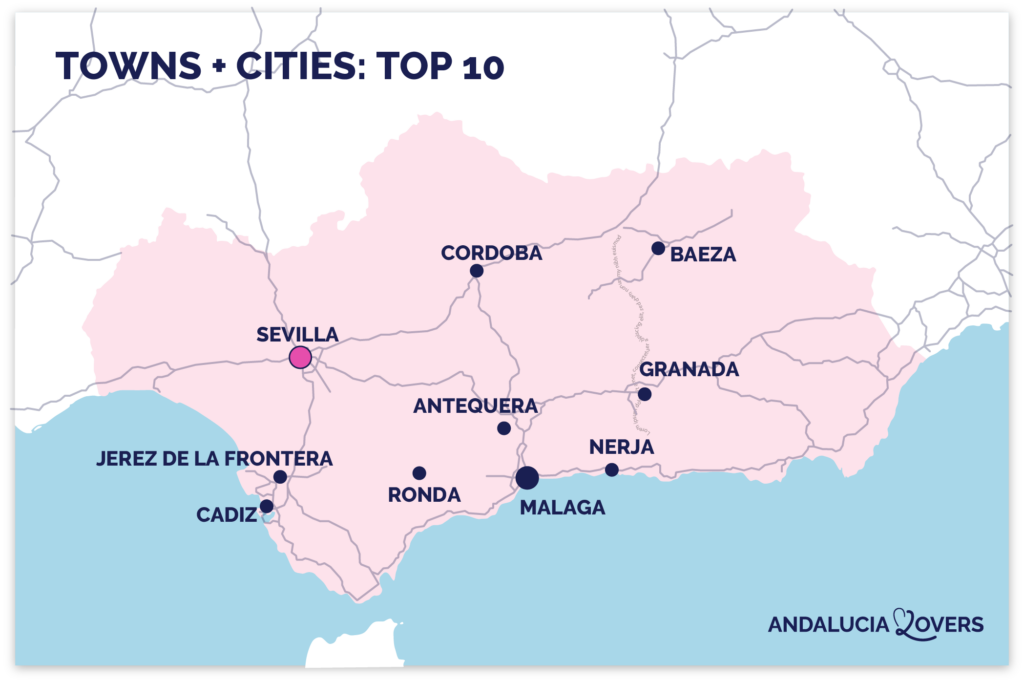
The Antequera Dolmens are located in the town of Antequera, Andalucia.
- Downtown Antequera for the Menga and Viera dolmens
- Carretera de Málaga, 5, Antequera, Málaga
- The El Romeral tholos is about 4km from the other two dolmens and requires a short drive.
- Malaga 45 min drive (55 km)
- Granada 1h15 away (97 km)
- Cordoba 1h30 away (123 km)
- Sevilla 1 hour 45 minutes’ drive (160 km)
- The map below shows Antequera to the north of Malaga.
RENT A CAR IN Andalucia
- Compare prices on our preferred platform: DiscoverCars – one of the best rated sites.
- Choose a compact car, as some villages have very narrow streets!
- Think ofcomprehensive insurance for the same reason
- Book early for choice.

How to get there?
The Menga and Viera dolmens are within easy reach of Antequera town center. They are located at the entrance to the town. To visit the three dolmens, we recommend you come by car. The first two dolmens (Menga and Viera) are on the same main site, but to reach the El Romeral tholos, you’ll need to take a short drive of around 4km.
It is also possible to book a guided tour of the first two dolmens. Book now.
Parking
Free parking is available near the main entrance to the site, where the Menga and Viera dolmens are located. For the El Romeral tholos, you’ll also find a parking area in the immediate vicinity.

Useful tips: duration, schedules, eating…
Schedules and prices
- Closed on Monday
- Opening hours: at least 9 a.m. to 6 p.m. Tuesday to Saturday
Sunday, 9 a.m. to 3 p.m. - Price: free for EU citizens, €1.50 for non-EU citizens
- See the latest news on the official website here
Best time to visit
The Antequera dolmens can be visited all year round. However, to make the most of your visit, we advise you to avoid the hottest hours in summer. An early-morning visit will be much more pleasant, and will allow you to better appreciate these exceptional monuments.

Length of visit and main difficulties
Allow 1 to 2h30 to visit the three dolmens, depending on your fascination for these places.
Access to the dolmens is relatively easy, but bear in mind that you’ll be entering ancient structures with sometimes narrow, low-ceilinged passageways. The main site has a museum where you can watch an explanatory video before starting your tour.

Advice on how to visit
For the best possible experience, we suggest this tour route:
- Start at the main site museum and watch the explanatory video, which will provide you with valuable context for understanding what you are about to see.
- Then visit the Menga dolmen, the largest of the three.
- Continue on to the Viera dolmen, just a few metres away.
- Finish off at the El Romeral tholos, around 4km away, with its different, more recent architecture.
This chronological progression will help you better understand the evolution of construction techniques.

Visiting with children
The mysterious aspect of these ancient tombs usually captures their imagination.
We’ve found that the explanatory videos in the main site museum really help to contextualize the visit for younger visitors. But keep a close eye on them inside structures, where spaces can be tight and dark. Bring comfortable shoes and bottles of water, especially in summer, as the sites are relatively exposed to the sun.

Guided tours
Guided tours are available on request. For reservations, contact the site at vistasdolmenesdeantequera.ccul@juntadeandalucia.es or by phone at 952712206/07. A guided tour not only takes in the dolmens, but also the old town of Antequera and El Torcal, one of Europe’s most important karst landscapes.
Catering
There are no restaurants on the dolmens site itself, but you’ll find several dining options in the town of Antequera.
The Dolmens Museum

Before setting off to explore the impressive dolmens of Antequera, a visit to the visitor center is highly recommended. This small museum presents clear, well-designed videos that place the dolmens in their historical and geological context. We discover how these monumental structures were built, and above all, what they reveal about the beliefs and skills of megalithic civilizations. An invaluable appetizer for fully appreciating the field visit.
The Menga dolmen: a megalithic masterpiece
An impressive monumental structure
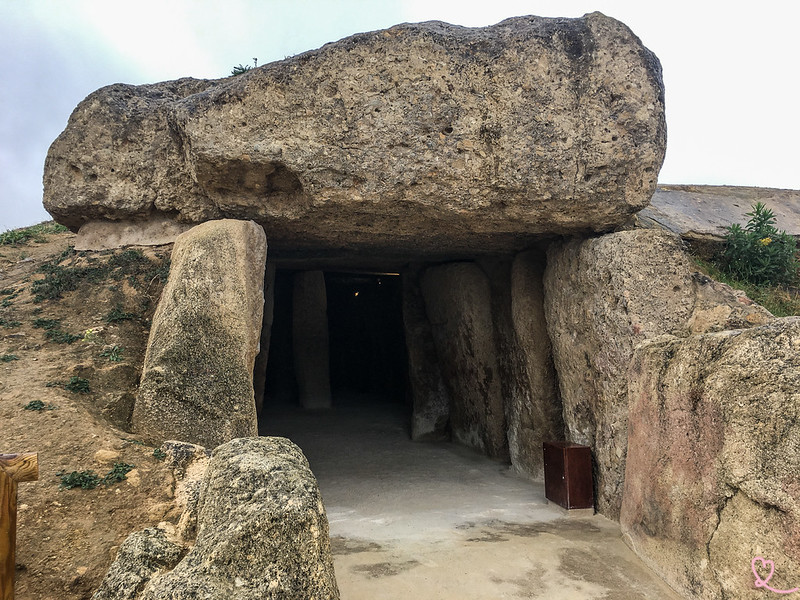
The Menga dolmen is truly the jewel of the Antequera site. Built around 5,000 years ago, during the Neolithic period, it stands out as the largest dolmen in Europe, with its colossal dimensions: 27.5 metres long, 6 metres wide and 4 metres high.
We spent a long time admiring this giant chamber. The structure is composed of 32 massive slabs, with walls made up of seven blocks on each side and one at the back. The roof, made of five enormous slabs, is a real feat of engineering. The largest of these slabs measures 6 by 7 metres and weighs an incredible 180 tonnes! You’ll be impressed, as we were, by the three central pillars that support this monumental load.

Unique orientation to the Peña de los Enamorados
What distinguishes the Menga dolmen from most other Mediterranean dolmens is its particular orientation. While the majority of megalithic structures are oriented towards celestial phenomena, Menga points directly towards the Peña de los Enamorados, a distinctive rock formation that rises abruptly from the plain. We were fascinated by this intentional relationship between architecture and the surrounding landscape. This “mountain of lovers” has a profile reminiscent of a human face. We’ll let you find out on the spot.

Exceptional testimony to prehistoric architectural genius
The Menga dolmen represent an indisputable masterpiece of human creative genius. Standing inside this monumental chamber, you will feel, as we did, a deep admiration, in particular for the solution of intermediate pillars to support the colossal weight of the roof pushes the possibilities of lintel construction to the limit.
We were particularly impressed by the quality of the stonework and the remarkable state of preservation of the whole. The entire structure is covered by an earthen mound, a feature shared by all three Antequera dolmens.
For us, the visit was a particularly pleasant experience, as the staff kindly answered all our questions.

The Viera dolmen: a perfectly preserved megalithic corridor
A remarkable megalithic corridor
Just a few dozen metres from the Menga dolmen stands the Viera dolmen, equally captivating but of a different design. Built between 3,500 and 3,000 BC, this monument is characterized by its impressive corridor leading to a burial chamber. We were particularly intrigued by the narrowness and length of this passageway, which spans some 20 metres. The structure is composed of 16 upright stones forming a corridor 185 cm high and 120 cm wide.

Traditional astronomical orientation
Unlike the Menga dolmen, the Viera dolmen has a classic astronomical orientation, aligned with the sunrise on the equinoxes. This characteristic makes it the only one of the three Antequera dolmens to follow this widespread tradition in Mediterranean megalithic architecture.

The evolution of megalithic construction techniques
The Viera dolmen bears precious witness to the evolution of building techniques since the time of the Menga dolmen. Entering this narrow corridor, we were able to observe the architecture. With the exception of a few missing stones at the entrance, the rest of the structure is remarkably intact, allowing you to admire the ingenuity of its builders.
Unlike the Menga dolmen, the Viera dolmen seemed more austere. A different atmosphere!

El Romeral tholos: unique funerary architecture
A monument of Mediterranean influence
The El Romeral tholos, often referred to as the El Romeral dolmen although technically a different type of construction, is the most recent of Antequera’s three monuments. Built around 1800 B.C., it lies some 4 km from the Menga and Viera dolmens, requiring a short drive to visit. We were particularly interested in its distinctive structure, which reflects Mediterranean rather than Atlantic influences. Unlike the other two monuments, El Romeral features round, beehive-shaped chambers, characteristic of the Tholos or Cueva style. You’ll immediately notice, as we did, that the walls are not made of huge monolithic slabs, but of smaller stones arranged in circles that gradually move towards the top.

History’s first false arch
One of the most remarkable features of the El Romeral tholos is its innovative construction technique. It is considered to have the first false vault in history, a considerable architectural feat for its time. As we entered this monument, we were fascinated by the way the stones on the walls gradually draw closer together towards the top, giving the impression of a vaulted ceiling. It is not a true vault, however, as the roof of each of the two chambers is formed by a single megalithic slab laid horizontally. This technique of approximating stone rows reflects a significant evolution in construction methods. You’ll be impressed, as we were, by the ingenuity of this architectural solution, which created circular interior spaces while ensuring the stability of the whole.

Orientation to El Torcal
Like the Menga dolmen, the El Romeral tholos is geographically rather than astronomically oriented. We found it particularly significant that this structure faces the nearby El Torcal mountains, an impressive karst landscape. This intentional relationship between funerary monuments and outstanding natural landscape features is one of the most distinctive features of Antequera’s dolmens. In addition, the El Romeral tholos lies along an axis linking the Menga dolmen to the Peña de los Enamorados, suggesting an overall planning of these monuments in the landscape. During your visit, take time to observe these alignments, which bear witness to a sophisticated conception of sacred space by the prehistoric populations who inhabited this region.

Subscribe to our Newsletter
- Get away from it all with Region Lovers’ beautiful destinations!
- Once a month
- Advertising-free
PLAN YOUR TRIP TO Andalusia
Inspiration

Practice

Places not to be missed