If you’re really short on time, you might be wondering which city to choose: Baeza or Úbeda?
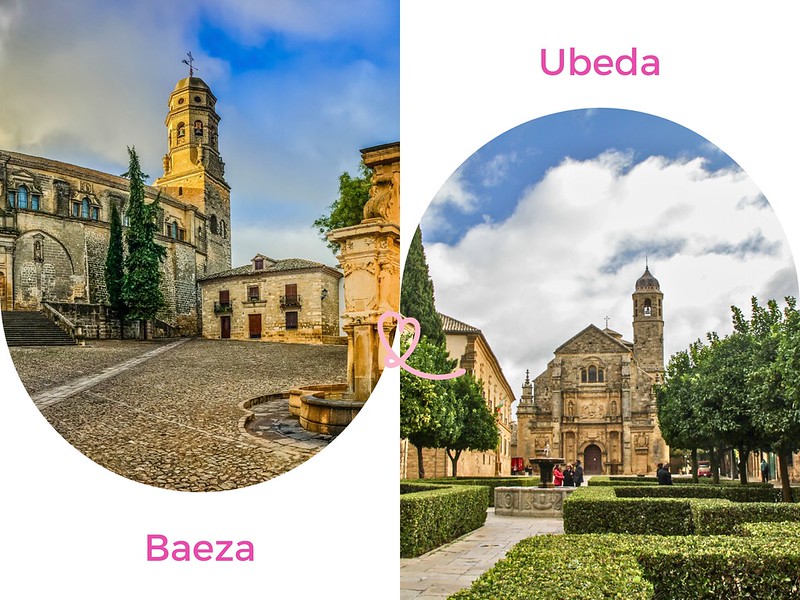
We love both. The choice is all the more difficult because they’re both listed as UNESCO World Heritage Sites. We’ll help you decide by sharing our opinions based on specific criteria. Here’s our Baeza vs. Úbeda showdown, complete with our tips and photos.
This opinion is completely independent, based on our experiences. We made our own choices, visited the area anonymously, and paid our bills in full.
Baeza or Úbeda: Comparison Summary
Short answer
Ideally, visit both: they complement each other and are just a 10-minute drive apart. If you’re short on time, our favorite is still Baeza.
Baeza is a city of churches and learning: it boasts a cathedral, a seminary, and a historic university where the poet Antonio Machado once taught. Compact and perched on the edge of a plateau, it can be explored in half a day and offers views of the Guadalquivir Valley.
See the top-rated accommodations in Baeza.
Úbeda, a more sprawling city, is known as the city of the great lords of the Renaissance. Its palaces and funerary chapel—commissioned by the entourage of Charles V (emperor and king of Spain in the 16th century)—are worth at least a full day’s visit.
See the top-rated accommodations in Úbeda.

Depending on what you’re looking for…
- For a short visit: Baeza
- For a sense of traveling back in time: Baeza
- For its wealth of Renaissance monuments: Úbeda
- For its museums: Úbeda
- For views of olive groves: Baeza
- For a quiet evening: Baeza
- For young children and families: Baeza, which is more compact
- For the most beautiful hotels: Úbeda
- For a romantic getaway: a tie
- For fine dining: a tie
- For easy exploration of the region: a tie

Atmosphere: Two Sister Cities, Two Distinct Personalities
The atmosphere in Baeza

Baeza has a population of about 15,000 and retains the pace of a small town. We were struck by how quiet it was at the end of the day, once the tour groups had left. Its historic center is concentrated along just a few streets: the cathedral, palace, convents, and squares are all clustered within a small area.
The city owes its character to its religious and academic heritage, as the university founded in 1538 has educated generations of students there. We found a studious, somewhat austere atmosphere there that invites you to wander aimlessly.
The Atmosphere in Úbeda

Úbeda is larger, with a population of about 34,000, and livelier. In the 16th century, the city benefited from the rise to power of Francisco de los Cobos, Secretary of State to Charles V, and his family. This influence is still evident in the city’s architecture: the palaces are adorned with an abundance of coats of arms and sculpted facades.
We noticed a stark contrast between the solemn atmosphere of Plaza Vázquez de Molina and the lively neighborhood vibe around Plaza Primero de Mayo, dotted with outdoor cafes. We also enjoyed the more down-to-earth shopping streets, away from the historic center.
Our Opinion
Baeza charms with its intimate atmosphere, while Úbeda impresses with its grandeur. For a peaceful first visit, we prefer Baeza.
Our winner: Baeza.
WHERE TO STAY IN Andalucia
Our independent picks for the accommodation of your dreams:
Select by city:
- Best hotels in Sevilla
- Best hotels in Malaga
- Best hotels in Granada
- Best hotels in Cordoba
- Best hotels in Ronda
- Best hotels in Almeria
- Best Hotels in Cádiz
Select by hotel type:

Renaissance monuments, palaces, and museums
Attractions in Baeza

To learn more about the coats of arms and building facades, you can book a guided walking tour of the city: see the options. Baeza’s main attractions are:
- Plaza del Pópulo, its 16th-century Fountain of the Lions, the Puerta de Jaén, and the Casa del Pópulo, which houses the tourist office
- The Cathedral of the Nativity of Our Lady, built on the site of a former mosque: the 13th-century Gothic-Mudejar Puerta de la Luna, the Renaissance nave designed by Andrés de Vandelvira, and the bell tower, which is open to visitors— book your skip-the-line ticket
- Plaza de Santa María and its 16th-century fountain, shaped like a triumphal arch with three arches
- The Jabalquinto Palace and its Isabelline Gothic façade, a style from the late 15th century under the Catholic Monarchs

- The Old University, founded in 1538, and the classroom where Antonio Machado, the great 20th-century Spanish poet, taught French from 1912 to 1919
- The Church of Santa Cruz, a 13th-century Romanesque building that is among the best-preserved in Andalucia
- The Aliatares Tower (12th century) and the Puerta de Úbeda, remnants of the medieval city walls
- Outside the walls, the Balcón del Concejo, a Baroque balcony from which dignitaries watched the festivities on the Paseo de la Constitución
- Learn more in our article on the best attractions in Baeza.
Attractions in Úbeda

The main attractions in Úbeda are:
- Plaza Vázquez de Molina, one of the highest concentrations of Renaissance buildings in Spain
- The Sacra Capilla de El Salvador (1536–1559), the burial chapel of Francisco de los Cobos designed by Diego de Siloé and Andrés de Vandelvira— book your ticket
- The Basilica of Santa María de los Reales Alcázares and its Gothic cloister, located on the site of the former Great Mosque
- The palaces: the Palacio de las Cadenas, now City Hall; the Palacio Vela de los Cobos; and the Casa de las Torres, whose Plateresque façade (early Spanish Renaissance) is flanked by two towers

- The Sinagoga del Agua, a 14th-century synagogue rediscovered in 2007, and its mikveh, the ritual bath of the Jewish tradition
- The Hospital de Santiago, nicknamed “the Andalusian Escorial” in reference to the royal monastery near Madrid
- The museums: the Centro de Interpretación Olivar y Aceite, the Museo de San Juan de la Cruz, dedicated to the mystical poet who died in Úbeda in 1591, and the Museo Arqueológico
- The medieval gates, including the Puerta del Losal with its horseshoe-shaped Mudejar arch
- Learn more in our article on the best attractions in Úbeda.
Our Opinion
Úbeda has more monuments open to the public and museums. Baeza concentrates most of its attractions within a smaller area, making it easier to visit quickly.
Our winner: Úbeda, for the richness of its heritage.
PLAN YOUR DREAM TRIP TO andalucia
All the information you need for your trip:
- 7 maps that make planning easier
- + 150 pre-selected locations
- Practical advice
- 300+ photos to help you choose
Viewpoints and olive groves
There are no beaches here: both cities are inland, more than a 2-hour drive from the Mediterranean coast. Their horizon is the “sea of olive trees” in the province of Jaén, one of the world’s leading olive oil-producing regions.
Viewpoints in Baeza

Baeza sits on the edge of a plateau overlooking the Guadalquivir Valley. The Paseo de las Murallas runs along the old city wall and offers an unobstructed view of the olive groves, all the way to the Mágina and Cazorla mountain ranges. We returned there at sunset and then again at sunrise: the old town is very quiet at those times, and the light changes from one hour to the next. We also recommend climbing the cathedral’s bell tower to take in a panoramic view of the rooftops of the historic center.

Viewpoints in Úbeda

Úbeda also has lookout points overlooking the valley, located on the outskirts of the city center, near the city walls. We found a great vantage point near the Iglesia de San Lorenzo, a former church that has been deconsecrated and converted into a cultural center. The walk continues along the walls of El Carmen. However, we found these views less well showcased than in Baeza, where the walk along the ramparts is an integral part of the visit.
Our Opinion
Both cities share the same horizon lined with olive trees. Baeza showcases it better, thanks to its landscaped promenade.
Our winner: Baeza.
Access + Location for Exploring the Region
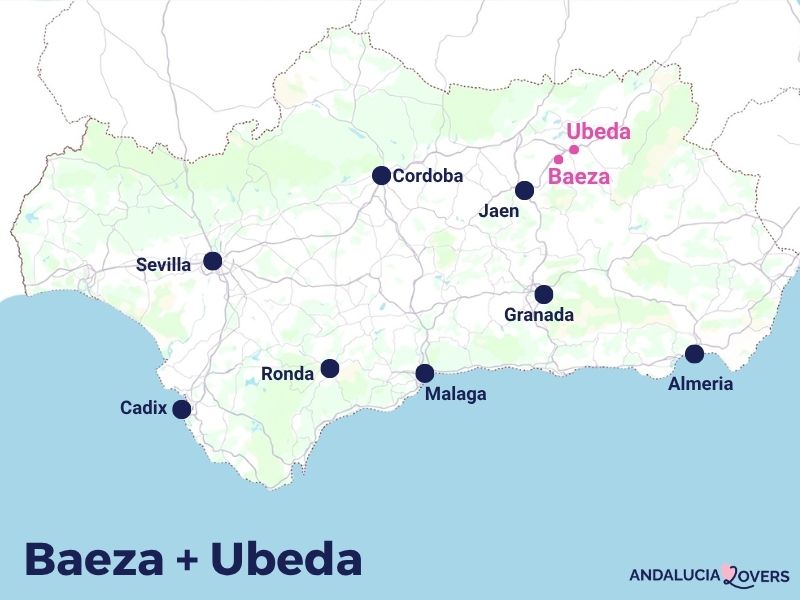
Baeza and Úbeda are located in the heart of the province of Jaén, in northeastern Andalucia. They are almost equally well-suited for exploring the region. Úbeda is a little closer to the Sierras de Cazorla, Segura, and Las Villas Natural Park, while Baeza is closer to Jaén and the A-44 highway toward Granada.
Here are some travel times to help you better assess your options:
- Baeza to Úbeda = 9 km, about a 10-minute drive
- Baeza to Jaén = about 40 km, 30 to 40 minutes by car
- Úbeda to Jaén = about 55 km, 40-minute drive
- Baeza or Úbeda to Granada = about a 1.5-hour drive
- Baeza to Córdoba = about a 1 hour and 35 minute drive
The nearest airport is Granada-Jaén (Federico García Lorca), about 1 hour and 10 minutes from Baeza and 1 hour and 20 minutes from Úbeda. Málaga Airport, which has better international flight connections, is about a 2-hour-and-30-minute drive away. Allow about 3 hours and 15 minutes from Madrid-Barajas.
Compare available flights.
Neither city has a train station in the city center. The Linares-Baeza train station, located about 15 km away, offers connections to Madrid, Sevilla, and Málaga; a shuttle bus then runs to both city centers. The bus stations are also served by ALSA from Granada, Jaén, Madrid, and Sevilla.
RENT A CAR IN Andalucia
- Compare prices on our preferred platform: DiscoverCars – one of the best rated sites.
- Choose a compact car, as some villages have very narrow streets!
- Think ofcomprehensive insurance for the same reason
- Book early for choice.

Accommodations: Baeza vs. Úbeda
Hotels in Baeza

Baeza has limited hotel options: a few hotels in historic mansions and rentals in stone houses. We stayed in a house in the historic center and enjoyed the nearly empty streets in the evening. During peak season, book early.
We particularly recommend:
- Hotel: Hotel Puerta de la Luna – see prices, photos and availability
- Historic setting: Hotel Cetina Palacio de los Salcedo – see prices, photos and availability
- Vacation Rental: El Cabijo in Baeza, where we stayed – see prices, photos and availability
Hotels in Úbeda

The selection of hotels in Úbeda is broader and more varied. Several establishments are housed in Renaissance mansions in the historic center, including a Parador, part of the public hotel chain located in Spanish monuments.
We particularly recommend:
- Renaissance Palace: Parador Hotel in Úbeda, located in the Palacio del Deán Ortega designed by Vandelvira— see prices, photos and availability
- Boutique: Hotel Don Juan – see prices, photos and availability
- Charming: Hotel Álvaro de Torres – see prices, photos and availability
- Historic Center: Palacio de Úbeda Hotel – see prices, photos and availability
Our Opinion
Úbeda offers more choices, particularly in the luxury segment, and its Parador is housed in a palace on Plaza Vázquez de Molina. In Baeza, the selection is more modest, but it allows you to enjoy a very quiet town once night falls.
Our winner: Úbeda for the variety, Baeza for the atmosphere.

It’s time to book!
Compare everything: airlines, prices, schedules, and availability.
Best Dining Options
Restaurants in Baeza

Baeza has been home to a Michelin-starred restaurant since 2023: Restaurant Vandelvira, located near the ruins of the Convento San Francisco. The historic center also features taverns serving traditional cuisine, where local olive oil takes center stage. We haven’t tried these places yet, but they’re on our list:
- Vandelvira Restaurant (1 star): modern cuisine in a Renaissance setting
- Taberna Canela en Rama Restaurant: a Michelin Guide-selected establishment
- Taberna El Pájaro Restaurant and Taberna El Arcediano Restaurant: traditional dishes in the heart of the historic center
Restaurants in Úbeda

Úbeda offers a wider selection of restaurants and tapas bars. As is the case throughout Andalucia, meals are eaten late: lunch around 2:00 p.m. and dinner rarely before 9:00 p.m. You can also take a guided tasting of extra virgin olive oils at the Centro de Interpretación Olivar y Aceite (workshop costs about €10). On our list:
- Cantina La Estación Restaurant (Michelin Guide Bib Gourmand): seasonal cuisine in a dining room modeled after the interior of a train car, a short distance from the city center
- Misa de 12 Restaurant: near the Iglesia de San Pablo
- Antique Restaurant: in the historic center
Our Opinion
Baeza has the most ambitious dining scene of the two cities, while Úbeda offers a more varied selection on a daily basis. We’re looking forward to trying out these places to decide which is better.
For now: a tie.
FUN in Andalucia: activities
- Cooking course in Sevilla
- Canyoning from the Costa del Sol
- Guided Hike on the Caminito del Rey

Ease of getting around in these cities
Getting around in Baeza

You can explore Baeza entirely on foot: the main sights are just a few minutes apart. The streets are cobblestone and have gentle slopes. We left the car in the free parking lot on the main access road, which is open 24 hours a day and has about 200 spaces. We do not recommend driving into the old town, as the streets there are narrow and traffic is restricted.
Getting Around in Úbeda

The historic center of Úbeda covers a larger area: expect to do more walking between Plaza Vázquez de Molina, Plaza Primero de Mayo, and the city walls. We recommend the paid parking lot at Plaza de Andalucía, at the entrance to the historic center, or the one at Puerta de Santa Lucía, a 5-minute walk from the main monuments. Be sure to wear comfortable shoes for the cobblestone streets.
Our Opinion
Baeza, which is more compact, is the easiest to get around. A tourist train also runs through both cities for those who’d rather give their legs a rest.
Our winner: Baeza.
Is it possible to visit Baeza and Úbeda on the same trip?

Yes, and that’s actually what we recommend. The two cities are only 9 km apart: about 10 minutes by car, about 30 minutes by bus (with about 15 departures a day), or about 40 minutes by bike on the bike path.
Ideally, plan to stay two nights: one full day for Úbeda, half a day for Baeza, and a sunset on the Paseo de las Murallas. If you only have one day, we suggest starting with Baeza in the morning and then spending the afternoon at the Plaza Vázquez de Molina.
Please note: As is often the case in Andalucia, many monuments close between approximately 2:00 p.m. and 4:00 p.m. The Úbeda and Baeza Tourist Pass includes several admissions and guided tours in both cities, which we find convenient for a short stay.
Why not other cities?
In Andalucia, there are other cities worth visiting. You can read our guides:
- Things to Do in Granada
- Things to Do in Córdoba
- Things to Do in Baeza
- Things to Do in Úbeda
- Or check out our list of the most beautiful cities in Andalucia.
PLAN YOUR TRIP TO Andalusia
Inspiration

Practice
Places not to be missed