Baeza is a small town in the province of Jaén, in Andalucia. Its historic Renaissance center, designated a UNESCO World Heritage Site along with that of Úbeda, features a cathedral, palaces, and fortified squares all within just a few streets. We were surprised by the sheer number of monuments in this place, where every facade tells a piece of history.
Check out our ideas for things to do in Baeza, illustrated with photos that will make you want to go there. Bonus: useful tips and additional activities.
This opinion is completely independent, based on our experiences. We made our own choices, visited the area anonymously, and paid our bills in full.
Is the town of Baeza worth a visit?
Yes, the town of Baeza is worth a visit. We enjoyed the concentration of Renaissance monuments within a small area that was easy to explore on foot. It is one of the most beautiful small towns in Andalucia and, along with Úbeda, has been a UNESCO World Heritage Site since 2003.
1. Explore the narrow streets, travel back in time

The best way to explore Baeza is on foot, strolling through its cobblestone alleys lined with facades adorned with coats of arms. We enjoyed getting lost in this labyrinth that spans several centuries of architecture, from the Romanesque to the Baroque, including the Renaissance. Low-rise houses stand side by side with more understated mansions, often recognizable by the stones bearing coats of arms.

You’ll also come across partially open patios and carved porches that bear witness to the city’s prosperous past. We recommend looking up at every street corner, because details are often hidden high up.
To better understand the city and its landmarks, you can book a guided walking tour of the city: see the options.
RENT A CAR IN Andalucia
- Compare prices on our preferred platform: DiscoverCars – one of the best rated sites.
- Choose a compact car, as some villages have very narrow streets!
- Think ofcomprehensive insurance for the same reason
- Book early for choice.

2. The Plaza del Pópulo, the Fountain of the Lions, and the Puerta de Jaén

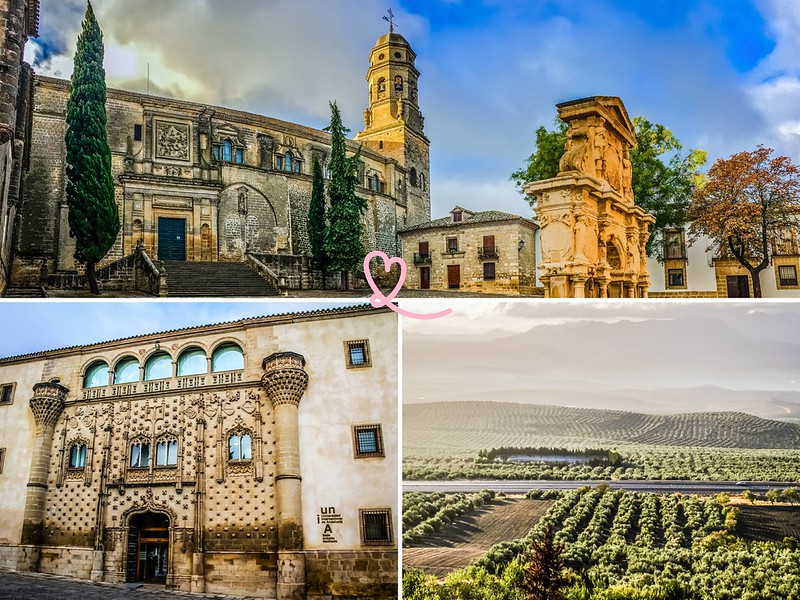
The Plaza del Pópulo, also known as the Plaza de los Leones, is one of the most complete complexes in Baeza. In the center stands the Fountain of the Lions, a Renaissance fountain from the early 16th century topped by a female figure traditionally identified as Himilce, an Iberian princess; according to legend, some of its elements are said to have come from the ancient city of Cástulo. We looked at the carved animals spouting water at its base.

The square also features the Puerta de Jaén, a remnant of the old medieval wall, and the Arco de Villalar, built in the 16th century to commemorate a royal victory. It is one of the most beautiful medieval gates we have ever seen.

You’ll also see the Casa del Pópulo, a Plateresque building that now houses the tourist office.
3. The Cathedral of the Nativity of Our Lady of Baeza

The cathedral was built on the site of an old mosque, remnants of which can still be seen in the cloister. We were struck by the blend of styles: the Puerta de la Luna, a 13th-century Mudejar Gothic structure; the 14th-century rose window; and a Renaissance nave designed by the architect Andrés de Vandelvira.
Inside, the processional monstrance is one of the most important in Spain. You can also climb the bell tower to enjoy a view of the rooftops of the old town. We recommend that you set aside a little time for this; a visit to the adjacent museum nicely complements the tour of the building.

- Hours: Monday through Friday from 10:00 a.m. to 2:30 p.m. and from 4:00 p.m. to 7:00 p.m., Saturday from 1:00 p.m. to 7:00 p.m., and Sunday from 10:00 a.m. to 4:00 p.m.
- Price: about €7 (museum admission and audio guide included)
- Visit the official website for more info here
- Book your skip-the-line ticket
WHERE TO STAY IN Andalucia
Our independent picks for the accommodation of your dreams:
Select by city:
- Best hotels in Sevilla
- Best hotels in Malaga
- Best hotels in Granada
- Best hotels in Cordoba
- Best hotels in Ronda
- Best hotels in Almeria
- Best Hotels in Cádiz
Select by hotel type:

4. Plaza de Santa María and its Fountain

Across from the cathedral lies the Plaza de Santa María, one of the most harmonious squares in Baeza. We enjoyed the Santa María Fountain, a 16th-century Roman triumphal arch with three arches, which was originally built to celebrate the arrival of water in the city.

The square is also home to the 15th-century Casas Consistoriales Altas and the 17th-century Seminario San Felipe Neri. It’s a great starting point from which to explore the other landmarks in the historic center.
5. The Paseo de las Murallas and its views

The Paseo de las Murallas runs along the old city wall, overlooking the rest of the city. From this lookout point, we enjoyed an unobstructed view of the Guadalquivir Valley and the olive groves that stretch all the way to the Mágina and Cazorla mountain ranges.

You can take a leisurely stroll there, away from the hustle and bustle of the historic center. This section nicely rounds out a tour of the ancient city gates, which are scattered all around the Old City. We loved taking walks there at sunset and sunrise. Plus, the old town is very quiet at those times, and the experience is exquisite.
6. The Palace of Jabalquinto and the Old University of Baeza

The Jabalquinto Palace dates from the late 15th century. We admired its Isabelline Gothic façade, adorned with diamond-shaped spires and coats of arms—one of the most intricately crafted in the city. It really is a surprising facade. It’s worth standing right in front of it to admire all the details and be surprised that you didn’t notice certain things before.

Inside lies a two-level Renaissance courtyard featuring a central fountain and a Baroque staircase. The palace is now the headquarters of the International University of Andalucia. Right next door, the Old University, founded in 1538, still houses the classroom where the poet Antonio Machado taught French from 1912 to 1919. You are free to visit its Renaissance courtyard.
- Jabalquinto Palace: The courtyard is open Monday through Friday from 9 a.m. to 2 p.m.
- Old University: Open daily from 10 a.m. to 2 p.m. and from 4 p.m. to 7 p.m.; free admission
- Visit the official website for more info here
7. The Church of Santa Cruz

Directly across from the Jabalquinto Palace stands the Church of Santa Cruz, a 13th-century Romanesque building considered one of the best-preserved in all of Andalucia. We liked the simplicity of its facade, which is quite different from the more ornate palaces surrounding it. Some historians believe it belonged to the Knights Templar.
8. The Aliatares Tower

Standing in the Plaza de España is the Aliatares Tower, an ancient rectangular tower dating from the 12th century. We spotted it from a distance thanks to its 19th-century clock, the first one installed in the city. It is one of the few remaining sections of the Arab wall of Baeza, which was largely destroyed in the 15th century on the orders of Isabella the Catholic. You can admire it from the square, but you can’t go inside.
We really liked the contrast with the colorful building next door.
9. The Gate of Úbeda

The Puerta de Úbeda takes its name from the road that once led to the nearby town of Úbeda. It originally had three arches, but only one remains today following the destruction ordered by Isabella the Catholic.
10. Outside the City Walls: the Balcón del Concejo and City Hall
Be sure to visit the rest of the city.
Most tourists tend to gather within the old city walls, but there are also some very beautiful buildings in the surrounding area.

Just outside the fortified walls, the Balcón del Concejo—also known as the Casas Consistoriales Bajas—holds a special place on the Paseo de la Constitución. Built between 1684 and 1701, it served as the official grandstand for spectators watching the bullfights and festivals held in this square. We admired its double Baroque gallery of semicircular arches, supported by paired Tuscan columns.

You can then head to the current City Hall, a former 16th-century Casa de Justicia, located near the house where Antonio Machado lived. Once again, take a moment to admire the details of the carved elements on the facade.

FUN in Andalucia: activities
- Cooking course in Sevilla
- Canyoning from the Costa del Sol
- Guided Hike on the Caminito del Rey

11. Spend a night in Baeza
Spending a night in Baeza lets you enjoy the historic center once the day-trippers have left. We loved the peaceful atmosphere, the narrow streets all to ourselves, and the panoramic views of the valley at sunrise and sunset.
There are rentals in beautiful stone houses, as well as small hotels.

We recommend the Hotel Puerta de la Luna, located in a former palace in the city center, or the Hotel Palacio de los Salcedo—also known as the Hotel Cetina Palacio de los Salcedo—for its historic setting. The Hotel La Casona del Arco and the Hotel Fuentenueva are also among the well-located options.
- Please note that options are limited. Be sure to book your accommodations in advance during peak season.
- See the best rated accommodations
- For example:
– Hotel Puerta de la Luna in its palace: check photos and availability
– Cetina Palacio Hotel, also located in a palace: check photos and availability
– and EL Cabijo in Baeza, the house where we stayed: check photos and availability
12. Combine with Úbeda

Úbeda is located just 9 km from Baeza, which is about a 10- to 15-minute drive. We recommend combining a visit to both cities, which have been listed as a UNESCO World Heritage Site since 2003 for their Renaissance architecture. There is also a bike path about 9 km long connecting the two historic centers, for those who prefer biking to driving. You can also reach Úbeda by bus; the route connecting the two cities offers about 20 daily departures.
Things to Do in Baeza: Other Ideas
- Padre Sifón Museum and Workshop:
This small museum and workshop rounds out a tour of the historic district. Practical details are still to be determined: hours, prices, and the exact content of the collection [to be specified]. - Paseo de la Constitución:
This wide, arcaded street forms the heart of daily life in Baeza, below the historic center. It features the Balcón del Concejo, cafés, and shops under the arcades. In the center is a lovely park that provides a bit of coolness.

- Antonio Machado’s “Aula“:
Located within the Old University, this classroom has retained its original furniture. Antonio Machado taught French there between 1912 and 1919, before becoming one of Spain’s greatest poets. - The ruins of the Convento San Francisco:
This 16th-century funerary and monastic complex, designed by Andrés de Vandelvira, was damaged by an earthquake in the early 19th century and later looted by Napoleonic troops. It still features a stone altarpiece and is now home to the Municipal Auditorium, where a statue pays tribute to the architect. - The tourist train:
One way to explore Baeza and Úbeda is by taking the tourist train, which offers a different perspective

How to Get to Baeza + Parking
Where is Baeza?
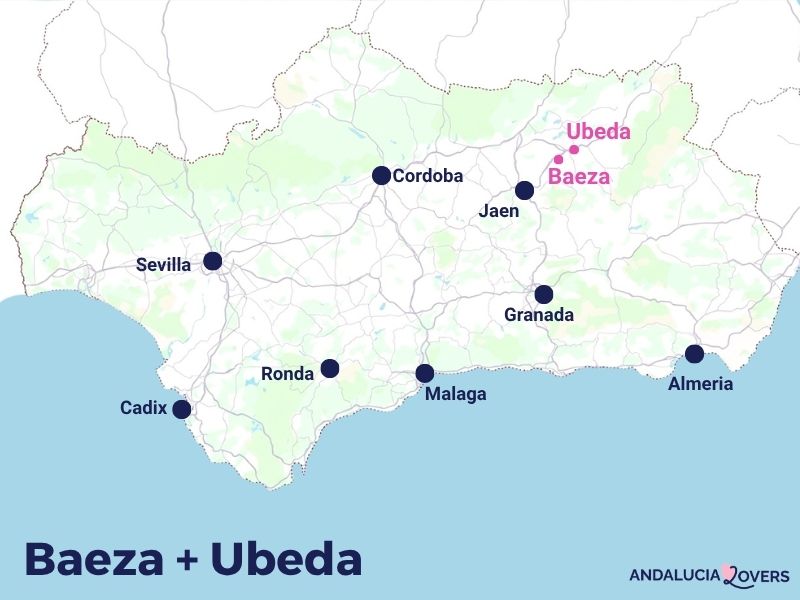
- In the province of Jaén, in Andalucia
- Úbeda: 9 km, or a 10- to 15-minute drive
- Jaén: about 40 km, or a 30- to 40-minute drive
- Granada: about 90 km, or a 1.5-hour drive
- Córdoba: about 150 km, or a 1-hour-and-35-minute drive
How to get there
By car, Baeza can be reached via the A-316, which connects to the A-44 from Jaén and Granada. For public transportation, the Linares-Baeza train station, about 15 km away, offers direct connections to Madrid, Sevilla, and Málaga; a shuttle bus then runs to the city center. The Baeza bus station is located less than one kilometer from Plaza de Santa María.
Parking in Baeza
We found a free parking lot on the main access road to the city, which is open 24 hours a day and has about 200 spaces. From there, you can walk to the historic center in just a few minutes.
There are also paid parking spaces in the center.
Don’t try to drive into the old town!

Helpful Tips for Visiting Baeza
How long and when?
Allow half a day to see the main sights in Baeza, or a full day if you also want to visit the museums and combine your visit with a trip to Úbeda. Spring and fall offer pleasant temperatures for walking through the streets of the historic district. If you can come early or late, you’ll avoid the tour buses that stop and unload tourists in the middle of the day.
Tour directions, map and difficulty
We recommend starting at the Plaza del Pópulo, then heading up toward the cathedral and the Plaza de Santa María, before continuing on to the Jabalquinto Palace and the Church of Santa Cruz. The streets in the city center are cobblestone and have a few gentle slopes; sturdy shoes are still a good idea.
Restaurants
We haven’t tried the restaurants in Baeza yet. But on our list is:
- Restaurant Vandelvira, located near the ruins of the Convento San Francisco,
- For traditional dishes: Taberna El Pájaro and Taberna El Arcediano, both located in the historic center.
Visiting Baeza in Winter
Winters in Andalusia are mild and sunny most of the time, making a visit to the historic center pleasant even during this season. However, not everything stays open in the middle of summer.
PLAN YOUR TRIP TO Andalusia
Inspiration

Practice
Places not to be missed