Úbeda is a small town in Andalucia known for its Renaissance heritage, which is listed as a UNESCO World Heritage Site. We were impressed by the density of its palaces, churches, and monumental squares. A medieval synagogue, city walls, several museums, and views of olive groves round out the tour.
Here is our guide to the must-see sights inÚbeda, Andalucia, along with helpful tips for planning your visit.
This opinion is completely independent, based on our experiences. We made our own choices, visited the area anonymously, and paid our bills in full.
Is the city of Úbeda worth a visit?
Yes, the city of Úbeda is worth a visit. We found its Renaissance historic center—which, along with that of Baeza, has been designated a UNESCO World Heritage Site since 2003—to be remarkably cohesive. With its palaces, chapels, synagogue, and museums, we recommend that you set aside some time to explore the area. It’s one of Andalucia’s most beautiful cities.
1. Stroll through Plaza Vázquez de Molina

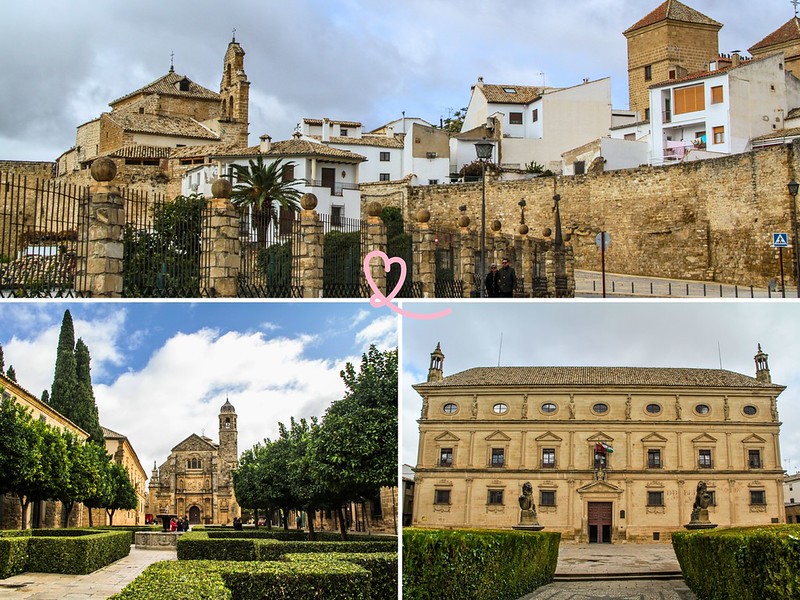
Plaza Vázquez de Molina is the historic heart of Úbeda. Designated a UNESCO World Heritage Site, this vast square is home to the highest concentration of Renaissance-era civil palaces and religious buildings in Spain. Free access.

You’ll find several must-sees there:
- the Sacra Capilla de El Salvador,
- the Basilica of Santa María
- the Palacio de las Cadenas.
- The Palacio del Deán Ortega, which has been converted into a Parador.
- the Renaissance fountain, presented—as was the tradition—by the Venetian Senate to Francisco de los Cobos.
RENT A CAR IN Andalucia
- Compare prices on our preferred platform: DiscoverCars – one of the best rated sites.
- Choose a compact car, as some villages have very narrow streets!
- Think ofcomprehensive insurance for the same reason
- Book early for choice.

2. Visit the Sacra Capilla de El Salvador

The Sacra Capilla de El Salvador is the most iconic and most-visited landmark in Úbeda. This funeral chapel, built between 1536 and 1559, is the work of Diego de Siloé and Andrés de Vandelvira, two leading architects of the Spanish Renaissance. It houses the tomb of Francisco de los Cobos, Secretary of State to Charles V.
First, we took the time to look at the carved facade. Inside, we admired the large altarpiece and the sacristy. You can follow along during the tour using the included audio guide.

- Opening hours:
Monday through Thursday, at least from 10:00 a.m. to 2:30 p.m. and from 4:30 p.m. to 7:00 p.m.,
Friday and Saturday, at least from 10 a.m. to 7 p.m.,
Sundays, at least from 12:00 p.m. to 2:30 p.m. and from 4:00 p.m. to 7:00 p.m. (hours vary by season) - Price: €7 (general admission); discounted rates for seniors and children ages 8–15; audio guide included
- Admission included with the Úbeda and Baeza Tourist Pass
- Book your ticket now to save time!
3. Explore the Basilica of Santa María de los Reales Alcázares

The city’s main collegiate church, the Basílica de Santa María de los Reales Alcázares, stands on the site of the former Great Mosque, which was converted into a Christian place of worship in 1233 by Ferdinand III, King of Castile.
The building thus blends different eras. There we discovered a small Gothic cloister, built in the late 15th century on the site of the former ablution courtyard. We then took a look at its Renaissance facades. Once you’re there, you’ll understand why the church was elevated to the status of a minor basilica in 2014.

- Opening hours:
Monday through Friday: 10 a.m. to 2 p.m. and 4 p.m. to 7 p.m.
Saturday: 10 a.m. to 6:45 p.m.
Sunday: 10 a.m. to 2 p.m. - Price: €6, audio guide included via QR code
- Located on Plaza Vázquez de Molina
- Visit the official website for more info here.
4. Spend a night in Úbeda

We recommend that you spend at least one night in Úbeda. The city is home to so many monuments, museums, and scenic viewpoints that it’s hard to see them all in a single day. We think staying in the area is the best way to explore the city early in the morning or in the evening, at a more leisurely pace. The historic district is home to several hotels housed in historic mansions. What ideas:
- Parador de Úbeda Hotel, located in the Palacio del Deán Ortega, a 16th-century Renaissance palace designed by Vandelvira— check photos and availability
- Don Juan Boutique Hotel – Check photos and availability
- Alvaronde Terres Boutique Hotel – Check photos and availability
- Palacio de Úbeda Hotel, in the historic center— check photos and availability
- Las Casas del Cónsul Hotel, on Plaza del Carmen—check photos and availability
- Or view all the top-rated accommodations
WHERE TO STAY IN Andalucia
Our independent picks for the accommodation of your dreams:
Select by city:
- Best hotels in Sevilla
- Best hotels in Malaga
- Best hotels in Granada
- Best hotels in Cordoba
- Best hotels in Ronda
- Best hotels in Almeria
- Best Hotels in Cádiz
Select by hotel type:

5. Admire the palaces of Úbeda
Palacio de las Cadenas

Designed by Andrés de Vandelvira and completed in 1568, the Palacio de las Cadenas was built for Juan Vázquez de Molina, Secretary of State to Charles V and later to Philip II. This grand Renaissance palace is now home to City Hall. We spotted it thanks to the iron chains on its facade—which gave it its name—and its stone lions. We also walked through its central courtyard, which is lined with arcades. In the basement, you’ll find the Andrés de Vandelvira Interpretation Center, dedicated to the architect.
- Hours: Access to the courtyard during City Hall’s business hours
- Price: Free admission to the courtyard
- Entrances via Plaza Vázquez de Molina or Plaza del Ayuntamiento
- Some areas of the palace may be closed for restoration work
Palacio Vela de los Cobos

Located on the Plaza del Ayuntamiento, the Palacio Vela de los Cobos was designed in the 16th century by Vandelvira for Francisco Vela de los Cobos, a municipal magistrate of Úbeda—not to be confused with Francisco de los Cobos. We noticed its corner balcony, typical of the Andalusian Renaissance. Inside, you’ll discover a collection of paintings and one of the largest private libraries in Andalucia.
- The interior is open to the public only as part of a guided tour; admission is €6.
- Tuesday through Saturday, 1:00 p.m. to 7:00 p.m.
- Only the ground floor is wheelchair accessible
Anguís Palace, Medinilla

Built around 1580 for Dr. Anguís Medinilla, this palace overlooks the small Plaza Álvaro de Torres, which is named after the nephew who inherited it. Its two-story facade features a linteled doorway, a balcony framed by coats of arms, and a broken pediment. The building now houses municipal offices, so you can take a look at its columned courtyard on weekdays.
- Hours: Monday through Friday, 8 a.m. to 2 p.m.
- Admission is free, but you can only see the inner courtyard. The rest is an event venue
- Latest news on the official website here
Casa de las Torres Palace

Located on the Plaza de San Lorenzo, the Casa de las Torres is considered Úbeda’s first major noble palace. Its Plateresque façade—a style from the early Spanish Renaissance characterized by highly detailed ornamentation—is flanked by two massive towers that give it the appearance of a small fortress. We examined the Dávalos family’s emblems: shells from the Order of Santiago, eagles, and cornucopias. The building is now home to the city’s art school.
Other palaces…
- The Palacio del Marqués de Mancera, on Plaza Vázquez de Molina: a 16th- and 17th-century tower palace that served as the residence of Pedro de Toledo, viceroy of Peru
- The Palacio de los Torrente
- The Palacio de los Manueles, recognizable by its semicircular pediment adorned with heraldic motifs
6. Stroll through the streets of Úbeda

Beyond its grand squares, Úbeda reveals itself as you wander through its streets. The historic center consists of a network of cobblestone streets, small squares, and passageways where different eras overlap. We enjoyed gazing up at the ochre-colored stone facades, the carved coats of arms, the wrought-iron balconies, and the Renaissance-style gates. At every intersection, a stately home, a church, or a remnant of a city wall catches the eye. We recommend that you wander around without a specific itinerary: that way, you’ll make your own discoveries, away from the most crowded tourist routes.

- Free access to the streets of the historic district
- Explore the churches (next section) as well as:
- The Hospital de Santiago, nicknamed “the Andalusian Escorial,” served as a hospital until 1975 and now houses a cultural center.
- The Antiguas Casas Consistoriales, the former city hall: located on Plaza Primero de Mayo, this 16th- and 17th-century building is notable for its Renaissance loggias, some of which were designed under the supervision of Vandelvira. Today, it houses the María de Molina Conservatory.

On Calle Baja del Salvador, the Hospital de los Honrados Viejos del Salvador provided shelter for elderly people without means. Founded in the 14th century by a brotherhood, it was rebuilt during the Renaissance with the support of Francisco de los Cobos.

It’s time to book!
Compare everything: airlines, prices, schedules, and availability.
7. Other Places of Worship
Church and Convent of the Most Holy Trinity

In a city dominated by Renaissance architecture, the Iglesia de la Santísima Trinidad is one of the few examples of Baroque architecture. Built in the 17th and 18th centuries outside the city walls for the Order of the Trinitarians, it is notable for its west facade, adorned with geometric motifs, and its painted vaults. We also noticed its bell tower. The former convent is now home to a high school, so you won’t be able to visit its courtyards.
- Hours: Every day from 11 a.m. to 1 p.m.
- Price: 1€
Santa Clara Monastery

Founded in the 13th century, the Real Monasterio de Santa Clara is the oldest convent in Úbeda. Cloistered nuns still live there. Isabella the Catholic is said to have stayed there in 1489. The complex combines Mudejar Gothic, Renaissance, and Baroque styles. We loved the local tradition: a bride-to-be brings a dozen eggs to her sisters to keep the rain away on her wedding day. You can also purchase homemade pastries made by the nuns from 9:00 a.m. to 5:45 p.m.
Synagogue of the Water
The Sinagoga del Agua is a 14th-century medieval synagogue that was rediscovered by chance in 2007 during renovation work. Open to the public since 2010, it can only be visited in small groups accompanied by a guide. You’ll be amazed by its natural wells and its mikveh—the remarkably well-preserved underground ritual bath of the Jewish tradition.
- Hours: Guided tours every day, starting at 10:30 a.m. and in the afternoon
- Price: €6 (adults), €4.50 (children ages 7–12)
- Duration: about 45 minutes
- Latest news on the official website here.
Church of San Pedro

Located on the quiet Plaza de San Pedro, the Iglesia de San Pedro is one of the oldest parish churches in the city. It may have been built on the site of a former mosque. We particularly admired its Renaissance-style south portal, built between 1605 and 1615 based on designs by Alonso de Barba, a disciple of Vandelvira. There you will see Corinthian columns and reliefs depicting the virtues. The church is often closed when services are not being held.
And lots of other churches…
- The Church of San Pablo, on Plaza Primero de Mayo: a Gothic main façade, a Plateresque bell tower, and a south façade in the Isabelline style (late Gothic from the era of the Catholic Monarchs)
- The Church of San Miguel, part of the Discalced Carmelite convent founded in 1587, where Saint John of the Cross died; it is adjacent to the San Juan de la Cruz Museum
- The Church of San Isidoro, one of the city’s few Gothic churches, built on the ruins of a mosque and featuring two facades in the Flamboyant Gothic style
8. Go through the gates and walk along the ramparts

During the Muslim period, the city was protected by a dual defensive system: an outer wall and an inner citadel, the alcázar. At that time, there were nine main gates leading into it. Much of the city wall was dismantled in the 19th century, but several sections, towers, and three medieval gates still stand today. There, you’ll discover the city’s defensive side, which serves as a counterpoint to the Renaissance palaces.

- Puerta de Granada: Located south of the historic center, it opened onto the old Camino Real, which led to the Nasrid Kingdom of Granada. Its semicircular arch makes it one of the three remaining medieval gates. Tradition has it that Isabella the Catholic crossed it in 1489, on her way to the siege of Baza.
- Puerta del Losal: Also known as the Puerta de Valencia, it is one of the city’s best-preserved medieval gates, built in the Mudejar style. What caught our attention most was its brick horseshoe arch, set into the stone fortifications.
- Puerta de Santa Lucía: Also known as the Mudejar Gate of Quesada, it has been rebuilt. From the nearby parking lot, it takes just 5 minutes to walk to the main attractions.
- Note: In the nearby town of Baeza, the Puerta de Úbeda is a 12th-century fortified gate flanked by a projecting tower.
9. Gaze out over the olive groves

Around Úbeda, olive trees cover the landscape as far as the eye can see. In fact, the countryside of the province of Jaén—one of the world’s leading olive oil-producing regions—is often referred to as a “sea of olive trees.” We found a great vantage point on the city walls, near the Iglesia de San Lorenzo, from which the view stretches across the Guadalquivir Valley. We recommend extending your walk along the walls of the Carmen. This will help you appreciate the close connection between the city and its surrounding countryside.
FUN in Andalucia: activities
- Cooking course in Sevilla
- Canyoning from the Costa del Sol
- Guided Hike on the Caminito del Rey

10. Visit the museums in Úbeda
Several museums round out the city tour.
Olive Grove and Olive Oil Interpretation Center:
Housed in the Casa de la Tercia, it is an interactive museum dedicated to olive cultivation in the province of Jaén. We recommend that you take a guided tasting tour of the region’s extra virgin olive oils (EVOO).
- From October through May, Tuesday through Saturday from 10 a.m. to 2 p.m. and from 5 p.m. to 7:30 p.m., Sunday from 10 a.m. to 2 p.m.; From June through September, Tuesdays and Wednesdays from 10 a.m. to 2 p.m., Thursdays through Saturdays from 10 a.m. to 2 p.m. and from 6 p.m. to 8:30 p.m., and Sundays from 10 a.m. to 2 p.m.; closed on Mondays.
- Admission is about €3.50; the tasting workshop is about €10.
- Visit the official website for more info here.
The Iglesia de San Lorenzo, a former medieval church built on the city wall, has been deconsecrated. We liked its new role as an alternative cultural center, run by a neighborhood foundation, which hosts exhibitions and concerts.
- a donation of about 1€ to access the sacristy, the choir, and the viewpoint on the city wall;
The Museo de San Juan de la Cruz is housed in the Carmelite convent where this Spanish mystical poet spent his final days in 1591. There you will see his tomb, relics, and historical manuscripts displayed in 12 rooms.
- Usually open from 11 a.m. to 2 p.m. and 4:30 p.m. to 7 p.m.
- Closed on Wednesdays
- €4, audio guide included.
- Visit the official website for more info here.
The Archaeological Museum of Úbeda is finally housed in a 14th-century Mudéjar mansion, a style born of the craftsmanship of Muslim artisans who remained in Christian lands. There you can see Iberian, Roman, and Islamic artifacts.
- Closed on Monday
- Tuesday through Saturday: 9 a.m. to 9 p.m.
- Sundays and holidays: 9 a.m. to 3 p.m.
- Price: 4 euros
- Visit the official website for more info here.
Other Attractions in Úbeda and the Surrounding Area
We’ve found several places that are easy to combine with a visit to Úbeda:
Baeza, the sister city

Located about ten kilometers away, Baeza has shared its UNESCO status with Úbeda since 2003. Don’t miss the Plaza del Pópulo, also known as Lions’ Square, and the Palacio de Jabalquinto.
See our article on Baeza.
Sabiote and Its Castle
This village near Úbeda is worth visiting for its historic center and castle, which are often included in a day trip to Úbeda.
The Sierras de Cazorla, Segura, and Las Villas Natural Park

Located about 40 km away, this vast natural park offers a mountainous contrast to the Renaissance towns and the plains dotted with olive groves.
How to Get to Úbeda + Parking
Where is Úbeda?
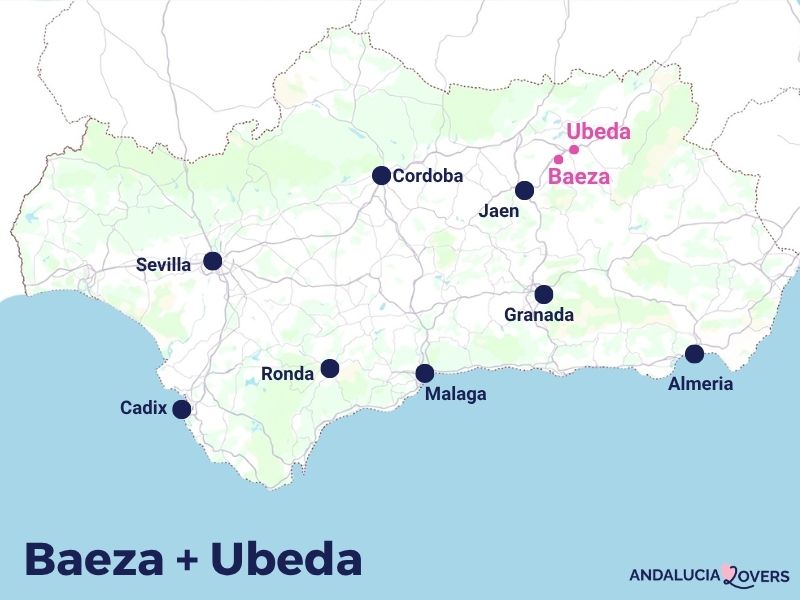
- In Andalucia, in the province of Jaén
- Baeza to Úbeda: 9 km, about a 10-minute drive
- Jaén to Úbeda: about a 50-minute drive
- From Granada to Úbeda: about a 1.5-hour drive
How to get there
A car is still the most flexible way to get to Úbeda and explore the surrounding area. By bus, the bus station (Calle San José) is served by ALSA from Madrid, Granada, Jaén, Sevilla, and Málaga. It takes about 1 hour and 50 minutes from Granada and 50 minutes from Jaén. By train, the nearest station is Linares-Baeza, which is connected to Úbeda by a shuttle bus.
Parking in Úbeda

We recommend that you park your car in the paid parking lot at Plaza de Andalucía, at the entrance to the historic district, and then explore the city on foot.
Helpful Tips for Visiting Úbeda
How long and when?
We recommend setting aside at least one full day—ideally, an overnight stay. As is often the case in Andalucia, most monuments and museums close in the early afternoon, between about 2:00 p.m. and 4:00 p.m.: plan your day accordingly. The Úbeda and Baeza Tourist Pass includes several admission tickets and guided tours.
Tour directions, map and difficulty

We suggest you start at Plaza Vázquez de Molina, which is home to the Sacra Capilla de El Salvador, the Basilica of Santa María, and the Palacio de las Cadenas. Next, continue on to the Sinagoga del Agua, the streets in the city center, and Plaza Primero de Mayo, then head to the Puerta del Losal and the city walls to enjoy the views of the olive trees. Be sure to wear sturdy shoes for the cobblestone streets.
Visiting Úbeda in Winter
Úbeda is a great place to visit in the winter thanks to its many indoor attractions: a chapel, a basilica, a synagogue, and museums. We believe that this allows you to explore the city at a more leisurely pace. Winter hours, which are in effect from October through May at several locations, are, however, shorter in the afternoon.
Restaurants
We haven’t tried the restaurants in Úbeda yet.
But on our list are: Restaurant Misa de 12, near the Iglesia de San Pablo; Restaurant Cantina La Estación, featured in the Michelin Guide; and Restaurant Antique.
PLAN YOUR TRIP TO Andalusia
Inspiration

Practice
Places not to be missed