Visiting Almeria? Don’t miss the Monasterio de las Puras! Nestled in the heart of the historic center, this 16th-century religious building offers a haven of peace away from the hustle and bustle of the city. We were seduced by the contemplative atmosphere that reigns within its walls and by the richness of its architectural heritage. This Conceptionist monastery contains unsuspected treasures that bear witness to monastic life through the centuries.
In this article, you’ll find some useful tips to help you prepare for your visit and have a wonderful time!
This opinion is completely independent, based on our experiences. We made our own choices, visited the area anonymously, and paid our bills in full.
Why visit the Monasterio de las Puras?
Is the Monasterio de las Puras worth it? Our opinion:
Yes, the Monasterio de las Puras is well worth a visit. The monastery is an ideal complement to Almería Cathedral. We particularly appreciated the haven of peace offered by this place, untouched by the major tourist circuits. The contemplative atmosphere allows you to discover religious architecture in an intimate and authentic setting.

Why is the Monasterio de las Puras famous?
The monastery is famous for its 16th-century architecture, which harmoniously blends Mudejar and Renaissance influences. Founded by theConceptionist Order, it is home to a community of cloistered nuns who have been perpetuating the monastic tradition for almost five centuries. The building is also notable for its religious artworks, including altarpieces by renowned artists such as Salzillo and López.

Our favorite
In the room where the cloistered nuns used to attend mass, we were fascinated by a unique architectural detail. At the far end of this space, we discovered the little communion hideaway window. This ingenious device enabled the nuns to pass the ostia while respecting their contemplative life. We found this testimony to the clausura particularly moving and revealing of monastic organization.

History in brief
Here are the key dates in the history of the Monasterio de las Puras:
- 16th century: Monastery founded by the Franciscan Conceptionist Order
- 16th century: Construction of the cloister with its Tuscan columns and Mudejar arches
- 17th century: Tree of the Franciscan Order in the chapter house
- 18th century: Architectural modifications to the church and addition of the Baroque confessional
- 1936: Whitewashing of the refectory murals during the Civil War
WHERE TO STAY IN Almeria
Our favorites: neighborhoods and hotels
Downtown
Murallas de Jayran Boutique Hotel – See prices, photos and availability
Seaside
El Rincon de Huete Apartment – See prices, photos and availability

See our complete selection of the best hotels in Almería
How to get there: Monasterio de las Puras, Almería
Where is the Monasterio de las Puras?
The Monasterio de las Puras is located at C. José Ángel Valente, 5, 04002 Almería, Spain.
- Almeria city center
- only 1min walk from Almería Cathedral
RENT A CAR IN Andalucia
- Compare prices on our preferred platform: DiscoverCars – one of the best rated sites.
- Choose a compact car, as some villages have very narrow streets!
- Think ofcomprehensive insurance for the same reason
- Book early for choice.

How to get there?
It’s easy to get to, as the historic center is within walking distance. If you’re coming from the station, you can take the M370 bus to Fuente De Los Peces, which will take you there in 11 minutes. We appreciated the proximity of the main monuments, which made it possible to combine several visits in a single day.

Parking
There is no dedicated parking at the monastery. We recommend parking in one of the public parking lots in the city center, such as the one on Las Ramblas, a 10-minute walk from the monastery. This short walk will also allow you to discover the picturesque streets of Almeria’s historic quarter.

Useful tips: duration, schedules, eating…
Best time to visit
We recommend that you visit the monastery on weekday mornings, to fully appreciate the contemplative atmosphere. It’s also the perfect time to visit the monastery store. The Monasterio de las Puras also remains relatively untouched by major tourist circuits, guaranteeing a peaceful visit whatever the time of year.
Length of visit and main difficulties
Allow around 30min for a simple visit to the monastery. If you opt for the audioguide, allow 1 hour to fully appreciate the detailed explanations of the history and architecture of the site. You can also visit the boutique.

Advice on how to visit
We recommend you follow the route suggested by the audioguide. This itinerary has been designed to help you discover the different areas in a logical order, starting with the cloister before moving on to the common rooms and then the more intimate spaces of the monastery.
PLAN YOUR DREAM TRIP TO andalucia
All the information you need for your trip:
- 7 maps that make planning easier
- + 150 pre-selected locations
- Practical advice
- 300+ photos to help you choose

Visiting with children
The monastery has no special facilities for children.
Schedules and rates
The monastery is open:
- Monday to Saturday, 11 a.m. to 2 p.m. and 5 p.m. to 7 p.m.
- Sunday, 11 a.m. to 2 p.m.
Here are the prices:
- Single admission to the monastery: €6
- Combined visit with the Cathedral: €11
We recommend the combined option, which offers excellent value for money to discover two major monuments of Almeria’s religious heritage.
Guided tours
An audioguide is available to accompany your tour of the monastery. For a more in-depth experience, guided tours can be arranged on request. Visit the official website for more info here.

Catering
There’s no on-site restaurant, but as the monastery is in the center of town, there are plenty of alternatives in the surrounding streets. Just 2 steps from the monastery, we tried out Café Hierbabuena, where we drank a delicious fresh orange juice.
See our Where to eat in Almería article for more addresses.

Subscribe to our Newsletter
- Get away from it all with Region Lovers’ beautiful destinations!
- Once a month
- Advertising-free

What can you see at the Monastère de las Puras? The 8 essential steps
The monastery reveals its treasures on a carefully orchestrated tour. We were captivated by the diversity of spaces that make up this place of monastic life, each testifying to a precise function in the organization of the religious community.
The 16th-century cloister: an oasis of peace
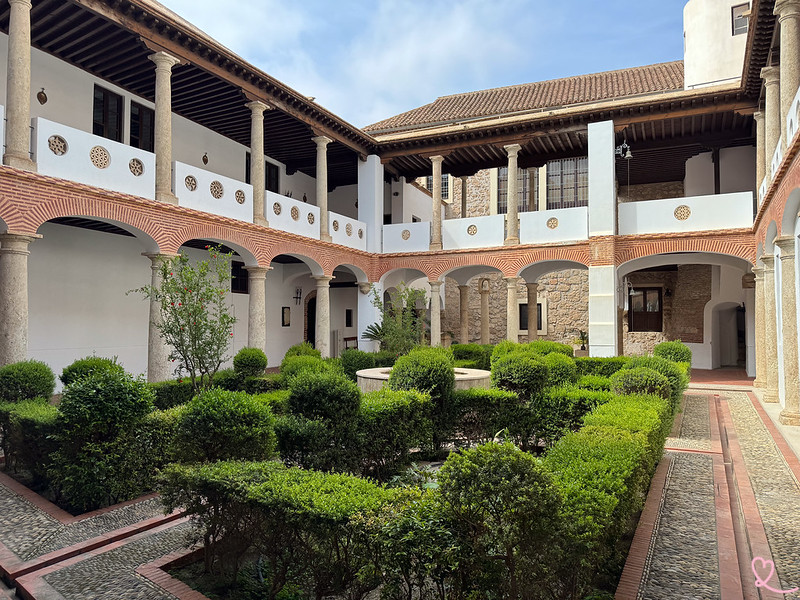
A peaceful atmosphere welcomes visitors to this central patio, a veritable time capsule. This 16th-century cloister is distinguished by its Tuscan columns and Mudejar-style arches. We were struck by the elegance of the architecture, which combines sobriety and refinement. You’ll notice a triumphal column adorned with the bust of Saint Beatrice de Silva, founder of the Conceptionist order, and a water cistern that testifies to the ingenuity of the builders in ensuring the monastery’s autonomy. The central patio distributes the various rooms that make up the monastery on either side. On the first floor are communal areas such as the church and refectory.
The upper floor houses the nuns’ private rooms, the chapter house and the high choir. We appreciated this rational organization, which perfectly reflects the hierarchy of monastic spaces between community life and clausura.

The monastery church: a jewel box of spirituality
The church is rectangular in plan, with a magnificent coffered ceiling that immediately catches the eye. We were impressed by the proportions typical of Conceptionist architecture, which create a space that is both intimate and solemn. Eighteenth-century modifications enriched the building without altering its original harmony. You’ll discover remarkable altarpieces by masters such as López, Salzillo, Mora and García Puerta, true masterpieces of Baroque sacred art. The paintings of the Life of the Virgin that adorn the walls tell the Marian story so dear to the Conceptionist order. We particularly appreciated the quality of conservation of these works, which allow us to appreciate the finesse of the artists’ work. The whole is a setting of great spiritual and artistic richness, where you can capture all the fervor of monastic devotion.

The low choir: between clausura and liturgy
The low choir is a fascinating space that perfectly illustrates the life of cloistered nuns. We were intrigued by the architectural ingenuity that allows the nuns to attend mass while respecting their vow of clausura. You’ll notice the beautiful columns that structure the space and a finely crafted 18th-century confessional. But it was the communion window that really caught our attention. This discreet device enabled the ostia to be passed to the nuns during communion, thus maintaining the spiritual link with the Eucharistic celebration without breaking the physical separation imposed by monastic rule.

The refectory: testimony to community life
The refectory reveals the daily organization of the monastic community around communal meals. We were impressed by the sober, functionalarchitecture of this room, enhanced by period furniture that transported us back in time. You’ll notice the raised pulpit from which a nun read spiritual texts while her fellow nuns ate in silence. This practice illustrates how every moment of monastic life was oriented towards meditation and spiritual elevation.

Take note of the murals that once adorned the walls. Unfortunately, they were covered in whitewash in 1936, during the Spanish Civil War. We found this loss regrettable, but it also bears witness to the turbulent history of the monastery.

The original cell: monastic austerity
A visit to an original cell is a particularly moving part of the tour. We were struck by the extreme sobriety of this space, where a nun spent her nights in prayer and rest. The preserved antique bed bears witness to the modest living conditions chosen by the nuns, who renounced all material comforts. You’ll appreciate the striking contrast between the simplicity of these cells and the artistic richness of the monastery’s common spaces. This immersion in the daily life of the nuns gives a concrete understanding of what it meant to lead a life entirely devoted to contemplation. We appreciate that the monastery has preserved this authentic space, which offers a rare and precious insight into monastic reality, far from any idealization. You’ll be able to grasp all the dimensions of self-sacrifice and spiritual devotion that characterized these women.

The Prayer chapel in the garden
The Chapelle de la Prière in the garden contains remarkable works of art that deserve special attention. It takes its name from Luis Barueso’s painting of Jesus and the Apostles, an emotionally powerful composition that captures Christ’s fervor as the apostles sleep beside him. But it was the three-key chest that caught our eye the most. This ancient piece of furniture possessed a strong symbolism: each of the three keys was entrusted to a different authority within the monastery, ensuring that the safe could only be opened in the presence of several witnesses. We found this system ingenious, illustrating the rigor of monastic management and the transparency sought in the administration of community goods.

The chapter house: the monastery’s decision-making heart
The chapter house was the nerve center of monastic life, where important decisions affecting the community were taken. We were impressed by the symbolic function of this space, which hosted the nuns’ regular meetings. The spatialorganization reflects the monastic hierarchy, with seats arranged according to the rank and seniority of each nun. Admire the magnificent, richly-ornamented coffered ceiling and the sober yet elegant decoration of the walls. We were surprised to discover a piano in this room, testifying to the importance attached to music in Conceptionist spirituality. The 17th-centuryTree of the Franciscan Order is a centerpiece of the room. This genealogical representation is an artistic illustration of the order’s spiritual filiation. A metal staircase then leads up to the tower, adding a vertical dimension to your discovery of the monastery. You’ll appreciate the solemn atmosphere of a place steeped in history.

PLAN YOUR TRIP TO Andalusia
Inspiration

Practice

Places not to be missed