A stroll through Sevilla’s Santa Cruz district? Take a detour to the Casa de Pilatos, one of the city’s most beautiful palaces after the Alcazar. This monument combines Mudejar, Gothic and Renaissance architecture in an awe-inspiring setting. We were seduced by its decor, gardens and antique collections.
In this article, you’ll find our photos and tips for making the most of your visit to Casa de Pilatos.
This opinion is completely independent, based on our experiences. We made our own choices, visited the area anonymously, and paid our bills in full.
Why visit Casa de Pilatos
Is Casa de Pilatos worth it? Our opinion:
Yes, Casa de Pilatos is well worth a visit. We were struck by the beauty of the decor and the state of conservation of this palace, often overshadowed by the nearby Real Alcázar. You’ll also be surprised to discover beautiful patios and gardens, as well as Roman sculptures from Spain.
This is one of Sevilla’s best activities.
>> Book your ticket for Casa de Pilatos now

Why is Casa de Pilatos famous?
Casa de Pilatos owes its reputation to a number of factors. Listed as a Spanish National Monument, it is a fine example of Andalucia’s Renaissance civil architecture. Its name, which literally means “Pilate’s House”, derives from a 16th-century comparison between the palace and Pontius Pilate’s home in Jerusalem. It also houses a fine private collection of Roman and Greek sculptures from Spain, assembled during stays in Italy by the dukes of the Ribera family. Finally, the palace still belongs to the Medinaceli ducal family, one of Spain’s oldest noble families.
WHERE TO STAY IN Seville
Option 1: In the historic center
Convenient for visiting everything on foot, we recommend:

Option 2: El Arenal
Between quiet streets and riverside ambience, we recommend it:

See our complete selection of the best hotels and neighborhoods in Sevilla
History in brief
Casa de Pilatos is the result of centuries of construction and embellishment. Here are the milestones in its history:
- Late 15th century: Don Pedro Enríquez, Adelantado Mayor of Andalucia, and his wife Doña Catalina de Ribera begin construction of the palace on land near the Porte de la Macarena.
- 1519: Don Fadrique Enríquez de Ribera, first Marquis of Tarifa, returns from a pilgrimage to the Holy Land and establishes a Via Crucis between the palace and the Cruz del Campo. The supposed comparison between this palace and Pontius Pilate’s home in Jerusalem gave it its current name.
- 16th century: Don Per Afán de Ribera, first Duke of Alcalá and Viceroy of Naples, enriched the palace with antique sculptures brought from Italy, and commissioned work implementing Renaissance decoration.
- 17th-18th centuries: The ducal family moves its main residence to Madrid. The palace enjoys a long period of minimal maintenance.
- 19th-20th centuries: successive restorations. The monument is a Spanish national heritage site.
- Today: The Casa Ducale de Medinaceli Foundation manages the palace, which is open to the public all year round.

Our favorite moments
Here are the highlights of our visit:
- Discover the Patio Principal and its Mudejar stucco arabesques.
- Fresh gardens adorned with orange trees and rose bushes
- The gilded vault of the main staircase and its domed ceiling.
>> Book your ticket for Casa de Pilatos

RENT A CAR IN Andalucia
- Compare prices on our preferred platform: DiscoverCars – one of the best rated sites.
- Choose a compact car, as some villages have very narrow streets!
- Think ofcomprehensive insurance for the same reason
- Book early for choice.

Architecture: a dialogue between two worlds
The Casa de Pilatos is often cited as the finest example of Andalucia Renaissance civil architecture. In our view, its beauty lies precisely in the superposition of several stylistic influences, the end result of which is remarkably coherent.
Mudejar, Gothic and Renaissance styles
The Casa de Pilatos is an architectural synthesis, where three major stylistic trends coexist in surprising fashion. We found the Mudejar style, a direct legacy of Hispano-Moorish art, in the poly-lobed arches, carved wooden ceilings (artesonados) and finely chiseled stucco decorating the galleries. Gothic elements, perceptible in the pointed arches, stone statuary and some elaborate capitals, bear witness to the influence of 15th-century Castilian master builders. We were struck by the way these two traditions intertwine. The Renaissance touch, introduced in the 16th century, adds classical medallions, Genoese marble columns and busts of Roman emperors, giving the whole a distinctly Italianate dimension. Of particular note are the medallion portraits arranged in friezes on the walls of the main patio, a detail typical of the ornamental vocabulary of the Spanish Renaissance. All this makes the Casa de Pilatos a unique monument in the Iberian architectural panorama.

First floor rooms and second floor
The first floor houses the palace’s most ornate spaces. We were surprised by the richness of the rooms surrounding the main patio: gilded coffered ceilings, azulejo panelling, niches housing original antique sculptures. The Praetorium is one of the masterpieces, decorated with Mudejar gypseries on the ceiling and a frieze of painted tiles. The fresco room, with its 16th-century paintings of mythological scenes, is also well worth a visit.
The second floor, accessible at an additional cost and on guided tours only, retains the character of an inhabited aristocratic residence. Immerse yourself in the ambience of these richly furnished apartments, featuring collections of Flemish and Spanish paintings and valuable tapestries that have remained virtually untouched since the 19th century. We found a more intimate atmosphere.

PLAN YOUR DREAM TRIP TO andalucia
All the information you need for your trip:
- 7 maps that make planning easier
- + 150 pre-selected locations
- Practical advice
- 300+ photos to help you choose

Azulejos and interior design
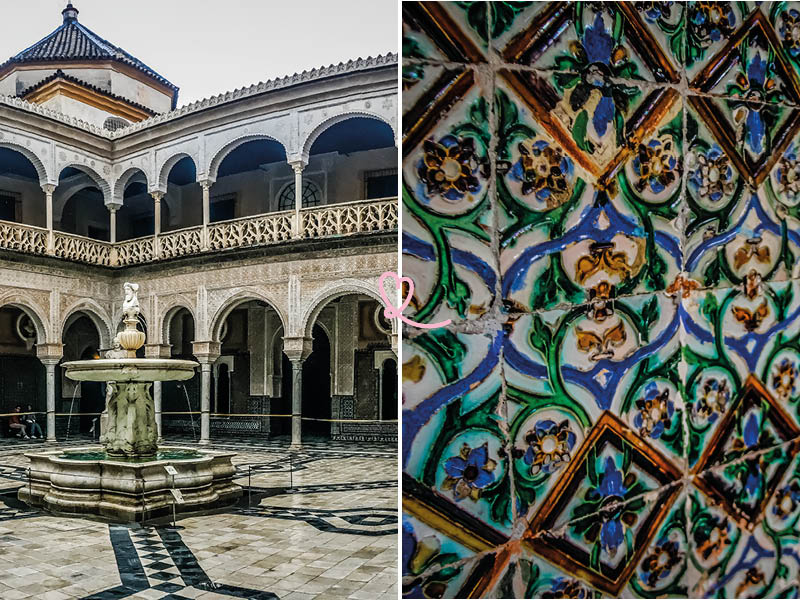
One of the most striking features of the Casa de Pilatos is the azulejos, the painted earthenware tiles that line the walls. Manufactured for the most part in Triana, Seville’s ceramics district, they feature highly precise geometric and floral motifs. Take a close look at the color variations, from cobalt blue to olive green to ochre yellow. Each panel is a compositional exercise in its own right. We also admired the gypseries (sculpted stucco) that crown the azulejos in the main patio. The interior design reflects the owners’ love of Antiquity. Original Roman sculptures, busts and life-size statues occupy the niches and galleries. You’ll be captivated by the beauty of this decorative ensemble.

Patios and gardens
Beyond its interior architecture, Casa de Pilatos stands out for the quality of its outdoor spaces. Patios and gardens punctuated our visit.
Patio del Apeadero
The Patio del Apeadero, or carriage courtyard, is the first area you pass through on entering the Casa de Pilatos. Vast and sober compared to the main patio, it was once used to accommodate crews and VIP guests. Its imposing dimensions give an idea of the aristocratic life that animated this palace in the 16th and 17th centuries. We enjoyed the contrast between the austerity of its whitewashed walls and the precision of its semicircular arches. Pay close attention to the column capitals framing the passageways: some combine late Gothic motifs with early Renaissance ornamentation, bearing witness to the palace’s various construction campaigns. A number of antique sculptures have also found a home here, including some particularly well-preserved pieces.

Le Grand Patio (Patio Principal)
The Patio Principal is undoubtedly the beating heart of Casa de Pilatos. We enjoyed strolling beneath its arcades, whose poly-lobed arches rest on columns of white Genoa marble. The whole frames a central space featuring a marble fountain surrounded by four sculptures of ancient divinities. Contemplate the details of the stucco lining the upper galleries: the geometric and floral interlacing bears witness to the skills of 16th-century Mudejar craftsmen. We were impressed by the finesse of this space. You’ll also be captivated by the relief medallions adorning the pillars, depicting Roman emperors and mythological characters, typical of the vocabulary of the Spanish Renaissance. The floor, covered in azulejos, extends the decorative richness of the walls downwards, completing the visual unity of the whole. We recommend that you take a few minutes to sit and observe the place from one of the gallery benches.

The gardens
The gardens of the Casa de Pilatos occupy the rear of the palace and comprise two distinct areas linked by a gallery. The Jardin Inférieur, the largest of the gardens, is laid out in geometric parterres bordered by low hedges, in a layout characteristic of Spanish gardens. You’ll find orange trees, rose bushes and bougainvilleas that add a pleasant perfume to the walk in spring and summer. Roman sculptures line the walkways. We particularly enjoyed the coolness of this green space, all the more appreciated on hot Sevillian days. The smaller, more intimate Upper Garden is accessible from a gallery on the first level. Take a moment to savor the view over the rooftops of the Santa Cruz district and the city’s domes: it’s one of Sevilla’s lesser-known panoramas.

How to get there: Casa de Pilatos, Sevilla
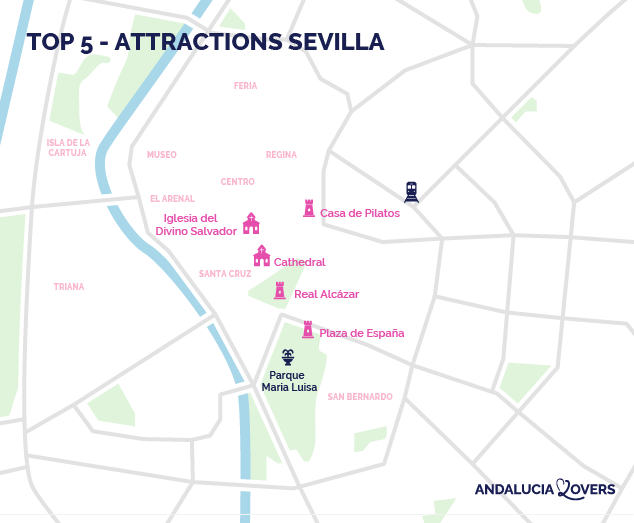
Where is Casa de Pilatos?
- In the heart of Sevilla’s historic center, at the gateway to the Santa Cruz district
- Plaza de Pilatos, 1, 41003 Sevilla
- About a 10-minute walk from Sevilla Cathedral and the Real Alcázar
How to get there?
Casa de Pilatos is located in Sevilla’s historic center, at the gateway to the Santa Cruz district, a largely pedestrian zone. The most practical solution is to walk from the main points of interest: about 10 minutes from the Cathedral or the Real Alcázar. By public transport, bus routes C3 and C4 serve nearby stops (Ponce de León stop). Sevilla’s metro doesn’t have a station in this area, but the Puerta Jerez station is a 15-minute walk away. From Santa Justa Station, a cab or VTC is the most direct option for travelers loaded down with luggage.

Parking
Car parking in the neighborhood is particularly difficult. Most of the streets in the historic center are pedestrianized or reserved for local residents. The nearest underground parking lot is Parking Alameda de Hércules, about 15 minutes’ walk from Casa de Pilatos. Other public parking lots are located near the Cathedral or Prado de San Sebastián. We strongly advise you to take public transport or leave your car on the outskirts, then walk or take the bus to the center.
Useful tips: duration, schedules, eating…
Best time to visit
Sevilla is best visited in spring (March to May) or autumn (September to November), when temperatures remain pleasant. It’s also the flowering season for the palace gardens, which reveal their full beauty. In summer, the heat can make a visit inside the palace a real challenge. We recommend you visit early in the morning, as soon as it opens at 9 a.m., to enjoy the spaces in peace before the crowds of visitors. In high season, online booking is highly recommended to avoid waiting at the cash desk.

Length of visit and main difficulties
Allow 1 hour for a complete tour of the first floor, upper floor, patios and gardens. And 1h30 if you opt for a guided tour. The first floor areas are all on one level and present no major accessibility problems. The second floor, on the other hand, is only accessible by staircase. We encountered no particular difficulties during our visit. In midsummer, be prepared for summer heat: bring water and light clothing.

Advice on how to visit
The tour naturally begins with the Patio del Apeadero, the large entrance courtyard, before moving on to the Patio Principal. From here, the various rooms on the first floor open out on all four sides. Then head for the gardens, accessible from the back gallery. A map of the palace is available at the entrance, included in your ticket.
Subscribe to our Newsletter
- Get away from it all with Region Lovers’ beautiful destinations!
- Once a month
- Advertising-free

Visiting with children
Casa de Pilatos is ideal for a family visit, although there are no specific activities. Open patios and gardens offer plenty of space to move around freely. Antique sculptures, fountains and colorful azulejos generally arouse the curiosity of younger visitors. Children up to 11 years of age receive a free ticket.

Schedules and rates
Casa de Pilatos is open every day of the week, from 9am to 6pm from November to March and until 7pm from April to October. Prices are as follows:
- First floor: €12
- Upper floor: €6 supplement
- Children under 11: Free (accompanied by an adult)
- Handicap over 50%: 50% discount (upon presentation of proof)
- Handicap over 65%: Free (upon presentation of proof)
The individual ticket includes the service of a physical or downloadable guide, or an audioguide available in English, French, Spanish, Portuguese, German, Japanese and Italian. Visit the official website for more info here.
>> Book your ticket for Casa de Pilatos

Guided tours
The audioguide included in the ticket is a satisfactory option for a self-guided tour of the first floor. It is available in seven languages: English, French, Spanish, Portuguese, German, Japanese and Italian. You can also opt for a guided tour. The Medinaceli Foundation also offers themed tours from time to time: consult their program on the official website here.
Catering
There are no restaurants or cafés inside Casa de Pilatos. The surrounding Santa Cruz district, on the other hand, is packed with restaurants and tapas bars. Take advantage of your visit to explore the surrounding streets and discover local addresses. See our suggestions in our article on the best restaurants in Sevilla.

Frequently asked questions
Can I visit Casa de Pilatos without a reservation?
Yes, you can buy your ticket directly on site, at the Casa de Pilatos ticket office. In high season (spring and autumn in particular), however, queues can form at the entrance. We recommend that you book your ticket online in advance to save time and ensure access at the desired time.

How long does it take to visit Casa de Pilatos?
A visit to the first floor, patios and gardens usually takes 1 hour. If you wish to include the second floor, please allow a further 30 minutes. For an in-depth exploration of all the rooms and collections, allow 2 hours in total.
PLAN YOUR TRIP TO Andalusia
Inspiration

Practice

Places not to be missed


SHE MADE THE TRIP Claire