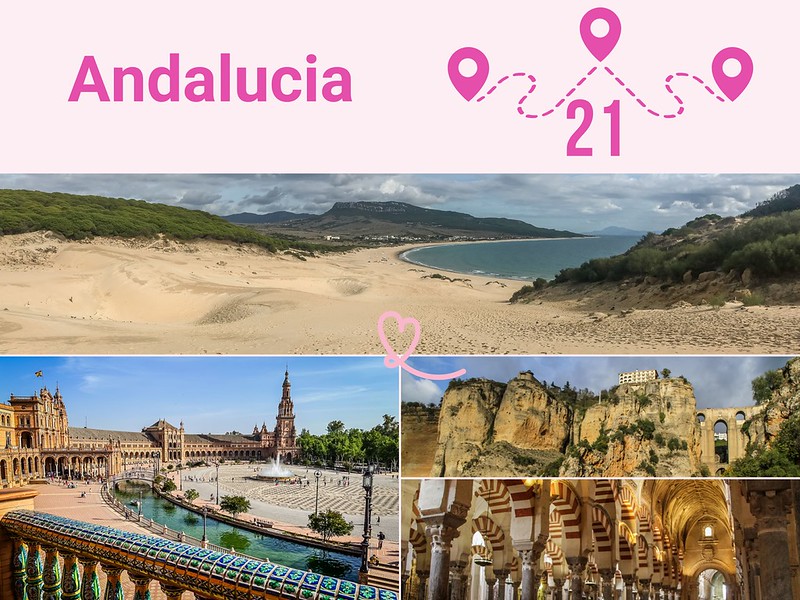
A three-week trip to Andalucia lets you explore Andalucia’s major cities and white villages, Moorish palaces and desert landscapes —all without missing out on relaxing beaches. From Sevilla to Cádiz, via Granada, Málaga, and Ronda, this itinerary takes you on a complete tour of the region at a leisurely pace.
We’ve put together this 21-day road trip itinerary through Andalucia to cover all the must-see sights while leaving time for lesser-known local surprises.
This opinion is completely independent, based on our experiences. We made our own choices, visited the area anonymously, and paid our bills in full.
3-Week Itinerary in Andalucia: Our Approach
This tour follows a loop that starts in the east of Sevilla, heads north toward Córdoba and Jaén, then south again to Granada, runs along the Costa del Sol to Málaga, climbs up to the white villages around Ronda, then reaches the Atlantic via Tarifa and Cádiz before closing the loop back at Sevilla. We sought to strike a balance between:
- major cities steeped in history and smaller, more secluded villages
- days filled with sightseeing and quieter days, by the sea or out in nature
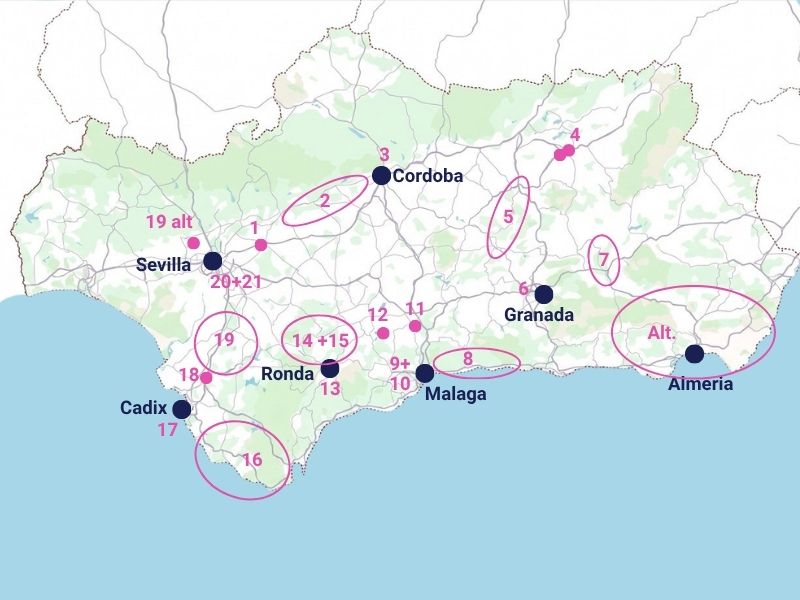
This itinerary starts in Sevilla, but you can just as easily begin in Málaga or Granada if your flight lands there: simply join the loop on the corresponding day and follow it in the same direction.
Practical Tips for a Road Trip in Andalucia
What type of car?
This tour requires a rental car from the first day to the last. Be sure to book it in advance, especially between April and October, as prices rise quickly during peak season. A compact car will suffice for most of the trip, but be sure to choose a car with decent power for the often winding mountain roads around Ronda and the Sierra Nevada.
See our tips for renting a car.

Driving in Andalucia
The Andalusian highway network is in good condition, and the distances between major cities can be covered with ease. Driving gets a little trickier in the white villages, with their narrow streets, and on the small roads of the Sierra de Grazalema or the Tabernas Desert. We recommend that you park your car at the entrance to the historic districts rather than trying to drive into them.
See all our tips for driving in Andalucia.
RENT A CAR IN Andalucia
- Compare prices on our preferred platform: DiscoverCars – one of the best rated sites.
- Choose a compact car, as some villages have very narrow streets!
- Think ofcomprehensive insurance for the same reason
- Book early for choice.

Day 1 – Carmona
First day of this road trip! After picking up your rental car in Sevilla, head toward Carmona, which is 30 minutes east. This gentle start helps you adjust to the time difference before tackling a more intense schedule.
Carmona, one of the oldest cities in Europe
Carmona is one of the oldest inhabited cities on the continent, and its historic center features several layers of history: Roman walls, a Moorish alcázar, and Baroque churches all stand side by side on the same promontory.

We appreciated the fact that this site wasn’t very crowded; it’s often overlooked in favor of Sevilla, even though it’s worth spending a whole half-day there. See the attractions in Carmona.
Overnight stay in Carmona. Book your accommodations in advance: there are fewer options here than in Sevilla. See the top-rated accommodations.
Day 2 – Almodóvar del Río and Medina Azahara
Total driving time: about 1h30
Stop 1 – Almodóvar del Río Castle

Halfway between Carmona and Córdoba, the castle of Almodóvar del Río overlooks the Guadalquivir Valley from its rocky outcrop. This fortress, originally built during the Caliphate era and remodeled in the Middle Ages, has gained fame thanks to television series filmed there, which in no way detracts from the authenticity of its crenellated towers.
We recommend visiting the city walls, which offer a particularly unobstructed view of the Cordoba countryside. Allow between 1.5 and 3 hours, depending on your interest. Save time and buy your ticket now!
Stop 2 – Medina Azahara

Just outside Córdoba, Medina Azahara is home to the ruins of a vast palace-city built around 940 by the Umayyad caliph Abd al-Rahman III. This site, one of the largest in Western Europe for that period, reveals the extent of the caliphate’s power at its peak.
We found the tour even more enlightening thanks to the introductory museum, which puts the ruins into context before the walk to the ruins themselves. All our tips for visiting Medina Azahara.
Overnight stay in Córdoba. Book a 2-night stay.
See our selection of the best hotels in Córdoba or go directly to the top-rated accommodations (including rentals)
Day 3 – Córdoba

Spend the entire day exploring the historic center of Córdoba, the former capital of the Umayyad Caliphate.
- The Mosque-Cathedral remains the most striking monument: beneath its red-and-white ribbed arches stands a Gothic and Renaissance cathedral, built at its heart in the 16th century. We recommend that you go in as soon as it opens, before the tour groups arrive. Buy your ticket with an audio guide
- Continue on to the Alcázar of the Christian Monarchs and its terraced gardens, then cross the Roman bridge to the Calahorra Tower for a panoramic view of the city.

- The afternoon is a great time to take a leisurely stroll through the Jewish quarter ( the Judería), where the medieval synagogue stands as a testament to the religious coexistence that has shaped the city. If your visit happens to be in May, the Flowered Patios Festival is well worth a visit: during this time, locals open their courtyards, which are covered with geraniums.
- Take in the view of the bridge at sunset!
- Learn more about the attractions in Córdoba.
Second night in Córdoba.
Day 4 – Úbeda and Baeza, Gems of the Renaissance
Total driving time: about 1h30
Stop 1 – Úbeda

Úbeda has one of the highest concentrations of Renaissance buildings in Spain, particularly around Plaza Vázquez de Molina. These palaces, built of light-colored stone, were funded by families who had amassed wealth in the 16th century, during the kingdom’s political heyday. We were surprised by the architectural coherence of the main square, which has remained almost intact for five centuries.
Stop 2 – Baeza

Just a few minutes from Úbeda, Baeza, together with Úbeda, forms a site listed as a UNESCO World Heritage Site. The Cathedral of the Nativity of Our Lady, the Plaza del Pópulo and its Fountain of the Lions, and the Jabalquinto Palace make up a historic center on a human scale that’s pleasant to explore on foot.
The old university, where the poet Antonio Machado taught, and the Romanesque church of Santa Cruz round out the tour. We enjoyed getting lost in those narrow streets at the end of the day, when the tour groups had already left the city.
Overnight stay in Baeza.
We recommendthe Hotel Puerto de la Luna for its historic charm (check photos and availability) or the Hotel Carmen Boutique, which offers a more relaxing atmosphere (check photos and availability).
Or directly to all top-rated accommodations.
Day 5 – Jaén Cathedral and Fortaleza de la Moza
Total travel time: about 2 hours and 30 minutes
Stop 1 – Jaén Cathedral

On your way to Granada, stop in Jaén to see its cathedral, a major landmark of Andalusian Baroque architecture. Its sculpted façade, completed after nearly two centuries of construction, overlooks the city from an open esplanade.
We also enjoyed getting a bird’s-eye view of the old town and the cathedral.
Buy your ticket with an audio guide.
Stop 2 – Fortaleza de la Mota

On the road between Jaén and Granada, the Fortaleza de la Mota stands on a rocky promontory overlooking the surrounding valley. This Nasrid-era fortress long marked the border between the Kingdom of Granada and the reconquered Christian lands.
The climb up to the ruins is a bit of a challenge, but the ruins themselves and the various panoramic views of the Vega hills make the effort worthwhile.
Overnight stay in Granada. Book a 3-night stay.
See our selection of the best hotels in Granada or go directly to the top-rated accommodations (including rentals)
Day 6 – Granada and the Alhambra

Granada is worth a full day, with a focus on the Alhambra. This palatial complex, of which the Nasrid Palace is the artistic highlight, exemplifies the refinement of Moorish architecture in its twilight years, just before the Reconquista of 1492. Book your tickets several weeks in advance: entry slots sell out quickly during peak season. All our tips for visiting the Alhambra.

In the afternoon, walk up the steep alleys of the Albaicín, the old Muslim quarter, before heading to Sacromonte and its inhabited caves, where intimate flamenco performances are still held. Be sure to also visit the cathedral and the Royal Chapel, where the Catholic Monarchs are buried. We loved the variety of atmospheres, all concentrated within what is ultimately a small area. Learn more about Granada’s attractions.
Second night in Granada.
PLAN YOUR DREAM TRIP TO andalucia
All the information you need for your trip:
- 7 maps that make planning easier
- + 150 pre-selected locations
- Practical advice
- 300+ photos to help you choose
Day 7 – Guadix and the Gorafe Badlands
Total driving time: approx. 2h
Stop 1 – Guadix

Located one hour from Granada, Guadix is home to one of the largest concentrations of cave dwellings in Europe. These houses, dug into the ochre-colored clay, are still inhabited: there are still about 2,000 of them in the region, home to nearly 3,000 people. We found the landscape almost surreal, with those white chimneys rising straight out of the hills. The city’s cathedral and alcazaba, which are more traditional, are a worthwhile addition to the tour.
Stop 2 – Gorafe

Continue on to Gorafe, a small village surrounded by the Badlands, which form a lunar landscape of ochre-colored ravines. The contrast with the green hills we passed through the day before is striking. The village is also home to one of the largest dolmen sites in Europe, with dolmens scattered along several kilometers of trails.
Third night in Granada.
Day 8 – Nerja, its caves, and Frigiliana
Total driving time: approx. 2h
Stop 1 – Nerja Caves

On the way from Granada to the coast, the Nerja Caves make for a refreshing first stop. These caves stretch for more than 4 km and are renowned for their stalactites and stalagmites, which are among the most impressive in Spain. We enjoyed the coolness of the place—a welcome respite before hitting the road again in the middle of summer. Save time and buy your ticket now!
Stop 2 – Nerja and the Balcony of Europe

Nerja has retained the character of an old fishing village despite the boom in tourism along this stretch of the Costa del Sol. The Balcony of Europe, a promontory converted into a promenade, offers an unobstructed view of the Mediterranean Sea and the mountains that plunge directly into the sea. The Aigle Aqueduct, just a few minutes from downtown, is a nice way to round out the walk. Learn more about Nerja’s attractions.
Stop 3 – Frigiliana

Perched in the mountains above Nerja, Frigiliana is one of the most beautiful white villages in Andalucia. Its cobblestone streets lined with flowers, its whitewashed houses, and its views of the Mediterranean make it a popular place to stop at the end of the day. We recommend staying there until evening, when the heat subsides and the day’s tour groups have left. See the attractions in Frigiliana.
Overnight stay in Málaga. Book a 3-night stay.
See our selection of the best hotels in Málaga or go directly to the top-rated accommodations (including rentals)
Day 9 – Málaga: From the Historic Center to the Museums

Malaga is worth exploring on its own, rather than just as a gateway to the Costa del Sol.
- Start with the Alcazaba, a Moorish fortress overlooking the harbor, then head up to Gibralfaro Castle for a panoramic view of the bay.
- The Cathedral of the Incarnation, one of whose towers remains unfinished, then defines the historic center.

- As Picasso’s birthplace, Málaga is also home to a world-class museum scene: the Picasso Museum traces the artist’s career, while the Centre Pompidou Málaga—recognizable by its colorful glass “Cubo” designed by Daniel Buren—features a program of contemporary art.
- The Carmen Thyssen Museum, dedicated to 19th-century Spanish painting, rounds out this selection. End your day at the Atarazanas Central Market, which is bustling until late afternoon. Learn more about Málaga’s attractions.
Second night in Málaga.
Day 10 – Malaga’s Beaches

After a busy first day of sightseeing, take it easy today. The urban beaches of La Malagueta and Pedregalejo let you go swimming without leaving the city, in a setting that’s more lively than wild.
We enjoyed alternating between swimming and having lunch at one of the seaside restaurants in the Pedregalejo neighborhood, which is famous for its grilled sardines.
If you’d rather stay active, take this opportunity to revisit a site you missed the day before, or to stroll through the residential neighborhoods around Parque de Málaga, which are less crowded than the city center. See our selection of the most beautiful beaches in Málaga.
Third night in Málaga.
Day 11 – Antequera, the geographic heart of Andalucia
Total driving time: about 1h30
Stop 1 – Torcal de Antequera

El Torcal Natural Park features a series of limestone formations sculpted by millions of years of erosion, stacked like stone discs. Several marked trails, of varying lengths, allow you to explore this rocky landscape. Be sure to also stop by the Alcazaba and the Santa María la Mayor Collegiate Church in the city center.
Stop 2 – Antequera Dolmens

Antequera, nicknamed the heart of Andalucia because of its central location, offers an astonishing variety of attractions within a small area. The dolmens, designated as a UNESCO World Heritage Site, are among the largest megalithic monuments in Europe. We were struck by their size, which far exceeds the image people generally have of them. Learn more.
Stop 3 – The City of Antequera

We really enjoyed the atmosphere in Antequera, with interesting monuments on every street corner. Even if you don’t visit the Alcazaba, be sure to head up there to enjoy the view of the city and the surrounding area! See the best attractions in Antequera.
Overnight stay in Antequera or Málaga. We prefer to stay overnight so we can enjoy a quiet evening.
We recommend the Hotel Convento la Magdalena for its views from the garden (check photos and availability) or the Fuente del Sol Hotel & Spa, located in the countryside 10 km from the city center (check photos and availability).
Or directly to all top-rated accommodations.
Day 12 – Caminito del Rey

Travel time: about 1 hour to the trailhead
The Caminito del Rey is one of the most spectacular trails in Andalucia: a suspended walkway running along the walls of the Gaitanes Gorge, several dozen meters above the river. The hike, which takes between 3 and 4 hours including the shuttle rides, does not require any particular level of physical fitness but may be daunting for those who are afraid of heights. Book your tickets several weeks in advance: the number of daily admissions is limited.
We found the experience to be different from what the photos suggest: the first half of the trail, through the wilderness before the footbridge, is just as worth seeing as the suspended walkway itself. All our tips for hiking the Caminito del Rey.
Overnight stay in Ronda. Book a 3-night stay.
See our selection of the best hotels in Ronda or go directly to the top-rated accommodations (including rentals)
Day 13 – Ronda and its bridge

Ronda captivates visitors from the moment they arrive with its natural setting: the city is divided into two parts on a rocky plateau, connected by the Puente Nuevo, built in the 18th century over the 120-meter-deep Tajo Canyon. We were impressed by the breathtaking views from the various vantage points around the bridge, especially from the gardens of the Casa del Rey Moro.

You can explore the entire old town on foot, and it has plenty of surprises in store:
- the well-preserved Arab baths,
- the Plaza de Toros, considered the birthplace of modern bullfighting,
- as well as several palaces that have been converted into museums.
- Take some time to sit on the terrace at the end of the day: the atmosphere in Ronda changes noticeably once the tour groups have left.
- Learn more about Ronda’s attractions.
Second night in Ronda.
Day 14 – White Villages: Zahara, Grazalema, and Montejaque
Total travel time: approximately 2 hours and 30 minutes for the loop
See our selection of the most beautiful villages around Ronda.
Stop 1 – Zahara de la Sierra

Zahara de la Sierra clings to a rocky outcrop topped by a Moorish watchtower, with the turquoise reservoir of Zahara-El Gastor lying below. The contrast between the white houses, the rock, and the water creates a scene that changes depending on the angle from which you view it. The climb up to the tower is a challenge, but it’s a short one.
See the attractions in Zahara.
Stop 2 – Grazalema

Grazalema, nestled in the heart of the Sierra de Grazalema Natural Park, is renowned for its local textile crafts, particularly its wool blankets woven using traditional techniques. The village, surrounded by mountains that receive the heaviest rainfall in Spain, has a greener atmosphere than the rest of the region. See the attractions in Grazalema.
Stop 3 – Montejaque

Montejaque, less well-known than its neighbors, offers a more authentic glimpse into life in these mountain villages. We enjoyed its white houses arranged in an amphitheater around the main square (but don’t try to explore by car!).
Above all, we loved the road between Grazalema and Montejaque.
Third night in Ronda.
Day 15 – Acinipo, Setenil de las Bodegas, and sunset in Tarifa
Total driving time: approx. 2h
Stop 1 – Acinipo Archaeological Site

Located 20 minutes from Ronda, the Acinipo site sits on a secluded plateau where the ruins of a Roman city remain, including a partially excavated theater. This off-the-beaten-path location stands out above all for its 360-degree panoramic view of the surrounding countryside. We recommend setting aside about 30 minutes for the walk and the tour.
Learn more.
Stop 2 – Setenil de las Bodegas

Setenil de las Bodegas is known for its houses, which are literally built beneath rocky overhangs; the rock itself forms the roof over several shopping streets. This layout, designed to provide protection from the heat, offers welcome coolness in the middle of the day. We recommend stopping for lunch at one of the restaurants nestled beneath the rock face—as much for the atmosphere as for the food. See the attractions of Setenil de las Bodegas.
Stop 3 – Sunset in Tarifa

The route ends in Tarifa, the southernmost city on the European mainland, which faces Morocco across the Strait of Gibraltar. The atmosphere there stands in stark contrast to the villages we passed through earlier in the day: as the European capital of kitesurfing and windsurfing, Tarifa attracts a young and laid-back crowd. Settle down on the beach at the end of the day to watch the sunset over the Atlantic—renowned as one of the most beautiful on the coast.
Overnight stay in Tarifa.
See all top-rated accommodations directly.
Day 16 – Tarifa, the Bolonia Dune, and Baelo Claudia
Total driving time: about 1h30
Stop 1 – Morning in Tarifa

Spend the morning exploring Tarifa’s small historic center, a blend of Spanish and Moroccan influences that is evident even in its architecture. Weather permitting, a day trip to Tangier is possible from the port, but it would take up the entire day: we recommend planning it separately if you’re interested in Morocco.
Stop 2 – Bolonia Dune

The Bolonia Dune rises more than 30 meters above the beach, shaped by the winds that regularly sweep across this stretch of the Costa de la Luz. The climb offers an unobstructed view of the Strait of Gibraltar and, on a clear day, of the Moroccan coast. We recommend that you go up there early, before the sand gets too hot under your feet.
Stop 3 – Baelo Claudia

At the foot of the dune, the ruins of Baelo Claudia bear witness to a Roman city founded about 2,000 years ago as a fishing village, before becoming a center for the production of garum, a fermented fish sauce that was highly prized throughout the Roman Empire. The site, located right on the coast, takes about an hour to tour and stands out for its location, which is rare for such well-preserved ruins. See our selection of archaeological sites in Andalucia.
Overnight stay in Cádiz. Book a 2-night stay.
See all top-rated accommodations directly.
Day 17 – Cádiz: Where History Meets the Sea

Cádiz, one of the oldest cities in Western Europe, is distinguished by its location, being almost entirely surrounded by the ocean.
- The cathedral and its tower—which you can climb for a view of the city’s rooftops—define the historic center.
- The Roman theater and the nearby archaeological museum offer a glimpse into the city’s Phoenician and later Roman origins.

- Set aside the afternoon for La Caleta Beach, framed by San Sebastián Castle,
- before strolling through the central market and then through Genovés Park, which is filled with exotic plant species brought back by explorers.
- We loved how easily you can go from the medieval alleyways to the wide seaside promenades here, without ever having to go very far.
- See the best attractions in Cádiz.
Second night in Cádiz.
Day 18 – Jerez de la Frontera

Travel time: about 40 minutes
Jerez de la Frontera boasts a dual heritage of flamenco and sherry. We especially enjoyed the tour of one of the city’s century-old bodegas, where the solera aging methods have been passed down through generations and usually conclude with a tasting. The Royal School of Equestrian Art, which presents choreographed performances combining dressage and music, rounds out the picture.
At the end of the day, seek out one of the city’s intimate tablaos to enjoy a flamenco show: Jerez is considered one of the historic birthplaces of flamenco, and the performances here have a different intensity than the more tourist-oriented shows in Sevilla. Learn more about the attractions in Jerez de la Frontera.
Third night in Cádiz.
Day 19 – Medina Sidonia, Arcos de la Frontera, and Italica
Total travel time: about 2 hours and 30 minutes
Stop 1 – Medina Sidonia

On the road to Sevilla, Medina Sidonia sits on a hill overlooking the plains of Cádiz. This village, one of the oldest in southern Spain, still features the ruins of an Almohad castle and a network of steep, narrow streets that are less crowded than those in Ronda or Arcos. A brief stop is all it takes to enjoy the view.
Stop 2 – Arcos de la Frontera

Arcos de la Frontera is one of the most spectacular white villages, perched high above a bend in the Guadalete River. The watchtowers in the historic center offer a bird’s-eye view of the river, which lies several dozen meters below. We recommend that you park your car before entering the old town: the streets there are particularly narrow.
Alternative: Italica

If you’re more interested in Roman archaeology than in the white villages, replace this second stop with Italica, which is 30 minutes from Sevilla. This Roman city, founded around 206 B.C., is home to an amphitheater that could seat 25,000 spectators, as well as remarkably well-preserved mosaics. You can then spend your last afternoon in Italica instead of visiting the white villages, before heading to Sevilla.
Overnight stay in Sevilla. Book a 3-night stay.
See our selection of the best hotels in Sevilla or go directly to the top-rated accommodations (including rentals)
Day 20 – Sevilla, iconic palaces and monuments

- Start this penultimate day with a visit to the Royal Alcázar, a Moorish-inspired palace that the Spanish royal family still uses during their stays in Sevilla. Its terraced gardens and the Patio de las Doncellas, with its particularly refined Mudejar architecture, are both well worth a careful visit. All our tips for visiting the Alcázar.

- Next, visit the Sevilla Cathedral, the third-largest cathedral in the world and the largest Gothic cathedral,
- Then climb the Giralda for a panoramic view of the city.
- If time permits, be sure to visit the Casa de Pilatos, a palace that blends Gothic, Mudejar, and Renaissance influences in a more intimate setting than the Alcázar.
- Learn more about Sevilla’s attractions.
Second night in Sevilla.
Day 21 – Sevilla, Neighborhoods, and Final Impressions

On this last full day, head to the Plaza de España and María Luisa Park, where the ceramic benches each represent one of Spain’s provinces. We found this ensemble particularly photogenic in the late morning, when the light glances off the colorful azulejos of the semicircular facade.

Spend the afternoon at the Metropol Parasol, nicknamed “Las Setas” because of its mushroom-like shape: this wooden structure, measuring 150 meters by 75 meters and standing 28 meters tall, stands in deliberate contrast to the rest of the historic center. Finish up with the Triana neighborhood, on the other side of the Guadalquivir River, known for its pottery workshops and its less touristy atmosphere than the city center. A final evening at a tapas bar or a flamenco venue would be a great way to wrap up this trip. Learn more about the Metropol Parasol.
Third night in Sevilla.
PLAN YOUR DREAM TRIP TO andalucia
All the information you need for your trip:
- 7 maps that make planning easier
- + 150 pre-selected locations
- Practical advice
- 300+ photos to help you choose
A more natural alternative
If you’re looking for a little more nature, you should add the southeast. To make the most of these, we recommend skipping Day 5 (Jaén and Fortaleza de la Mota) and/or traveling directly to Sevilla from Ronda.
Allow an additional 2 to 3 days to include this detour between Granada and the coast.
Stop 1 – Almería

Almería, a coastal city in southeastern Andalucia, stands out for the diversity of its landscapes: the Tabernas Desert—Europe’s only desert—lies right next to the unspoiled beaches of the Cabo de Gata-Níjar Natural Park.
We enjoyed the Moorish fortress of the Alcazaba, which overlooks the city and whose walls offer an unobstructed view of the bay. The fortress cathedral, built to withstand pirate raids, rounds out this stop before we continue on toward the coast.
See the best attractions.
Stop 2 – Cabo de Gata

The Cabo de Gata Natural Park encompasses the longest stretch of unspoiled coastline in Andalucia, shaped by an arid climate and volcanic geological formations dating back 15 to 16 million years.

Playa de los Muertos, despite its name, is one of the most beautiful beaches in the region, as are the coves that dot the coastline near the Cabo de Gata lighthouse. We recommend that you take the time to drive around this volcanic landscape without a specific itinerary: the best viewpoints are often discovered by chance while driving down a side road.
See the best beaches and attractions in Cabo de Gata.
Stop 3 – Sierra Nevada

Sierra Nevada National Park is home to the highest peaks in mainland Spain, including Mulhacén and Veleta. This mountain range is ideal for hiking, mountain biking, and—in season—skiing, in a setting where the alpine flora stands in stark contrast to the desert landscapes traversed the day before. For example, you can take the road that connects three charming villages: Pampaneira, Bubion, and Capileira.
Frequently asked questions
Do I need to book tickets for the Alhambra and the Caminito del Rey in advance?
Yes, in both cases. The Alhambra limits the number of visitors per time slot and is fully booked several weeks in advance during peak season. The Caminito del Rey operates on the same principle, with even fewer spots available. We recommend that you book these two activities as soon as your travel dates are set, even before you book your accommodations.
Can this itinerary be adapted to 2 weeks?
With two weeks, you can stick to the same itinerary by cutting back on certain parts: skip the day in Jaén, shorten your stay in Málaga to two nights, and skip one of the days spent visiting the white villages around Ronda; skip either Jerez de la Frontera or Medina Sidonia…
When is the best time to take this road trip?
Spring, from April to June, and fall, from September to October, offer more comfortable temperatures for hiking and visiting outdoor sites, such as the Torcal de Antequera or the Caminito del Rey. In the Andalusian interior, around Córdoba or Sevilla, summer temperatures can exceed 40°C, making midday sightseeing quite taxing.
PLAN YOUR TRIP TO Andalusia
Inspiration

Practice

Places not to be missed