A lover of architecture and aristocratic residences? The Palacio de Las Dueñas awaits you in the heart of Sevilla. The historic residence of the Casa de Alba, one of Spain’s most influential noble families, this 15th-century palace combines Mudejar, Gothic and Renaissance art. We were seduced by the richness of its collections and the tranquil beauty of its patios.
In this article, you’ll find our photos and tips for making the most of your visit to the Palacio de Las Dueñas.
This opinion is completely independent, based on our experiences. We made our own choices, visited the area anonymously, and paid our bills in full.
Why visit Las Dueñas Palace?
Is the Las Dueñas Palace worth it? Our opinion:
Yes, the Palacio de Las Dueñas is well worth a visit.
We found the visit to this palace particularly interesting for the quality of its Mudejar architecture and the diversity of its art collections. Its flower-filled patios and arcaded galleries make it an authentic place, away from the busiest circuits. You’ll be charmed by this typical 15th-century Sevillian residence.
This is one of Sevilla’s best activities.
Book your audioguide ticket now!

Why is the Palacio de Las Dueñas famous?
The Palacio de Las Dueñas enjoys a double reputation: one of Sevilla’s best-preserved Mudejar architecture, and a strong link with Spanish culture. The poet Antonio Machado (1875-1939), one of the leading exponents of the ’98 generation in Spanish literature, was born here in 1875. His birth in the palace’s outbuildings inspired him to write several verses, including the famous “Mi infancia son recuerdos de un patio de Sevilla” (“My childhood is memories of a patio in Sevilla”). What’s more, the palace belongs to the Casa de Alba, the Spanish noble family with the highest number of noble titles recognized by the Guinness Book of Records! Duchess Cayetana de Alba (1926-2014), a flamboyant figure of Spanish aristocracy, was a regular resident and left a personal imprint that is still visible today.
Our favorite moments
- Take a stroll through the interior patios with their 16th-century azulejos.
- The discovery of Duchess Cayetana de Alba’s personal objects in the salons, giving the place an intimate, human dimension.
Book your audioguide ticket now!

WHERE TO STAY IN Seville
Option 1: In the historic center
Convenient for visiting everything on foot, we recommend:

Option 2: El Arenal
Between quiet streets and riverside ambience, we recommend it:

See our complete selection of the best hotels and neighborhoods in Sevilla
History in brief
Here are the milestones in the history of the Palacio de Las Dueñas:
- 14th century: first construction, in the San Lorenzo district, then on the outskirts of the medieval town.
- 15th century: the palace takes on its main form under the influence of Mudéjar architecture, a style specific to medieval Spain that blends Hispano-Moorish techniques with Christian elements.
- 16th century: addition of Renaissance elements, notably in certain galleries and facades. Installation of the famous azulejos that still adorn the patios today.
- 1496: the palace becomes part of the Casa de Alba estate through the marriage of Fadrique Álvarez de Toledo to Isabelle de Zúñiga.
- 1875: poet Antonio Machado is born in the palace outbuildings, where his maternal grandfather occupied a service apartment.
- 19th-20th centuries: the collections are enriched by the various dukes and duchesses of Alba, who transform the palace into a veritable showcase for paintings, sculptures, porcelain and family souvenirs.
- 2016: the palace opened to the public, two years after the death of Duchess Cayetana de Alba, allowing all visitors to discover this exceptional heritage.

Access: Las Dueñas Palace, Sevilla
Where is the Las Dueñas Palace?
- In the Casco Antiguo, between Encarnación-Regina and Santa Catalina, north of Sevilla’s historic center
- Calle Dueñas, 5, 41003 Sevilla
- 250m from Las Setas
- Approx. 15min walk from Sevilla Cathedral and the Alcazar

RENT A CAR IN Andalucia
- Compare prices on our preferred platform: DiscoverCars – one of the best rated sites.
- Choose a compact car, as some villages have very narrow streets!
- Think ofcomprehensive insurance for the same reason
- Book early for choice.

How to get there?
The Palacio de Las Dueñas is within easy reach of the center of Sevilla. On foot from Sevilla Cathedral and the Alcazar, allow 15 minutes to cross the El Arenal district and then head north. By public transport, bus routes C3, C4 and C5 (circular) serve the area. The T1 streetcar stops at the Archivo de Indias station, from where it’s about a 15-minute walk.

Parking
Parking in Sevilla’s historic center is often difficult and not recommended. But there are underground parking lots such as Parking Imagen (C. Sta. Ángela de la Cruz, 2, Casco Antiguo, 41003 Sevilla), which is a 2-minute walk from the palace, and is the most convenient option for motorized visitors.
Useful tips: duration, schedules, eating…
Best time to visit
A visit to the Palacio de Las Dueñas is possible all year round. Spring (March to May) is the ideal time of year, however: the gardens are in bloom, temperatures are mild and the light in the patios is particularly beautiful. Avoid July and August if you’re sensitive to the heat, as temperatures regularly exceed 40°C in Sevilla. In autumn, there are fewer visitors and conditions are more comfortable. In winter, the weather can be rainy. That’s what happened to us. Please note that in Spain, the timetables of some sites may be adjusted on local public holidays or during Semana Santa (Holy Week), a period of heavy tourist traffic throughout the city.
PLAN YOUR DREAM TRIP TO andalucia
All the information you need for your trip:
- 7 maps that make planning easier
- + 150 pre-selected locations
- Practical advice
- 300+ photos to help you choose
Length of visit and main difficulties
Allow between 45min and 1h30 for a full tour of the palace, taking time to explore the patios, galleries and exhibition rooms. Most of the route is on one level, making it easier for visitors with reduced mobility, but some areas have irregular thresholds or cobblestones. What’s more, the first floor can be visited and accessed by stairs. We advise you to avoid the middle of the day in summer, when outdoor areas are particularly hot.
Book your audioguide ticket now!

Advice on how to visit
The tour is free. We suggest you start in the large central patio, then walk along the galleries before entering the indoor showrooms. A map is available at the palace reception desk.
Visiting with children
The Palacio de Las Dueñas is ideal for a family visit. Patios and gardens provide open spaces where children can move around freely. The collections, including some unusual decorative elements such as armor and family portraits, often attract the attention of younger visitors. But there is no specific educational program for children, and the visit remains contemplative.
Schedules and rates
Las Dueñas Palace is open all year round. Timetables vary according to the season:
- April to September: open Monday to Sunday, 10 a.m. to 7 p.m.
- October to March: open Monday to Sunday, 10 a.m. to 6 p.m.
- Free on Monday afternoons
- Adult price: €15
- Reduced rate: €11
- Free: for children under 8 years of age
Visit the official website for more info here.

Guided tours
Guided tours are available in Spanish and English. They provide an in-depth look at the collections and a better understanding of the history of Casa de Alba. Click here for current slots and rates. Audioguides are included with admission for visitors wishing to explore the palace at their own pace.
Book your audioguide ticket now!
Catering
There is no restaurant inside the palace. On the other hand, there are plenty of good addresses within walking distance. See our suggestions in our article on the best restaurants in Sevilla.

Architecture: a dialogue between Mudejar, Gothic and Renaissance styles
In our opinion, one of the main attractions of the Palacio de Las Dueñas is the harmonious superimposition of several architectural styles. They bear witness to the different phases of construction and enlargement of the palace between the 15th and 16th centuries.
Mudejar friezes
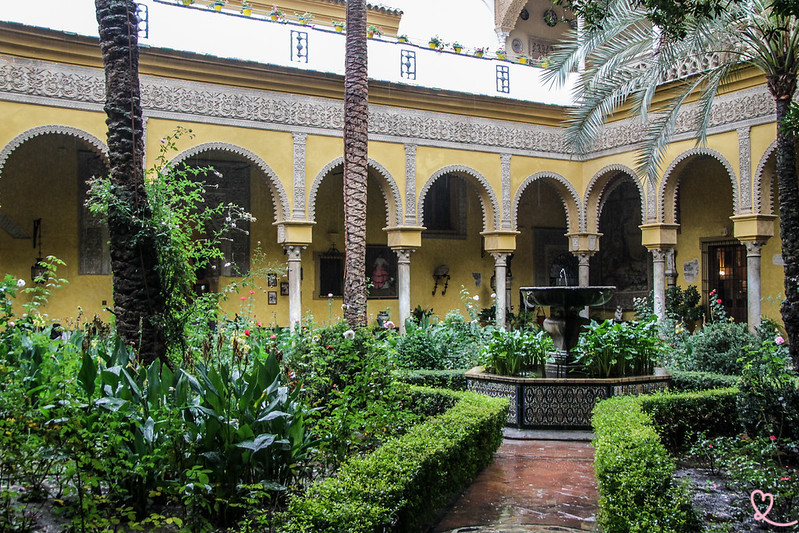
From the moment you enter the patio galleries and then the interior, you’ll be charmed by the Mudejar style. It is distinguished by its horseshoe arches and friezes of geometric motifs finely carved in stone. The Mudejar style, which emerged in the Iberian Peninsula from the 12th century onwards, refers to the work of Hispano-Moorish craftsmen working for Christian clients. The result is a highly distinctive decorative language, of which Las Dueñas is a prime example. We took the time to observe the interlacing and arabesques. Do the same!

Azulejo ceilings and floors
Look up and admire the ceilings. You’ll see the 16th-century azulejos, painted earthenware tiles with geometric and floral motifs alternating with heraldic representations. We were struck by the chromatic richness of these coatings, dominated by cobalt blue, green, yellow and white. Stop in front of the azulejo panels to identify the different decorative themes: some reproduce the coat of arms of the Casa de Alba, others are inspired by Italian models imported to Sevilla in the 16th century.

Patios and gardens: the living heart of the palace
In Andalucia architecture, the patio is more than just a transitional space: it’s the organizing center of the house, a source of light, freshness and life. Las Dueñas Palace boasts several of these.
The large central patio
The large central patio is the palace’s largest and most representative space. Organized around a marble fountain, it is surrounded on all four sides by galleries with Mudejar arcades whose white marble columns support poly-lobed arches of great finesse. Orange trees, palms and potted plants occupy the central space, diffusing their fragrances in fine weather. We found this patio particularly successful in its balance between the geometric rigor of the galleries and the free-flowing vegetation. You’ll particularly appreciate the natural coolness of this space, kept at a pleasant temperature even in summer thanks to the interplay of the façades and the evaporation of water. It was here that the poet Antonio Machado undoubtedly drew his first images of childhood in Sevilla.

Patios and secondary gardens
In addition to the large patio, the palace has several other courtyards, such as the Lemon Patio, the Patio del Aceite and the Santa Justa Garden, linked by tiled corridors. These more intimate spaces offer different atmospheres, sometimes shaded by bougainvillea, sometimes organized around a shallow pool or a fountain decorated with azulejos. We loved this succession of spaces. Look out for the carved column capitals on some of the walls of the Patio del Aceite. Some of these blend Romanesque vocabulary with Mudejar motifs, reflecting the palace’s various construction phases.

The collections: art, history and intimacy at Casa de Alba
The Palais de Las Dueñas is not just an architectural monument: it’s also a showcase for the artistic and personal collections built up over several centuries by the Casa de Alba, one of Europe’s most numerous noble families.
Portrait gallery and paintings
The palace rooms house a gallery of aristocratic portraits tracing the history of Casa de Alba from the first dukes to Duchess Cayetana de Alba (1926-2014), a key figure in contemporary Spanish society. There are also paintings from different periods, including works from the 17th and 18th centuries depicting mythological scenes or religious subjects. We paid particular attention to the 18th-century portraits, which bear witness to the close ties between the House of Alba and the great European artistic movements of their time. Let your gaze linger on the clothing details of these representations. Clothes, jewels and backdrops provide clues to the fashions and customs of the Spanish aristocracy over the centuries.

Duchess Cayetana’s personal belongings
One of the unique features of the Palacio de Las Dueñas compared with other historic residences is the presence of personal objects that belonged to the Duchess Cayetana de Alba, who died in November 2014. A number of rooms house her memorabilia, photographs, outfits and gifts from celebrities the world over. This museographic approach gives the space an intimate feel. We found this approach touching. You may be captivated by the accumulation of everyday objects that tell, in fragments, the story of a woman with a passion for art, flamenco and bullfighting.

Decorative arts: porcelain, furniture and tapestries
Decorative arts occupy an important place in the palace’s collections. Sèvres and Chinese porcelain, 17th and 18th century cabinetry, Flemish tapestries and oriental rugs make up an interesting ensemble. We noted the quality of the marquetry furniture, some of which comes from Italian or Flemish workshops. Look closely at the details of the drawers and legs to appreciate the finesse of the inlays. In addition, the porcelain collections in the showcases illustrate the commercial and diplomatic exchanges that animated Sevilla during the Enlightenment, when it was one of Europe’s major ports in direct contact with the Americas and Asia.

Subscribe to our Newsletter
- Get away from it all with Region Lovers’ beautiful destinations!
- Once a month
- Advertising-free
Frequently asked questions
Do I need to book in advance to visit the Palacio de Las Dueñas?
Online booking is not compulsory, but is highly recommended in high season (March to June, September to October) and during Holy Week. The palace has been receiving an increasing number of visitors since it opened in 2016. Book in advance to avoid disappointment at the entrance.

What’s the difference between the Palacio de Las Dueñas and the Palacio de la Casa de Pilatos in Sevilla?
These two Seville palaces are often compared, as they share an architecture that blends Mudejar and Renaissance styles. However, they belong to different families: Las Dueñas is owned by Casa de Alba, while Casa de Pilatos belongs to the Medinaceli family. The Casa de Pilatos is larger, better known and has been open to the public for much longer. Las Dueñas, which opened more recently, offers a more intimate atmosphere and collections that reflect the personalities of its most recent occupants.
PLAN YOUR TRIP TO Andalusia
Inspiration

Practice

Places not to be missed