The Roman amphitheater and the ruins of Italica, located in Santiponce north of Sevilla, are an impressive testament to ancient architecture. Built between 117 and 138 AD, it could seat up to 25,000 spectators, making it one of the largest amphitheaters in the Roman Empire. This site is part of the Italica archaeological complex, which is rich in ruins that tell the story of this Roman city.
In this article, discover our helpful tips—illustrated with photos —to help you best prepare for your visit and fully enjoy this journey into Roman antiquity.
This opinion is completely independent, based on our experiences. We made our own choices, visited the area anonymously, and paid our bills in full.
Why Visit Italica
Is Italica worth it? Our opinion:
Yes, Italica is well worth a visit: walking through this monumental arena, exploring its underground passages, and admiring its remarkably well-preserved mosaics offers a striking immersion in the grandeur of ancient Rome. It is one of the most beautiful archaeological sites in Andalucia.

The size of the bleachers attests to the site’s exceptional capacity, illustrating its central role in the social and cultural life of Italica. The serene atmosphere that reigns among the ruins invites contemplation and reflection, while exploring the mosaics—often overshadowed by the grandeur of the arena—enriches the experience by revealing the artistic sophistication of that era.
Book a guided tour! (with or without transportation from Sevilla).
Why is the Italica Amphitheater famous?
The Italica Amphitheater is known for its direct connection to the Roman emperors Trajan and Hadrian, who were born in this city of Andalucia. This monument illustrates the central role that performances played in ancient social life, accommodating up to 25,000 spectators.

Its significance extends beyond local history: it served as a filming location for the series *Game of Thrones*, further enhancing its contemporary fame. As such, it embodies a major part of Andalucia’s Roman heritage, blending architecture, history, and popular culture.
Our favorite moments
- Walking into the arena and taking a seat in the stands offers a unique perspective on the site’s vastness and its amazing acoustics.
- Exploring the still-mysterious underground tunnels reveals the ingenious ways to access the battles and the hidden life beneath the arena.
- Viewing the mosaic of Bacchus and Ariadne, with its well-preserved colors, adds an unexpected artistic touch to the heart of the ruins.

WHERE TO STAY IN Seville
Option 1: In the historic center
Convenient for visiting everything on foot, we recommend:

Option 2: El Arenal
Between quiet streets and riverside ambience, we recommend it:

See our complete selection of the best hotels and neighborhoods in Sevilla
Directions: Italica, Santiponce, Sevilla
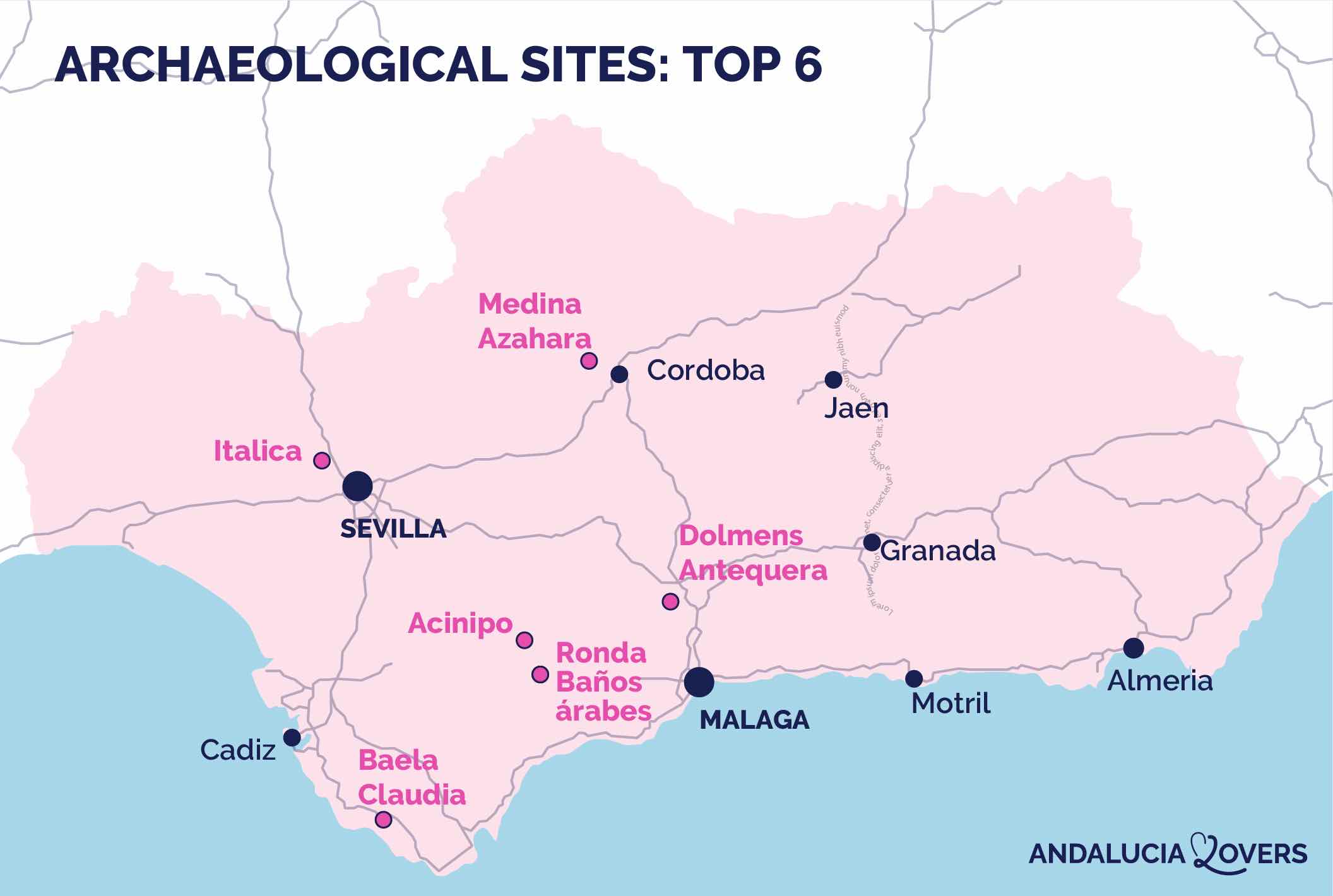
Where is Italica located?
- In Santiponce, north of Sevilla
- Address: Avenida de Extremadura 2, 41970 Santiponce
- From Sevilla: 20-minute drive
- Here is a map to help you find your way around, showing Italica near Sevilla:
How to get there
- By bus: The M-170A and M-170B lines depart from the Plaza de Armas bus station in Sevilla and stop at the entrance to the archaeological complex.
- By car: From Sevilla, take the N-630 toward Mérida. The site is located 9 km from the city and is directly accessible by car.
Parking
Free parking is available at the main entrance, with designated spaces for passenger cars and buses.

RENT A CAR IN Andalucia
- Compare prices on our preferred platform: DiscoverCars – one of the best rated sites.
- Choose a compact car, as some villages have very narrow streets!
- Think ofcomprehensive insurance for the same reason
- Book early for choice.

Useful tips: duration, schedules, eating…
Length of visit and main difficulties
A visit to Italica usually takes between 1.5 and 3 hours, giving you plenty of time to explore the ruins and the surrounding area at your own pace. The site covers a vast area, offering a complete immersion in Roman architecture.
The trail includes a few steps and dirt and gravel surfaces, which are typical of ancient ruins. These factors can make access difficult for people with limited mobility, even though the site remains largely technically accessible.

Advice on how to visit
Start outside to get a sense of the scale, then head up to the bleachers before going down into the arena. Next, explore the underground passages and finish by visiting the rest of the ruins with the mosaics.

Visiting with children
We did not find any activities specifically designed for young audiences at the Italica amphitheater, such as activity booklets or special workshops. The tour should therefore be adapted to the children’s ages, as there are no special resources to help them explore the site.
Schedules and rates
- Schedules:
April 1 through June 20: Tuesday, Wednesday, and Thursday from 9 a.m. to 6 p.m.; Friday and Saturday from 9 a.m. to 9 p.m.; Sunday, holidays, and Mondays preceding a holiday from 9 a.m. to 3 p.m.
June 21 through September 20: Tuesday through Saturday from 9 a.m. to 3 p.m.; Sundays, holidays, and Mondays preceding a holiday from 9 a.m. to 3 p.m.
September 21 through March 31: Tuesday through Saturday from 9 a.m. to 6 p.m.; Sundays, holidays, and Mondays preceding a holiday from 9 a.m. to 3 p.m. - Closed: Mondays (except the day before a holiday). January 1, January 6, May 1, December 24, December 25, December 31.
- Adult admission: €1.50 (for non-European citizens)
- Free Admission: Free for citizens of the European Union (upon presentation of identification).
- See the latest news on the official website here.
- Book a guided tour! (with or without transportation from Sevilla).

A Roman arena of impressive dimensions
The Monumental Ellipse and the Building Materials
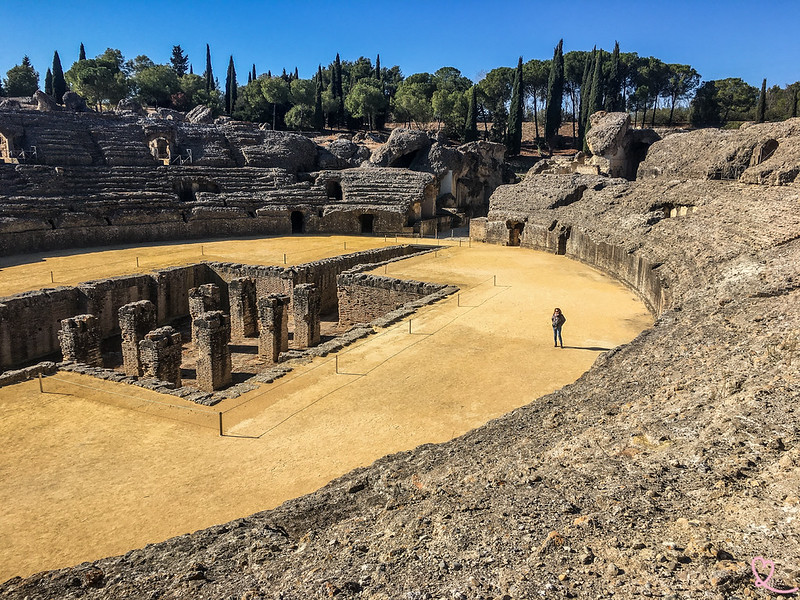
The amphitheater at Italica has an elliptical shape characteristic of Roman structures, designed to provide optimal visibility for all spectators. Measuring approximately 160 meters long by 137 meters wide, it stands out as one of the largest amphitheaters in the Roman Empire—an impression that becomes clear as soon as you approach the site.

The structure is built on a sturdy foundation of silica and limestone pebbles, bound together by ancient Roman concrete, which ensures the building’s strength. This foundation is reinforced by brick elements, used to strengthen the vaults and underground passages, reflecting the architectural expertise of the time.

The most prominent sections, particularly the visible facings of the bleachers, are adorned with marble, a material chosen for its durability and aesthetic appeal. From the upper tiers, the interplay of these materials emphasizes the monument’s grandeur, while revealing the technical complexity that made it possible to create such an architectural masterpiece.
The three levels of bleachers
The amphitheater at Italica is notable for its three tiers of seating, known as the cavea. This architectural structure reflected the Roman social hierarchy, with each level reserved for a specific category of spectators. The lower level accommodated the most privileged classes, offering a close view of the arena, while the upper levels were reserved for the working classes.

With a reported capacity of up to 25,000 spectators, the Italica amphitheater was one of the largest in the Roman Empire. This large capacity underscores the central role that performances played in the social and cultural life of the ancient city.
From the upper bleachers, the monument’s scale is particularly striking. The panoramic view of the arena and the various tiers of bleachers highlights the building’s grandeur and the ingenuity of its architecture.

We were impressed by how the layout of the bleachers made it possible to efficiently manage a large crowd while respecting social distinctions. This arrangement also facilitated the movement of spectators, helping to ensure a smooth flow of people entering and exiting.
In the heart of the Italica amphitheater
Walking in the arena
Standing in the center ofthe arena at the Italica amphitheater offers a unique sense of grandeur. This vast space, surrounded by semicircular bleachers, gives a sense ofthe scale of the performances that once took place here.

The visual connection between the arena and the stands highlights the venue’s exceptional capacity, which allowed up to 25,000 spectators to attend events. This arrangement allows visitors to immerse themselves in the atmosphere of gladiatorial combat, venationes, and other public spectacles that shaped social life in antiquity.

As you walk across the arena floor, you can almost hear the crowd cheering and imagine the tension of the battles. This experience helps us understand the central role of the amphitheater in the Roman city, far beyond that of a mere venue for entertainment.
The Underground Tunnels for Gladiators and Animals
The amphitheater at Italica has an underground network called the hypogeum, which played a crucial role in organizing performances. These tunnels were used to prepare the gladiators and house the wild animals before they entered the arena, thereby ensuring spectacular and well-orchestrated performances.

Thanks to hatches and hoist systems, fighters and animals could suddenly appear in the arena, creating an element of surprise for the spectators. This technical device illustrates Roman ingenuity in the management of performances and their mastery of stage spaces.

During your visit, you can explore some of these underground tunnels, including the large central pit that ran through the arena. It was used to store the animal cages and allowed for discreet and efficient movement beneath the bleachers. This behind-the-scenes look adds a practical dimension to our understanding of how the auditorium works.
The Mosaics and Ruins of Italica
Roman Houses and Their Mosaics
Beyond the amphitheater, Italica reveals a network of cobblestone streets lined with the remains of domus—those vast Roman residences arranged around a central courtyard.

We were particularly impressed by the House of Birds (Casa de los Pájaros), the first house on the site to be fully excavated, where a central mosaic surrounded by more than 30 medallions depicts a different species of bird in each one, including a royal peacock and a parrot.

You’ll also discover the House of Neptune, where a mosaic of marble, glass, and ceramic depicts the god on his chariot drawn by seahorses, surrounded by a procession of sea creatures.

Nearby, the Maison de l’Exèdre covers nearly 4,000 square meters around a patio featuring a fountain, while the Maison du Planétarium takes its name from a circular mosaic depicting the seven celestial bodies known to the Romans.
The Mosaic of Bacchus and Ariadne
The mosaic of Bacchus and Ariadne is a major artistic feature of the Italica archaeological site. She skillfully depicts the mythological figures of the god of wine and the Cretan princess, adding a cultural and symbolic dimension to this Roman site. This depiction illustrates the importance placed on mythology in the decoration of public and private spaces in ancient times.

This work of art stands out for its excellent state of preservation, which is rare for a mosaic from this period. The colors and details of the patterns remain visible, offering a valuable glimpse into the craftsmanship of Roman artisans. This level of preservation allows visitors to better appreciate the decorative splendor that accompanied the performances and social life in the amphitheater.
Book a guided tour! (with or without transportation from Sevilla).
FUN in Andalucia: activities
- Cooking course in Sevilla
- Canyoning from the Costa del Sol
- Guided Hike on the Caminito del Rey

Other parts of the city
Communallatrines

At the start of your walk through the streets of Italica, you’ll come across the remains of public latrines, a feature characteristic of Roman urban planning. We found it interesting to observe this type of communal facility, which reflects the methodical organization of daily life in the ancient city
The Bakery

Among the taverns that lined the streets of Italica, several housed a panadería, where we were able to see the remains of bread ovens that are still visible today. The Maison des Oiseaux still has a bread oven in one of its outbuildings, while the Maison du Planétarium even had two, both located in the same production area. You’ll also find one in the Casa de la Exedra, where one of the house’s tabernae served as a bakery.
This proximity between the ovens and the dwellings is evidence of a small-scale, artisanal system, in which bread was baked right within the residential neighborhoods rather than in large, centralized bakeries as in Pompeii or Ostia.
The Temple of Trajan and the highest point in the city
As you make your way up toward the top of the new city (Nova Urbs), you’ll reach the site of the Temple of Trajan, dedicated to the emperor who was born in the region. Italica is unique in that it was the birthplace of two Roman emperors, Trajan and Hadrian—the only emperors to have been born in what is now Sevilla. This high vantage point on the site also offers a panoramic view of the ancient city’s layout, its streets, and its sewer system—a remarkably well-preserved drainage system for its time.
The Thermal Baths

Italica preserves the remains of two large thermal complexes, one in the old city (vetus urbs) and the other in the new city (nova urbs). We were struck by the sheer size of the Major Baths, also known as the Baths of the Moorish Queen, which covered an area of approximately 32,000 square meters in the nova urbs.
There, you can see the different stages of the Roman thermal bath complex: the entrance and service area, the frigidarium with its large pool (or natatio), the tepidarium, and finally the caldarium, all heated by a hypocaust system.
Museum
At the entrance to the site, a visitor center also serves as an exhibition space, where you can learn about the history of Italica before beginning your tour of the ruins. We also recommend that you take a few minutes to read these informational signs, which will help you better understand the scope of the site before exploring it.

However, most of the artifacts and archaeological finds unearthed during the excavations were not left at the site; they are now housed at the Archaeological Museum of Sevilla, in María Luisa Park. If you’d like to explore Italica beyond its architectural ruins, a visit to this museum is the perfect way to round out your excursion.
History in brief
Italica was founded in 206 B.C. as the first Roman colony in Hispania, laying the foundation for a city that would come to play an important role in the Empire. It was in this city that Emperor Trajan was born; he reigned from 98 to 117 AD, marking the height of Roman power in the Mediterranean.
The amphitheater, built during the reign ofHadrian between 117 and 138 A.D., attests to Italica’s importance at that time. It could accommodate up to 25,000 spectators, illustrating the central role that public spectacles played in the social life of the Roman city.
Beginning in the 3rd century, Italica began to decline gradually, largely due to the silting up of the Guadalquivir River, which hindered access to the city. The site was rediscovered in the 17th century and designated a National Monument in 1912, thereby ensuring its protection and recognition as a major historical landmark.

Frequently asked questions
Is the Italica Amphitheater accessible to people with limited mobility?
The Italica archaeological site, of which the amphitheater is a part, features a walking path that is mainly on gravel and dirt, with some paved areas. These features may make it difficult for visitors in wheelchairs or with limited mobility to get around, particularly near the ruins and mosaics.
Although the site is largely accessible from a technical standpoint, it should be noted that certain areas do not have specific accommodations to facilitate mobility. The natural state of the ruins therefore imposes a few limitations that are important to keep in mind when planning your visit.
Which scenes from *Game of Thrones* were filmed at the Italica Amphitheater?
The Italica amphitheater was chosen as the setting for several memorable scenes in Seasons 7 and 8 of *Game of Thrones*. In particular, it depicts the Dragonpit in King’s Landing, a strategic location where major diplomatic meetings are held. Season 7 depicts the meeting between Daenerys Targaryen, Jon Snow, and Cersei Lannister, capturing the solemn atmosphere of the council.
In Season 8, the amphitheater once again serves as the setting for the final council scene, where the main characters debate the future of the kingdom following Daenerys’s downfall. The arena’s elliptical shape and well-preserved bleachers are clearly visible, providing an authentic and impressive setting that highlights the significance of these pivotal moments.
PLAN YOUR TRIP TO Andalusia
Inspiration

Practice

Places not to be missed