Wondering where to go in Andalucia?
From the imperial cities of the interior to the Sierra Nevada mountains, the various coastlines, and even Europe’s driest desert, Andalucia is more than just a list of cities: it is a collection of regions, each with its own identity.
Rather than listing the cities one by one, we’ve decided to highlight our 7 favorite regions, along with the city that serves as a gateway to each and the must-see attractions in the surrounding area.
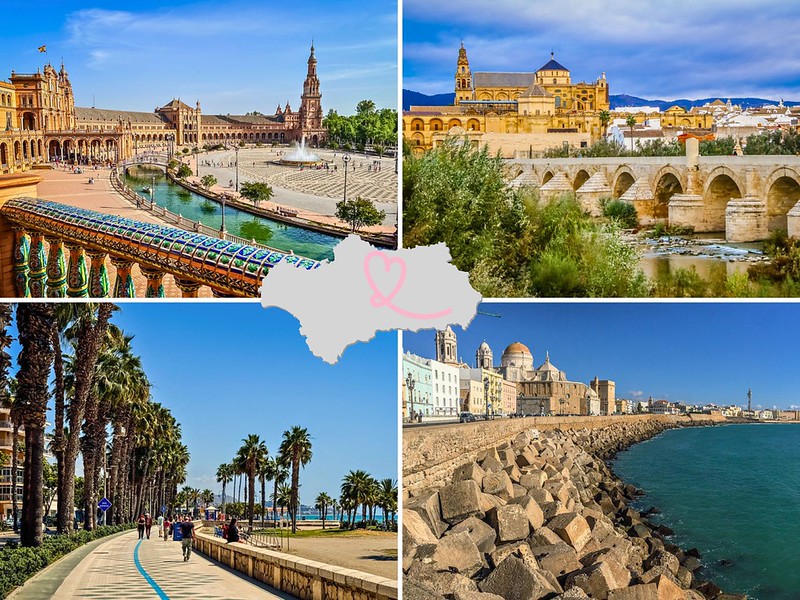
This opinion is completely independent, based on our experiences. We made our own choices, visited the area anonymously, and paid our bills in full.
The Most Beautiful Regions of Andalucia – Map + Summary
Where to Go in Andalucia – Map of the Regions
Andalucia is Spain’s largest region, and it’s difficult to explore by focusing on individual cities; it’s better to think of it in terms of larger areas, each with its own main city and surrounding region.
Here is a map showing the 7 regions we have selected:
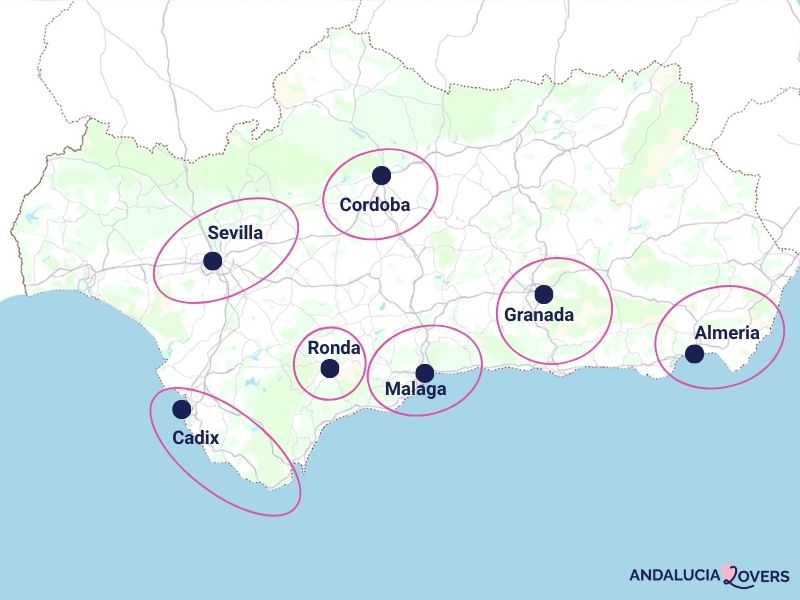
The most beautiful regions
We’ll go into detail about them later in this article, but here’s a summary of the 7 regions:
- Sevilla and its surroundings—the quintessential capital of flamenco and Andalucia—and the Roman ruins of Italica right next door
- Córdoba and its province, for the Mosque-Cathedral and the hilltop villages of the Sierras Subbéticas
- Granada and the Sierra Nevada, for the Alhambra and the villages of the Alpujarras clinging to the mountainside
- Málaga and the Costa del Sol, for the beaches, the white coastal villages, and the Caminito del Rey
- Ronda and the White Villages, for its canyon and the charm of the surrounding area
- Cádiz and the Costa de la Luz: home to the oldest city in Western Europe and the wild beaches of the Strait
- And finally, Almería and Cabo de Gata—the region least known to foreign visitors, nestled between the desert and pristine beaches

1. Sevilla and the Surrounding Area—Where to Go in Andalucia?
Why visit?
Sevilla is undoubtedly the most sensory city in Andalucia: the scent of orange blossoms in the spring, the heat rising from the cobblestones in the summer, the sound of guitars and the click-clack of heels late at night in the tapas bars. It is a densely populated city, yet one on a human scale, where you move seamlessly from a cool, shaded square to a narrow street bathed in dazzling white light.
All around, the landscape changes completely: grain fields and olive groves stretch as far as the eye can see toward Carmona and Écija, two sleepy towns basking in the sun where time seems to have stood still in the 18th century, while in Italica, Roman ruins emerge directly from the dry grass, far from the crowds of major tourist sites.

The Most Beautiful Places in Sevilla
- The cathedral, one of the largest Gothic churches in the world
- The Real Alcázar and its Mudejar gardens
- Las Setas, the massive wooden structure designed by Jürgen Mayer (2011)
- The other palaces: the Casa de Pilatos, known for its azulejos, and the Palace of Lebrija, known for its Roman mosaics
- Plaza de España, especially at sunset when the lights come on
- See the best attractions in Sevilla

The area around Sevilla
- Italica, a Roman city founded in 206 B.C., the birthplace of Emperors Trajan and Hadrian: its amphitheater (one of the largest in the Roman Empire) and its mosaics are well worth a visit, just 30 minutes from Sevilla
- Carmona, one of the oldest continuously inhabited cities in Europe, with its Alcázar, the Puerta de Sevilla, and its Roman necropolis
- Écija, nicknamed the “frying pan of Andalucia” for its extreme summer heat, but also known as the “city of bell towers” for its eleven Baroque church towers adorned with azulejos, and its 18th-century palaces
- From Sevilla, you can also take a day trip to explore other regions: Córdoba, Ronda, Cádiz
- See our article on the best day trips from Sevilla

Where to stay?
- Sevilla’s Historic Center: Everything Within Walking Distance
See our selection of the best neighborhoods and hotels in Sevilla
or go directly to View the top-rated accommodations in Sevilla - Carmona: For a Quieter Night Just 30 Minutes from the Capital
See the top-rated accommodations in Carmona

To Know
- Plan to spend at least 3 days in Sevilla, half a day in Italica, and half a day in Carmona or Écija
- If possible, avoid visiting in July and August: temperatures regularly exceed 40°C, and Écija, in particular, is one of the hottest cities in Europe
- Sevilla is easy to explore on foot or by hop-on-hop-off bus, but renting a car makes it easier to take day trips to Italica, Carmona, and Écija

RENT A CAR IN Andalucia
- Compare prices on our preferred platform: DiscoverCars – one of the best rated sites.
- Choose a compact car, as some villages have very narrow streets!
- Think ofcomprehensive insurance for the same reason
- Book early for choice.

2. Córdoba and the Province of Córdoba
Why visit?
Córdoba is our favorite city in Andalusia: a place that’s almost silent as soon as you step off the main streets, where flower-filled patios are hidden behind wrought-iron gates and offer unexpected coolness, even in the middle of summer. Inside the mosque-cathedral, the dim light and the forest of red and white columns create an almost hypnotic atmosphere, very different from the light in the alleys of the Jewish quarter just a few meters away.
Head out of the city and the landscape changes dramatically: the Sierras Subbéticas unfold into hills covered with olive trees as far as the eye can see, dotted with white villages clinging to the slopes, in an atmosphere far more rural and mountainous than that of the capital.

The Most Beautiful Places in Córdoba
- The mosque-cathedral and its hundreds of arches
- The Alcázar and its gardens
- The old Roman bridge and the promenade along the Guadalquivir River
- The Viana Palace and its 12 patios, each one unique
- The Jewish Quarter and its cobblestone streets
- See the Best Attractions in Córdoba

Around Córdoba
- Medina Azahara, 8 km from the city center: the ruins of this 10th-century caliphal palace city, a UNESCO World Heritage Site since 2018, are among the most important archaeological sites in Spain
- Almodóvar del Río, whose medieval castle—one of the best-preserved in Andalucia—overlooks the banks of the Guadalquivir River
- Zuheros, a white village perched on a mountainside in the Sierras Subbéticas Natural Park, dominated by its castle of Arab origin and located near the Cueva de los Murciélagos, a major Neolithic site
- See our article on the best day trips from Córdoba

Where to stay?
- The historic center of Córdoba, near the Mosque-Cathedral
See our selection of the best neighborhoods and hotels in Córdoba
or go directly to View the top-rated accommodations in Córdoba

To Know
- Plan to spend at least 2 days in Córdoba, plus half a day at Medina Azahara
- A bus runs from Córdoba to Medina Azahara Tuesday through Sunday; otherwise, you’ll need a car to get to Zuheros, Priego de Córdoba, and Almodóvar del Río
- Córdoba is easy to explore on foot despite a slight incline; the hop-on, hop-off bus is still a convenient option

3. Granada and the Sierra Nevada
Why visit?
Granada offers a view that no other city in Andalucia can match: if you look up from an alley in the city center, you can see the snow-capped peaks of the Sierra Nevada, even in the middle of summer. The city exudes a unique energy, somewhere between the tranquility of the gardens and fountains on the Alhambra hill and the bustling student and bohemian atmosphere of the Albaicín, where the scent of incense and mint tea often lingers.
As you climb toward the Sierra Nevada, the air grows cooler and the landscape becomes more rugged: the villages of the Alpujarras cling to the slopes of steep-walled valleys, with their white cube-shaped houses reminiscent of the Moroccan Atlas Mountains, in near-total silence once night falls.

The Most Beautiful Places in Granada
- The Alhambra Complex: the Alcazaba, the Nasrid Palaces, and the Generalife— book your ticket several months in advance
- The sloping streets of the Albaicín neighborhood
- The Sacromonte neighborhood and its caves
- The cathedral and its royal chapel
- See the best attractions in Granada

The Sierra Nevada and the Alpujarras
Less than an hour from Granada, the Sierra Nevada is home to Europe’s southernmost ski resort, which is open from December through April, with Mount Mulhacén (3,481 m)—the highest peak on the Iberian Peninsula—as a backdrop.
On the southern slope, the Alpujarras are dotted with a string of white villages featuring cube-shaped houses inspired by Berber architecture:
- Pampaneira, Bubión, and Capileira—the three most picturesque villages, perched on the slopes of the Poqueira ravine and connected by hiking trails
- Trevélez, at an elevation of 1,476 meters, is one of the highest villages in Spain and is renowned for its Serrano ham, aged at high altitudes
- Órgiva, the shopping center of the Lower Alpujarra, with a more local and alternative vibe
- Guadix (optional): Its cave houses carved into the rock and its Moorish Alcazaba offer a final, very different glimpse of the province
- And the city of Granada is central enough to explore a variety of landscapes on day trips
- See our article on the best day trips from Granada

Where to stay?
- Downtown Granada: Explore on Foot or by Tourist Train
See our selection of the best neighborhoods and hotels in Granada
or go directly to View the top-rated accommodations in Granada

To Know
- Plan to spend at least 2 days in Granada, and an extra day in the Alpujarras
- Granada isn’t easy to explore on foot (steep hills)—alternate between walking, taking a taxi, and riding the sightseeing train
- The villages in the Poqueira ravine are less than 90 minutes by car from Granada, but a car is still essential
- The ski season generally runs from December to April at the Sierra Nevada/Pradollano resort

4. Málaga and the Costa del Sol
Why visit?
Málaga has a distinctly seaside atmosphere: a palm-lined seaside promenade, warm, slightly salty air, and lively outdoor cafes that stay open late into the evening. The historic district, which is more densely built-up and shaded, stands in stark contrast to the bright light of the waterfront just a few steps away.
As it stretches east and west, the Costa del Sol alternates between highly urbanized beach resorts and white villages perched above the coastline. Inland, the scenery changes dramatically at the Caminito del Rey: vertiginous gorges with steep limestone cliffs, where you walk suspended above the abyss in an almost mineral-like silence.

The Most Beautiful Places in Málaga
- The cathedral that towers over the city
- the imposing Alcazaba on the hill
- The historic district and its narrow streets
- The many museums, including the Carmen Thyssen Museum and the Centre Pompidou
- Beaches in the city
- See the best attractions in Málaga

The Costa del Sol and the Inland Region
- Mijas, a white village perched above the coast, known for its horse-drawn carriages and “donkey taxis”
- Frigiliana, repeatedly voted one of Spain’s most beautiful villages, with white-washed streets lined with a mosaic of pebbles
- Nerja, with its prehistoric caves and the Balcón de Europa viewpoint (see our dedicated section further down in this article)
- And further inland, don’t miss Antequera with its dolmens and rock formations.
- See our article on the best day trips from Málaga

Caminito del Rey
Located one hour from Málaga, this 7.7-kilometer-long pedestrian bridge clings to the vertical cliffs of the Gaitanes Gorge, reaching heights of up to 105 meters above the Guadalhorce River, between the towns of Ardales, Álora, and Antequera.
Renovated in 2015 and equipped with safety railings, it now welcomes approximately 300,000 visitors a year and is one of the most popular hiking trails in Andalucia.

Where to stay?
- Downtown Málaga: For the Waterfront and Museums
See our selection of the best neighborhoods and hotels in Málaga
or go directly to View the top-rated accommodations in Málaga - Marbella or Frigiliana, to continue along the coast
See the top-rated accommodations in Marbella

To Know
- Plan on spending 2 to 3 days in Málaga and at the beach, and a full day on the Caminito del Rey
- Tickets for the Caminito del Rey can only be purchased online in advance, and there is a limited number available each day—book early during peak season
- Málaga is easy to explore on foot or by hop-on, hop-off bus; a car makes it easier to reach the white villages along the coast

FUN in Andalucia: activities
- Cooking course in Sevilla
- Canyoning from the Costa del Sol
- Guided Hike on the Caminito del Rey

5. Ronda and the White Villages
Why visit?
Ronda is literally built straddling a canyon: in just a few steps, you go from a peaceful, flower-lined street to a 120-meter drop, giving the place a sense of drama that’s quite unique in Andalucia. The air there is drier and the light is harsher than on the coast.
All around, each white village has its own unique atmosphere: some are carved into the rock, others overlook turquoise reservoirs from their ramparts, and still others blend into a greener, more humid, almost alpine landscape in the heart of the Sierra de Grazalema Natural Park.

The Most Beautiful Places in Ronda
- The various viewpoints on the bridge (a 120-meter-deep canyon)
- The charming old town
- The bullrings and their museum: Plaza del Toros
- The palaces scattered throughout the city
- The ruins of the Arab baths in the gorge below the city
- See the Best Attractions in Ronda

The white villages around Ronda
- Setenil de las Bodegas, 20 minutes from Ronda: a unique village built right into the rock, where cave dwellings nestle beneath enormous overhangs
- Grazalema, in the heart of the Sierra de Grazalema Natural Park, one of the rainiest villages in Spain, renowned for its goat and sheep cheeses and its wool blankets
- Zahara de la Sierra, dominated by a 12th-century Moorish castle overlooking the lake formed by the Zahara-El Gastor Dam
- Olvera, perched on a rocky outcrop, with its Moorish castle and the Church of Nuestra Señora de la Encarnación
- See our article on the best villages around Ronda

Where to stay?
- Ronda, the most convenient and best-connected base
See our selection of the best neighborhoods and hotels in Ronda
or go directly to View the top-rated accommodations in Ronda

To Know
- Plan to spend 1 to 2 days in Ronda, and an extra day visiting two or three white villages
- A car is essential for traveling between villages, which are poorly served by public transportation
- Some hikes in the Sierra de Grazalema Natural Park, such as the Garganta Verde, require a free permit that must be requested in advance

6. Cádiz and the Costa de la Luz
Why visit?
Cádiz has a light and atmosphere unlike anywhere else in Andalucia: almost entirely surrounded by water, the city is swept by the salty Atlantic breeze. Its narrow alleys regularly open up, without warning, onto a stretch of sea or a seawall battered by the waves.
To the south, the Costa de la Luz takes on the feel of the end of the world: long, windswept, wild beaches; dunes creeping into the pine forest; all the way to the Strait of Gibraltar, where you can sometimes catch a glimpse of the coast of Morocco.

The Most Beautiful Places in Cádiz
- The cathedral, the most famous building in the old town
- The Roman ruins of an amphitheater, hidden beneath the city
- The waterfront and its forts
- The sandy beaches and the old town with its tall houses
- See the Best Attractions in Cádiz

The Costa de la Luz
- Jerez de la Frontera, less well known to foreign tourists but famous for its wine (sherry), the birthplace of flamenco, with its Alcázar and cathedral
- Vejer de la Frontera, a white village perched on a hill, known for its azulejo-tiled Plaza de España and its medieval walls
- Playa de Bolonia and Baelo Claudia: a nearly untouched beach backed by a giant dune 30 meters high, right next to the ruins of a Roman city that specialized in the production of garum, complete with its theater and temples
- Tarifa, the southernmost city on the European mainland, the “wind capital” that attracts kitesurfers and windsurfers, with its Guzmán el Bueno Castle and excursions to Morocco

Where to stay?
- Downtown Cádiz, for its lively atmosphere and seaside setting
See the top-rated accommodations in Cádiz - Jerez de la Frontera, for a more authentic experience
See the top-rated accommodations in Jerez - or Tarifa, for access to the beaches of the Costa de la Luz
See the top-rated accommodations in Tarifa

To Know
- Plan to spend 1 to 2 days in Cádiz, and 2 to 3 days exploring the Costa de la Luz as far as Tarifa
- The wind (the levante) blows strongly along this coast for much of the year, which explains Tarifa’s popularity among water sports enthusiasts.
- The bluefin tuna season in Zahara de los Atunes is best enjoyed between April and June
- A car is highly recommended for exploring this coastline, which has limited public transportation service

7. Almería and Cabo de Gata
Why visit?
Almería is the least touristy region featured in this article, and its landscape is radically different from the rest of Andalucia: to the east of the city, the Tabernas Desert unfolds into vast, ochre-colored, rocky expanses that resemble the moon, where the heat makes the horizon shimmer in the summer.
To the east, the Cabo de Gata-Níjar Natural Park offers a striking contrast: black volcanic cliffs plunge into a turquoise sea, the vegetation is sparse and wild, and the near-total absence of large hotel resorts gives the impression of a coastline that has remained untouched.

The Most Beautiful Places in Almería
- The Alcazaba, a Moorish fortress offering views of the sea
- The cathedral and its more modern cloister
- The archaeological museum
- See the Best Attractions in Almería

The Tabernas desert
About 30 kilometers north of Almería, this lunar landscape—spanning more than 280 km²—served as the setting for over 100 films between 1960 and 1980: “The Good, the Bad, and the Ugly,” “A Fistful of Dollars,” “Lawrence of Arabia,” and “Indiana Jones and the Last Crusade.”
Three of the former film sets are open to the public today: Oasys Mini Hollywood (with a zoo and shows), the more authentic Fort Bravo/Texas Hollywood, and Western Leone, which is more rustic and popular among movie buffs.

Cabo de Gata-Níjar
- San José, the liveliest village in the park and the starting point for the most beautiful beaches
- Playa de Mónsul, surrounded by volcanic rock formations, immortalized in “Indiana Jones and the Last Crusade”
- Playa de los Genoveses, a large, unspoiled beach with fine sand
- Playa de los Muertos, with over a kilometer of sandy beach and some of the most turquoise waters on the coast
- Níjar, a traditional village known for its pottery and textile crafts (jarapas)
- Learn more about Cabo de Gata

Where to stay?
- Downtown Almería, a great base for exploring Tabernas and Cabo de Gata
See our selection of the best neighborhoods and hotels in Almería
or go directly to View the top-rated accommodations in Almería - Or right in the heart of the Cabo de Gata Natural Park
See the best rated accommodations

To Know
- Plan on at least 3 to 4 days to visit Almería, the Tabernas Desert, and Cabo de Gata
- During peak season, vehicle access to certain beaches in the park (Mónsul, Los Genoveses) is limited to a daily quota—after that, only the shuttle is available
- Temperatures in the Tabernas Desert can exceed 40°C in the summer—be sure to bring water and sunscreen
- A car is essential for exploring the region, which has very limited public transportation service

PLAN YOUR TRIP TO Andalusia
Inspiration

Practice

Places not to be missed